Russian propaganda sources and, later, Argentinian prosecutors’ press releases largely dominated the coverage of the Rudnev case.
by Marco Respinti
Article 10 in a series of 10. Read article 1, article 2, article 3, article 4, article 5, article 6, article 7, article 8, and article 9.
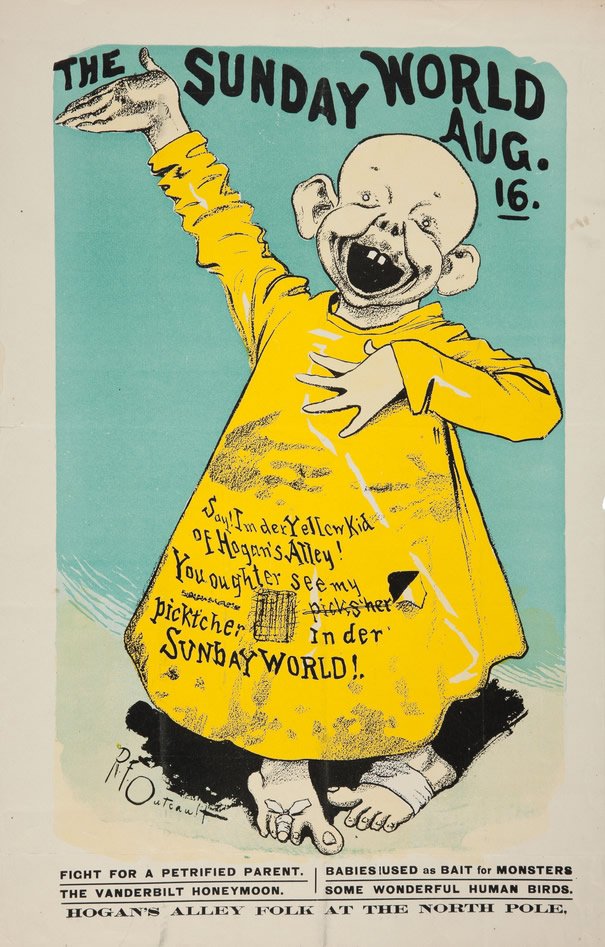
Yellow journalism
One of the most celebrated rivalries in the history of modern journalism was that between two publishers of the stature of Joseph Pulitzer (Hungarian by birth and originally named József) and William Randolph Hearst, particularly during the 1890s. Both were entrepreneurs (and later politicians) who quite legitimately sought to make a profit. Yet doubts arise when one considers that, in pursuing that goal, they employed journalism, whose primary purpose is not profit but to inform, perhaps even to explain, to hold power accountable, and to preserve—or at least not to distort—the historical record.
As the very term “media” (the plural of the Latin “medium,” meaning “means”) implies, it designates the vehicles through which facts are conveyed to the public. Here lie the roots of the principle, commonly regarded as a hallmark of quality English-language journalism, that facts should be kept separate from opinions. In reality, journalism devoid of opinion is merely an illusion, and perhaps not even a desirable ideal. A journalist’s duty is, in fact, to report facts while at the same time enabling readers to develop a critical, reasoned, and documented interpretative framework. That framework should ideally correspond to what civil-law jurisdictions refer to as an amicus brief: a systematic presentation of the facts, organized with the utmost logical and argumentative rigor by somebody who acts as a “friend (amicus, in Latin) of the court,” as distinguished from preconceptual advocacy or mere speculation. Thus, the principle of presenting facts separately from opinions should be understood as publishing reports that are neither arbitrary, unsubstantiated, nor unverified.
Pulitzer and Hearst, however, held that a swashbuckling approach to news was the easiest way to generate revenue, thus the most desirable. They then pioneered sensationalist, if not outright scandal-mongering, journalism, competing for readers and earnings through screaming headlines, forays into popular culture, and, not infrequently, outright falsehoods. This style came to be known as “yellow journalism” after the character “The Yellow Kid,” also known as Mickey Dugan, the protagonist of the comic strip “Hogan’s Alley” (later published under other titles), created by Richard F. Outcault. A shaven-headed, gap-toothed street urchin who tried to sell newspapers clad in a distinctive yellow nightshirt, the Yellow Kid became so popular that, between 1895 and 1898, both the “New York World” and the “New York Journal,” the rival newspapers owned respectively by Pulitzer and Hearst, published versions of the strip.
To claim that “yellow journalism” established the standard for subsequent media would itself be an exercise in “yellow journalism.” Yet, it is difficult to deny the lasting and growing influence of that model of news-making—and money-making—especially given the skyrocketing costs of the news industry. The driving idea that Hearst cynically popularized in the form “If it bleeds, it leads” or “If it bleeds, it sells” has, in fact, remained remarkably persistent, albeit in subtler forms, even among more respected publishers. Meanwhile, the fact that the most coveted prize for excellence in journalism bears the name of the unscrupulous Pulitzer, who established it in his own will (it was first awarded by Columbia University in New York in 1917), is a particularly bitter irony.
Enter “cults”
Scandals bleed, and they sell best. If serialized, they may even earn prizes for the reporters who expose them. The most scandalous of all bleeding-and-selling scandals are invariably those involving sex, or gossip of a para-, pseudo-, crypto-, or quasi-sexual nature. It is becoming increasingly common, in every country, for mainstream media to rely on sexually suggestive images, headlines, or situations, whether explicit or merely implied. Advertisements employ the same language. And when the two combine, the result is an oversexualized hybrid in the genre now commonly known as “infotainment.” Not infrequently, online media also feature side content or advertisements that border on open pornography.
Now, scandals and sex sell best when they bleed from “obscure,” “mysterious” and, why not, even “conspiratorial” circles and cabals. “Cults” offer the best examples of this, and for a simple reason: according to the common narrative, a “cult” is associated per se with unorthodox or abusive sexual activities.
In fact, regularly showing little imagination, the stereotypical accusations levelled against “cults” invariably include secretive practices, socially deviant behavior, and public harm disguised as religious or spiritual customs; enticement and perhaps even grooming; the unlawful accumulation and management of substantial financial assets, said to have been acquired through donation schemes involving coercion, psychological manipulation, or other forms of undue pressure; fiscal crimes; manipulation; substance abuses; and, increasingly, human trafficking. These accusations thrive in a context in which laws intended to punish such crimes are increasingly invoked to resurrect discredited theories of psychological coercion. What is said to bind together all these unacceptable forms of conduct is “brainwashing,” the quintessential “cultic” catch-all term, invoked to explain every kind of misconduct and, of course, the alleged procurement of illicit sexual favors.
It does not matter whether it is true. Readers are fed the notion that, of course, “cults” engage in such horrible acts precisely because they are “cults”; therefore, if a group is a “cult,” it must engage in those horrible acts. The need to prove such allegations before accepting them is relegated to the background.
This form of “yellow journalism,” whether found in shabby tabloids, more serious broadsheets or online, begins downstream from the very notion of “cult,” the rule being that a “cult” sells at least as much as hypersexualized content. It, in fact, calls for frenzied consumption, not plain reasoning; it reassures readers in the protected environment of conformist tastes and mass attitudes; it is easy to digest and requires no effort.
Inclusion—with exceptions
In the media, the words “cult” and “brainwashing” constantly recur in reports concerning religious groups regarded as somehow alternative to mainline religions—whatever “mainline” may actually mean. They also recur in accusations made against “mainline” religions themselves for practices, internal movements, and doctrines considered, in one way or another, excessively “intense” and therefore “extreme.”
Neutral journalists need not sympathize with so-called “cults” to recognize the grave abuse committed by their profession when it abandons its primary responsibility: reporting facts without distortion and providing accurate information. Professional ethics alone should, in fact, suffice. As scholars have abundantly proved in many scientific publications over the last decades, terms such as “cults” and “brainwashing”
are, in fact, devoid of any scientific value. They contain no truth. So-called “brainwashing,” or its cognate concept of “mental manipulation,” perceived by its advocates as a kind of super-law capable of explaining human behavior, has been rejected by U.S. case law and the European Court of Human Rights as inconsistent with established legal principles. When dealing with crimes such as rape, assault, child abuse, or fraud—often attributed to “brainwashing” or “mental manipulation” in cases involving “cults”—ordinary laws already exist and function effectively.
How, then, is it possible that mass media, which by definition address a broad non-specialist public, can use these terms without challenge and arbitrarily weaponize them? This is one of the great mysteries of contemporary communication. In a world that claims to be increasingly tolerant and inclusive, linguistic guidelines and manuals proliferate, instructing journalists to avoid any word, adjective, or verb that might be considered offensive or disparaging toward groups or individuals, thereby promoting discrimination, stereotyping, body shaming, ridicule, bullying, or hate speech on the grounds of sexual orientation, ethnic background, or skin color. Yet the same standard does not apply in the religious sphere, where empty or even false expressions such as “cults” and “brainwashing” continue to be used routinely, without scandal, to the detriment of the members of religious groups and scholars who demonstrate the inconsistency of such terms but are ignored while pseudo-experts are consistently promoted.
It appears the only convictions and practices that remain legitimately open to attack are religious beliefs and observances. It is as if the last acceptable prejudice were—and remains—a prejudice against religiosity. It is as if a “cult” of communication professionals and journalists committed to the maxim of seeing published only what bleeds aimed to “brainwash” their own readers and consumers by instilling caricatured narratives in their minds. Corruption—moral and otherwise—lies at the foundation of this degenerate approach to information. Some collusions and complicities explain certain improbable secularist wars against religions, both large and small. Still, in many cases, it is not even necessary to assume that money changed hands: the profit is ideological.
Western media A.D. 2026
An insult to the intelligence of readers, who in this way grow more and more uneducated, and a shame to the profession, yellow journalism finds a textbook case in the coverage of the story of Konstantin Rudnev, which contains all that bleeds and sells: “cults,” “brainwashing,” and sex.
The facts and details of the matter are known thanks to serious scholarly studies, and, given the seriousness of Rudnev’s health condition, due in relevant part to ill-treatment during detention, denunciations and pleas for a more humane approach have also been made.
Research indicates that Rudnev’s teachings came to be perceived as a threat by the Russian structures of power, namely the Russian Orthodox Church (ROC) and the regime, operating in close alliance. At the same time, anti-cult activists further contributed to the escalation of the controversy in the Russian Federation, where freedom of the press is severely restricted. Anti-cult campaigns targeting religious groups perceived as outside the ROC-state alliance are allowed to flourish and find a receptive audience within these power structures. The animosity toward Rudnev led to a series of heavily biased journalistic reports that have collectively shaped the public narrative and profoundly influenced readers’ perceptions.
When Rudnev was arrested in Argentina in 2025, Western media reacted with a speed and intensity that surprised even seasoned observers of religious-freedom controversies. Within a few days, more than one hundred articles appeared across Europe, North America, and Latin America. Newspapers, television networks, online platforms, and wire services all rushed to cover the case. The tone was uniform: alarmist, sensationalist, and uncritically aligned with the Argentine prosecutors’ narrative. It was the largest wave of Western coverage ever devoted to “Ashram Shambhala” (allegedly Rudnev’s group) or to Rudnev personally. The contrast with the muted reaction to his first arrest in Russia in 2010 and conviction in 2013 could not have been sharper.
The 2025 arrest created a perfect media storm. A Russian spiritual teacher, a 22-year-old pregnant woman, a group of Russians detained together, and a prosecution eager to present the case as a dramatic victory against human trafficking—these elements were irresistible to Western journalists.
The scale of the coverage was unprecedented. In addition to Latin America, major outlets in the United States, Canada, the United Kingdom, France, Germany, Spain, Finland, Belgium, and Australia published stories. Many of these articles were nearly identical, repeating the same claims in the same order, often using the same vocabulary.
The core narrative came directly from the Argentine prosecutors, who presented Rudnev as the mastermind of a transnational criminal organization. The most dramatic claim was that a young pregnant Russian woman, E., had been “trafficked” by Rudnev from Russia to Argentina for sexual exploitation and “cultic” abuse. The allegation was repeated everywhere, even though no evidence was ever presented to support it, and the woman herself denied it.
Another claim repeated across Western media was that the Russians arrested with Rudnev were found in possession of drugs. This assertion was based on a single prosecutorial statement. It was later denied by forensic examination (what was originally described as drugs and hallucinogenic mushrooms was, in fact, sleeping pills and ordinary mushrooms for cooking). Yet it appeared in dozens of articles, often framed as proof of a “criminal network.”
A third allegation, even more bizarre, was that Rudnev was wanted in Montenegro for organizing the filming of pornographic movies. This claim originated in sensationalist Montenegrin tabloids that had recycled Russian propaganda and invented a connection between Rudnev and an unrelated police operation in Žabljak against a group of Russian tourists, none of whom was prosecuted. Western media repeated it without verification.
These three claims—trafficking, drugs, pornography—became the pillars of Western coverage. None of them was true.
Copycat press
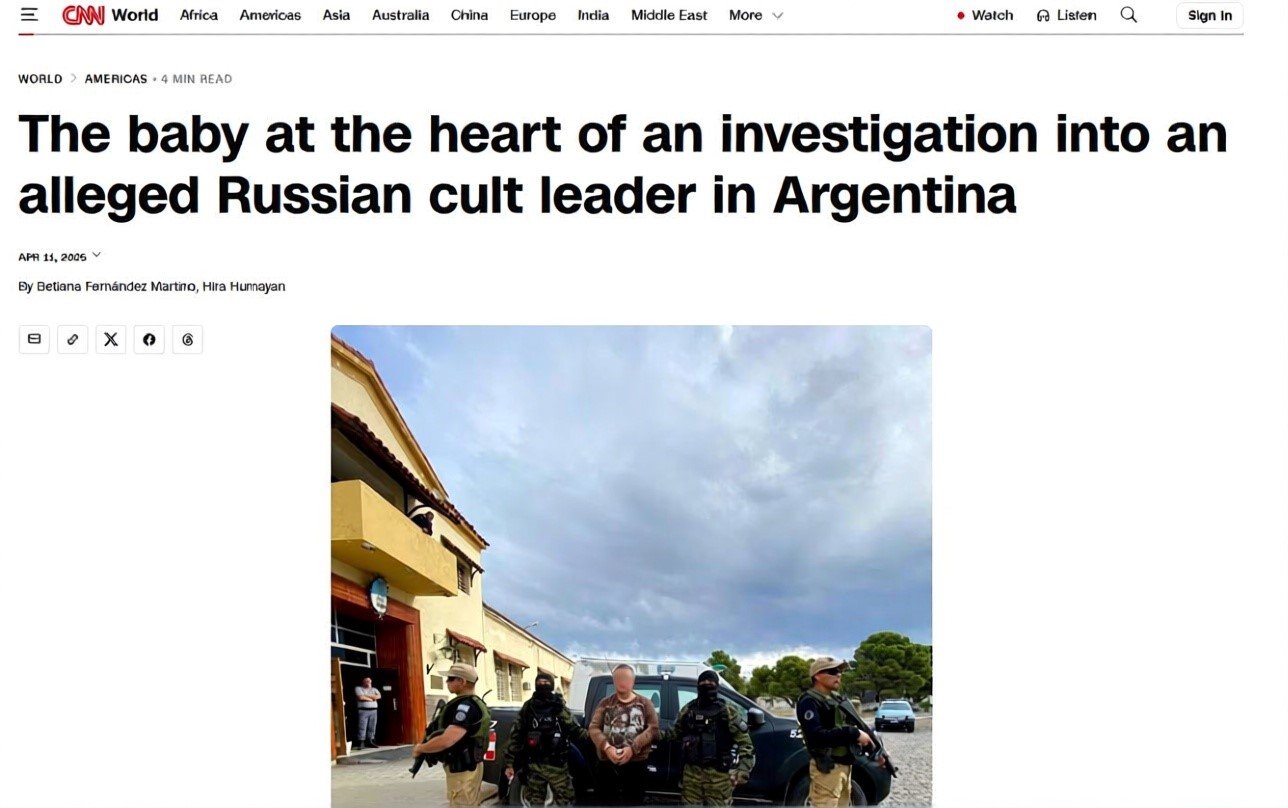
The most influential Western report was a CNN service published on April 11, 2025. CNN quoted Argentine prosecutor Fernando Arrigo, a man widely criticized for his cavalier handling of evidence and his almost pathological hostility toward Rudnev. Arrigo claimed that the pregnant woman had been brought to Argentina “for sex trafficking and slavery.” CNN published the quote without questioning it, without seeking independent verification, and without interviewing the woman herself.
CNN also acknowledged that its background information on the Rudnev case in Russia came from old reports by official Russian media, particularly the governmental press agency “RIA Novosti.” This admission was extraordinary. “RIA Novosti” was not an independent source. It was a state propaganda outlet. Yet CNN treated it as authoritative, repeating its claims about Rudnev’s past without noting that
Russian courts and media have repeatedly been criticized for fabricating cases against minority religious movements.
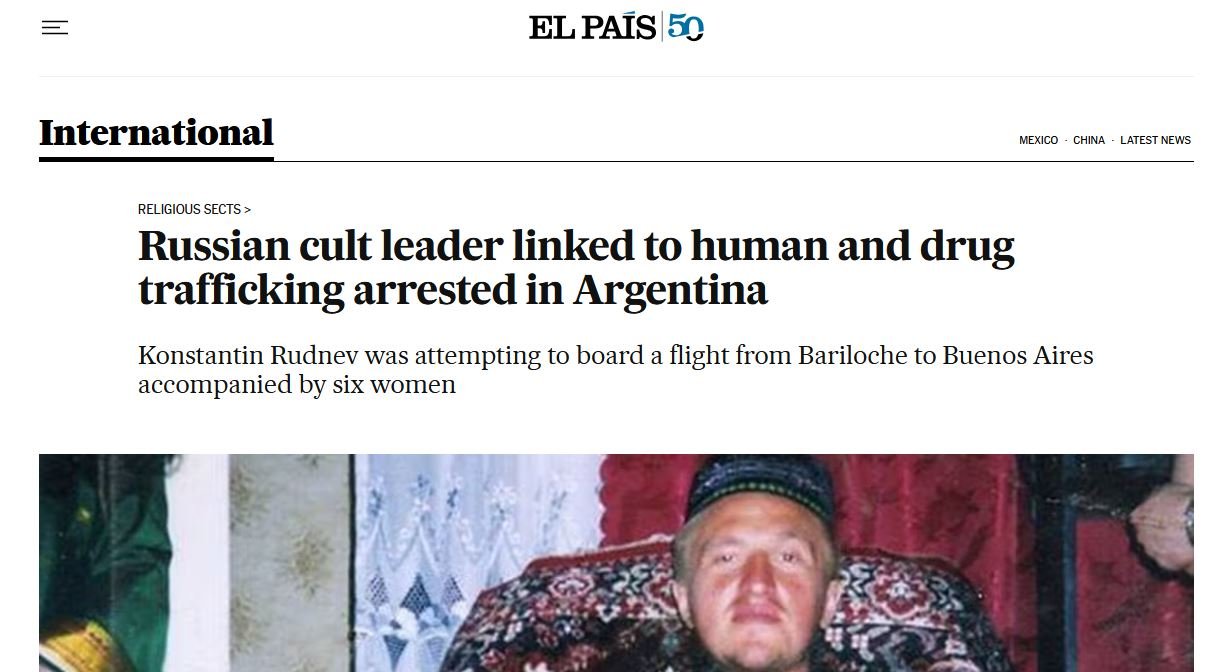
If CNN provided the authoritative tone, the Spanish newspaper “El País” provided the sensationalism. In a particularly vicious article, “El País” reported inter alia that Rudnev had been shooting movies of “ritual pornography” in Montenegro, a claim demonstrably false.
The most damaging allegation—that Rudnev trafficked a pregnant woman—was also the easiest to disprove. Scholar María Vardé interviewed the woman, who had returned to Moscow after giving birth in Argentina. She explained that she had traveled to Argentina for the same reason thousands of Russian women do every year: to give birth so that their children can acquire Argentine citizenship. She denied being part of any “cult.” She denied being trafficked. She denied being a victim. She stated that she had never met Rudnev personally. A single interview would have demolished the narrative. Western media did not conduct it.
The contrast with the first wave of Western coverage in 2013 is instructive. When Rudnev was arrested in Russia, Western media paid little attention. The most important article was published in “The Telegraph,” a respected British newspaper but known for an anti-cult bias, when he was sentenced in 2013. It limited itself to reproducing official Russian sources. There was no investigation, no interviews, no independent verification. The article was forgotten until Rudnev’s arrest in Argentina in 2025.
Hugues Gascan and Alban Bourdy
One exception to the Western media’s limited interest in Rudnev before the 2025 arrest in Argentina comes from a cluster of French-language publications, all dependent on two figures working together against “cults”: Hugues Gascan and Alban Bourdy. Their influence was disproportionate to their credibility.
Gascan, a former medical researcher, had reinvented himself as an anticult crusader after a personal and professional conflict inside a research laboratory in Angers, France. His accusations against colleagues, his fixation on “cultic infiltration,” and his harassment conviction for stalking a female colleague he falsely accused of being part of a “cult” connected with “Ashram Shambhala”—upheld by the Court of Cassation —are well documented. His hostility toward anything Tantric became a personal obsession. He later founded Groupe d’étude du phénomène sectaire (GéPS, Study Group of the Cult Phenomenon), a tiny anticult group that presented itself as a major investigative force.
Bourdy, who claimed to have once been the leader of a French offshoot of “Ashram Shambhala” after falling in love with the Chilean spiritual teacher María Soledad Domec Espinoza, also became a somewhat professional anticult activist. In his autobiographical 2018 book “Un Bisounours au pays des se(x)ctes,” he reported that he had been appointed leader of Ashram Shambhala in France with Rudnev’s approval. He also claimed that Rudnev had issued death threats against Domec, speaking to her from his Siberian prison, when she was trying to separate from him and form her independent group. For anyone familiar with Russian prisons, the story is fantastical. Rudnev was allowed to speak by phone rarely, only with his wife, and calls were monitored. He had disbanded any organization before his arrest and could not have managed or organized a group from jail.
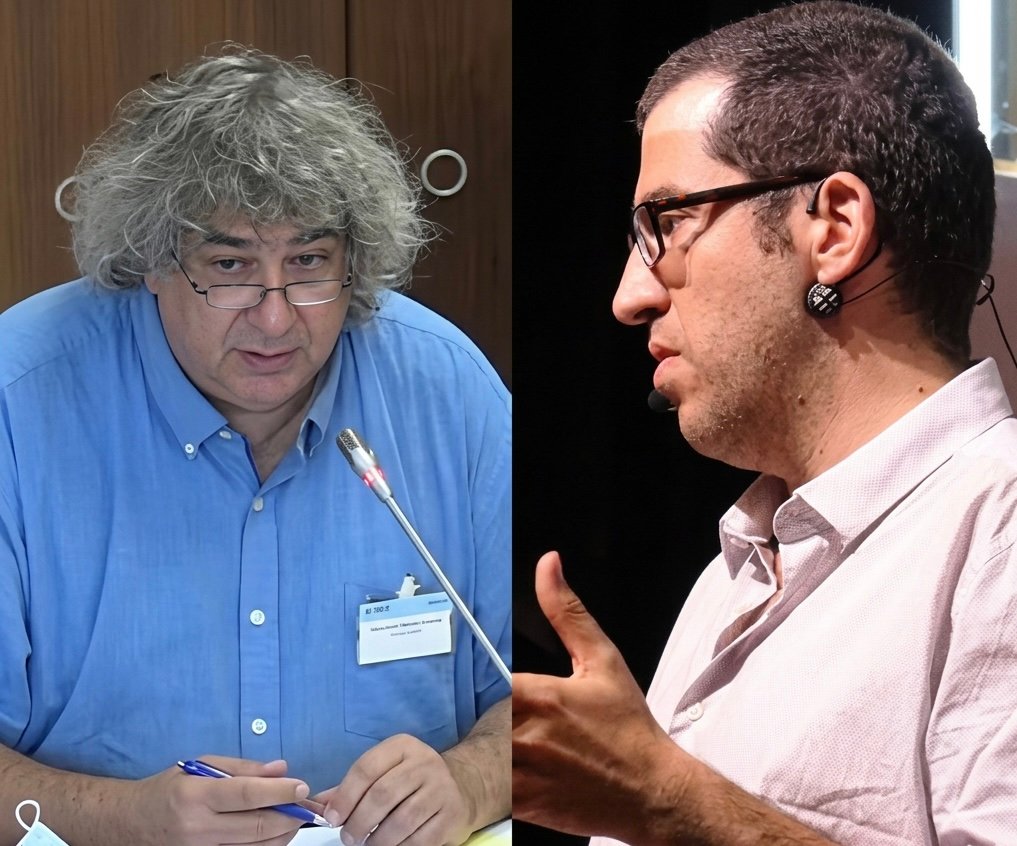
What actually happened is somewhat different: Rudnev taught thousands of students, and while he was in jail, several developed independent teachings, sometimes using the name “Ashram Shambhala” and sometimes, conversely, hiding references to him while using his books. He was not responsible for their activities and knew nothing about them during the eleven years he was imprisoned. Bourdy also wrote three novelized accounts of evil Tantric groups, his love for Domec, and his horrific experiences in the “cult Ashram Shambhala,” which he admittedly described as works of fiction, although allegedly “based on a real story.” He never offered any evidence of contact with Rudnev, and his comments about the Russian teacher are based on Russian media and accounts by disgruntled ex-members rather than on direct experience.
Despite this, French anticult journalist Olivier Hertel presented Bourdy’s story as credible, even testifying in the French Senate. Bourdy also spoke at an anticult conference in 2026 in Salamanca, presenting a paper originally prepared for another conference held almost 10 years before and referring to Rudnev as his leader at the time Bourdy was a “cultist,” even though he had never met the Russian spiritual teacher. The French anticult organization Union nationale des associations de défense des familles et de l’individu (UNADFI, National union of associations defending families and individuals) has collected on its website several articles that rely on Gascan and Bourdy, creating an echo chamber that Western media later mistook for independent reporting.
The Western misreading of the Rudnev case can thus be traced to three sources:
- Early Russian official reports, which framed Ashram Shambhala as a dangerous “cult” and portrayed Rudnev as a criminal.
- The French cluster centered on Gascan and Bourdy, whose personal grievances and fantasies were mistaken for investigative journalism.
- The Argentine prosecutors, who in turn relied on Russian sources and provided Western media with sensationalist allegations.
The religious illiteracy of the “free press”
Originating in Russia, the anti-cult narrative against Rudnev followed him to Montenegro, where no one knew him before the local press began recycling old Russian information and even outdated pictures. In Montenegro, he had no organization, collected no followers, and gave no spiritual teachings. From Montenegro, the same narrative resurfaced in Western media as a perfectly timed ticking time bomb when Rudnev relocated to Argentina. In all cases and countries, the conventional narrative triggered or accompanied police raids, arrests, detention, and inhumane treatment. For sure, the free press in what still claims to be identified as the free world can do better.
The so-called free press in the free world showed such a poverty of creativity that it merely repeated the false claim that Rudnev had escaped from Russia, where his “Ashram Shambhala” had been banned, only to rebuild that allegedly dangerous “cult” elsewhere. The supposedly free press was so eager to follow the Russian cliché that it portrayed Rudnev as the leader of a poisonous “cult” called “Ashram Shambhala,” which was itself dubious (the groups registered by Rudnev in Russia had different designations). Moreover, after his detention in Russia, Rudnev never established any organized group under that name or any other name, either in Montenegro or in Argentina. Most probably, the “exotic” sound of “Ashram Shambhala” (two common terms in East Asian religious and mythological traditions) was considered perfectly suited to the stereotype of the toxic “cult” and was consequently misused.
Doesn’t the so-called free press feel the weight of the fact that its derivative and formulaic yet calumnious reports may have played, and may perhaps still be playing, an important negative role in the continued denial of transforming Rudnev’s detention in Rawson Prison, Chubut Province, Argentina, into house arrest? Prosecutors have filed repeated appeals against judges who ruled in favor of a man who is in a highly critical health condition and has suffered intolerable treatment after a delicate surgical operation. He is now being requested to be sent back to prison after a short period of house arrest granted for medical reasons.

Why is the so-called free press so vulgar as to repeat falsehoods such as the claim that, in Montenegro, the police raided the place where Rudnev was staying in September 2021 and found a “cult” operating there? In fact, it was merely a routine document check that local media distorted by reproducing Russian propaganda, thereby fueling the narrative of the dangerous “cult” leader being pursued by law enforcement.
Why is the so-called free press doubly vulgar in disseminating lies, such as the claim that the house where Rudnev could enjoy a brief period of house arrest in the Spring and Summer of 2026, while preparing for a delicate surgical intervention with his wife, Tamara Siburova, is a fancy villa with a swimming pool, well-kept gardens, and recreational areas spread over a considerable piece of land? These media are subtly suggesting that they live in luxury and are not a persecuted couple whose human rights and religious liberty are systematically denied with arrogance. In fact, the place itself (as a video reveals) is neglected, damp, and surrounded by swampy ground. Can journalists accurately describe places they have never visited, merely copying information from the internet, as in this case, relying on an advertising description used to rent the property?
Western media, including respected outlets, parroted what tainted sources said. They did not investigate or verify. They did not consult scholars. They did not question the narrative.
The result was a cascade of misinformation that shaped international perceptions and contributed to the persecution of a man whose case deserved scrutiny rather than sensationalism.
The Rudnev case is not only a legal scandal. It is a media scandal. It reveals how easily misinformation can become international, how quickly narratives can solidify, and how difficult it is to correct them once they have spread. It also reveals the anti-cult bias of Western media, which treats any accusation involving a “cult” as inherently credible, even when a quick fact-check would expose it as false.
Western journalism must do better. And Konstantin Rudnev deserves better than to be judged by headlines written thousands of kilometers away, based on rumors, propaganda, and prosecutorial rhetoric.

Marco Respinti is an Italian professional journalist, member of the International Federation of Journalists (IFJ), author, translator, and lecturer. He has contributed and contributes to several journals and magazines both in print and online, both in Italy and abroad. Author of books and chapter in books, he has translated and/or edited works by, among others, Edmund Burke, Charles Dickens, T.S. Eliot, Russell Kirk, J.R.R. Tolkien, Régine Pernoud and Gustave Thibon. A Senior fellow at the Russell Kirk Center for Cultural Renewal (a non-partisan, non-profit U.S. educational organization based in Mecosta, Michigan), he is also a founding member as well as a member of the Advisory Council of the Center for European Renewal (a non-profit, non-partisan pan-European educational organization based in The Hague, The Netherlands). A member of the Advisory Council of the European Federation for Freedom of Belief, in December 2022, the Universal Peace Federation bestowed on him, among others, the title of Ambassador of Peace. From February 2018 to December 2022, he has been the Editor-in-Chief of International Family News. He serves as Director-in-Charge of the academic publication The Journal of CESNUR and Bitter Winter: A Magazine on Religious Liberty and Human Rights.