Scholars, lawyers, a journalist, and the alleged “victim” examine how prejudice and structural flaws kept a seriously ill man in jail.
by Massimo Introvigne and María Vardé
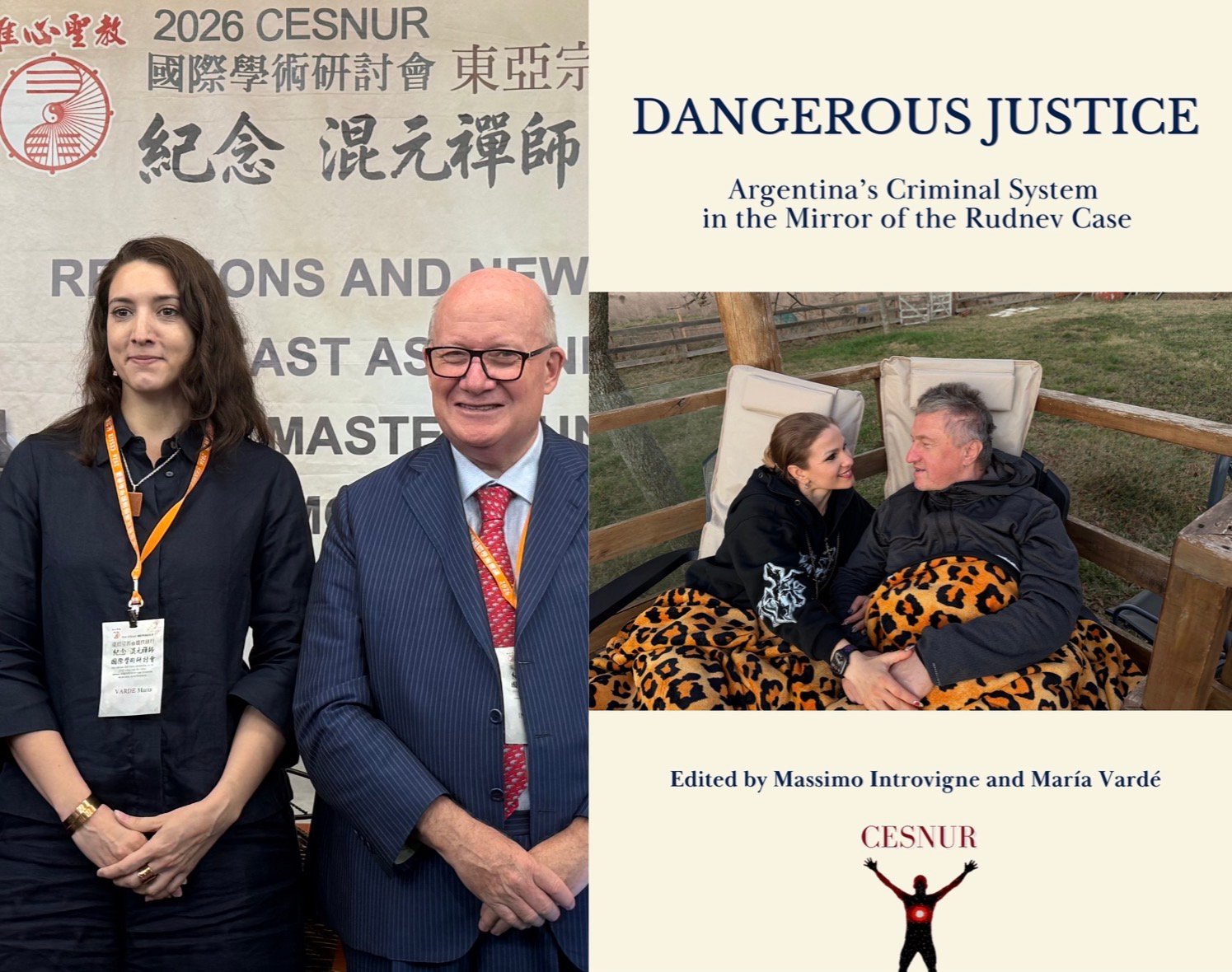
CESNUR has just published “Dangerous Justice: Argentina’s Criminal System in the Mirror of the Rudnev Case,” a collective volume we have edited, with an introduction by American sociologist James T. Richardson. The book can be downloaded free of charge.
Konstantin Rudnev was arrested at the Bariloche airport in March 2025. Within days he was in a high-security prison in Rawson, in Patagonia, labeled by the prosecution as an “evil cult leader” at the head of a transnational human trafficking ring. The charges included aggravated trafficking, reduction to servitude, unlawful deprivation of liberty, and transportation of narcotics. More than a year and a half later, the narcotics turned out to be sleeping pills and cooking mushrooms, the only person identified as a victim has repeatedly and publicly denied being one, and Rudnev, a seriously ill man who lost 53 kilograms in custody, is still in pre-trial detention.
As noted in the introduction by James T. Richardson, one of the world’s leading scholars of new religious movements and their legal problems, the book uses the Rudnev case as a mirror. In it, two distinct sets of problems become visible. The first concerns the prejudice that takes over as soon as a defendant is described as the leader of a “cult.” The second concerns structural features of Argentine criminal justice that long predate the case and affect thousands of defendants who have nothing to do with spirituality: the expansive reach of anti-trafficking legislation, the routine use of pre-trial detention, the influence of media and politics on judicial decisions, and the scant accountability of prosecutors. The contributors include sociologists, anthropologists, legal scholars, practicing lawyers, a prosecutor, a public defender, a journalist, a former diplomat, and the woman the prosecution insists on calling a victim. They do not all reach the same conclusions, and we have deliberately included voices that read the case more cautiously than we do.
Download: free download of the book from CESNUR’s website.
After Richardson’s introduction, the volume opens with a chapter in which one of us (Introvigne, a sociologist of religion) identifies ten interconnected falsehoods that shaped the proceedings. The first five belong to a transnational narrative that preceded Rudnev’s arrival in Argentina: that he is a “cult leader,” that he practices “brainwashing,” that his teachings drawn from the Tantric tradition are inherently abusive, that his conviction in Putin’s Russia proves his guilt, and that he fled Montenegro to escape the police. The remaining five concern the Argentine case itself: the alleged reconstruction of his “cult” in Bariloche, the trafficking of Elena Makarova, the drug charges, and the claims that his situation requires prolonged detention and that his health is compatible with prison. Each falsehood collapses once it is checked against the documents, and their combination explains how a narrative could survive the evidence.
The next three chapters step back from the case to examine the legal and institutional framework that made it possible. Marisa Tarantino, an assistant prosecutor in Buenos Aires, traces the expansion of Argentine anti-trafficking law from Law No. 26,364 of 2008 to its 2012 amendment by Law No. 26,842. She shows how the removal of the “means” element from the basic offense, the declared irrelevance of consent, and an open-ended notion of “vulnerability” combined to produce a punitive policy in which consensual relationships can be retrospectively treated as coercive. She also notes an interpretive double standard: labor exploitation still requires proof of subjection, while sexual exploitation may be inferred from the mere existence of sex work.

Cecilia Varela and María Vardé (the second of us), both from the University of Buenos Aires, reconstruct how the anti-trafficking campaign took root in Argentina. Its success rested partly on a local human rights vocabulary, as women in prostitution were presented as the “disappeared under democracy,” evoking the memory of the military dictatorship. From the late 2010s onward, state agencies working on trafficking began to absorb categories from anti-cult activism, renamed in more technical language as “coercive organization” and “coercive persuasion.” Through cases such as Monte Sión and Hotel City, these categories moved from court rulings into prevention plans and training materials. The authors show how, within this framework, a person’s denial of being exploited can be read as proof of the control exercised over her, so that rejecting the label of victim ends up confirming it.
Ezequiel Kostenwein is a researcher at Argentina’s National Scientific and Technical Research Council (CONICET) who coordinates the Sociology of Criminal Justice Area at the Institute of Legal Culture of the National University of La Plata. Drawing on extensive interviews with judges, prosecutors, and defense attorneys in the province of Buenos Aires, he explains why pre-trial detention persists as a routine practice despite its exceptional character in law. The expected sentence becomes a proxy for the risk of flight, turning detention into an anticipation of punishment. Judicial actors speak of “judicial danger,” the professional risk faced by whoever orders a release that later goes wrong, and describe the disciplining effect of political campaigns built around the metaphor of the “revolving door.” Kostenwein’s analysis, which does not address the Rudnev case directly, provides one of the backgrounds against which the rest of the book should be read.
Patricia Duval, a well-known French attorney specialized in international human rights law, returns to Rudnev and documents his treatment in custody: arrest on a prosecutor’s verbal order, no access to a lawyer for twelve days, ten days of solitary confinement in a punishment cell, medication administered without explanation or translation, and a progressive deterioration of his health that eventually required emergency surgery. She argues that provisions of the Code of Criminal Procedure designed for complex transnational crime were applied without any transnational organization having been identified, and that the purpose of the detention was to pressure Rudnev into accepting an abbreviated trial in exchange for a confession, which he has consistently refused. She measures these practices against the Tokyo Rules and the Mandela Rules, which Argentina itself helped draft.
The second part of the book is a forum in which six contributors approach the case from different angles. Rosita Šorytė, a former diplomat who grew up in Soviet-occupied Lithuania, examines the videos devoted to Rudnev by the Russian “professional skeptic” Mikhail Lidin, the most recent of which has passed one million views. She reads them as the product of a Soviet-style scientism that survived the Soviet Union, and as part of a campaign that diversifies its messengers beyond Orthodox anti-cultists to influence the Argentine proceedings.
Alejandro Agostinelli, an Argentine journalist, offers a self-critical testimony. In 1991 he wrote a widely read article in Página/12 on “flying-saucer cults” that relied on the “brainwashing” theory and contributed to the “cult invasion” climate of the early 1990s. That climate soon fed the persecution of Valentina de Andrade, a Brazilian religious leader later acquitted of crimes eventually confessed by a serial killer. Having reexamined his assumptions through dialogue with sociologists, Agostinelli describes himself as a “repentant anti-cultist” and recognizes in the media treatment of Rudnev the same mechanisms he once helped set in motion.
Liliana Eva Cucurullo, a public defender in the province of Buenos Aires, provides the most cautious contribution. Based on the court materials she was able to review, she finds an objective basis for investigation. She insists, however, that the threshold of proof must rise as the proceedings advance, that vulnerability must be assessed individually, and that if every statement contradicting the prosecution’s hypothesis is treated as further evidence of subjection, that hypothesis becomes impossible to refute. Her questions about the handling of Makarova’s position deserve the attention of anyone, whatever their view of the case.
Elena Makarova then speaks for herself. A pregnant young woman who left Russia to escape a violent partner and give birth in Argentina, as thousands of Russian women do every year, she explains that she had never met Rudnev. A photocopy of his passport, produced at the hospital by an acquaintance under pressure to name the father of her child, became the origin of the entire trafficking accusation. DNA tests later confirmed that Rudnev is not the father. She describes threats to take away her son, a cesarean section to which she did not consent, and weeks without a lawyer of her choice, and she states that the only people who victimized her in Argentina were the prosecutors, against whom she has filed a complaint.
Alessandro Amicarelli, a London-based human rights attorney and the President of the European Federation for Freedom of Belief, measures Argentine practice against the case law of the European Court of Human Rights, from “Letellier v. France,” “Clooth v. Belgium,” and “Ilijkov v. Bulgaria” to two 2026 decisions concerning Ukraine. From these judgments he derives three tests: detention must not exceed a reasonable time, investigators must proceed with diligence, and effective remedies must be available. Applying them both to Rudnev and to the Franco Casco case, in which police officers spent six years in pre-trial detention, he concludes that Argentina fails all three, and he recalls the human cost of prolonged detention for defendants’ families.
Finally, political scientist Michele Olzi, from Italy’s University of Insubria, asks who watches the watchmen. Starting from John Stuart Mill’s notion of individual autonomy and from the interpretation of Article 17 of the International Covenant on Civil and Political Rights by the United Nations Human Rights Committee, he argues that state interference may be prohibited as arbitrary even when it has a legal basis. Imposing the status of victim on an adult woman who rejects it, and interpreting her rejection as proof of coercion, is in his view a textbook case of such arbitrary interference.
Read together, these contributions suggest that the Rudnev case cannot be reduced to an isolated accident or to the work of a single overzealous prosecutor, although the conduct of Prosecutor Fernando Arrigo receives critical attention throughout the book. The case brings together tendencies that exist independently of it in Argentina’s criminal system and that reinforce one another. We hope this volume will contribute to a broader discussion in Argentina on how to protect those who are truly exploited without silencing those who say they are not, and how to investigate serious crimes without abandoning the presumption of innocence.

Massimo Introvigne (born June 14, 1955 in Rome) is an Italian sociologist of religions. He is the founder and managing director of the Center for Studies on New Religions (CESNUR), an international network of scholars who study new religious movements. Introvigne is the author of some 70 books and more than 100 articles in the field of sociology of religion. He was the main author of the Enciclopedia delle religioni in Italia (Encyclopedia of Religions in Italy). He is a member of the editorial board for the Interdisciplinary Journal of Research on Religion and of the executive board of University of Pennsylvania Press’ Nova Religio. From January 5 to December 31, 2011, he has served as the “Representative on combating racism, xenophobia and discrimination, with a special focus on discrimination against Christians and members of other religions” of the Organization for Security and Co-operation in Europe (OSCE). From 2012 to 2015 he served as chairperson of the Observatory of Religious Liberty, instituted by the Italian Ministry of Foreign Affairs in order to monitor problems of religious liberty on a worldwide scale.