How a hospital incident, Russian precedents, media bias, and prosecutors’ obsession with “cult trafficking” led to the construction of the “Russian cult” narrative.
by María Vardé
Article 4 in a series. Read article 1, article 2, and article 3.
Introduction
The Argentine proceedings against Konstantin Rudnev began in March 2025 with a hospital referral concerning Elena Makarova, identified as R.T. in the judicial file (although multiple media have now disclosed her name), a pregnant Russian citizen, in San Carlos de Bariloche. The referral did not concern a religious organization, a local spiritual school, or a complaint against Rudnev. Within days, however, the episode had been reorganized publicly and procedurally as the “discovery” of a transnational “cult” involved in human trafficking, sexual exploitation, servitude, attempted alteration of a newborn’s identity, immigration offenses, and drug transportation. This report examines that expansion.
The proceedings remain at the investigative stage. My analysis reaches no conclusion on criminal responsibility and distinguishes judicial records from prosecutorial allegations, defense reconstructions, expert findings, journalistic accounts, and statements by the persons involved. Sources include the federal criminal file, Gendarmerie chemical reports, party submissions, official communications, press coverage, and interviews by the author. The aim is to reconstruct how observations, relationships, objects, messages, and references to foreign media came to be read together as evidence of a single coercive organization.
Legal anthropology treats a criminal file as a field of production rather than a neutral repository: documents select events, translate speech, assign classifications, and connect circumstances from different settings. In trafficking cases, this work gives practical content to “vulnerability” and affects whether an adult’s account is accepted as testimony or reinterpreted as impaired perception. Here it intersected with a consolidated foreign archive. Studies by other scholars, the earlier reconstruction by Introvigne and Vardé, and expert reports on the Russian proceedings document a substantial distance between the offenses formally adjudicated in Russia and the wider repertoire circulated by media and anti-cult activists: orgies, mind control, suicides, unidentified corpses, occult powers, narcotics, and threats to children.
The distinction between a foreign judgment and the public image built around it is central. A judgment may be evaluated as background under the receiving jurisdiction’s evidentiary rules. A reputation assembled through media campaigns, anti-cult activism, official statements, and repeated unattributed allegations has a different status. The analysis traces the movement from hospital concern to prosecutorial theory, from foreign reputation to local organization, and from early media assertion to procedural persistence.
The hospital referral and the first formulation
Makarova arrived in Argentina in January 2025 during the final stage of her pregnancy. According to her account, she had left a violent relationship and traveled to Bariloche to give birth in safer conditions. She was accompanied by Nadezhda Belyakova, a friend of her mother. Neither spoke Spanish, and Makarova spoke little English. During hospital visits, they sought help from Svetlana Komkova, a Russian and Portuguese teacher who could communicate in Spanish. Hospital personnel read this reliance as a possible sign that Makarova could not speak freely; the women described it as mutual assistance among Russian speakers in an unfamiliar medical setting.
The referral gathered observations made under those linguistic conditions. A nurse believed that Makarova appeared younger than the age recorded in her passport and attributed her limited participation to fear or submission. When Makarova gave the nurse a white rose, the gesture was interpreted as a possible coded request for help. In Makarova’s account and the interviews I conducted for an earlier study, the flower was an expression of gratitude. The meaning assigned to her conduct, therefore, depended on translation, cultural interpretation, and assumptions about those relationships.
The question of the child’s father introduced Rudnev’s name. Makarova declined to identify her former partner and asked that the child be registered under her surname. Hospital personnel nevertheless requested paternal documentation; the nurse later acknowledged that it was not legally required for discharge but said she requested it to obtain information about Makarova. A photocopy of Rudnev’s passport was produced, but the reviewed materials do not establish who supplied it or verify its provenance. Prosecutors interpreted it as part of a plan to attribute paternity to Rudnev and grant him Argentine nationality. The defense maintained that, after hospital personnel insisted on paternal papers, one woman used a copy found among documents left at the accommodation by someone who had assisted Rudnev and his wife with immigration inquiries.
A second conflict concerned the newborn’s surname. Makarova continued to request that the child bear her surname. The initial paperwork used the feminine Russian ending corresponding to the mother, and Komkova asked that it be changed to the masculine form used for a boy. The women stated that a hospital employee tore the document during the argument. Prosecutors later presented the episode as an attempt to alter or destroy an official record and linked it to the alleged plan concerning Rudnev’s paternity. A disagreement over Russian naming conventions was thereby entered into the file as possible evidence of falsification.
Following the cesarean delivery, police and prosecutors intervened. Makarova stated that she awoke without her telephone, separated from those on whom she relied for communication, and unable to understand the officials around her. She remained with her newborn under supervision and was later transferred to protected accommodation. The measures were recorded as state protection. In Makarova’s account, they restricted contact with her mother and with the privately retained lawyer who sought access to her and limited her ability to challenge the official description of the situation.
The first prosecutorial initiative concerned one Mexican and five Russian women and did not include Rudnev. After hearing Makarova and the women, Federal Guarantees Judge Gustavo Villanueva declined to authorize formalization. The investigation was later pursued before another judge and broadened in scope. The reviewed materials identify no complainant who described the eventual twenty-one defendants as members of a single organization. Makarova continued to deny recruitment and exploitation, stated that she had never met Rudnev, repeated that position after returning to Russia, and even requested the prosecutors’ recusal.

Assembling the transnational organization
On March 28, security forces detained Rudnev, his wife, and other Russian citizens at Bariloche Airport and searched rented houses, vehicles, and luggage. At the March 31 hearing, prosecutors stated that some women arrested as suspects might later be classified as victims. Defense lawyers reported that their clients did not understand the reasons for detention or the proceedings. A single Russian interpreter served numerous defendants, several of whom later stated that the hearing had not been fully translated. The judge excluded journalists and protected names and images because possible victims were among the accused, although identifying information and detailed allegations had already reached national media.
During the formalization hearings of April 3–5, prosecutors accused twenty-one persons of participating in a “coercive transnational organization” concealed behind philosophy, spirituality, and yoga. The alleged offenses included aggravated trafficking for sexual exploitation and servitude, attempted alteration of the newborn’s identity, immigration offenses, and aggravated transportation of narcotics. Judge Gustavo Zapata authorized the investigation and imposed preventive detention on Rudnev. The other defendants were released subject to reporting duties and restrictions concerning travel, residence, passports, and contact.
The hearing record shows that foreign reputation supplied much of the alleged organization’s identity. Prosecutors said they had consulted “diverse sources,” including Montenegrin newspapers and the Russian conviction. Their presentation did not systematically separate conduct established in the judgment from allegations propagated by tabloids, television programs, anti-cult activists, and derivative publications. The composite nevertheless furnished the attributes of the Argentine theory: a sexually predatory leader, psychological domination of women, control over food and property, spirituality used as concealment, and cross-border mobility. Foreign journalism did not formally become expert evidence, but it helped define the organization investigators believed they had found before the local material was properly examined.
The prosecution also referred to travel arrangements, shared accommodation, rented vehicles, covered windows, labeled utensils, stored food, clothing, manuscripts, and messages concerning diet or punishment. Defense counsel disputed the ownership, provenance, context, attribution, and translation of those items; meanwhile, the digital material was not yet available for adversarial review. The social connections were heterogeneous: some defendants knew Rudnev or his wife, while others knew one another through travel, accommodation, or Russian-speaking networks, and several denied knowing him. The public account identified no local school with teachers, students, courses, recruitment practices, ceremonies, or a documented chain of command. “Organization” consequently operated both as the conclusion to be demonstrated and as the frame through which any association became membership, any assistance became subordination, and any proximity became coordination.

Media circulation and the confirmation loop
The first national media cycle preceded legal formalization. On March 31, “Infobae” combined “a cult from Montenegro,” “malnourished and hairless women,” and the terror of a victim in its headline; the article also questioned Makarova’s documented age and described a twenty-thousand-member movement, surrender of property, expensive yoga courses, and emaciated women surviving on leftovers. On April 1, “El País” reported that Ashram Shambhala had been discovered behind the referral, described the detainees as Rudnev’s followers fleeing toward Brazil, and stated that they possessed 130 “cocaine pills.” The “Buenos Aires Herald,” “Buenos Aires Times,” and “La Nación” adopted the same narrative and repeated the narcotics claim.
The apparent convergence among Russian, Montenegrin, Argentine, and later international reports concealed a circular movement of information. The attributes attached to Rudnev in Argentina had not emerged for the first time from the Bariloche investigation. They belonged to a repertoire already consolidated in Russia, where state-aligned and opposition media alike had represented him through sexual deviance, psychological enslavement, occultism, drugs, violence, fraud, and danger to children. Montenegrin reporting reactivated the same image after local authorities encountered his name. Argentine investigators and journalists then drew on that archive when interpreting the hospital referral and the arrests. Once the Argentine accusations were published, Russian and international outlets presented them as new confirmation of the older portrait. What appeared to be corroboration across countries was, therefore, in significant part, the recirculation of a single anti-cult figure through successive jurisdictions and media environments.
Official communications strengthened the feedback loop. The Public Prosecutor’s Office described a “coercive transnational organization” concealed behind spirituality and yoga, repeated the alleged plan involving the newborn’s identity and Brazil, and reported that an orientative test indicated cocaine in the tablets. The releases described a reconstructed criminal system at an early stage of investigation. Investigative information supplied journalists with a coherent plot; publication gave it public visibility and apparent confirmation; later, official statements circulated in which its characters and sequence were already familiar. Repetition enlarged the appearance of support without adding an independent source.
Contradictory information followed a different trajectory. Makarova’s refusal of victim status reached national news agencies months later. Negative chemical findings circulated mainly through outlets with smaller audiences, while the principal early articles and official releases remained accessible without correction of the cocaine allegation. Several defendants also described unsuccessful efforts to attract the attention of embassies and human-rights organizations after their names and photographs had been associated with trafficking, sexual exploitation, narcotics, and a “cult.” Judicial measures protecting identities came after public exposure had already created a durable searchable record.
Victimhood, contradictory accounts, and translation
Makarova occupied several positions in the proceedings: her hospital situation triggered the referral; she was classified as the principal victim; she was the mother involved in the registration dispute; and she was an adult whose account contradicted the prosecution’s premise. Her privately retained lawyer informed the court that she did not wish to accuse anyone. A state-appointed representative argued that a person subjected to “coercive control” might not recognize herself as a victim. Prosecutors also cited messages allegedly extracted from her telephone as instructions to deny victimization and Rudnev’s responsibility.
The hearing did not establish that Rudnev sent those messages or instructed another person to send them. Defense counsel objected that their extraction, authorship, context, and translation had not been available for adversarial review. Even so, the messages were used to interpret Makarova’s denial as instructed, while her repeated refusal of victim status was regarded as compatible with the coercion hypothesis. Other women denied belonging to a Rudnev-led spiritual group or being victims, and most denied knowing him. Prosecutors and judges are not required to accept such denials at face value. But contrary statements must still retain probative force. If the accusation confirms exploitation and the refusal to accuse is also treated as evidence of domination, the classification ceases to be tested by the person’s account and instead absorbs it.
Argentine scholarship on anti-trafficking practices helps locate this problem without presuming in advance whether the prosecution or the women’s accounts should prevail. Varela’s analysis of the interpretive process through which “vulnerability” becomes legally recognizable shows that victimhood is constructed through the selection and ordering of signs. Martynowskyj’s formulation of women who experience themselves as being “accused of being victims” names the procedural position produced when disagreement no longer functions as contrary evidence but is reintroduced as a symptom requiring expert interpretation. Tarantino’s critique of protective-punitive frameworks further clarifies the risk that assistance may restrict the agency it claims to restore. In this case, the issue is how much evidentiary weight remained available to Makarova’s statements once the official hypothesis had classified her refusal as part of the coercive situation itself.
Language and translation formed part of the evidentiary problem from the outset. Hospital exchanges relied on companions, telephone applications, improvised interpretation, and a remote translator. One interpreter served numerous defendants at the hearings, and several later reported incomplete translations. Messages and handwritten texts were invoked while their linguistic contexts remained disputed. One year after formalization, prosecutors requested twelve additional months because digital material still required translation and most devices had not been fully examined. At the extension hearing, the prosecution acknowledged having used Google Lens and stated that an official translation was now required. In a case where command, obedience, punishment, and coercion were inferred from words, translation was part of the evidentiary infrastructure. Provisional and unaudited linguistic interpretations had already helped sustain the accusation, organize the alleged hierarchy, and justify coercive measures before reliable translation became available.
Narcotics, detention, and procedural persistence
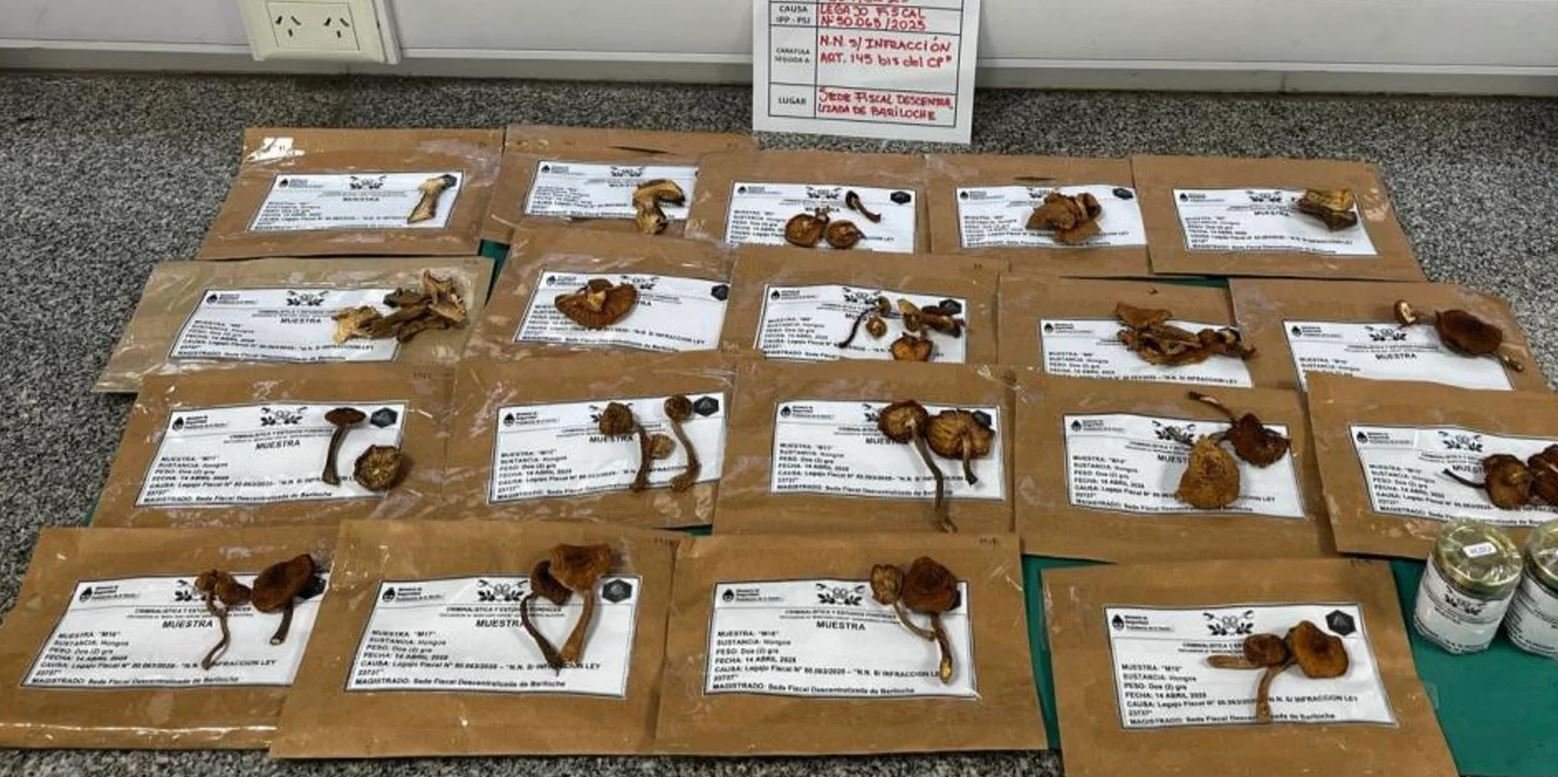
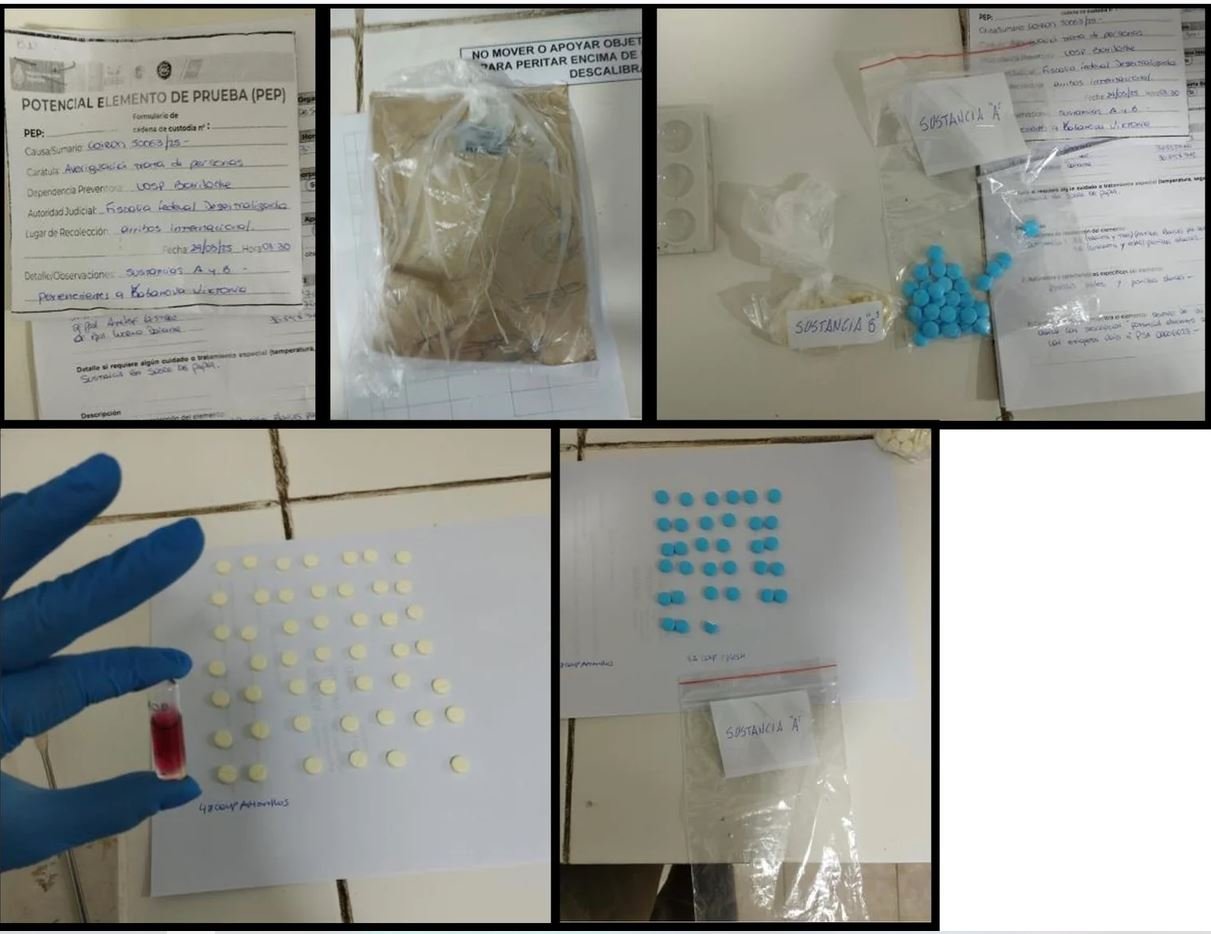
The narcotics allegation offers the clearest chronology of a public claim surviving technical contradiction. Authorities seized 131 tablets from two women at the airport. The existence of an initial orientative test was presented publicly and procedurally as an indication that the tablets contained cocaine. Gendarmerie Chemical Report no. 135491, however, analyzed samples and was signed on April 3, 2025, before the formalization hearing. It expressly excluded cocaine and MDMA. That evening, prosecutors nevertheless told the court that the women had attempted to transport “131 pills containing cocaine,” and the narcotics charge was formalized. A second report, no. 136132, dated May 14, found no controlled psychotropic or narcotic substances in nineteen dried-mushroom samples and three liquids seized during searches.
By the time the negative findings could have corrected the case’s public framing, the cocaine allegation had already become part of the story through “El País,” “La Nación,” the “Buenos Aires Herald,” and official prosecutorial communication. The major early reports were not corrected, producing an evidentiary split: the forensic record no longer supported the narcotics claim, but the media and institutional narrative continued to associate the alleged organization with drug transportation.
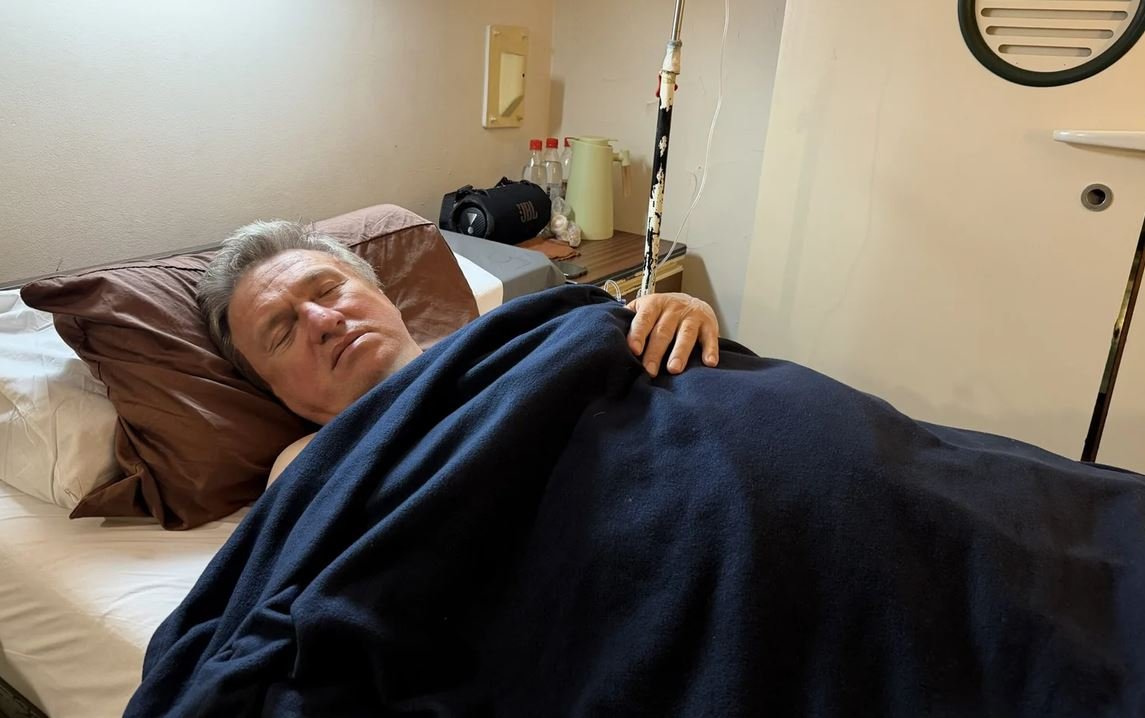
After formalization in April 2025, Rudnev was the only defendant held in preventive detention and was transferred to Federal Prison Unit No. 6 in Rawson. Medical submissions later documented substantial weight loss, fainting, respiratory episodes, adverse effects attributed to medication, and requests for specialist examinations. On January 21, 2026, Judge Zapata granted house arrest on health grounds. The prosecution appealed, disputing the medical basis and invoking flight risk; on January 28, the Review Court revoked the measure pending further assessment.
At the April 1 extension hearing, when the prosecution requested another twelve months to investigate, the court extended the investigation and Rudnev’s preventive detention until April 2027. On April 23, a review panel ordered detention at a residence in San Vicente, subject to electronic monitoring, a bond, and restrictive conditions. The prosecution appealed, relying on flight risk, alleged economic capacity, and the organization’s supposed international reach. The appeal was rejected on May 5, and Rudnev was transferred to house arrest in mid-May.
On June 4, 2026, the Federal Court of Criminal Cassation granted the prosecution’s complaint and revoked Rudnev’s house arrest. The ruling referred to the tablets as substances that “presumably” contained psychotropics and treated their simultaneous transportation as support for a coordinated organization. The narcotics allegation was not incidental. Along with the alleged transnational structure, Rudnev’s presumed leadership, and flight risk, it contributed to the court’s assessment that the case involved seriousness and organizational capacity incompatible with house arrest. The decision did not address the completed Gendarmerie reports that excluded illegal substances. Although house arrest was revoked, implementation was subject to medical exams because Rudnev had recently undergone surgery. In July, while still electronically monitored, he was urgently admitted to the Naval Hospital following postoperative deterioration.
The evidentiary effects were unequal. Negative laboratory results altered the forensic record but did not displace drugs from the judicial description of the organization’s dangerousness. Meanwhile, untranslated, encrypted, and unexamined material was expected to substantiate the theory later and was invoked to prolong investigation and detention in the present. A technically contradicted allegation remained available, while evidence not yet produced continued to function as anticipated confirmation.
Conclusion
The proceedings began with a hospital referral formulated under difficult linguistic and intercultural conditions and expanded once Rudnev’s name connected it to a transnational anti-cult archive. Russian and Montenegrin representations supplied a recognizable “leader” and a repertoire of abuse, psychological control, deprivation, narcotics, and concealed spirituality. Argentine investigators associated that repertoire with the hospital encounter, migration plans, travel, accommodation, objects, and messages whose translation and context remained disputed. National media then reported the hypothesis as the discovery of a known criminal system, while later foreign coverage returned the Argentine accusations as apparent confirmation.
The legal-anthropological issue is not that such associations were impossible to investigate, but that facts of different origin and status were made coherent before their evidentiary conditions had been stabilized. Assistance with translation could be read as control; migrant support networks as organizational membership; disagreement with victim status as impaired perception; and objects whose evidentiary meaning depended on disputed attribution and context as signs of hierarchy. These interpretations required attribution, context, reliable translation, and revision in light of contrary evidence. Yet the organizational frame persisted while central digital material remained inaccessible or untranslated, the principal alleged victim rejected the status assigned to her, and state laboratory reports contradicted the most widely reported narcotics allegation.
The analysis does not substitute a defense narrative for the prosecution’s account. It preserves distinctions indispensable to judicial and public evaluation: an allegation’s provenance and its repetition; an orientative indication and a confirmatory examination; a foreign reputation produced within a politically inflected anti-cult and media environment and conduct established in Argentina; protective classification and proof that an adult cannot describe her own experience. Institutional classifications are necessary for legal intervention, but their authority depends on the evidence through which they are produced and contested.
Foreign media reports first served as investigative leads, then as interpretive context, and finally, through Argentine reporting and official communication, as apparent corroboration. The image of the transnational “cult leader” was complete within days. More than a year later, investigators were still translating and assessing material said to sustain it; Makarova continued to reject the status assigned to her; and a narcotics allegation excluded by state expert reports remained present in a detention decision. Once a penal narrative becomes durable, repetition can conceal an unstable evidentiary base, and the passage of time itself may become one of the penalties imposed by the process.

Maria Vardé graduated in Anthropological Sciences at the University of Buenos Aires and is currently a researcher at the Instituto de Ciencias Antropológicas, Facultad de Filosofía y Letras, Universidad de Buenos Aires (Institute of Anthropological Sciences, Faculty of Philosophy and Humanities, University of Buenos Aires). She has written and lectured on archeology, spirituality, and freedom of religion or belief.