Cases from the 1990s demonstrate how “cult” rhetoric destroyed reputations and led to false accusations in Argentina. The story repeats itself in the Rudnev case.
by Alejandro Agostinelli
The “common sense” that mobilizes those who label certain movements as “cults,” the scarcely or entirely unaudited power of prosecutors’ offices, the expansive use of criminal-law provisions such as human trafficking laws, the media exposure of judicial investigations through leaks, and the way the media construct guilt before a verdict is handed down are essential both in a court case and in a piece of journalism. Even so, these issues remain practically invisible to mass audiences. Not because of a lack of specialists in scientific disciplines who could shed light in the darkness, but because it is easier, corporately advantageous, and even profitable to be part of this structure, a “culture of suspicion” rooted in the mainstream. Understanding, exposing, and dismantling it will require far more energy, time, and resources.
The recent case of Konstantin Rudnev in Argentina is a textbook example of manufacturing a media-judicial moral panic. News coverage followed the same old sensationalist formula: “if it bleeds, it sells,” as Marco Respinti puts it. He adds something more uncomfortable: neutral journalists do not need to sympathize with so-called “cults” to recognize the serious abuse committed by their profession when it abandons its primary responsibility—to report without distorting the facts. Professional ethics alone should suffice. And this disproportion relative to the actual risk, together with law-enforcement operations focused on “rescuing” victims who deny being victims or simply do not exist, ends up causing more harm than the harm prosecutors, “anti-cultists,” or the media claim to prevent.
There is a basic point, which consists of identifying and becoming familiar with the group (official name, number of followers, etc.) and its historical trajectory, listening to representatives and members of the community, interviewing people who claim to have been harmed by its activities, seeking expert sources (sociologists, anthropologists, historians), lawyers for both sides, and, if the case is before the courts, obtaining testimony from the officials responsible for an ongoing investigation. But this ABC is rarely followed.
The crimes Valentina did not commit
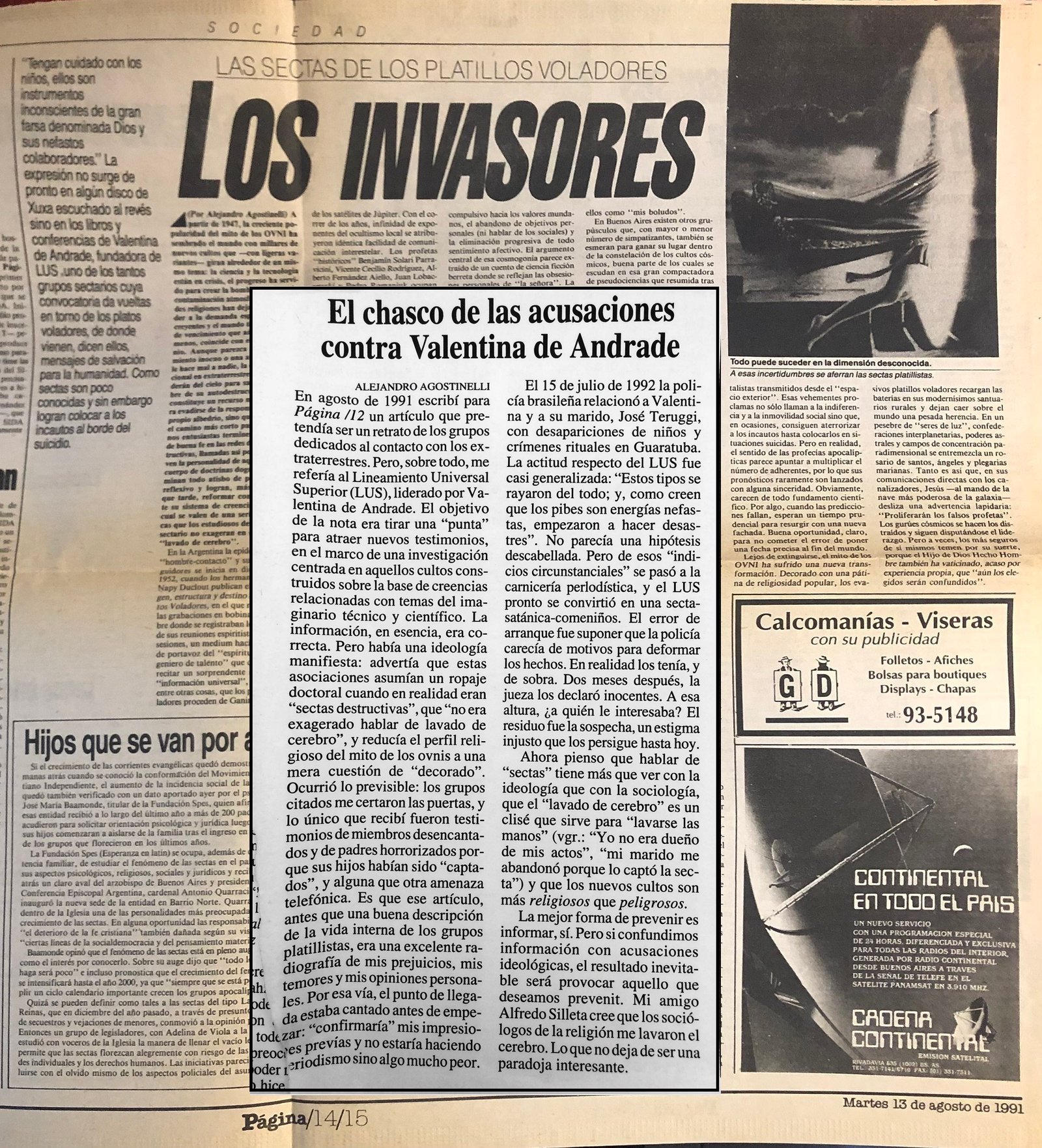
In 1991, an Argentine morning newspaper published a two-page article titled The Invaders, under the kicker “The Flying-Saucer Cults.” The author framed the growing popularity of the “naïve” UFO myth alongside other social trends that, in his view, led those interested in them toward these “pseudoscientific cults.” He stated as a fact that this movement constituted “a risky challenge to the mental health of mystery enthusiasts… tempted by that flying-saucer-shaped bait.” I will comment only on the opening: dissecting the entire article would provide material for a complete thesis.
“Although it may seem like harmless entertainment or a hobby that does no harm, the irrational belief in extraterrestrials who will descend from the sky to save humankind from its self-destruction not only constitutes a petty means of escaping responsibility for one’s own free will, but also offers some enthusiasts a shorter path to becoming trapped in the networks of destructive cults, so-called because they dissolve the personalities of those individuals into a body of dogmatic doctrines, eliminate every trace of reflective thought, and, sooner rather than later, completely reform their belief systems, for which they employ a series of techniques that scholars of the cultic problem do not exaggerate in calling ‘brainwashing.’” (Página/12, August 13, 1991)
The boldface is mine. And so is the text: I myself wrote the article 35 years ago.
Today, that article published in “Página/12” is a “pilot case” for understanding how the discourse of social agitation, moral panic, and the stigmatization of religious minorities was structured in Argentina in the late 1980s and early 1990s. It belongs to a pivotal moment when the debate surrounding “cults” was shifting from the “invasion” of the “electronic churches,” evangelical preachers to whom a role of “geopolitical and imperialist infiltration” was attributed (1985–1988), and the most stigmatized religious minorities (the Unification Church, Jehovah’s Witnesses, Pentecostals, Scientology, the Children of God, etc.), toward the advent of novel groups, such as those inhabiting UFO culture and other margins of religiosity. Well into the 1990s, the “social problem of cults” emerged as a threat, particularly after the arrival in the country of the North American and European model of “coercive persuasion.”
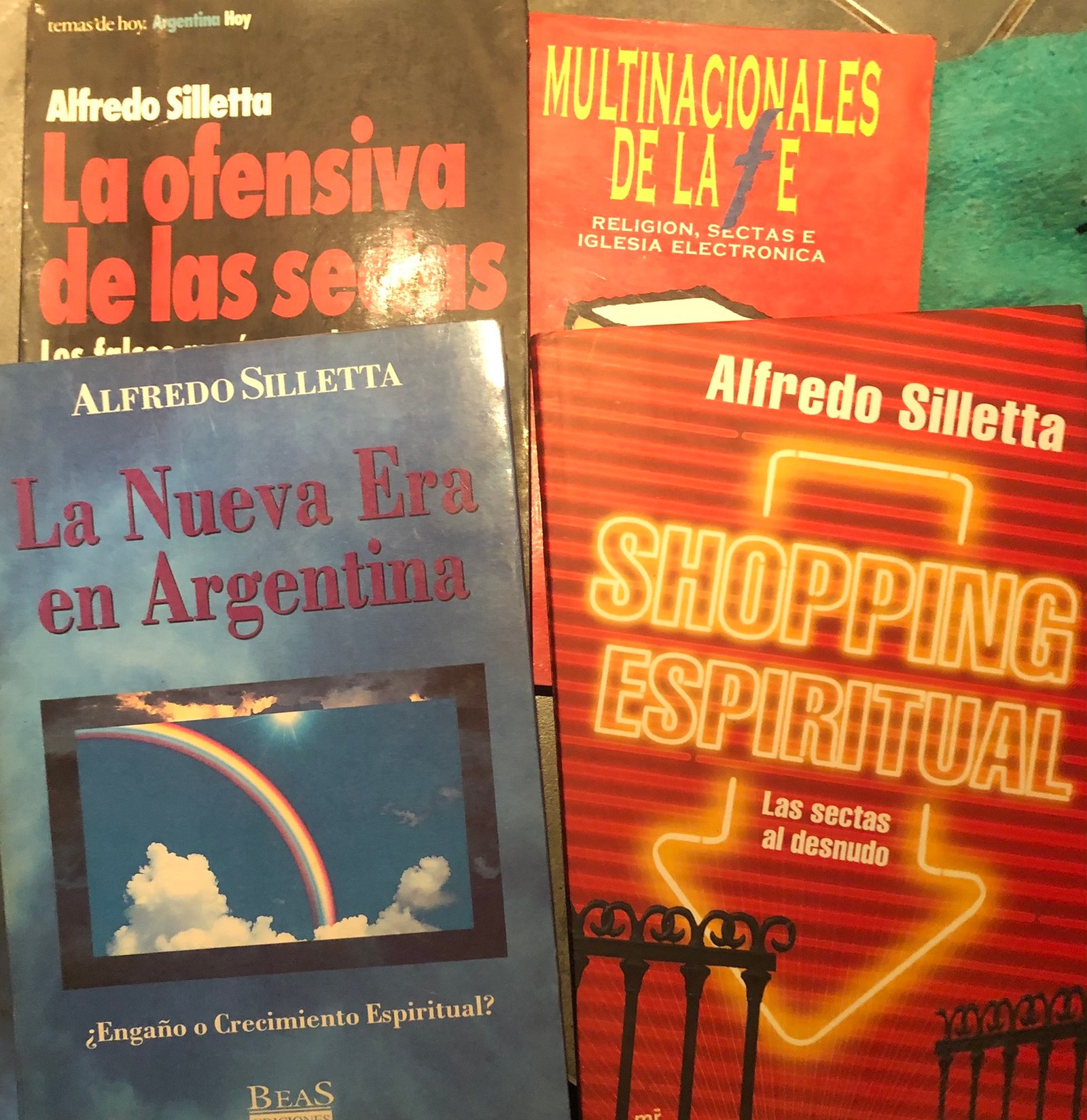
The very notion of “destructive cults that nullify the will of individuals,” which discredits the group by denying converts their autonomy and even the authority the article grants to “scholars of the cultic problem [who] do not exaggerate in calling it ‘brainwashing,’” today, at least for me, makes my skin crawl. In my mind, those “scholars” were the specialized journalists Pepe Rodríguez, author of “The Power of Cults” (El poder de las sectas, 1989), and the Argentine Alfredo Silletta, author of titles such as “Cults Invade Argentina” (Las sectas invaden la Argentina, 1986), as well as the psychologist José María Baamonde, whose close relationship with the Catholic Church I did not regard as incompatible with a balanced judgment, perhaps because, not so long ago, priests and lay members of the Church were regarded as the “owners” of the religious field.
My “Página/12” article in August 1991 functioned not as a prophecy but as a catalyst for the “cult invasion” climate that erupted the following year. In July 1992, when the police chief of Paraná, Brazil, accused Valentina de Andrade, the leader of the group Lineamento Universal Superior (LUS), of an alleged ritual crime, I, acting as a co-creator of news with my colleague Silletta, rushed to steer public debate under the stigma of the “destructive cult.”
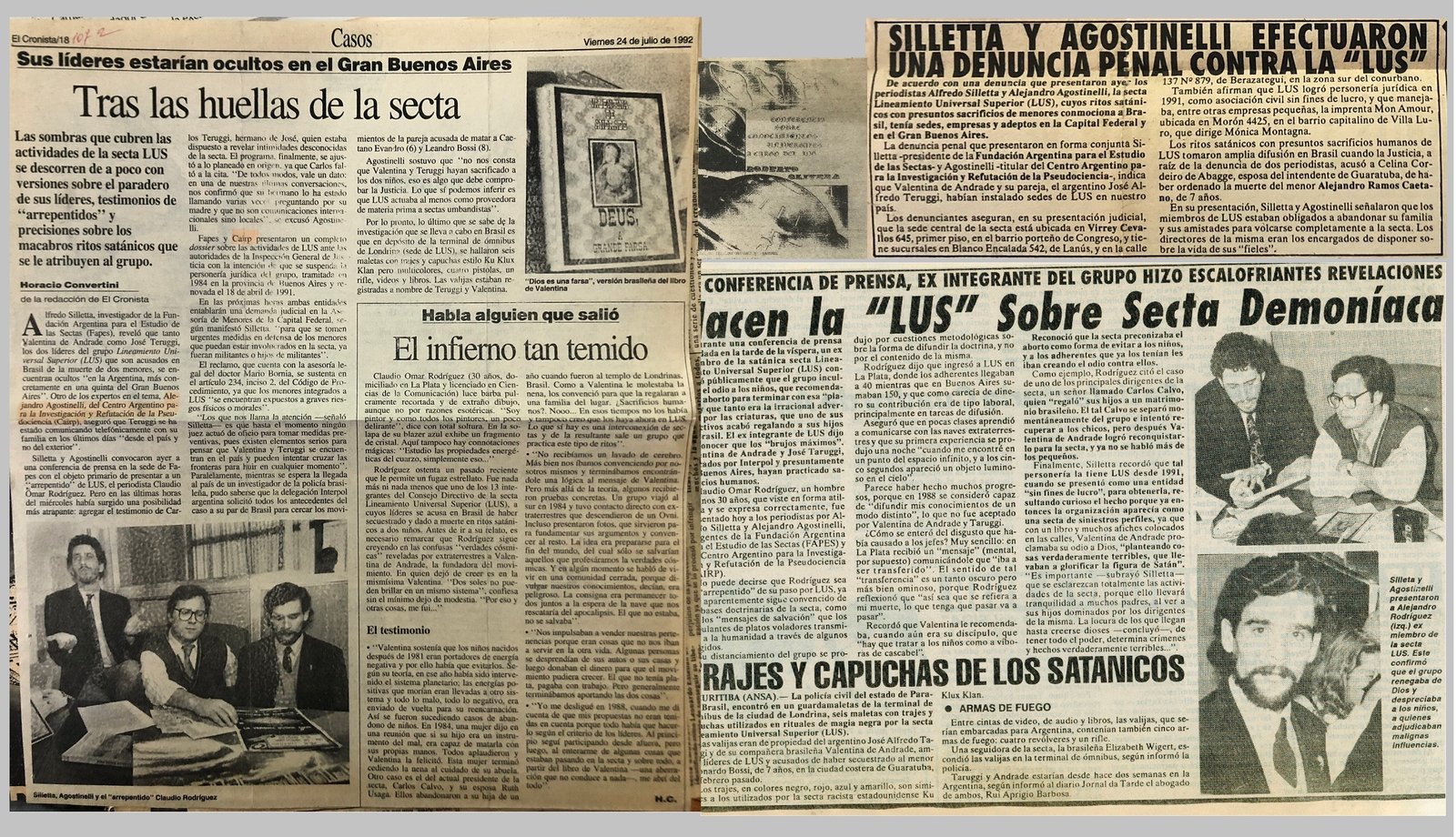
My responsibility was limited because I made clear that I knew nothing about the case, but the Brazilian leader had written in her book “The Truth About God” (La verdad sobre Dios, 1989) that “children born after 1981 have a harmful energy.” Guilt by association was thereby established.
The video in which Valentina’s husband, José Teruggi, supposedly said while in a trance, “Kill the little child I asked for” (“”) caused an uproar. The correspondent for an Argentine newspaper validated this translation, and the story exploded in our country. Months later, official expert examinations demonstrated that the phrase was “But there are little children who are experienced” (“Mas tem criancinhas que são experientes.”).
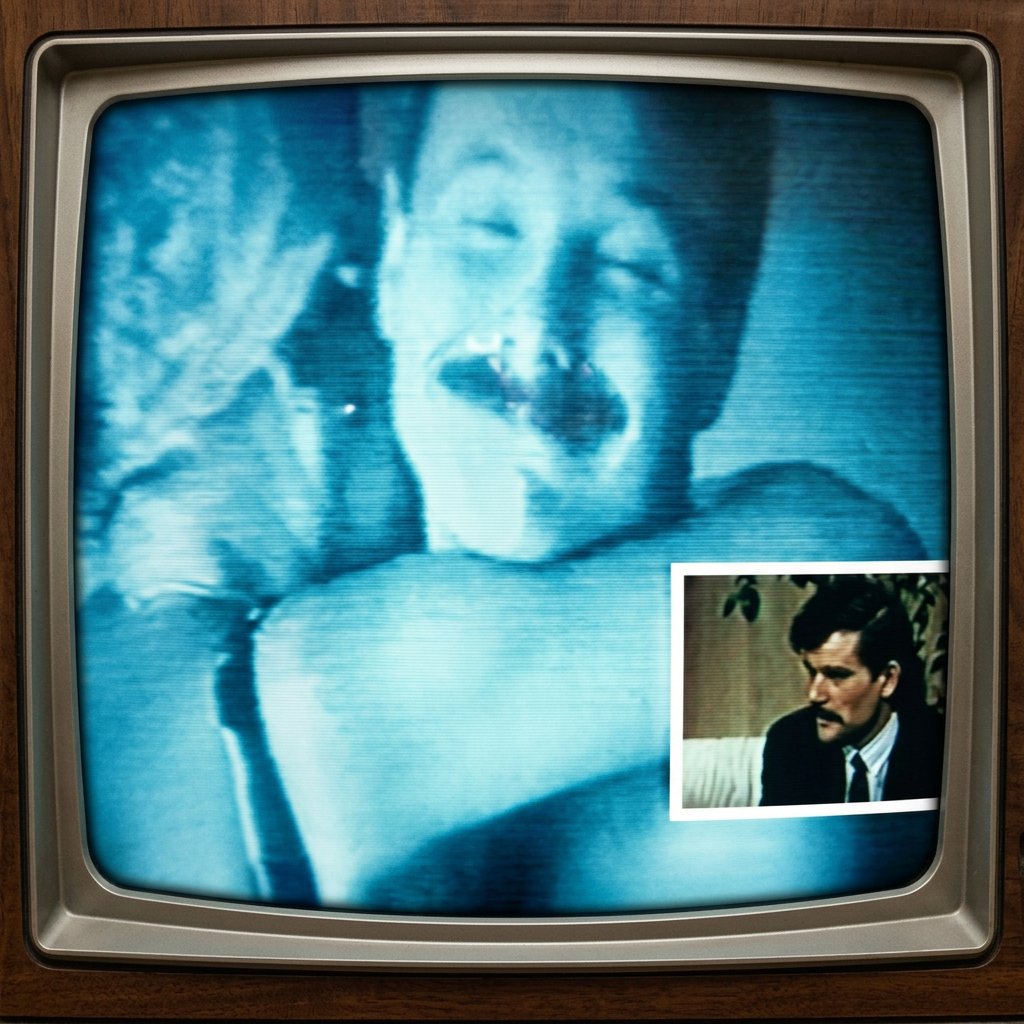
A linguistic fantasy co-created by a journalist fed the spectacle. In September 1992, Valentina and Teruggi were acquitted. But the persecution of her and her group persisted. Between 1993 and 2003, she went through a lengthy judicial process. Because of her controversial history and her visits to Altamira, Brazil, De Andrade was accused of the kidnapping, mutilation, and murder of children between the late 1980s and early 1990s. She was acquitted in late 2003, when police arrested serial killer Francisco das Chagas Rodrigues de Brito, who confessed to committing the crimes.
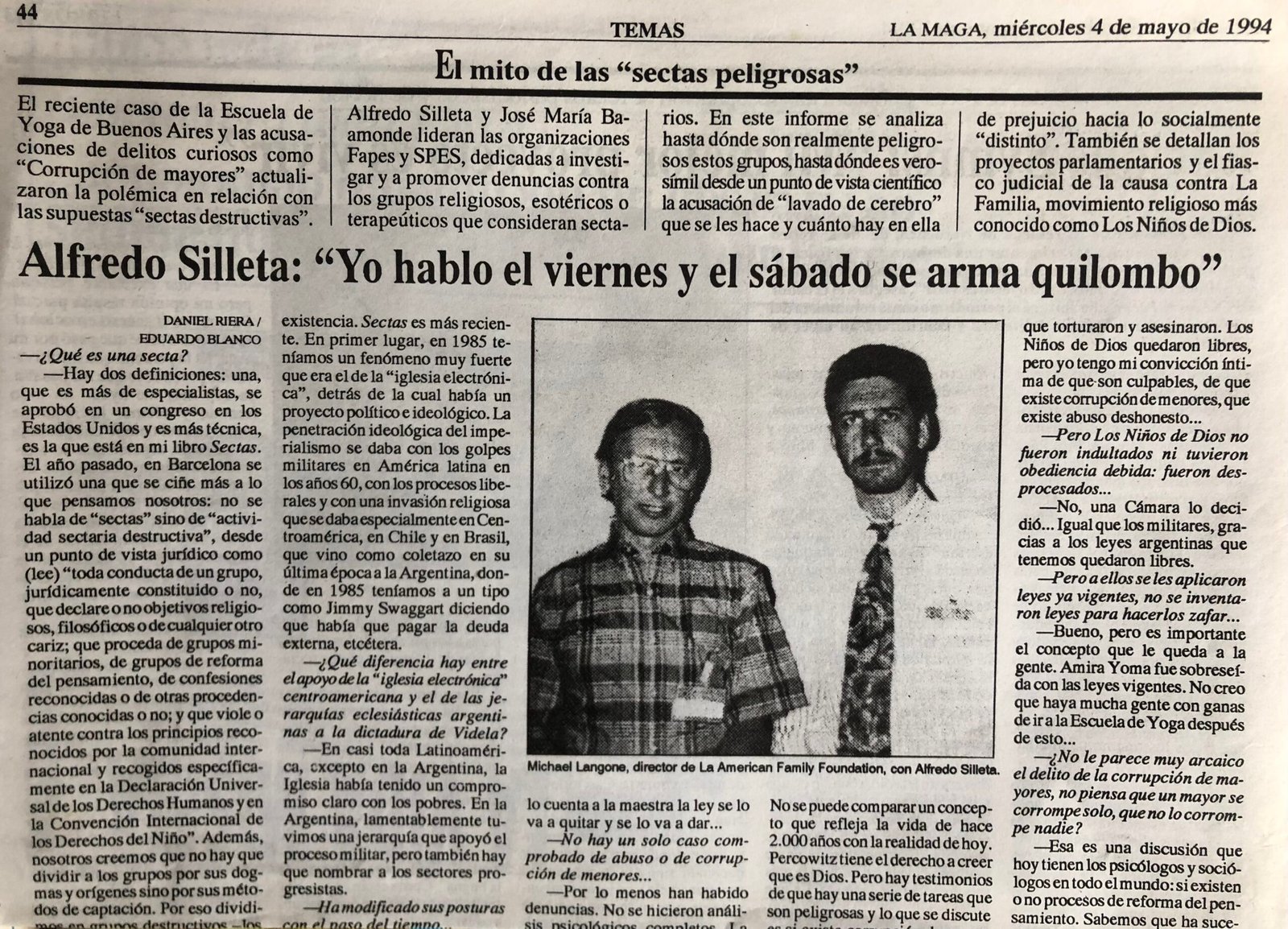
Confessions of a repentant anti-cultist
Today I would be even more ashamed of my hasty activism were it not for the fact that three years later I wrote the article “The Fiasco of the Accusations Against Valentina” (“La Maga,” May 4, 1994). Not every journalist has the good fortune to become friends with a patient academic such as Dr. Alejandro Frigerio, who provided me with the readings that put me back on course.
In that article, I acknowledged that my earlier conclusions had served an anti-cult interpretive framework: “Far from being an objective description of the internal life of the groups, [that article was] an excellent X-ray of my prejudices, my fears, and my personal opinions.” I also wrote that brainwashing theory lacked scientific support— a “cliché that allows people to wash their hands of responsibility”—a convenient label that allows former members to evade responsibility for their own actions or families to justify ruptures and departures from home. The systematic use of such labels, I added, “serves only to stigmatize and, through media and judicial persecution, to provoke the very isolation that one seeks to prevent.” Starting from such biases, “the outcome was predetermined before the process even began”: speaking of “cults” “has more to do with ideology than with sociology,” because these groups “are more religious than dangerous.” Under that logic, social scientists, former members without grudges, and journalists seeking neutrality become “accomplices,” “cover-up agents,” or outright victims of “coercive persuasion.”
To write my “Página/12” article, I could hardly have consulted more biased sources: I relied on testimony from former adherents or disillusioned former members. I visited the group carrying a burden of prejudice that blinded me to the obvious. That was where my “investigation” began (and ended), without taking into account that the accounts of militant apostates must be handled with extreme care, since they tend to follow the pattern of “atrocity tales.” Such accounts can exaggerate or fictionalize experiences, redefining the former group as intrinsically “evil” and mobilizing public resources against it. Often, the former member resorts to rhetoric that is more creative than neutral to absolve himself of his own responsibility and justify past decisions, embracing a deterministic mystique—the role of victim of “brainwashing” or “coercive persuasion”—that downplays his previous participation and relegates him to a passive, almost zombie-like condition.
This also has to do with the readjustment of those who decide to leave a marginalized group: because society offers few avenues for reintegration, the person seeks to assimilate into mainstream morality by adopting the legitimized role of the “apostate,” which at times requires a melodramatic renunciation of one’s past to gain attention from those close to them, if not for psychological relief and social recognition.
In “The Making of a Moonie” (1984), Eileen Barker, Professor of Sociology and Professor Emerita at the London School of Economics (LSE), demonstrated that dissidents who exaggerate their accounts or deploy a menu of false accusations constitute a minority that does not represent the experiences of most former members, whose experiences are rarely given attention. Yet this does not prevent apostasy from often becoming a career, one the sensationalist press readily exploits. Eventually, the individual stages his repentance and denounces the “perversity” of the group, transforming his status as a former member into a specialty or profession—“consultant,” “expert witness,” or even “anti-cult influencer”—as a means of economic subsistence and social validation.

Sociologists Thomas Robbins and Alejandro Frigerio have explained how the media and anti-cult activism jointly manufacture public scandals. Robbins calls this bias “epistemological Manichaeism”: former members who make accusations are believed unquestioningly, while believers who remain in the group are dismissed or infantilized because “brainwashing”—it is claimed—has deprived them of decision-making capacity. Thus, anti-cult groups end up speaking on behalf of supposed victims without allowing them to speak for themselves, while validating the voice of the hostile former member without further scrutiny. To keep the flame alive, this activism resorts to what Joel Best calls “domain expansion”: it needs ever more former members willing to tell terrible stories and stretches the label of “dangerous cult” to include common practices such as yoga, biodanza, or ufology. This constant expansion of the threat lets it justify its existence, gain prestige, and push for harsher laws, such as criminalizing the mere “capture of consciousness.”
My own 1991 article already contained the trap in miniature. It took for granted the idea that these groups “dissolve personality,” “eliminate every trace of reflective thought,” and “reform” the belief system of their adherents; if one of them declared that they joined of their own free will, that very happiness was interpreted as proof that the brainwashing had worked. The punitive labels still applied today to a heterogeneous set of groups are enough to confirm that journalistic and judicial treatment of the issue has not improved much since then.
Barker warned that, to determine whether abuses or manipulation occur within a group, the group must be defined independently of any prejudice: placing a diverse collection of groups into the same category precludes both neutrality and any genuine empirical finding. The guilt-by-association fallacy works the same way: if groups as different as peaceful mystery enthusiasts and controversial organizations are labeled under the same category—“flying-saucer cults”—the generalization casts suspicion on every leader, doctrine, and adherent of a non-traditional movement and strips them of their particular identity.
Under that same logic, my 1991 article preceded the description of every group or figure in the Argentine contactee movement with a “negative summary of facts.” On the basis of that “thematization,” I combined fascination with extraterrestrial life, certain commercial dynamics, and police cases without judicial resolution: together, though none did so separately, they cast the shadow of an urgent social threat that justified public condemnation, state intervention, legislative reforms, and raid operations.

The moral panic that came in from the cold
The case keeping Konstantin Rudnev detained in Argentina repeats this pattern with almost millimeter-perfect precision. Prosecutor Fernando Arrigo—questioned for his careless handling of evidence and his “obsessive hostility” in other high-profile cases—pursued the accusation with a fervor that would have been admirable in a case grounded in evidence. Much of Rudnev’s public profile was built on Russian state propaganda from “RIA Novosti” (2013), which described him as the “alien from Sirius” and claimed he had 30,000 followers. A caricatured biography was used to justify his eleven-year sentence in Russia. That portrait created the climate of suspicion he arrived in Bariloche to, although he was never convicted of any crime in Argentina.
The case, initiated in 2025, accuses him of aggravated human trafficking, reduction to servitude, unlawful deprivation of liberty, ideological falsification, and transportation of narcotics; the last charge collapsed when chemical tests revealed that the allegedly seized substances were sleeping pills and ordinary cooking mushrooms. The allegation of “ritual pornography,” for its part, relates to a raid on a rented house in Žabljak, Montenegro, in October 2024, with no connection whatsoever to Rudnev, and no one was prosecuted. Nevertheless, the Argentine media recycled that narrative from the Balkan sensationalist press, which insisted on linking Rudnev to the raid.

Inventing a victim
The case file centers on one name: Elena Makarova, the sole “victim.” In her statement before a Gesell Chamber, she was unequivocal: she stated that she did not know Rudnev, moved freely around Bariloche, and had suffered neither coercion nor exploitation. After returning to Russia, she filed a criminal complaint against the prosecutors for forcing her into the status of victim.
As Argentine anthropologist María Vardé explains, this mechanism functions as a device of “guilt by association” that strips people of agency: if an independent adult woman denies having been exploited, PROTEX psychologists treat that denial as “proof” that brainwashing worked. It is the same logic as that of parlor sorcerers: if the spell “works,” the client comes back; if it does not work, the client still has to come back. The spell is too powerful. Magic—and prosecutors—never lose.
In April 2026, CESNUR published a study dismantling the case’s central pillars. In May of the same year, Rudnev’s defense sought Prosecutor Arrigo’s recusal for an “absolute lack of objectivity.” Two international NGOs with special consultative status with ECOSOC, CADD (Citoyens en action pour la démocratie et le développement) and CAP-LC (Coordination des associations et des particuliers pour la liberté de conscience), reported to the United Nations Human Rights Council in Geneva on the prosecutor’s persecution, his “special obsession” with the accused, and the case’s procedural irregularities. Since then, the case has become a “crime control theater,” in the words of Canadian sociologist and Concordia University professor Susan Palmer in Montreal.
Despite his fragile health after surgery for an inguinal hernia, the Court of Criminal Cassation lifted Rudnev’s house arrest in June 2026, sending a seriously ill man back to Rawson prison on the basis of Internet rumors and Russian propaganda. Konstantin Rudnev remains in preventive detention, without a conviction.

Alejandro Agostinelli is an Argentine journalist and editor of FactorElBlog.com. He has published “Invasores. Historias reales de extraterrestres en Argentina” (Sudamericana, Random House, 2009) and “Argentina X. Un cronista a la caza de fantasmas, alienígenas y demonios” (Fondo de Cultura Económica, 2025).