In addition to ready-made stories for sale, the media can also produce scripts for more aggressive forms of state control.
by María Vardé
Article 2 of 4. Read article 1.
The first article in this series examined how media narratives can transform accusations against leaders or prominent members into a totalizing image of the group as a whole. This second article follows that process into the realm of state action, where the same mechanism may influence not only public opinion but also the legal and political treatment of religious minorities.
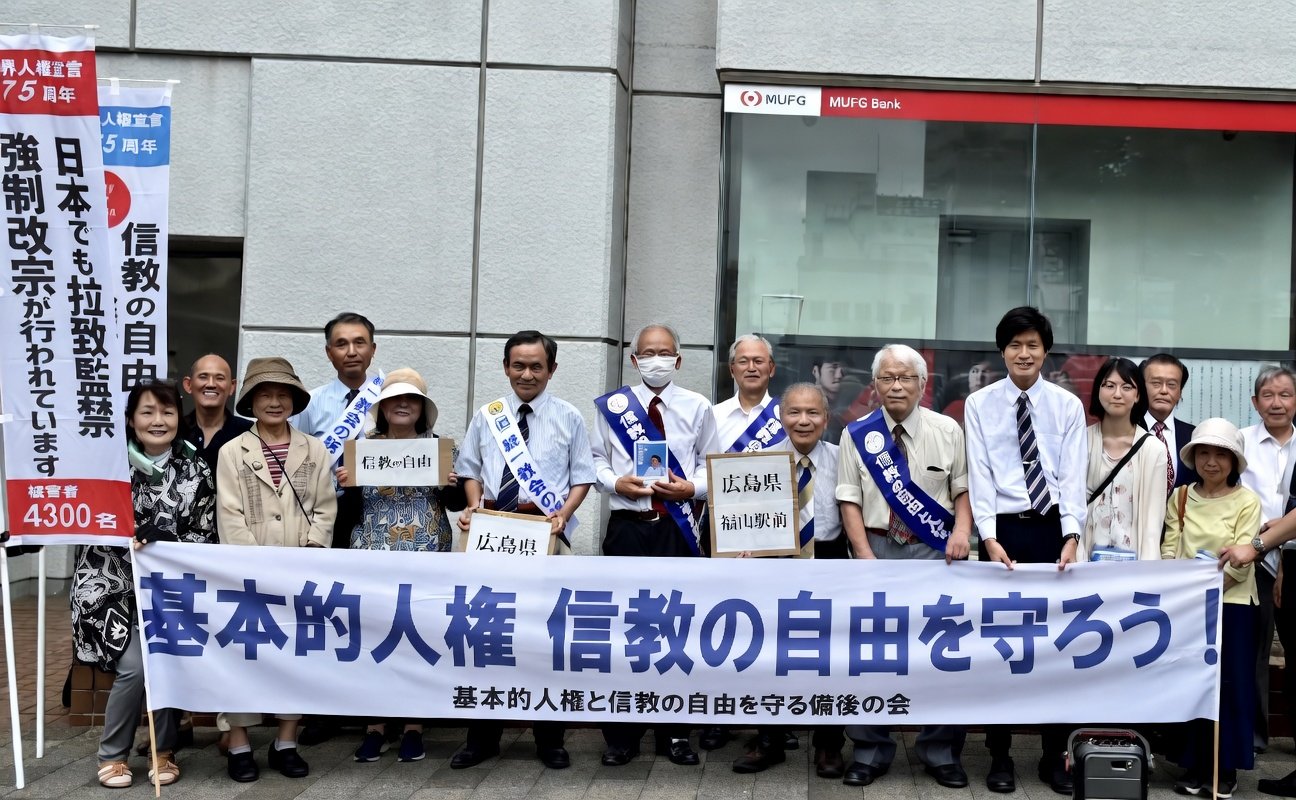
A particularly clear example can be found in Japan, after the assassination of former Prime Minister Shinzo Abe in July 2022. The perpetrator, Tetsuya Yamagami, stated that he hated the Unification Church (now called the Family Federation for World Peace and Unification) because his mother had made excessive donations to it many years earlier, and that he targeted Abe because of the former prime minister’s public proximity to organizations connected with the movement. In the months that followed, however, media outlets and anti-cult discourses reshaped the public meaning of the crime. Yamagami was increasingly presented as a victim of the Church, while the Church itself became the true moral agent responsible for the assassination.
That reversal was not merely rhetorical. It created the political and emotional climate in which the Japanese government changed its interpretation of the law governing religious corporations. As attorney Patricia Duval has analyzed, the law had traditionally been understood as allowing dissolution only in cases involving proven criminal offenses. After Abe’s assassination and the intense public campaign that followed, however, past civil litigation concerning donations came to be treated as sufficient grounds to request the dissolution of the Unification Church. The Tokyo District Court and, later, the Tokyo High Court accepted this new interpretation.
Under that frame, Abe’s assassination, earlier civil disputes, and anti-cult interpretations of the Church’s beliefs merged into a problematic public and legal narrative. That narrative did not simply identify wrongful conduct committed by specific individuals. It reconstructed the Church as an organization whose proselytizing, donation practices, and doctrinal formation were allegedly based on “brainwashing” or “mind control.” From that perspective, religious education aimed at salvation within the Church was read not as part of the believers’ spiritual life, but as a mechanism designed to extract money. The expressed will of members who had donated was disregarded on the assumption that they had not acted freely, and even the absence of new complaints was explained by claiming that the faithful remained too influenced to recognize their own harm.
This reasoning transformed the Church into a structurally fraudulent and socially harmful entity. Although an appeal to the Supreme Court remains pending, the immediate consequences were severe. Places of worship were closed, assets and bank accounts were transferred to a liquidator, and the religious life of ordinary believers was directly affected by a process that treated the organization itself as extinguishable.
Mother Hak Ja Han Moon, leader of the Unification Church, was incarcerated in connection with allegations that one of her associates had given bribes to politicians and to the former president’s wife. She maintains that this happened without her knowledge or consent. The controversy then moved toward a broader political initiative. In early 2026, a bill publicly known as the “Church Dissolution Act” was introduced in the National Assembly. The proposal would allow the state to inspect religious organizations compulsorily, interrogate their leaders, revoke their legal status, dissolve them, and absorb their assets.

Although the text of the bill was framed in general terms, the political discourse around it made clear which groups were being targeted. The Unification Church and Shincheonji appeared as the immediate examples of movements requiring extraordinary supervision. The measure was presented as a response to alleged political interference by religious groups, but its language was broad enough to potentially affect any religion regarded as politically problematic. In this context, anti-cult discourse converges with a rhetoric of state protection against religious influence, producing a legal vocabulary in which some movements are treated less as communities of believers than as risks to be managed.
The Korean case is important because it extends a process already visible in Japan. Whereas the Japanese dissolution followed a specific public crisis triggered by Abe’s assassination and by a long-standing campaign against the Unification Church, the Korean bill appears as a general instrument of state power over religious organizations. Its objective is not to respond to a particular controversy, but to create a mechanism through which the state may supervise, suspend, or eliminate religious bodies whose activities are interpreted as socially or politically dangerous.
A different but related problem can be observed in Argentina, where anti-trafficking law has intersected with anti-cult repertoires in cases involving religious or spiritual minorities. In these cases, notions such as psychological manipulation, coercive organization, spiritual dependence, and sexual or labor exploitation may be combined in ways that make religious belonging itself part of the suspicious structure. The legal category is human trafficking, but the narrative through which the case is publicly and institutionally organized may come from the older anti-cult imagination of the manipulative leader, the captive follower, and the hidden network.
The case of Konstantin Rudnev illustrates this dynamic with particular clarity. The earlier media construction of Ashram Shambhala became crucial when Rudnev was arrested in Argentina in 2025 and formally charged in a human trafficking case. The Argentine case did not arise from the initial discovery of an organized criminal network, but from suspicions activated in a hospital and migration context and then rapidly reframed as a case involving a “Russian cult,” despite the alleged victim’s denial that she was a victim. At the formalization of charges hearing, prosecutors began by reading Montenegrin headlines, themselves largely copied from Russian sources, and then suggested that Rudnev was organizing a network in Argentina. In this way, the case was framed from the outset as an “international criminal organization,” before the prosecution had analyzed the evidence. According to what prosecutors admitted at the last hearing held on April in Bariloche, that analysis had still not been carried out.

Rudnev had already been represented for years in Russia as the leader of a criminal “cult,” after a trial that serious observers have described as based on false accusations and inseparable from the broader Russian pattern of fabricating or amplifying accusations against dissidents and religious minorities. Once that image traveled through Russian and Montenegrin press materials, it became available as a ready-made explanation in Argentina. Before the local evidence had been fully examined, the figure of the “Russian cult” offered a narrative structure capable of linking hospital suspicions, migration status, foreign women, spiritual background, and trafficking law into one apparently coherent–but evidentially fragile–case.
The Japanese, Korean, and Argentine situations are not identical. Yet these scenarios are connected by the same movement from public suspicion to institutional consequence. Once this passage occurs, guilt by association no longer operates only as a cultural stigma; it becomes embedded in procedures, legal categories, and administrative decisions. This is the point at which guilt by association reaches its most consequential form. The label does not merely damage reputation, although it does that as well. It creates the conditions under which belonging to a stigmatized group can acquire legal significance.
In this sense, guilt by association functions as a mechanism of social control over religious diversity. Its effectiveness lies in the fact that it rarely appears as discrimination. It is more often expressed through languages that sound legitimate and reassuring, such as protection of victims, public good, legal rationality, social order, or national security. Yet when those languages allow the alleged responsibility of individuals to be projected onto entire communities, they transform stigma into structure. What began as a media narrative can then become a legal fact, and what began as suspicion can end in the restriction, supervision, or dissolution of religious life itself.

Maria Vardé graduated in Anthropological Sciences at the University of Buenos Aires and is currently a researcher at the Instituto de Ciencias Antropológicas, Facultad de Filosofía y Letras, Universidad de Buenos Aires (Institute of Anthropological Sciences, Faculty of Philosophy and Humanities, University of Buenos Aires). She has written and lectured on archeology, spirituality, and freedom of religion or belief.