A study of how major outlets reacted when informed that their reporting relied on compromised sources, and why some continue to resist correction.
by Massimo Introvigne
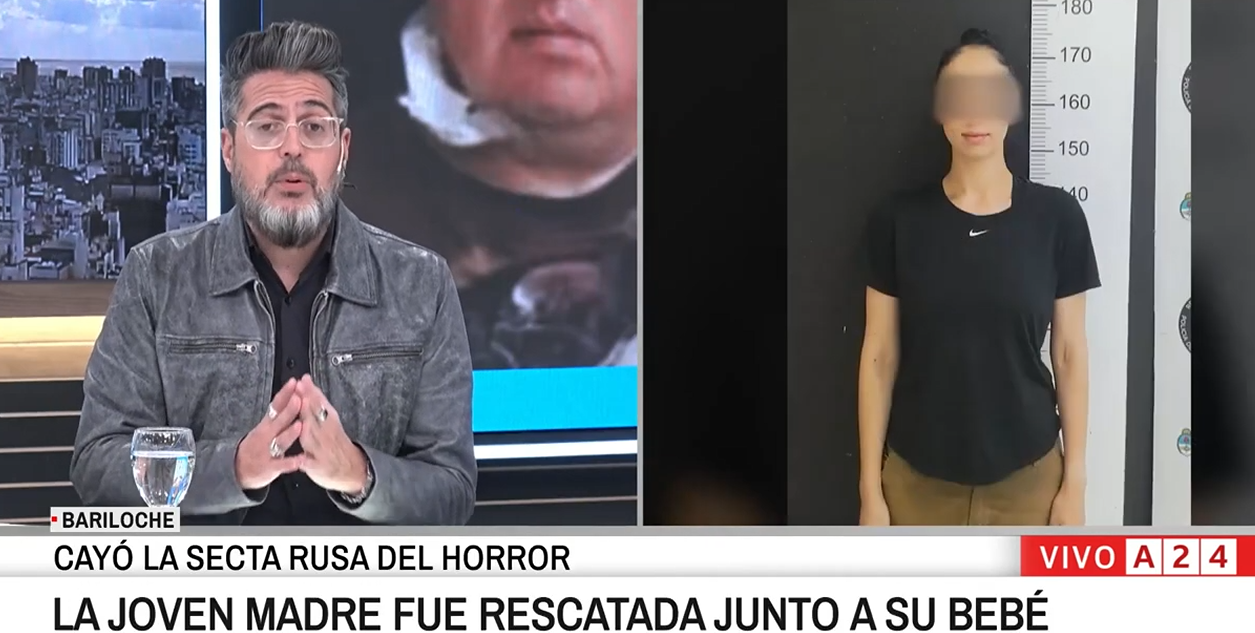
In the late 1990s, I witnessed a remarkable event in Italy that revealed how vulnerable the media are to manipulation when the subject is a group labeled as a “cult.” A mysterious organization called “Cosamo” began circulating fragments of a video that appeared to show masked individuals preparing to assault a bound girl. “Cosamo” sent the fragments anonymously to local media. They were presented as evidence of the activities of an esoteric and perhaps highly dangerous “cult.” The story grew until a major national television network announced it was ready to broadcast the full video. “Cosamo” replied that it could not provide the tape but could arrange a live feed. The network accepted. During the broadcast, the scene unfolded exactly as promised. The masked figures surrounded the girl. The tension rose. Before the network could interrupt the transmission, the girl stood up, removed her gag, and began dancing with the masked performers, singing a song that mocked the media’s gullibility.
“Cosamo” did not exist. The entire operation was a hoax by a group of artists and activists known as “Luther Blissett” (the name came from a notoriously inept soccer player of the 1980s). They aimed to expose how easily the media could be manipulated when the subject was a “cult.” The hoax became headline news. Italian journalists declared they had learned their lesson. They promised to be more cautious. They quickly forgot the lesson.
The academic study of new religious movements has long recognized the problem. In 2018, American scholar W. Michael Ashcraft published a comprehensive history of the field. He described how mainstream scholars reached a consensus that “cult” is not a scientific category, but a label used to stigmatize unpopular minorities; that “brainwashing” is a pseudoscientific theory employed to justify repression; and that apostate exmembers, a small minority of former adherents who become militant opponents of the groups they left, should not be treated as reliable sources. He observed that a tiny minority of scholars rejected these conclusions and created a separate field called “cultic studies,” which supports anti-cult movements and apostate narratives. Ashcraft emphasized that “cultic studies” is not recognized as mainstream scholarship. It survives as a project of a small cadre of committed activists, not endorsed by the larger academic community.
Yet Ashcraft also pointed out a paradox. While the media ignore mainstream scholars, “cultic studies” activists and apostates are quoted constantly and treated as “experts.” Their narratives dominate public discourse. Journalists rarely consult those who remain in the movements or those who study them professionally. They prefer sensational stories, accounts that confirm their expectations, and narratives that sell.
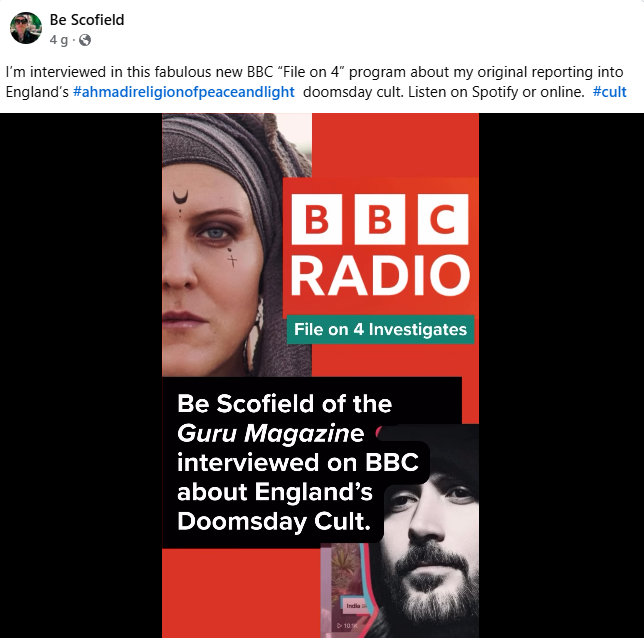
This dynamic is not limited to marginal outlets. A very recent example is a September 22 BBC podcast on AROPL, the Ahmadi Religion of Peace and Light, a new religious movement based in Crewe, England. An academic who has devoted years to studying the movement, Holly Folk, is given less than half a minute. Meanwhile, the podcast interviews at length an anti-cult activist, Be Scofield, who admits in her autobiographical book that some of the information guiding her to fight the “cults” comes from extraterrestrials and the spirits of the deceased. In her latest book, she exposes the ultimate “cult” leader, presented as a master of “brainwashing” and human trafficking: Jesus Christ. The problem is not Be Scofield. Individuals with a psychiatric history who create conspiracy theories based on visions have always existed. The problem is that the BBC offers Be Scofield a tribune.
The problem is structural. The Organization for Security and Cooperation in Europe’s 2019 Policy Guidance on freedom of religion or belief recognized it. The OSCE urged media to avoid negative stereotypes about religious and spiritual minorities, to convey accurate information, and to counter prejudices. It asked journalists to contribute to a tolerant discourse. The guidance was ignored. Media bias against groups labeled as “cults” became even worse.
This background is essential to understanding how the media reacted when they learned that their reporting on the Konstantin Rudnev case relied on questionable sources. The Rudnev case is complex. It involves a Russian criminal trial that international observers widely regard as compromised; apostate testimonies that changed over time; sensational claims repeated by Russian media without verification; the anti-cult ideology that has been used to persecute minority religions in Russia; an Argentinian prosecutor called Fernando Arrigo obsessed by a personal vendetta against Rudnev; and a political context in which spiritual dissent is treated as a threat.
When Rudnev’s representatives and, independently, scholars who had produced voluminous studies of Rudnev contacted international media to request corrections, the responses varied. Some outlets reacted responsibly. Others did not respond at all. The differences reveal much about the state of contemporary journalism.
Two media outlets, “The Sun” and “NDTV,” removed their negative articles entirely. They examined the evidence, recognized that the allegations against Rudnev were unreliable, and acted swiftly. Their decision demonstrates that responsible journalism is possible. It shows that some media take their ethical obligations seriously and are willing to correct mistakes when confronted with credible information.
CNN reacted differently. It edited its article but did not remove all the challenged allegations. It acknowledged that some elements of its report were problematic. It made partial corrections. They are considering publishing a new article that reflects the facts more accurately. CNN’s response is imperfect, yet it shows a willingness to engage. The outlet recognizes the need for accuracy and is prepared to reconsider its narrative.
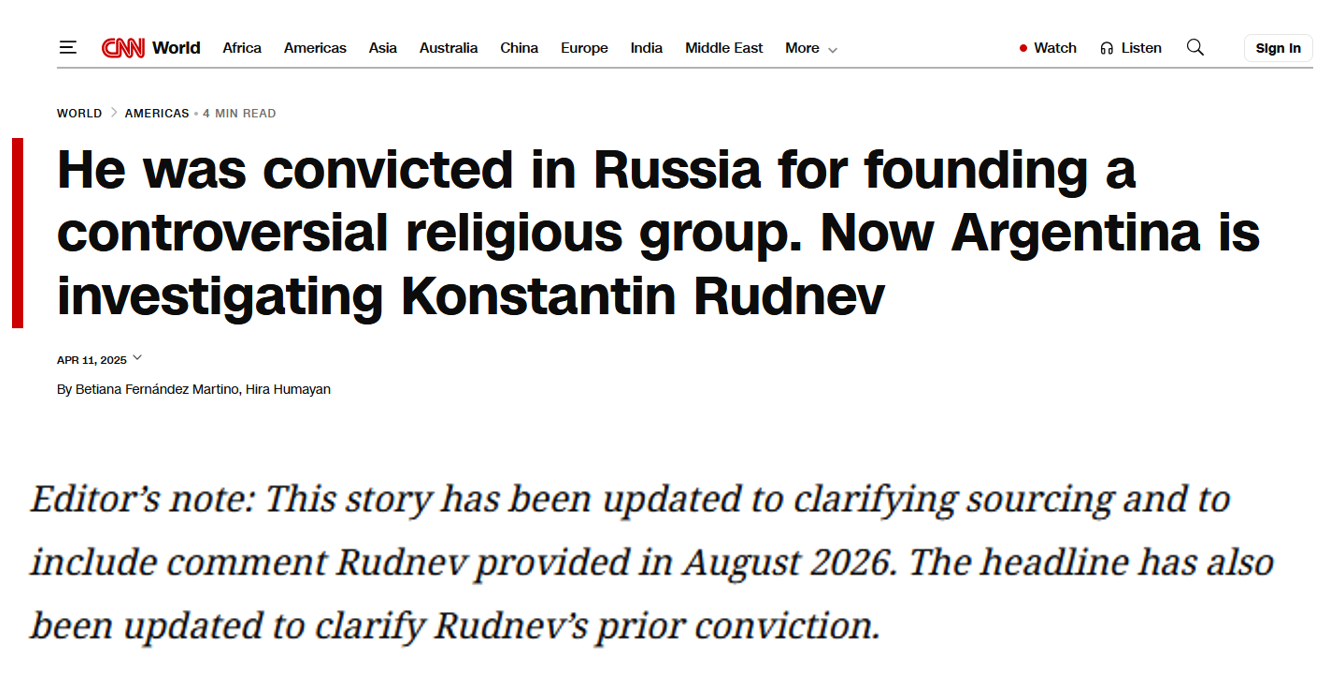
Other outlets did not respond at all or responded evasively. “El País,” “The Moscow Times,” “The Insider,” and “Clarín” continued to publish allegations that have been authoritatively challenged. They did not acknowledge the requests for correction or examine the evidence. Their silence raises serious concerns. It suggests they are not committed to accuracy or willing to reconsider narratives that attract readers, and that they prioritize sensationalism over truth.
The contrast between these reactions is striking. It reveals the fragility of journalistic standards when the subject is a group labeled a “cult,” how easily anti-cult activists can influence media, and how difficult it is to correct false narratives once they are published.
Why does this happen? The first explanation is simple. In 2023, “The New York Times” wrote of the “apparently bottomless appetite” of audiences for exposes of “cults.” Audience metrics drive commercial media. Audience means advertising. Advertising means revenue. Stories about “cults” featuring abuse, sex, power, and money sell. Stories about spiritual movements that are not presented as “cults” do not. Sensationalism is rewarded. Accuracy is not.
Yet this explanation is not sufficient. Media do not invent these stories on their own. They are fed by an organized anticult movement that is not respected in academia but is highly respected by journalists. Anticult activists provide endless material. They offer dramatic narratives and apostate testimonies. They cultivate relationships with reporters and shape public discourse. Even the bizarre Be Scofield can pass for an “expert.” The media either ignore who she is or do not care, as long as she can supply juicy stories.
This raises additional questions. Why do anti-cult activists spend so much time cultivating the media? Who supports, finances, and promotes these activists to help them reach an audience?
Anti-cultists are not all driven by the same motivations. Some oppose religion in general. Some oppose specific religious movements. Political agendas influence some. Some are connected to governments that seek to suppress dissent. The recent report by Anthropic on the misuse of artificial intelligence noted that China uses AI to produce massive slander campaigns against groups it labels as “evil cults” (and, while they are at it, against journalists who write for “Bitter Winter”). These campaigns are designed to destroy reputations, justify repression, and influence international media.
Pharmaceutical companies have their own interests. They oppose groups that criticize certain drugs. Scientology’s opposition to psychiatric medication has made it a target of powerful corporate actors.
Secular humanists oppose religion as a matter of principle. They also have learned how to be heard by journalists, a community where the anti-religious bias is more prevalent than in other professions.
In the case of Rudnev, the Russian regime has an interest in destroying him as a political and religious dissident. The campaign’s extremity suggests fear and that the Russian authorities remain concerned about the influence of his teachings, even though he has not had organized groups in Russia or elsewhere since he was incarcerated in 2010. The regime mobilizes its allies in the international anti-cult community. These allies, in turn, mobilize their friends in the media and in some prosecutors’ offices, as it happens in Argentina. The result is a chain of reinforcing narratives and a campaign that persists even when evidence emerges that the allegations are false.
Anthropic’s warning that China shares its skills in using AI for slander campaigns with Russia suggests that even darker tactics may be at work. Unseen operations may influence the media. Narratives may be shaped by forces that do not reveal themselves.
The media’s different reactions to requests to correct their Rudnev stories illustrate the consequences. It shows how easily media can be drawn into campaigns that serve political interests, and how difficult it is to correct false narratives once published. It also shows how responsible outlets can act ethically when confronted with the truth, while others refuse to engage.
When media are asked to correct errors, their reactions reveal their values. Those who remove false articles demonstrate integrity. Those who engage in dialogue demonstrate responsibility. Those who remain silent demonstrate indifference.
The Rudnev case is not unique. It is part of a larger pattern: a media system that rewards dramatic stories, a cultural environment that stigmatizes minority spiritual movements, a political context that treats dissent as a threat, and governments that use sophisticated technological tools to repress opposition and manipulate the media.
Correcting these narratives is difficult. It requires persistence, evidence, and engagement with responsible media.
The story of “Cosamo” and “Luther Blissett” remains relevant. It shows that media can be deceived and manipulated. They can be taught a lesson. They can forget the lesson, too.
The Rudnev case offers an opportunity to revisit that lesson, examine how media respond when confronted with the truth, defend the integrity of inquiry, protect minority spiritual movements from prejudice, and restore the honor and freedom of an innocent man.
It is an opportunity that should not be wasted.

Massimo Introvigne (born June 14, 1955 in Rome) is an Italian sociologist of religions. He is the founder and managing director of the Center for Studies on New Religions (CESNUR), an international network of scholars who study new religious movements. Introvigne is the author of some 70 books and more than 100 articles in the field of sociology of religion. He was the main author of the Enciclopedia delle religioni in Italia (Encyclopedia of Religions in Italy). He is a member of the editorial board for the Interdisciplinary Journal of Research on Religion and of the executive board of University of Pennsylvania Press’ Nova Religio. From January 5 to December 31, 2011, he has served as the “Representative on combating racism, xenophobia and discrimination, with a special focus on discrimination against Christians and members of other religions” of the Organization for Security and Co-operation in Europe (OSCE). From 2012 to 2015 he served as chairperson of the Observatory of Religious Liberty, instituted by the Italian Ministry of Foreign Affairs in order to monitor problems of religious liberty on a worldwide scale.