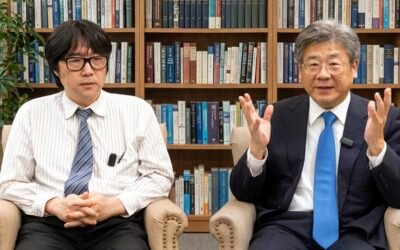
A bestselling author explains why her investigation reveals a profound crisis for religious liberty and constitutional guarantees in contemporary Japan.
by Masumi Fukuda*
*Address delivered at a press conference on the theme “Japan: The Hidden Story Behind the Eradication of a Religion,” organized by Human Rights Without Frontiers at the Brussels Press Club in Brussels, Belgium, June 29, 2026.
Article 1 of 3

I am a freelance journalist from Japan. Last November, I published a non-fiction book entitled “Sacrifice to the Nation.” It is based on a series of articles that I wrote intermittently for a monthly magazine beginning in late 2022, with substantial additions and revisions.
Including this latest work, I have published seven books. One of them, the non-fiction book “Fabrication,” became a bestseller, selling more than 230,000 copies. It received several major literary awards and was adapted into a feature film last year. This year, it was released on Netflix, where it ranked number one in the Japanese film category for two consecutive weeks. Two years ago, I was honored to receive the Wilbur Award in the United States, which recognizes outstanding works dealing with religion.
Readers of my latest book, “Sacrifice to the Nation,” have expressed deep astonishment. Their comments include: “Outrageous acts of injustice have been committed where the public could not see them”; “This is the truth that the media refuses to report”; “A must-read”; and “Every page is filled with truth.” I believe that much of what I have written in this substantial volume is information that the average citizen has never encountered before. Yet every fact presented in the book is supported by evidence. On the inside cover appear the words: “Do not turn a blind eye to the truth.”
Today, I would like to share with you the central message of this book. Most of you probably regard Japan as a highly developed democracy, where liberal values are firmly established and fundamental human rights, including freedom of religion, are fully protected. However, today’s Japan no longer fully reflects that image. Freedom of religion is being undermined, the principles of constitutional government and the rule of law are being weakened, and democracy itself is facing a serious challenge.
You may well ask, “What on earth is happening in Japan?” There is a religious organization of Korean origin known as the Family Federation for World Peace and Unification. Until 2015, it was officially known as the Holy Spirit Association for the Unification of World Christianity, commonly referred to as the Unification Church. Since that name is more familiar to many of you, I will use “Unification Church” throughout my remarks. I should also emphasize that I am not a member of the Unification Church. I am simply an independent journalist and an ordinary citizen.
As I mentioned earlier, liquidation proceedings have already begun against this religious corporation. Its headquarters and churches throughout Japan have been placed under the control of the court-appointed liquidator and sealed off, preventing members from entering their places of worship. In practical terms, believers can no longer gather in their own churches and have been deprived of the places where they conduct worship and religious ceremonies. Furthermore, many of the organization’s nearly 2,000 employees across Japan have already lost their jobs. You can imagine how difficult it will be for many of them to find new employment.
Since the assassination of former Prime Minister Shinzo Abe, ordinary members of the Unification Church have also been subjected to various forms of discrimination and persecution. Some members have taken their own lives. Others have been dismissed from their jobs after their affiliation with the church became known. Some students have been deeply distressed after hearing teachers tell their classmates that the Unification Church is an evil religion. Volunteer groups affiliated with church members have had all of their cooperation projects with local governments canceled.
The organization has received countless threatening phone calls and letters, and some of its facilities have been vandalized, with the word “cult” painted prominently on their walls. For a considerable period, the internet and social media were flooded with slanderous and defamatory attacks against the church. The situation has been especially difficult for church employees. Some have been denied the renewal of their apartment leases. Others have had their credit cards suspended or even been refused medical treatment at hospitals simply because the name of the church appears on their health insurance cards.
As I mentioned earlier, Japan is a country whose Constitution guarantees freedom of religion. So, did the Unification Church commit such a grave crime that it deserved to be dissolved? Many of you are probably familiar with the Aum Shinrikyo case in Japan during the 1990s. In 1995, members of Aum Shinrikyo carried out a sarin gas attack on the Tokyo subway system, killing 14 people in the attack itself and causing thousands of injuries, while other related crimes brought the total death toll to 29. The organization’s founder and several senior leaders were convicted of murder and executed. Given the magnitude of these crimes, Aum Shinrikyo was ordered to dissolve.

Is the Unification Church a similarly dangerous organization? Did it commit mass murder or comparable acts of violence? The answer is no. The Unification Church, as an organization, has never been convicted of a criminal offense. None of its leaders, and indeed none of its tens of thousands of members, has been convicted of murder. In fact, not even a single case of assault has been attributed to the organization.
So why has it been ordered to dissolve? Surprisingly, the principal issue concerns donations. Donations are an essential part of the life of virtually every religious organization. However, the court concluded that the Unification Church had accepted donations that exceeded what it described as the bounds of common sense and accepted social norms.
Until recently, it was commonly alleged that members had been pressured into making donations through fear, particularly through teachings relating to ancestral sins and the possibility of hell. Over the years, numerous civil lawsuits concerning donations have been brought against the Unification Church, and in most cases, the courts ruled against it.
Without going into the details of those cases today, it is worth noting that, in many instances, plaintiffs prevailed despite the absence of concrete evidence, leading, in my view, to an increasing number of unjust judgments. This may be because nearly all Japanese judges are non-religious and tend to view newer religious movements, such as the Unification Church, with suspicion, often regarding them as “cults.” Another possible explanation is that after years of media coverage portraying the Unification Church as a “cult,” a legal victory for the church would have undermined public confidence in the judiciary.
More recently, some courts have even ruled that although believers make donations voluntarily, they are unaware that they are allegedly under the church’s undue psychological influence. As a result, the donations have been deemed unlawful. This reasoning comes close to suggesting that religious faith itself is harmful. In effect, it amounts to judicial acceptance of the theory of mind control.
In addition to these unfavorable rulings, the dissolution order took an extraordinary step by treating settlement agreements that the church had reached with former members as evidence of illegal conduct. As a result, the church was ordered to dissolve. In other words, the outcome of civil disputes concerning large donations between the church and former members was used as the principal basis for dissolving an entire religious organization.
Furthermore, the court inferred, without concrete evidence, that the church would continue to create problems through large donations. It even examined the church’s doctrines, the teachings, and the conduct of its founder, concluding that, because it regarded the religion itself as fundamentally flawed, meaningful reform could not be expected.
Traditionally, Japanese courts have avoided judging religious doctrine, and it was once considered unthinkable for a court to assess the merits or shortcomings of a faith. This decision gives the impression that the court assumed the role of an inquisitor.
In short, I believe the dissolution order is fundamentally unjust. It was not the result of a fair trial based on clear evidence, and no criminal conduct by the organization was established. It is also difficult to ignore the influence of years of highly one-sided media coverage portraying the Unification Church as a cult.
The immediate catalyst for the dissolution proceedings was the assassination of former Prime Minister Shinzo Abe. Without that tragic event, I believe it is highly unlikely that the government would have sought the church’s dissolution.

Masumi Fukuda was born in Yokohama in 1956. She graduated from the Department of Sociology of Rikkyo University. After working for a specialty magazine and a magazine production company, she became a freelance journalist. She has reported and written about crime, Russia, and other topics. Her books include “Stalin: A Portrait of His Family” (Bungei Shunju), “Russia, an Assassination State: In Search of a Missing Journalist” (Shinchosha), “The True Nature of Political Correctness” (Hojosha), and others. In 2007, she won the 6th Shincho DocumentaryAward for “Fabrication: The Truth About the ‘Murder Teacher’ in Fukuoka” (Shinchosha).