Mapuche protests outside Rawson Prison target Prosecutor Fernando Arrigo, the same man who wants to keep the Russian dissident in jail.
by Massimo Introvigne
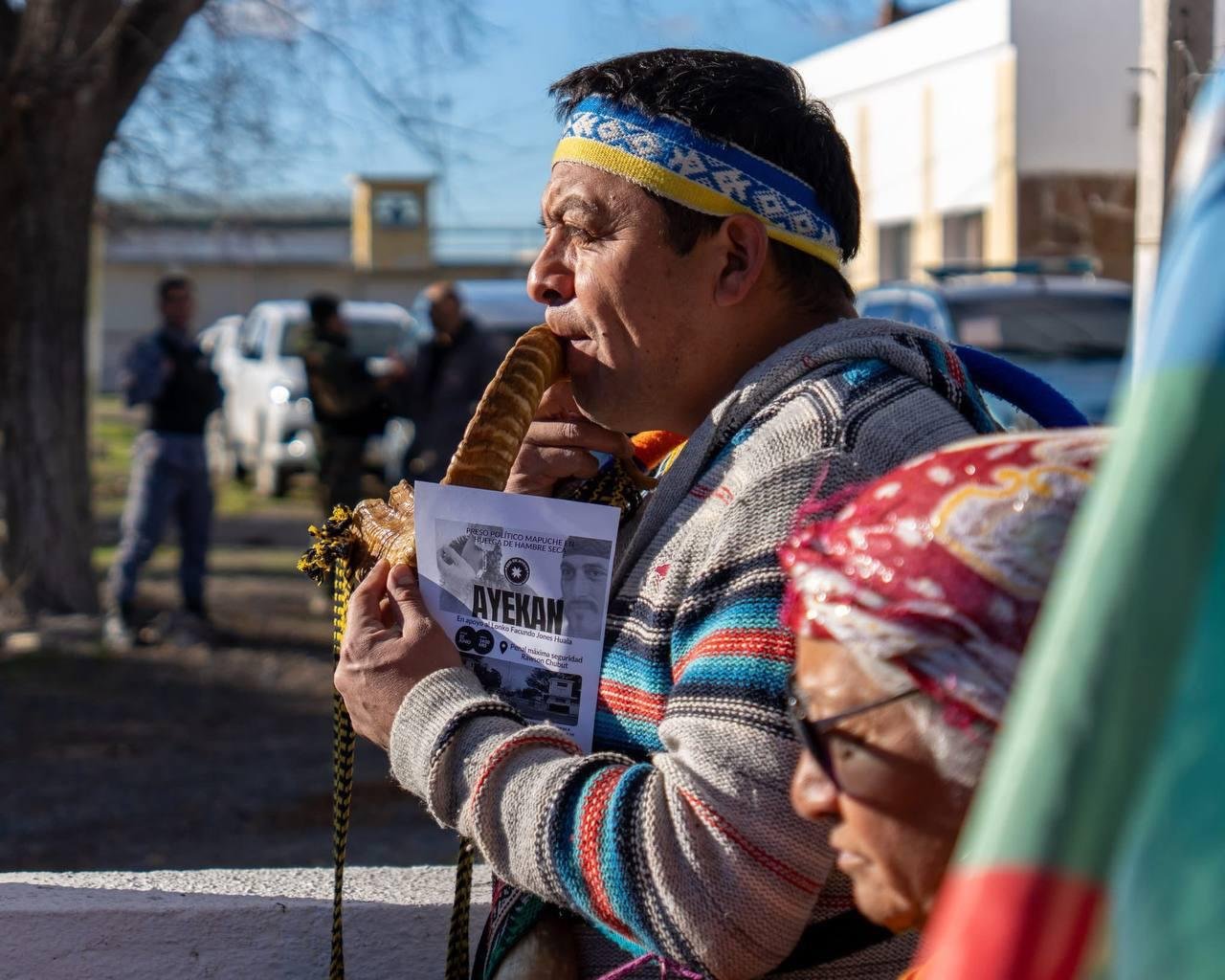
The latest developments in the case of Mapuche leader Facundo Jones Huala have once again drawn national attention to the work of Argentina’s Prosecutor Fernando Arrigo. On June 17, demonstrators gathered outside Rawson Prison, Block 6, the maximumsecurity facility where Jones Huala remains detained, to protest what they describe as a cycle of arbitrariness and abuse. Their anger intensified after the Federal Court of Appeals of General Roca confirmed the expansion of charges against him and upheld yet another ninetyday extension of his pretrial detention, ensuring he will remain behind bars at least until August 30. The same court is now expected to rule on June 23 regarding the suspension of his transfer to the Esquel highsecurity prison. This measure was appealed last week and remains frozen until the judges issue their decision.
Inside the Mapuche community, concern has reached a critical point. Relatives report that Jones Huala has resumed a dry hunger strike and has now accumulated fortynine days without food, a situation that is visibly deteriorating his physical, mental, spiritual, and emotional condition. His mother, María Isabel Huala, a respected “lawentuchefe” (traditional healer), released a public letter urging the courts to accelerate the pending hearing. She warned that the prolongation of the hunger strike could have irreversible consequences and held national officials and judicial actors responsible for the suffering her son is enduring.
Reportedly, Mapuche activists are turning to the spirits of their ancestors, seeking in that ancient lineage the protection and justice they no longer expect from the state. To them, the prospect of aid rising from the unseen world feels more real—and far more reliable—than anything promised by law‑enforcement authorities.
The same prosecutor at the center of the Jones Huala case—Fernando Arrigo—is also the figure responsible for the prolonged detention of Russian dissident and spiritual teacher Konstantin Rudnev. The two men, who share neither culture nor background, found themselves confined in the same prison under the authority of the same prosecutor. Their cases, though different in origin, reveal a strikingly similar pattern: prolonged preventive detention, repeated appeals by the prosecution to block transfers or humanitarian measures, and accusations that critics describe as inflated, unsubstantiated, or disconnected from concrete evidence.
In both cases, communities have accused Arrigo of targeting national minorities and religious groups. For the Mapuche, he is seen as the architect of a judicial strategy that criminalizes indigenous identity and resistance. For Rudnev’s supporters, he is the official who has kept a spiritual dissident imprisoned despite medical fragility, contradictory evidence, and multiple judicial decisions favoring house arrest. In both narratives, Arrigo emerges as a prosecutor who does not merely pursue cases but pursues people, and who does so with a persistence that many now describe as punitive rather than legal.
A scholar of psychology, Raffaella Di Marzio, who recently examined both cases, identified what he termed an obsessivecompulsive prosecutorial pattern, arguing that Arrigo’s behavior reflects a fixation on control, punishment, and the symbolic defeat of minority identities. Her analysis suggests that Arrigo’s approach is not simply harsh but borders on the pathological, driven by a need to reaffirm authority rather than seek justice. This psychological perspective has become an additional argument for those calling for his removal from both cases, as it raises the possibility that prosecutorial decisions may be influenced not by law but by personal compulsions.
Jones Huala and Rudnev were placed in the same prison. Both were deprived of liberty through preventive detention that has stretched far beyond what international standards consider reasonable. Both have been accused of crimes that their supporters insist are either nonexistent or grossly exaggerated. And in both cases, the same prosecutor has repeatedly intervened to prevent transfers, delay hearings, and maintain the harshest possible conditions.
For the Mapuche demonstrators outside Rawson Prison, the suffering of their leader is not an accident of the system but the result of one man’s decisions. They argue that when Arrigo was absent from the province, tensions subsided and communities lived in relative peace. It was only upon his return to office that conflict, raids, and judicial pressure intensified. Their message is that he does not correspond to the position he holds, because the province was calmer without him, and because his presence has coincided with a resurgence of repression.
Supporters of Rudnev express a similar sentiment. They describe a prosecutor who has kept an ailing man imprisoned despite medical emergencies, despite court rulings, and despite the absence of a proven victim. They argue that Arrigo’s actions have caused unnecessary suffering and have transformed the judicial process into a tool of persecution.
The demonstration for Jones Huala, held yesterday outside Rawson Prison, was therefore more than a protest about one case. It was a protest about a pattern. A protest about a prosecutor who, in the eyes of many, has turned the justice system into an instrument of fear for indigenous peoples, national minorities, and religious communities. And a protest about two men—one Mapuche, one Russian—who share nothing except the misfortune of having been placed under the authority of the same prosecutor.
The question now extends beyond the fate of Jones Huala. It reaches into the broader issue of whether prosecutors whose conduct has raised such profound concerns—legal, ethical, and psychological—should continue to wield the power to determine the liberty of vulnerable individuals. The cases of Rudnev and Jones Huala suggest that the answer may determine not only their future but the credibility of the justice system itself in Argentina.
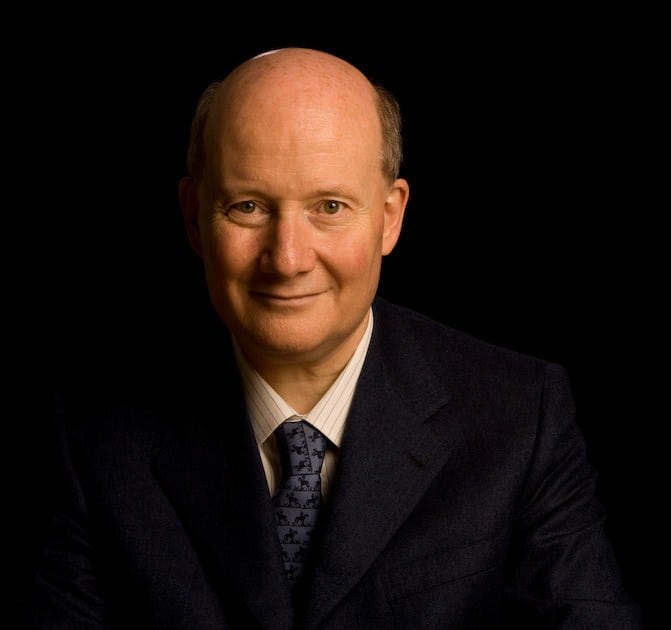
Massimo Introvigne (born June 14, 1955 in Rome) is an Italian sociologist of religions. He is the founder and managing director of the Center for Studies on New Religions (CESNUR), an international network of scholars who study new religious movements. Introvigne is the author of some 70 books and more than 100 articles in the field of sociology of religion. He was the main author of the Enciclopedia delle religioni in Italia (Encyclopedia of Religions in Italy). He is a member of the editorial board for the Interdisciplinary Journal of Research on Religion and of the executive board of University of Pennsylvania Press’ Nova Religio. From January 5 to December 31, 2011, he has served as the “Representative on combating racism, xenophobia and discrimination, with a special focus on discrimination against Christians and members of other religions” of the Organization for Security and Co-operation in Europe (OSCE). From 2012 to 2015 he served as chairperson of the Observatory of Religious Liberty, instituted by the Italian Ministry of Foreign Affairs in order to monitor problems of religious liberty on a worldwide scale.