At the core of the case was the abusive classification as a cram school of a community practicing qigong, martial arts, and self-cultivation.
by María Vardé*
*A paper presented at the Fourth World Conference for Religious Dialogue and Cooperation, Skopje, North Macedonia, June 24, 2026.

The Tai Ji Men case has often been studied as a problem of tax abuse, religious discrimination, and violation of due process. These approaches are indispensable, but they do not exhaust the conflict’s anthropological dimension. My starting point is that, before the sanctions and the long administrative trajectory of the case, Taiwanese state agencies performed a decisive act of institutional translation. They incorporated a complex spiritual and social form into a category that did not adequately describe it, but that did allow it to be recorded, taxed, and acted upon. The question, then, is not only what the Taiwanese state did with Tai Ji Men, but how it made Tai Ji Men legible as an object of legal and fiscal intervention.
Tai Ji Men is a menpai (similar to a “school”) of qigong, martial arts, and self-cultivation. This form combines a culturally rooted master-disciple relationship, bodily and spiritual practices, an ethics of conscience, and a community of belonging that extends beyond the group into members’ family and social lives. It cannot be reduced to the modern categories of church, school, business, or religion in the conventional sense. Yet the fiscal conflict that gave rise to the case was organised around a specific translation: Tai Ji Men was legally treated as a cram school, that is, an educational academy with taxable income. This categorical displacement structures much of the problem.
James C. Scott’s notion of state legibility, developed in “Seeing Like a State,” allows this point to be formulated more precisely. State institutions often simplify complex social realities to make them administrable. This simplification does not seek to describe a social world in its entirety, but to produce an operative version of what must be recorded, taxed, or controlled. In this sense, the bureaucratic gaze is not necessarily ignorant. It may be technically sophisticated, yet it remains selective. Its efficacy depends precisely on separating some aspects of social practice and circulating them as useful facts for administration.

Applied to the Tai Ji Men case, this framework is analytically useful because it shifts the focus from what the state may or may not have understood to the institutional effects of the category that became operative. It seems inadequate to claim that the Taiwanese state lacked cultural categories to understand qigong practices, martial arts, or forms such as the menpai. In a society traversed by these traditions, such a reading would be difficult to sustain. What appears, rather, is the institutional selection of a fiscally productive category over other available understandings. While Tai Ji Men was socially recognized as a menpai, the category that gained administrative efficacy was cram school. The central issue, then, is not a lack of cultural knowledge, but the politics of classification.
From this perspective, classification is not a neutral act of description, but a form of administrative production of reality. The cram school category enabled the translation of a master-disciple relationship into an ordinary educational relationship, and the red envelopes given by dizi (disciples) to their Shifu (Grand Master) to be treated as tuition payments or taxable income. The operation did not merely change a designation. It reordered the state’s field of perception and allowed a spiritual practice to be treated as a regular economic activity. The category thus produced the kind of object that tax administration could pursue.
The legal literature on the case shows the fragility of this translation. Taiwan’s Supreme Court acquitted Dr. Hong and his co-defendants in 2007, finding no fraud or tax evasion. It also recognized that the red envelopes were gifts from disciples to their master and were not taxable income. Judgment 422 of the Supreme Administrative Court, issued in 2018, further recognized that Tai Ji Men is a menpai of qigong, martial arts, and self-cultivation, not a cram school. Added to this is the fact that thousands of answers submitted by the dizi stated that the red envelopes were gifts. Taken together, these elements reveal the distance between the practice’s social life and its fiscal codification. Yet these legal and administrative recognitions did not end the tax trajectory.
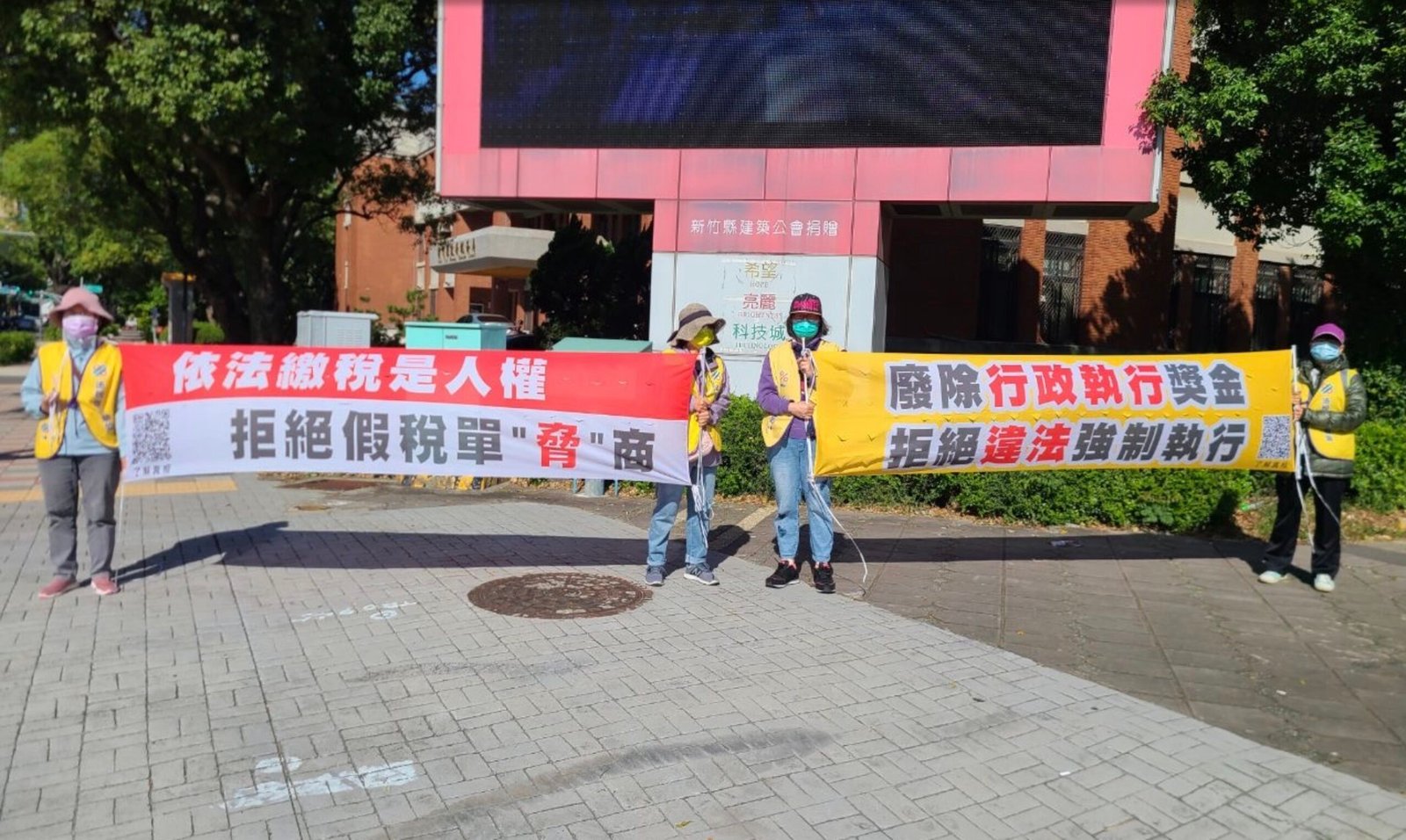
Tax enforcement actions, including confiscatory measures, continued, showing that the classificatory effects of the cram school category persisted beyond its judicial refutation.
This mismatch makes visible what I call classificatory violence. By classificatory violence, I mean the institutional harm produced when an authority imposes a category that disfigures the social meaning of a practice and forces the classified subjects to defend themselves within a framework that already renders them administratively suspect. The violence lies not only in the sanction, but in the way a morally and ritually framed practice was stripped of that meaning and treated as evidence of an alleged fiscal offense.
This dimension becomes clearer if one considers the context in which the case began. The literature on the case reconstructs that the accusation against Tai Ji Men arose in 1996, in a political climate of government hostility toward various religious and spiritual groups. The tax classification thus forms part of a broader fabric of public suspicion, institutional persecution, and circulation of disqualifying categories. In that context, the fiscal classification did not operate in isolation; it drew force from a prior construction of the group as administratively and publicly suspect.
The anthropologist Mary Douglas, in “How Institutions Think,” offers an important tool for understanding the persistence of defective institutional classifications. Her argument shows that institutions do not merely apply pre-given categories but also participate in producing legitimate ways of thinking, remembering, and deciding. Once an institution organizes its perception through a category, that category orients the archive, institutional competences, and successive decisions concerning what has been classified. This is why a deficient classification can persist even after judicial challenge: it survives as administrative memory.
In Tai Ji Men, the cram school category did not automatically disappear when different authorities recognized that the movement was not a cram school. It operated as a persistent bureaucratic structure, capable of sustaining a tax trajectory with lasting economic and social consequences. Even after the 2007 criminal acquittal and the recognition of Tai Ji Men as a menpai, the tax dispute was not fully resolved. In 2019, the tax bills for 1991 and 1993–1996 were corrected to zero, but the claim for 1992 was maintained, an exception inconsistent with the logic of prior decisions.
The 1992 exception is important not merely as an inconsistency, but because it exposes the gap between legal correction and bureaucratic practice: recognition may correct the designation, while administrative routines continue to operate through an earlier classificatory memory.
This trajectory also shows that case files are not mere repositories of facts, but spaces where certain versions of reality acquire authority, and others are subordinated. The case reveals a dispute marked by an evident inequality of power and institutional resources. When a spiritual minority is trapped in an inadequate classification, the institutional burden of proof shifts toward it, requiring it to prove it is not what the file already presupposes.
Classifications do not merely name subjects or groups; by interacting with institutions and forms of knowledge, they produce the conditions under which those subjects can be known, treated, and governed. In the Tai Ji Men case, the cram school category helped produce a field of intervention in which the dizi, the Shifu, and the red envelopes were reorganized as elements of a suspicious economic relationship. This modified both the community’s public recognition and its capacity to sustain communal continuity in public space. The tax classification did not replace the menpai’s internal experience. Still, it altered the public ground on which that experience had to be justified, translated, and defended for decades, with material, symbolic, and organizational consequences for its members and the community as a whole. This is the political dimension of the classificatory movement.
This reading has broader consequences for the study of the judicialization of religious minorities. When spiritual communities come into contact with state agencies, the question is not only whether they will be tolerated or persecuted, but how they will be classified, by whom, for what purposes, and with what effects. A community may describe itself from within its tradition, but the state can convert another description into an operative category. That asymmetry is one of the central mechanisms governing spiritual diversity.
Therefore, freedom of religion or belief does not depend only on whether the state tolerates beliefs or permits rituals. It also requires its institutions to recognize spiritual forms that do not easily fit their inherited categories and to be able to correct their own classifications when these produce harm. When that capacity fails, classification becomes a form of institutional violence.

Maria Vardé graduated in Anthropological Sciences at the University of Buenos Aires and is currently a researcher at the Instituto de Ciencias Antropológicas, Facultad de Filosofía y Letras, Universidad de Buenos Aires (Institute of Anthropological Sciences, Faculty of Philosophy and Humanities, University of Buenos Aires). She has written and lectured on archeology, spirituality, and freedom of religion or belief.