A bachelor’s dissertation on Ashram Shambhala would hardly deserve a review, had it not been disseminated online and used for anti-cult propaganda.
by Massimo Introvigne
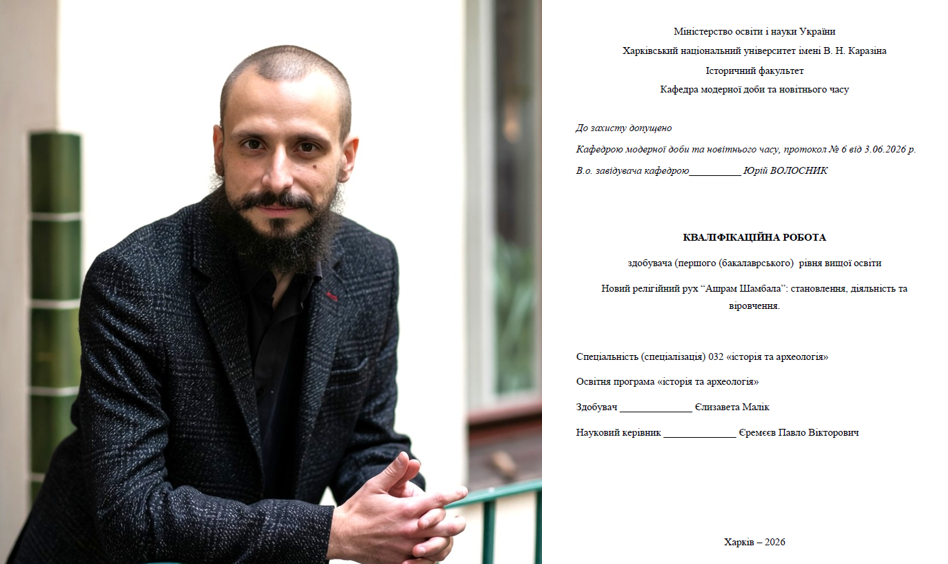
Reviewing bachelor’s theses is not normally the business of “Bitter Winter,” nor is it mine. Undergraduates are entitled to their mistakes, and their teachers are there to correct them. A thesis defended in June 2026 by Yelyzaveta Malik at the Faculty of History of V. N. Karazin Kharkiv National University, in Ukraine, on the new religious movement known as Ashram Shambhala and its founder Konstantin Rudnev, would have been left in peace in the university archive where such works usually rest.
It did not stay there. The thesis was posted on the Web, and an anti-cult activist connected with FECRIS, the European federation of anti-cult organizations, promptly advertised it on Facebook. A student paper thus became a weapon in the campaign against Rudnev, now at the center of a criminal case in Argentina, and against his followers. The bold claim that it is a “scientific novelty” that discusses Rudnev “for the first time in historiography” belongs to the standard language of Ukrainian theses. It plays a different role once the text is thrown into the international anti-cult arena.
There is a further reason for a few comments. The thesis refers dozens of times to the article that María Vardé and I published earlier this year in “The Journal of CESNUR,” “The Ashram Shambhala Saga.” It uses our work as its main source for Rudnev’s biography, then scolds it for being “too complimentary” and “almost entirely built on justifying” its subject. Being both a source and a culprit in the same footnotes entitles me, I believe, to comment. I will try to do so in the spirit of a friendly external examiner, the kind the thesis should have met before it met Facebook.
The thesis, about 85 pages in Ukrainian, was supervised by Associate Professor Pavlo Yeremeyev. It opens with a methodological promise. Following Eileen Barker, the author explains that “new religious movement” is a neutral scholarly category, preferable to “cult” (“секта” in Ukrainian, which scholars normally translate as “cult,” as they do with other derivatives of the Latin “secta” in different languages, since the English “sect” is less derogatory). “Cult” is indeed a word loaded with negative connotations in public discourse. The promise is broken before it is made, in the list of tasks of the introduction, which speaks of the reasons that led to the formation of “the cult.” Throughout the text, Ashram Shambhala is a “секта” and its members are “adepts” who are “recruited” and “zombified,” and the conclusion ranks it among “the most cruel and authoritarian new religious movements in Eastern Europe.” The bibliography includes a Russian article on “destructive totalitarian cults,” and the language of “totalitarian cults,” popularized in the 1990s by Alexander Dvorkin, the Russian anti-cult leader who served for years as vice president of FECRIS, runs through the whole text. Barker is on the label. Dvorkin is in the bottle.
The content comes from four sources. The first is “The Way of the Fool,” of which she quotes the edition published in Simferopol in 2000 under the pseudonym S. Sikorsky. The second is the memoir of an ex-member, Natalia Koksharova, self-published in Moscow in 2021 under the “modest” title “The Sect ‘Ashram Shambhala’: A Concentration Camp for Those Seeking God.” The third is a pair of video interviews with another ex-member, Elena Zakharova. The fourth is the Ukrainian anti-cult website “Hovory! Vilne slovo,” where Koksharova also writes.
The Zakharova interviews carry some of the heaviest accusations in the thesis. Each footnote referring to them reads, in full, “YouTube video hosting. URL: https://www.youtube.com.” This is roughly equivalent to quoting a book by indicating “a library, somewhere in Europe.” No title, channel, date or timestamp is given, and no examiner could have checked a single one of these references.
Current members of the movement are never heard. Nor are former members who left without becoming activists, or the scholarly literature on how apostate narratives are constructed, from David Bromley onwards. The thesis criticizes our article for not giving enough weight to Zakharova and Koksharova. It never explains why two hostile witnesses, one of them published by an anti-cult website, should outweigh everybody else.
“The Way of the Fool” deserves a paragraph of its own. The author honestly warns her readers that the book is a mythologized, ideological text, whose central female character, the dark and cruel schoolgirl Marianna, may never have existed. Having said so, she uses it as her main source for Rudnev’s childhood, his parents, his school years and his doctrine. Lines spoken by characters of what is, in fact, a picaresque novel become evidence of what happened in a Novosibirsk apartment in the 1970s and of what the movement believed. She also accepts, following Koksharova, that Rudnev wrote the first two parts of the book. He did not write it at all, as explained by Karolina Kotkowska in an article published in “The Journal of CESNUR.”
The novel says, for instance, that drugs and prostitution may generate good karma. The thesis duly lists this among Rudnev’s teachings, only to admit a few lines later that, according to all sources, members did not use drugs, and that even the ex-members it relies on report no prostitution. The obvious conclusion that a provocative novel is a poor catechism is never drawn. Meanwhile, the books Rudnev wrote in later years or that collected his teachings, such as the eleven-volume “Secrets of the Dead” and “The Dawn of Inliranga,” which his students today regard as their main references and which take a different view of family and children, do not appear in the bibliography. Nor does the bibliography include a single volume of the “Darshans,” the transcribed talks on which his doctrine is chiefly based.

My favorite passage, however, is the explanation of why Rudnev’s cosmology, with its three worlds, its Tengri and Ulgen, its Yav, Prav and Nav, and its five souls, is so complicated. According to the thesis, it was made complex on purpose, so that disciples would feel unable to understand it and become dependent on the master who alone holds the key. By the same standard, Helena Blavatsky wrote the two volumes and more than 1,400 pages of “The Secret Doctrine” to keep Theosophists in a state of permanent dependence, and Rudolf Steiner lectured for decades on the subtle bodies of man for the same sinister purpose. Rudnev’s system is actually simpler than many other esoteric cosmologies.
The argument has a history, which the author might have traced starting from the work of Wouter Hanegraaff she lists in her bibliography. Accusing esoteric teachers of building obscure systems to dominate their followers was a staple of the polemics against esotericism that Hanegraaff studied in “Esotericism and the Academy” (and more recently in “Esotericism in Western Culture”). A student of history who meets an old polemical trope is expected to identify it. Adopting it is a different exercise.
Smaller slips are what one expects in an undergraduate work, and I will mention only a few. Valery Averyanov, the founder of the “astral karate” Rudnev borrowed from, is correctly named in one passage and becomes Anatoly in two others. Hanegraaff’s classic study of the New Age is dated 1988, which would make it a remarkable act of prophecy, since it was published in 1996. In the comparison with the Children of God, “Flirty Fishing,” rendered in Ukrainian as “flirting with fish,” is described as a ritual involving children, although it was a recruitment practice of adult women members. The second chapter has two sections numbered 1.3, and the thesis calls itself, in one place, a “course paper.”
The most serious accusations deserve more care. The thesis states that in a “children’s ashram” in the village of Vinnykivtsi, in the Vinnytsia region, hot wax was dripped on children’s spines to cast out evil spirits, and that minors were involved in sexual “tantric practices.” Its source is Koksharova’s self-published memoir, plus the anti-cult website. Members of the movement interviewed by me and other scholars categorically deny these stories and explain that the summer camps, including one called “World of the Little Genius,” were organized locally by parents who were themselves students of Rudnev. Allegations of this kind, if true, would be very grave. Precisely for this reason, they need more than one footnote to a memoir and a website, and the other side should at least have been asked.
Which brings me to the most surprising feature of the thesis. Its account of Rudnev’s legal troubles follows the Russian prosecution. The 2013 conviction “on all counts” and the eleven-year sentence served in Norilsk are reported as the natural conclusion of the story. Our argument that the drugs were planted and that the rape charges rested on interpretation is mentioned, then left behind without discussion. Russian courts are treated as a reliable judge of a spiritual teacher who dared to criticize family values, school and work as Soviet and post-Soviet society understood them.
This is odd in Ukraine in 2026. Ukrainians know better than anybody else what Russian courts have done to political dissidents, to Jehovah’s Witnesses, and to Crimean Tatars. The thesis rests on a narrative born in the Russian anti-cult milieu and in Russian criminal files, carried by a memoir published in Moscow, recycled by a Ukrainian anti-cult website, endorsed in a Ukrainian university and finally relaunched on Facebook by an Italian anti-cult activist. It is a small but instructive example of how Russian anti-cult propaganda travels through international anti-cult networks and lands in the very country that is fighting Russian propaganda on every other front.
The surprise grows when one considers the supervisor. Associate Professor Pavlo Yeremeyev is known in Kharkiv for his critical work on Russian propaganda. In a 2024 online lecture, “Crimea as a ‘Lieu de Mémoire’: Between Science and Propaganda,” he dismantled the myth of Crimea as ancient Russian sacred land. He also warned against replacing one set of manipulative narratives with another. One wonders why the myths of the Russian anti-cultists, and the reliability of the Russian judiciary on which they depend, did not attract the same critical eye.
I have no wish to be too hard on the author. She is a young graduate, she worked with the sources she was given, and she showed some independence in accepting our reconstruction of Rudnev’s years in the army and in the psychiatric hospital. Her comparison of Rudnev’s cosmology with academic studies of Altaic religion and Slavic paganism is the best part of her work, and I hope she will develop it. If she continues her studies, she may want to interview some current members of the movement, read Rudnev’s later books, and ask why her favorite sources were published where they were.
The responsibility lies elsewhere, with the anti-cultists who mistake a bachelor’s thesis for a scholarly verdict and use it to fight people they have already decided to condemn. In the Tarot, the Fool is the card numbered zero, the one that begins the journey through the Major Arcana. A B.A. thesis is also a zero, in the best sense: a starting point. Those who present it as the end of the road are the real fools of this story.
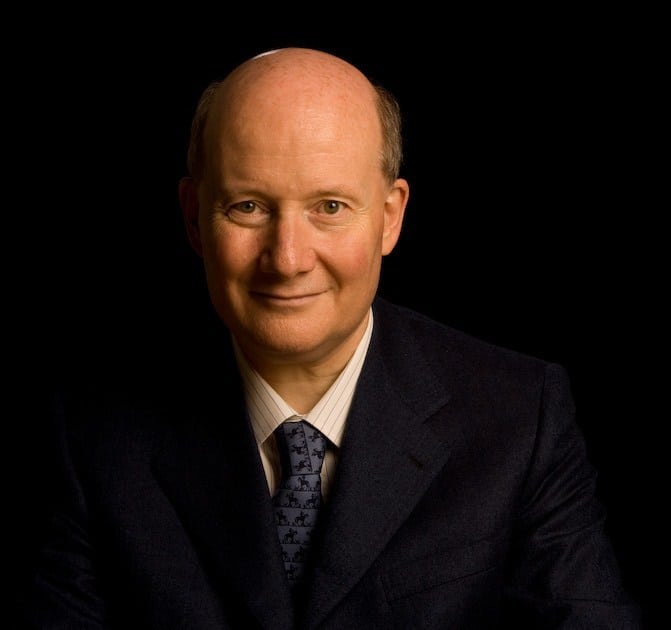
Massimo Introvigne (born June 14, 1955 in Rome) is an Italian sociologist of religions. He is the founder and managing director of the Center for Studies on New Religions (CESNUR), an international network of scholars who study new religious movements. Introvigne is the author of some 70 books and more than 100 articles in the field of sociology of religion. He was the main author of the Enciclopedia delle religioni in Italia (Encyclopedia of Religions in Italy). He is a member of the editorial board for the Interdisciplinary Journal of Research on Religion and of the executive board of University of Pennsylvania Press’ Nova Religio. From January 5 to December 31, 2011, he has served as the “Representative on combating racism, xenophobia and discrimination, with a special focus on discrimination against Christians and members of other religions” of the Organization for Security and Co-operation in Europe (OSCE). From 2012 to 2015 he served as chairperson of the Observatory of Religious Liberty, instituted by the Italian Ministry of Foreign Affairs in order to monitor problems of religious liberty on a worldwide scale.