The story of a young man who took his own life and keeps learning beyond death works as an accessible introduction to a complex esoteric system and as a practical training manual.
by Karolina Maria Kotkowska*
*A paper presented in the session “‘Ashram Shambhala’: A Panel on the Case of Konstantin Rudnev,” CESNUR 2026 conference, Taichung, Taiwan, October 11, 2026.
In “Secrets of the Dead,” Russian esoteric teacher Konstantin Rudnev takes the reader on a very long journey. The title might suggest a range of difficult subjects—emotionally, since they concern death, and formally, since texts dealing with what lies beyond the veil often take the form of complex treatises. Yet the book surprises in two respects. Its aim is highly practical: it is intended as a remedy for the problems of everyday life as well as for the grand metaphysical questions usually associated with life after death, and the two are interconnected. The book is also remarkable for its accessible form; indeed, it could almost be described as a novel.
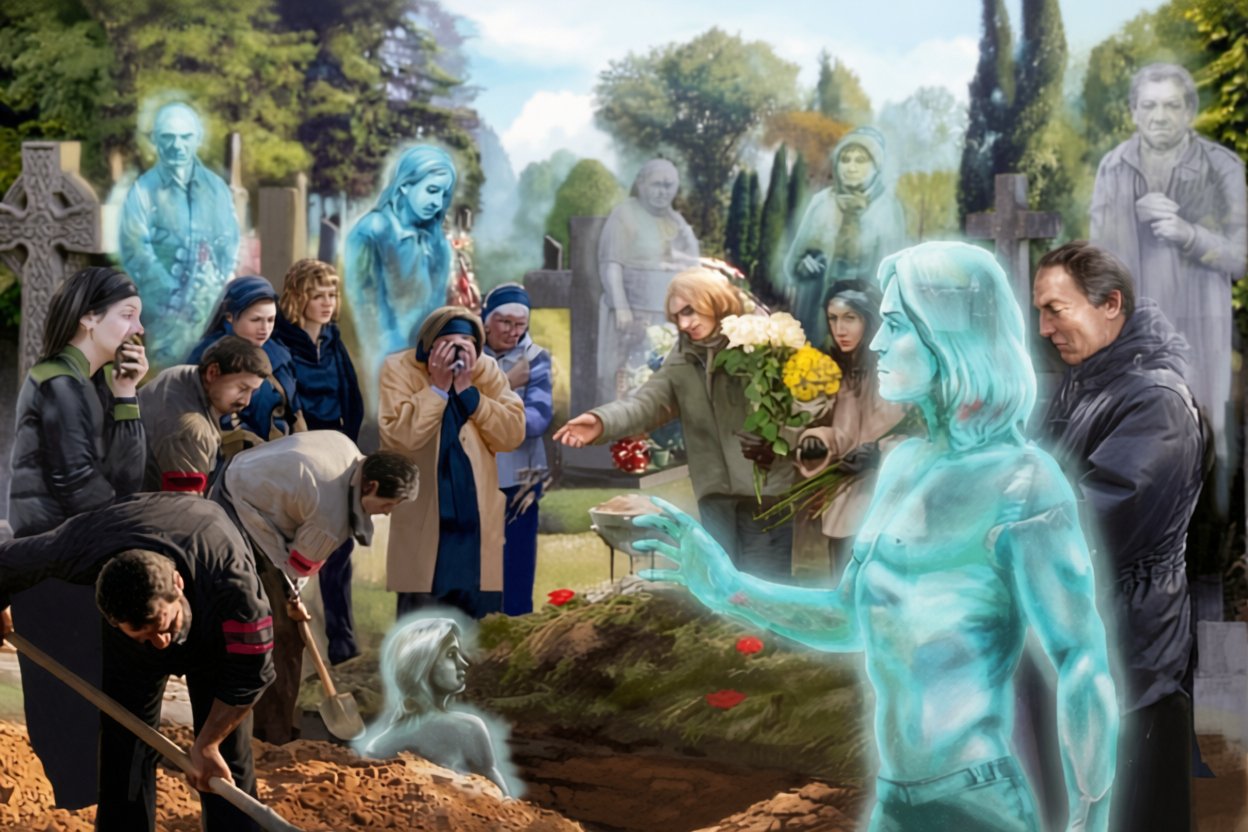
The protagonist who guides readers through life—his own and that of others, on Earth and beyond—is Ian, a young man who has committed suicide. His story offers a pretext for presenting, albeit in abbreviated form, most of the fundamental teachings contained in Rudnev’s more detailed “Darshans” and, I would argue, for developing some of them further. As befits an adventure story, the book also contains an interesting plot twist. At the outset, we learn that Ian’s testimony comes from channeling. Toward the end, together with the protagonist, we reach the point where Ian, residing in the subtle world, joins a group of students attending a hypnotic session and conveys his entire knowledge, experience, and story to one of the participants. The reader thus witnesses the very process through which the plot comes into being. The book also suggests that other, less obvious inspirations arising in people’s minds may likewise originate in the subtle worlds.
One of the main characters is the Master, whom readers should probably identify with the author. The persecuted innocent who lets his students devote themselves to spiritual work in defiance of an oppressive society is evidently a role Konstantin Rudnev can be recognized in.
From insects that make negative thoughts visible to the highest samadhi, “Secrets of the Dead” is in effect a summary of the teachings and may serve as an introductory text for those unfamiliar with this system. Above all, however, it is a text concerned with practical application in everyday, material life.
Although the work takes the form of a novel, its purpose is spiritual, and the teachings it contains may have, for the author and his students, a sacred status, addressing matters of vital importance. Are we dealing with fiction or with a sacred text of spiritual origin? Or perhaps with both? I do not intend to resolve these questions, but analyzing such a content-rich text is certainly demanding. From the perspective of intellectual history, the book also reveals, or perhaps emphasizes more than other texts do, interesting currents within twentieth-century Western esotericism, which become important elements in this assemblage.
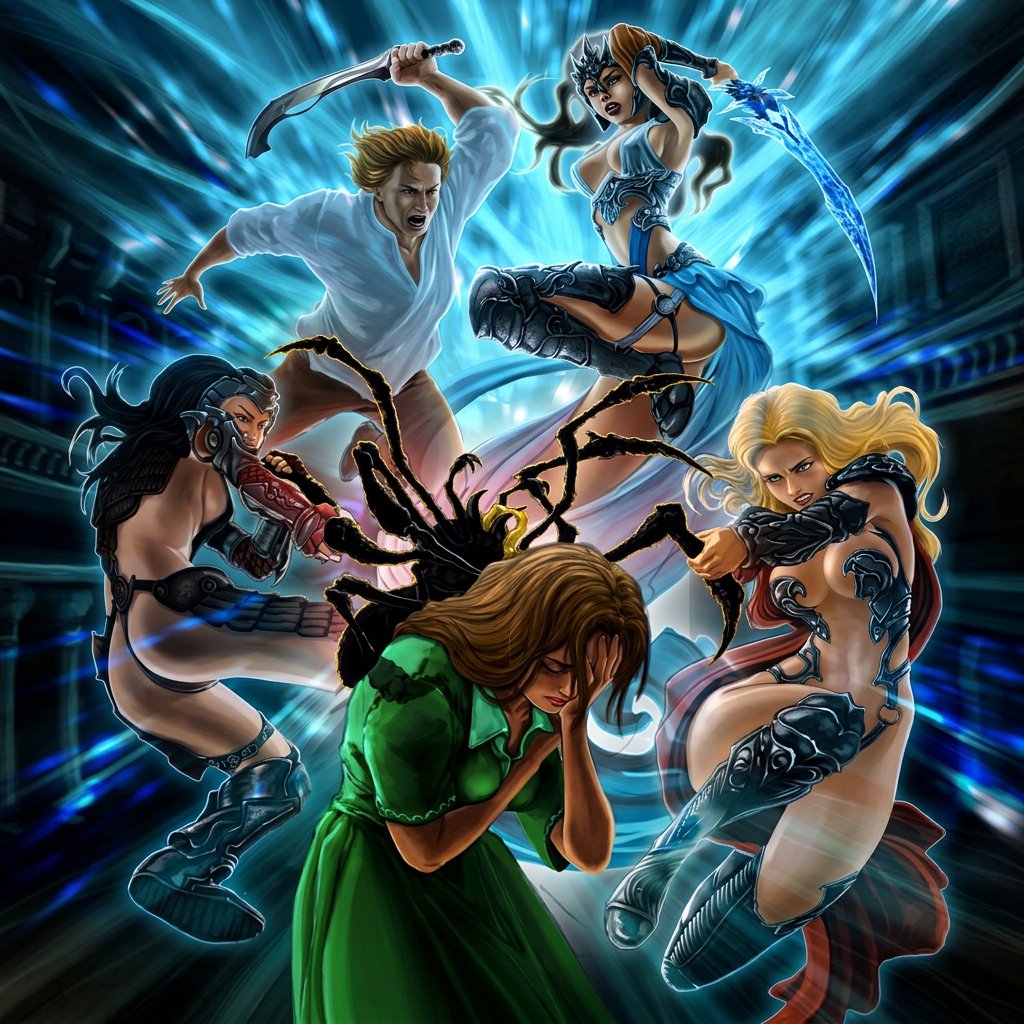
Although this work describes many spiritual practices, from the simplest to the highly complex, the minimum practice it presupposes is refraining from giving in to negative emotions. This differs little from the fashionable practice of visualization aimed at achieving worldly benefits, such as success at work or a trip to one’s dream vacation destination. The book describes in vivid detail the mechanism by which dark forces produce negative thoughts. Thoughts are energetic outgrowths on which enormous astral insects, spiders, and worms feed. These creatures stimulate the individual to produce such thoughts and then feed on them. Bad thoughts, sadness, even grief, anguish, or remaining in a toxic relationship are represented as a spider sitting on one’s head, a huge leech attached to the body, a disgusting beetle, a fly, or something similar, which can be observed in the subtle world and literally feeds on these emotions, growing as it does so. In contrast to popular affirmations and positive thinking, Rudnev focuses on overcoming negative thoughts in the subtle worlds and on the individual’s development, whose physical existence on Earth is only a transitional period and by no means the end of learning.
Compared with Rudnev’s “Darshans,” “Secrets of the Dead” shifts the emphasis regarding thoughts. In the Darshans, the author devoted considerable attention to the issue of incorrect thinking, which he presented as the result of the influence of social structures, from the smallest units, such as the family, to the largest, such as the state, whose aim is to subordinate the individual and thereby gain control over their life and goals.
The basis of individual liberation, and consequently of the liberation of entire groups, was therefore freedom from incorrect thinking. Rudnev identified various ways of achieving this goal, including spiritual practices known from earlier traditions, which, however, required conditions difficult to maintain in everyday life. In “Secrets of the Dead,” by contrast, emotions are the point of departure, above all negative emotions and the negative thoughts associated with them. They lead to poor well-being and, in extreme cases, to suicidal thoughts and attempts, while both these emotions and incorrect thinking are connected with a lack of any sense of meaning in life and in the world. Understanding how emotions function on the spiritual plane is intended to help individuals distance themselves from them; only that distance can lead to intellectual change and different life decisions, which are much harder to bring about when one remains directly entangled in the situation one is experiencing.
The way negative emotions are represented in the spiritual world, as repulsive entities clinging to people, also plays an important role here. Such vivid representations may be understood as a way of bringing the principle of distancing oneself from negative emotions into everyday practice. Self-torment becomes associated with disgust, and this association becomes a practical tool. The text also presents more active techniques for working on the spiritual plane in considerable detail. To simplify, Tantra may serve as the energetic fuel for such tasks, while astral karate serves as the tool.
One of the most important themes in “Secrets of the Dead” is undoubtedly spiritual evolution.
We follow it through the actions of several characters besides the protagonist. The paths they follow depend on where they begin. Taken together, these characters provide a fairly comprehensive picture of how humanity’s evolution is understood. Indeed, it could not be presented through a single character, which is why the novel explores different parallel paths.
Ian undoubtedly represents the lowest level of this spiritual development. At the beginning of the book, and later through retrospective accounts, we learn about much of what he experienced and the evil he committed. Moreover, suicide has been stigmatized in many cultures and religions, where it may be regarded as a serious transgression of moral or divine law.
It seems that a kind of “hell” awaits Ian, and indeed the protagonist experiences it. It turns out, however, that this state is also caused by negative thoughts and the expectation that something bad will happen—a spiritual guide, discussed below, teaches the boy how to emerge from it. In the subtle worlds, thoughts and states of consciousness shape the surrounding environment. Ian passes through various states, gains knowledge through his experiences, and eventually begins fighting to defend people in need on Earth. He becomes a Warrior of Light and, as a result, receives a special sword from Shambhala.
Ian’s path represents the first stage in the evolution of a person whose life had been far removed from spirituality. An interesting addition to the book, and to this theme of Ian’s development, are the illustrations, which in this context are partly rendered in a heroic fantasy aesthetic.
The second character is Sapphire—spiritually developed in the afterlife and Ian’s partner there—who incarnates as a girl in a difficult family situation. Thanks to her inner development and the help of friends from the afterlife, however, she discovers spiritual teachings while still in her early teens and rebels against her abusive father, so that her life takes a different, spiritual course much earlier. Here we encounter a reference to Rudnev’s teaching that families, like large social groups such as the state, impose incorrect thinking and programs through which individuals reproduce these structures and remain enslaved within them.
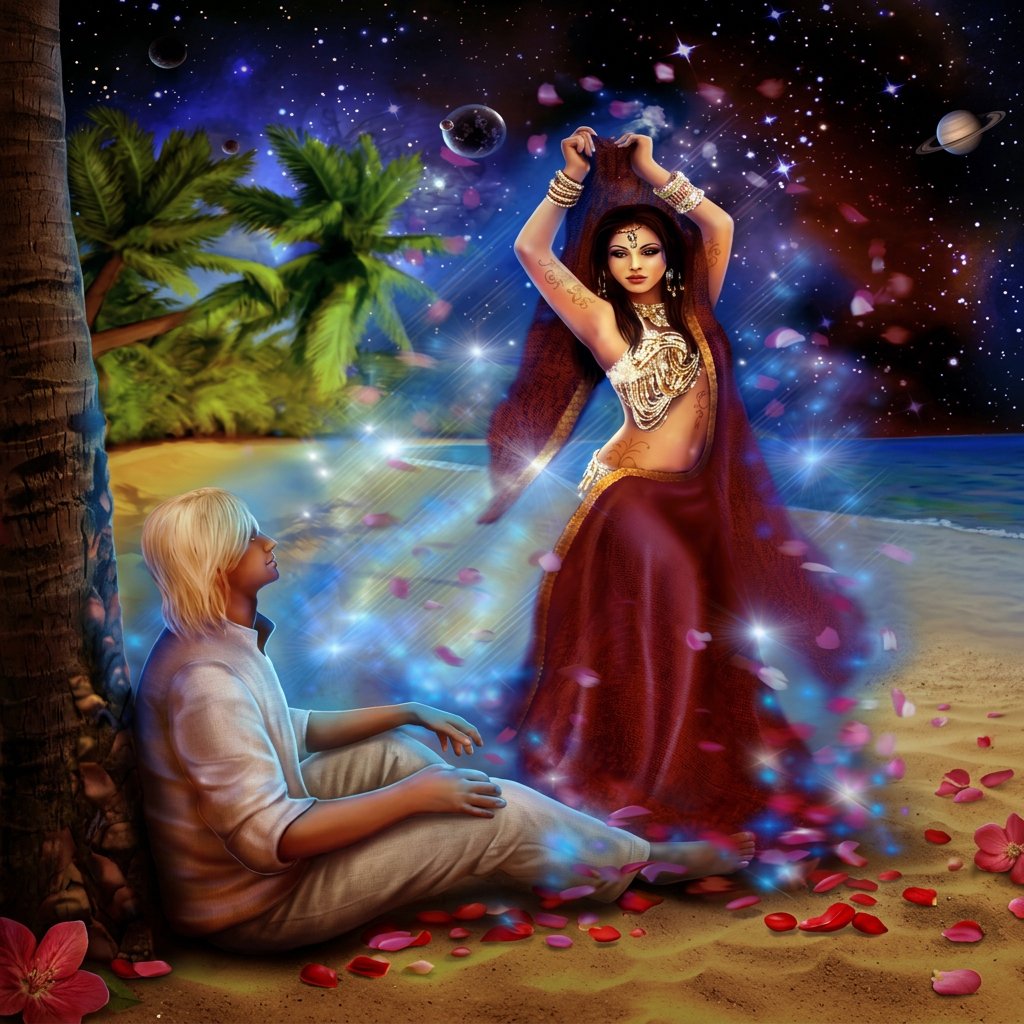
A very important character whose evolution we follow is Khadjur. His path suggests that the text is introductory, or at least functions as a kind of “prequel,” since in other texts by Rudnev we encounter him in a higher form than the one in which we meet him here. In this work, he is initially a priest in a temple in the astral world, where souls between incarnations reside at different stages of evolution. Most of them are awaiting reincarnation. Khadjur’s calling, however, is different—we learn that he is destined to ascend to the world of the angels. Readers are introduced to the angelic world, the angels’ characteristics, and the ceremony of Khadjur’s ascension to this state. He explains that this is not the end of his development: after leaving his astral body, he will ascend to the world of angels and then to that of archangels, eventually reaching the level of God. He also describes the further development through which, only from the level of God, he will return to reincarnation.
The book introduces the figure of the Master, a spiritual teacher living on Earth. Ian’s earthly girlfriend is a student of his teachings, and through her the Master remains in contact with Ian in the non-material realm. The Master’s insight into spiritual matters goes far beyond merely seeing the subtle worlds—he is able to navigate them. He is the one who rescues the protagonist from “hell” by instructing him to concentrate on his eyes (which may be understood in a quasi-hypnotic sense), thereby calming the boy’s negative thoughts. He also gives him some guidance about the world in which he finds himself. After coming under pressure from the authorities and being imprisoned, the Master experiences a series of samadhi states, which can be understood as successive stages of spiritual development. In the first of these, he begins to dissolve the boundary separating him from God and briefly experiences reality from God’s perspective. The subsequent samadhi states lead him through increasingly comprehensive visions concerning Christ, the structure of the cosmos, the origin and nature of the Atman, destiny, and finally the relationship between God and the divine sparks carried by individuals.
As can be seen, the stories of these characters are complementary, in the sense that they present different stages of a progressive evolution of consciousness toward higher levels. They can be imagined as rays running from different points toward a single source. At the same time, this evolution takes place across multiple worlds and levels of reality, while the individual returns in successive incarnations. It is the Atman that travels this path, with personality traits that change from one earthly incarnation to the next. The work also mentions that evolution proceeds through all levels of being, from the non-living, such as minerals, through the plant and animal worlds, and finally to humans. We learn from the stories of Khadjur and the Master what happens beyond.
The overarching line, centered on Ian’s story, should not mislead us into thinking that the book is a simple narrative. The number and variety of themes it contains are enormous. I will mention only a few in order to sketch a map, although it is difficult to convey in a few words the hundreds of parallel universes, pasts, and futures (time is a separate issue altogether), as well as the places and states in which the characters find themselves. Since movement in the astral world is practically unrestricted, Ian explores the universe, or more precisely, a great number of parallel worlds. They differ from ours in space as well as in the beings that inhabit them and the way these beings function. One example is a species of spiritually highly developed, dog-sized insects that lead peaceful lives in pyramid-shaped houses.
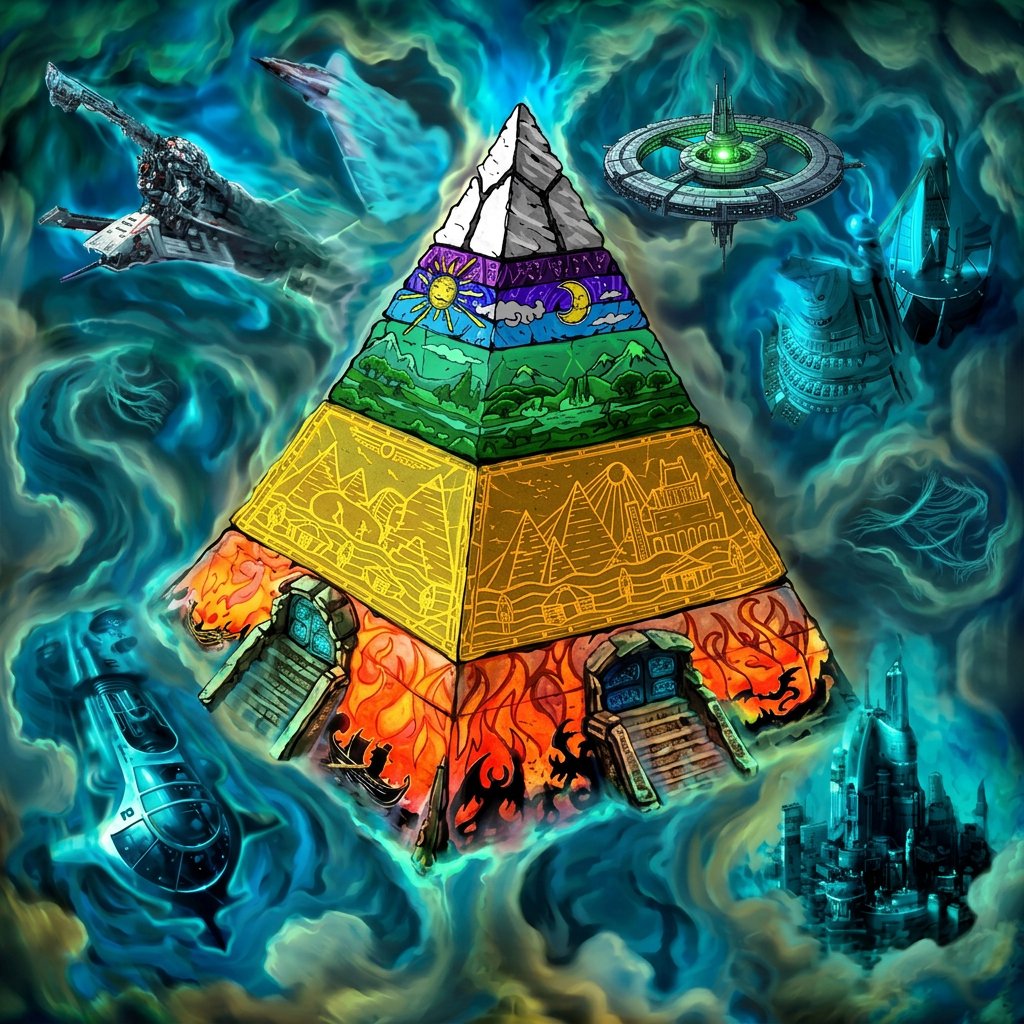
Some figures are nevertheless familiar to the reader, although they find a new place within this complex puzzle. One example is the little green men, who absorb the energy of the stars with their entire bodies and travel in flying saucers likewise powered by stellar energy. We learn from the book that they built the pyramids on Earth and erected the megaliths, which remain active energy-generating devices.
Many of these themes will undoubtedly interest scholars of esotericism as well as those who study what Egil Asprem, Asbjørn Dyrendal, and others have discussed as “conspirituality,” the confluence of spirituality and conspiracy theory. In “Secrets of the Dead,” aliens gave the Maya their pyramids and calendar, while the calendar itself is a “time machine.” There is an infinite number of parallel worlds on the subtle plane. Ian and his friends visit the world of lucent spots, living points of light that communicate through music. They create faces specifically in order to communicate with human beings. In these worlds, the travelers also encounter a flying mushroom with a face that carries a human being in its roots; the spirit of the psychotropic mushroom transports him through successive worlds. This is also explicitly presented as a critique of the recreational use of psychoactive substances—the book is, after all, a kind of moral tale and repeatedly contains such admonitions.
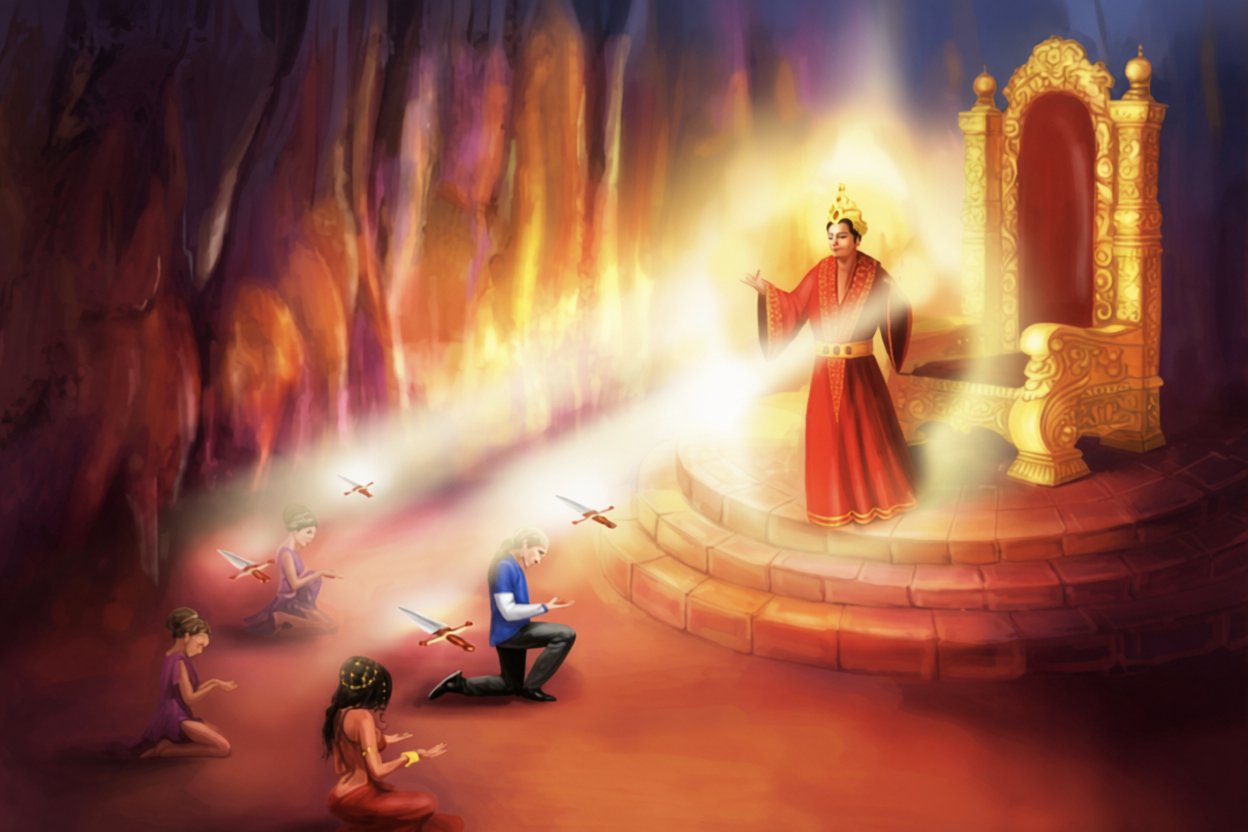
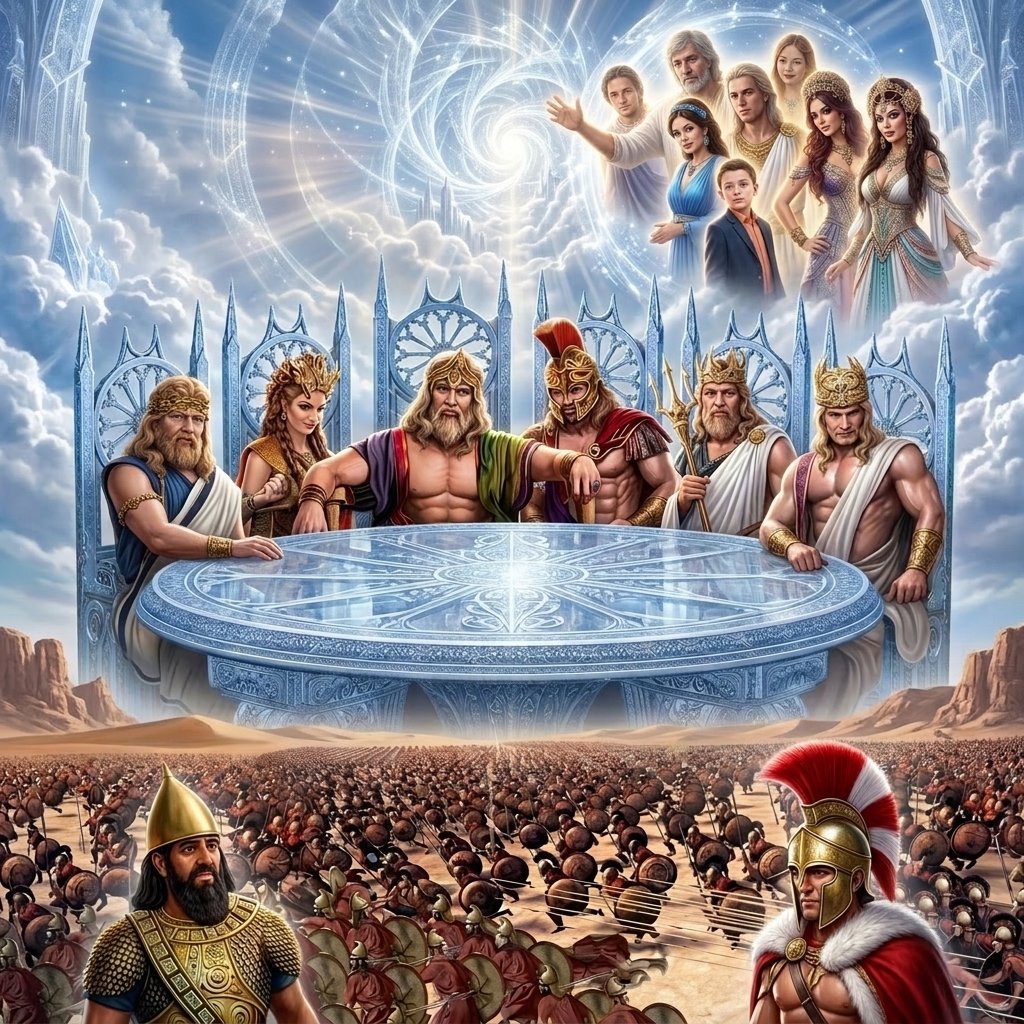
An important element of this cosmology is the Parliament of the Planetary Coordinators, a cosmic council located in Shambhala and comprising Christ, Buddha, Krishna, Mohammed, Moses, Morya, Zarathustra, Mahavira, and other great souls. In Shambhala, we also meet its king, Rigden Djapo, who initiates the protagonists. The reader also encounters a kind of living astrology, in which the planets are personified powers influencing human destinies, a theme also present in the Darshans. Greek gods appear too—in a scene set on Olympus, the gods and spirits of the “Helios system” gather for a cosmic council presided over by Jupiter. Among other things, they are responsible for planning the spread of Christianity. The forces of Light are opposed by the Dark Forces, commanded by Gagtungr, a personification of evil known from “The Rose of the World” (“Roza Mira”) by Daniil Andreev (1906–1959), first published in English in 1997.
Rudnev presents shamanism as a practice rooted in the specific social and spiritual conditions of a tribal community, where the shaman serves the tribe, its egregore, and its spirit. He explicitly states that “there is no need for a shaman where civilization exists.” He thus distinguishes this traditional, community-oriented form of shamanism from contemporary forms, suggesting that the latter cannot simply reproduce the shamanic experience outside its original cultural and social context.
We also encounter two masters well known from the Theosophical pantheon, El Morya and Koot Hoomi. Koot Hoomi teaches the protagonists astral karate, a technique for overcoming the forces of darkness discussed by Massimo Introvigne and María Vardé, Márk Nemes, and Stanislav Panin, and instructs them in tantric matters as well. The book contains numerous references to Tantra—techniques for arousing sexual energy and using it for self-development and action in the astral world—which are generally very important in Rudnev’s system, as his “Darshan Tantra” shows. In this work, he also frequently employs the Śiva–Shakti opposition. A characteristic example is his collective designation of three women as a single man’s Shakti (“Ian and his Shakti”). Although tantric traditions may involve groups of multiple participants, this collective application of the term “Shakti” to several women in relation to a single man departs from the classical binary model.
Having said all this, an important point must be emphasized. Rudnev makes use of an enormous number of themes familiar to readers interested in spiritual development. Their meanings, their places within the system, and their functions, however, diverge from those they had in the constellations from which they derive. They must therefore be considered within this new system of meanings and relationships. This is an important methodological point, because to say that Rudnev’s text is inspired by Tantra is, in itself, to say very little—and the same is true of shamanism. A tradition drawing on trance techniques would not necessarily be expected to criticize the use of psilocybin. Such examples could easily be multiplied, but the point here is that elements of Rudnev’s text lose their meaning when removed from their context. And there are a great many texts to consider, which leaves the historian of ideas considerable homework before drawing any general conclusions, because this system has its own language of meanings.
Neither Theosophy itself nor its principal theorists are ever mentioned explicitly in the Darshan corpus—that is, in the eleven volumes and the twelfth volume devoted to Tantra. Theosophical themes are nevertheless present and discernible throughout it. Perhaps the most important inspiration in the earlier texts was Nicholas Roerich (1874–1947) and, undoubtedly, the system of Agni Yoga recorded by his wife Helena Roerich (1879–1955) in books such as “Leaves of Morya’s Garden” and “Agni Yoga.” It is, in fact, a system co-created by the Roerichs, as the diaries of their disciple Sina Fosdick suggest.
Two features distinguish “Secrets of the Dead” from the other works: its explicit invocation of Theosophy and the multitude of themes that overlap with currents emerging from the Theosophical imagination, such as the teachings of the Summit Lighthouse, those of Alice Bailey (1880–1949), and—perhaps most importantly—the I AM Activity, founded by Guy Ballard (1878–1939), who wrote under the pen name Godfré Ray King. The book also shares what Danish scholar Mikael Rothstein has called the “ufological turn” of post-Theosophical currents.
In this context, one can speak of the prominent role of the Mahatmas, particularly El Morya and Koot Hoomi, and of a broader cluster of motifs firmly anchored in Theosophical traditions: the Masters of Wisdom and their hierarchical organization; the inclusion of figures such as Jesus and Buddha within a comparative framework of religious and spiritual teachers; karma and reincarnation; the existence of multiple planes of reality and the astral world; subtle bodies, auras, and chakras; spiritual evolution through successive stages and the kingdoms of nature; the correspondence between the human being and the wider cosmos; various forms of thought-energy; higher spiritual intelligences and angelic beings; Shambhala as a center of higher spiritual knowledge; the notion of a primordial or universal divine Spark, Fire, or Flame; the Great Central Sun; the idea that human development is guided by hidden spiritual hierarchies and transmitted esoteric knowledge; and, last but not least, the motif of the Ascended Masters. Taken individually, many of these elements are by no means uniquely Theosophical; taken cumulatively, however, they contribute to a distinctly Theosophical imaginative framework.
Once again, caution is in order. In “classical” Theosophy, the dead remain between incarnations in the state of “Devachan” and, in most cases, cannot directly contact the living. Their energy and love, rather, may transcend different states of existence and provide a form of protection. In the Theosophical sources, Koot Hoomi certainly does not teach tantric practices or, more generally, the use of sexual energy. Thus, as with the elements discussed earlier, even such a dense accumulation of references calls for caution in assessing how these elements actually function within Rudnev’s system.
Rudnev’s teachings have so far received little sustained attention. Media coverage has focused largely on the accusations against him, and journalists who mention his writings tend to dismiss them as convoluted or obscure. As this analysis has tried to show, however, the texts reward close reading: they form a complex system with its own internal logic and its own language of meanings, and their relationship to Theosophy, Tantra, and other currents of Western esotericism can only be assessed through careful study of the primary sources. The scholarly work undertaken in recent months, including studies by Introvigne and Vardé, Nemes, and myself, suggests that such study yields a considerably more nuanced picture of Rudnev than the one offered by the media.
I began by noting that “Secrets of the Dead” reads like a novel, but from a practical perspective it is undoubtedly also a training manual. It contains so many different practices, techniques, and principles that, if they were simply presented as a list to be learned, they would be difficult to master. Rudnev uses examples drawn from the lives of his characters—lives that, within the logic of the book, unfold across many different incarnations and even infinite parallel universes—to show how each of these practices can be applied in a concrete life situation. What should one do after an argument with an addicted husband? How should one behave when melancholy sets in? How does one meditate? How, and toward what, should one direct one’s sexual energy?
The examples thus turn the teachings into something to be practiced rather than merely learned. Each particular experience becomes an illustration of how the system is supposed to work in everyday life. Constructed and read as a narrative, the book ultimately works as a manual. And this is the main lesson Ian learns from the afterlife—and the reason reincarnation exists in the first place: life is for practice.

Karolina Maria Kotkowska is an Assistant Professor in the Centre for Comparative Studies of Civilizations, Jagiellonian University, Kraków, Poland. She holds PhD in Philosophy and works on her PhD in Sociology. She specializes in New Religious Movements and Western Esotericism in Central and Eastern Europe.