The persecuted spiritual teacher’s latest parables, penned in an Argentine prison, turn to personal memories and conceal hints of esoteric teachings.
by Márk Nemes
Readers of “Bitter Winter” are familiar with the case of Konstantin Rudnev, the Russian dissident and spiritual teacher who has been unjustly detained in Argentina after being forced to flee Russia and Montenegro. “Bitter Winter” has devoted an entire series of articles and studies to the background of his detention, exploring Rudnev’s early life, his teachings, his opposition to the totalitarian Russian state, and the state-stirred moral panics that followed him even to the other side of the globe.
During his incarceration in Argentina, he penned an initial series of public Manifestos on , , , and . These parables were written while he was in detention or shortly after he was transferred to house arrest. “Bitter Winter” published an in-depth analysis of these works in both English and Spanish, examining how Rudnev uses artistic forms to convey holistic insights as well as specific spiritual messages in each tale. Since that analysis, Rudnev has remained under house arrest and has released four new Manifestos. In the following lines, I examine them in light of his earlier writings, looking for new and reiterated statements by the persecuted spiritual leader, and perhaps even something more.
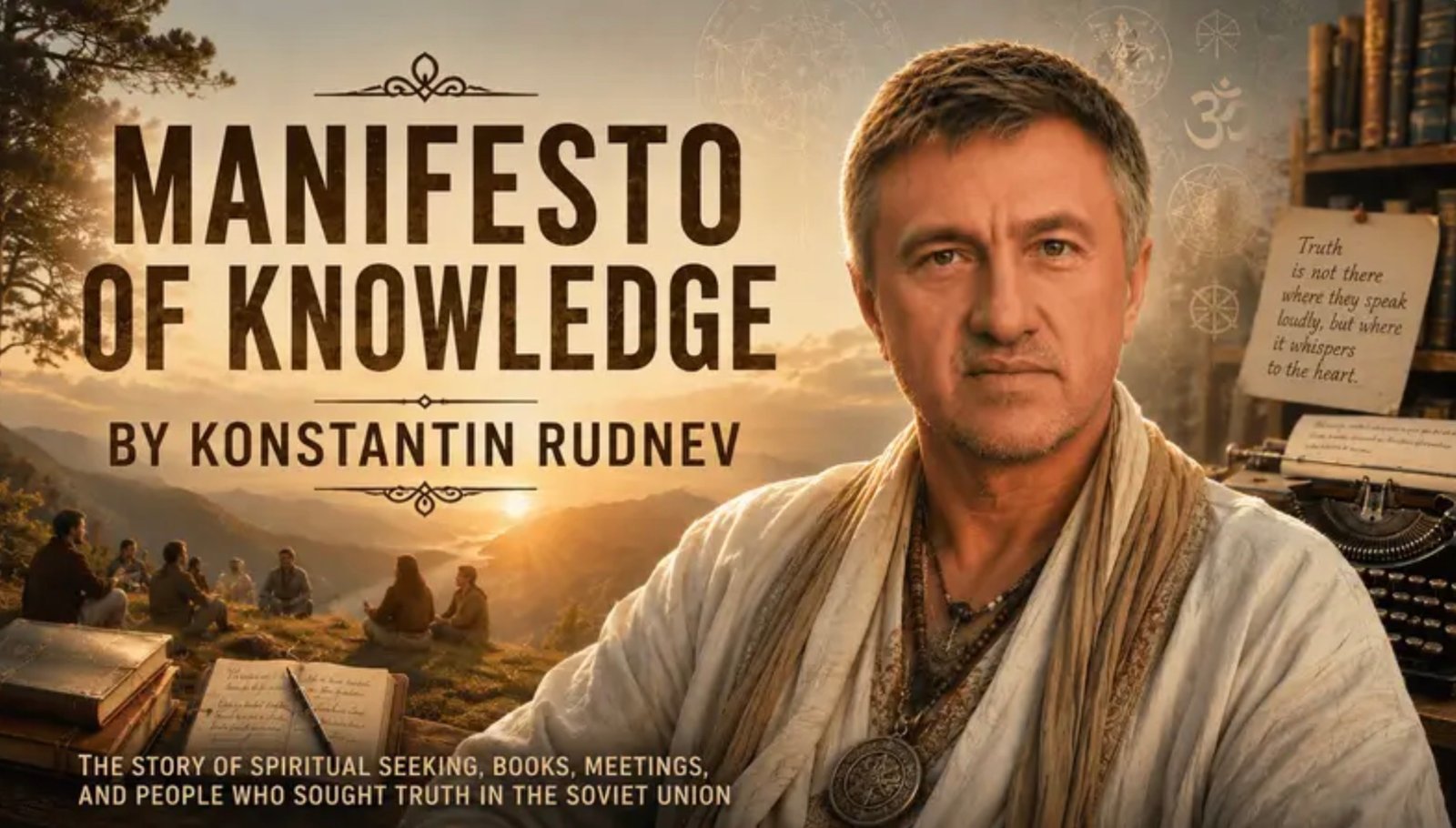
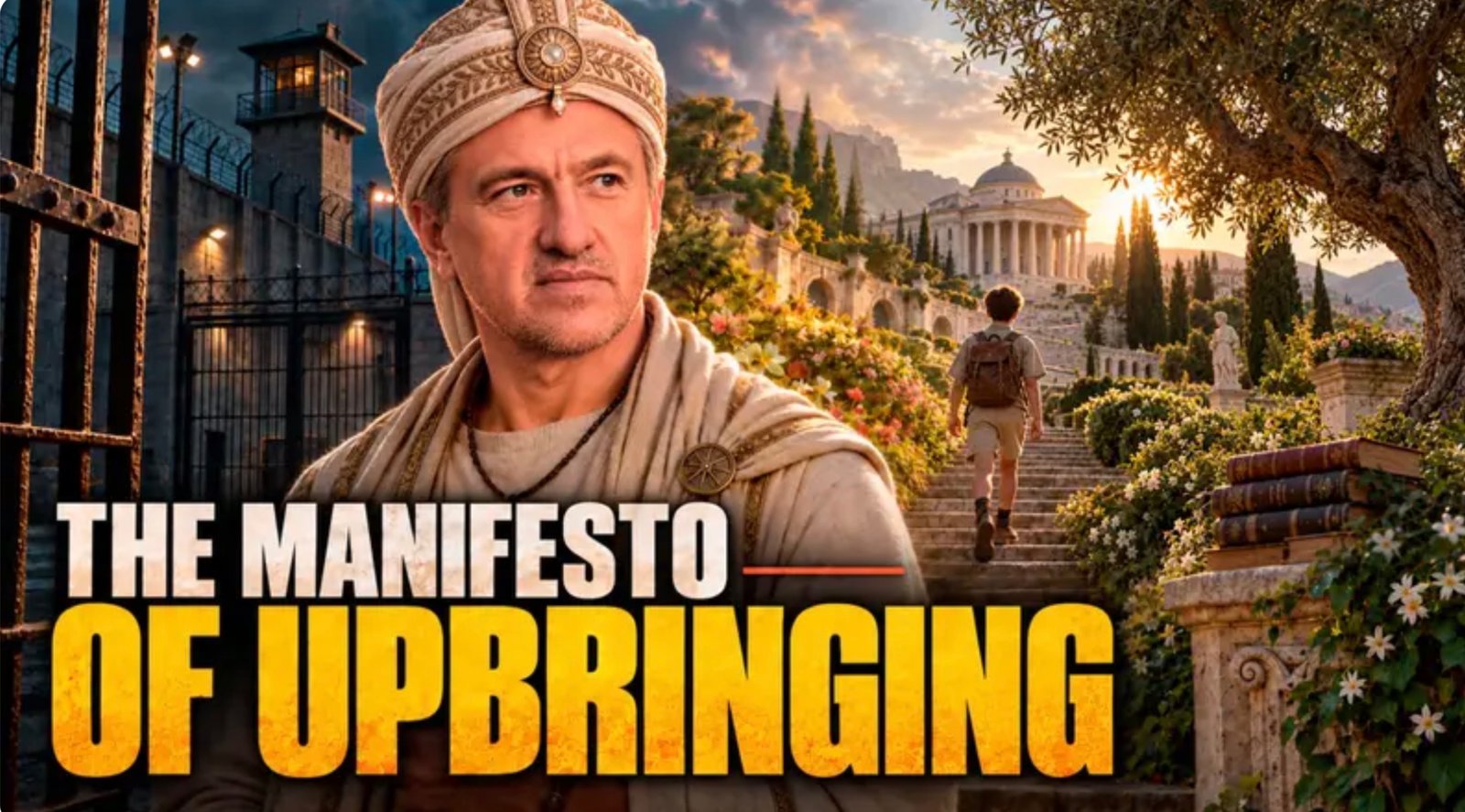
In these new Manifestos, Rudnev contemplates Gratitude, Responsibility, Knowledge, and Upbringing. Compared with his earlier works of the same kind, which directly critiqued modern social structures and advocated a more passionate, humanistic set of values, these new writings draw more deeply on personal recollections. Rather than only advocating grand ideals, Rudnev adopts a new position: he retreats into his own memories and builds his declarations from this inner dimension. His artistic style remains that of the parable, but the informed reader can more easily find moments where his usual rhetorical distance shortens, as he shares his own experiences with the reader to prove specific points. Furthermore, those with a keen eye can find hints of more “advanced” esoteric teachings in this new series of Manifestos.
The transformative power of environment
In certain respects, the new Manifestos echo messages already present in the previous set examined by “Bitter Winter.” Rudnev’s philosophical message still emphasizes individual spiritual growth grounded in agency, a holistic understanding of transformative environments, and the merits gained through adversity while resisting systemic conformity. The novelty lies in deeper personal reflections and esoteric hints within each of these themes. Taken together, the new writings argue that the “crisis of humanity” is in fact a crisis of maturity, whose solution can be found in education and in taking responsibility.
Upbringing and the role of environments
Across all the Manifestos, Rudnev insists that an individual’s development is closely linked to their socialization. Whether discussing the upbringing of children, the suppression of spiritual figures, or the acquisition of knowledge, he stresses that the intellectual soil in which a person’s thoughts are planted determines their future path. In this context, he also warns that placing children in criminal environments—whether justly or unjustly—inevitably produces suffering and opens the way to a life of crime.
He further states that society is responsible for nurturing these intellectual seeds: by creating spaces for culture, spirituality, and wisdom, Rudnev argues, humanity can leave fear and negative emotions behind. The same thoughts return in his reflections on education, where he elaborates on an educational system he considers ideal. These shared sentiments also connect to his earlier statements on Truth, where he notes that individuals deprived of positive role models or intellectual freedom create and recreate environments defined by violence and ignorance, which stunts their spiritual potential and distorts their future. He also recalls the lives of several esoteric teachers, such as Jiddu Krishnamurti, to illustrate how an optimal environment with “wise, moral, and highly cultured mentors” can fundamentally improve a person’s life path.
Inner freedom and spiritual quest
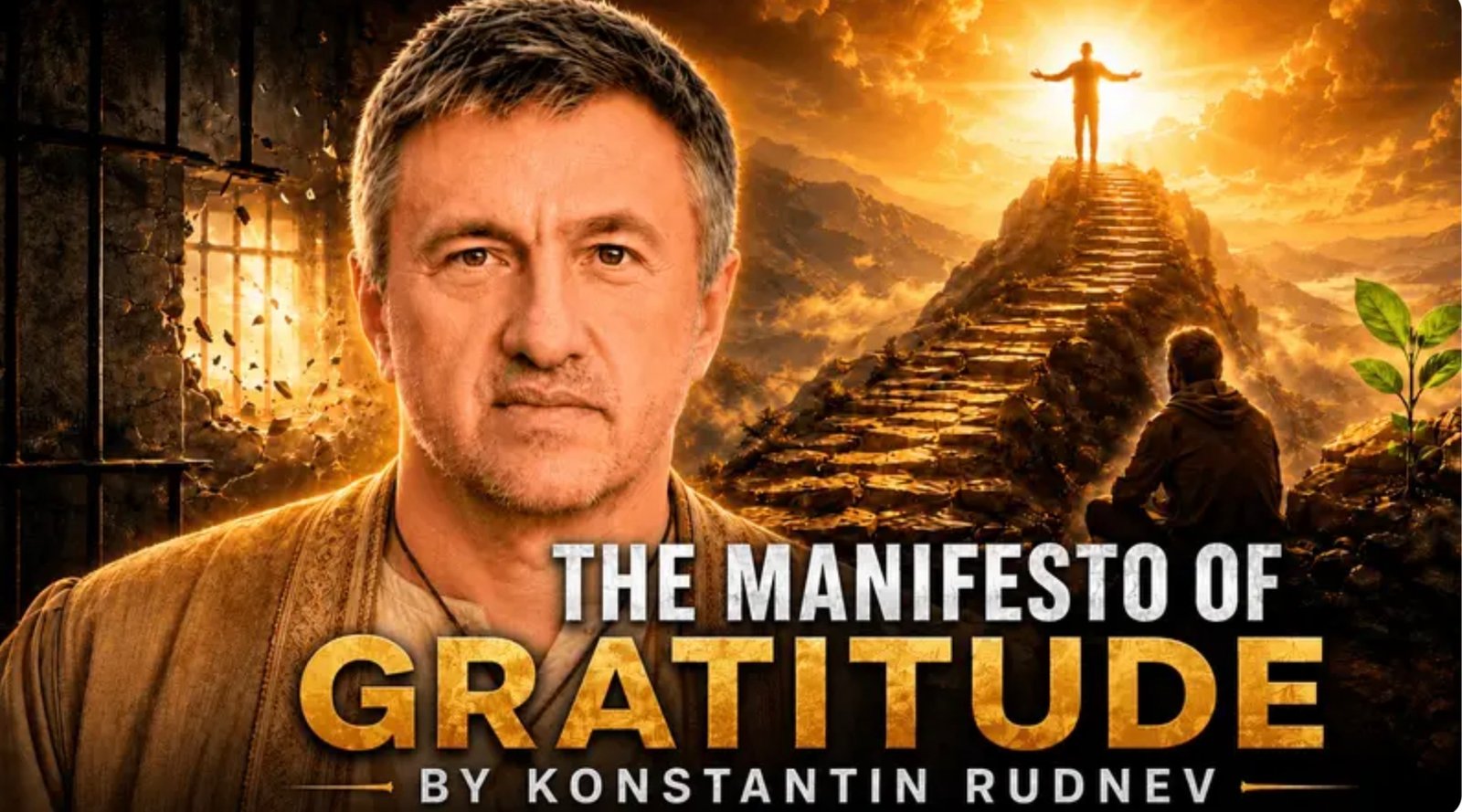
A central pillar of his thought is that true human value lies in the soul’s pursuit of truth, independent of external authority or social dogma. Rudnev frames this spiritual quest as a dangerous but essential act of defiance against dominant systems that prefer obedient, faceless flocks. In the “Manifesto of Knowledge,” he recounts the risks he took to share his spiritual insights during the Soviet era, emphasizing that the knowledge he imparted was a lived experience passed from heart to heart, much more than secret information. His thoughts return to those years in the “Manifesto of Gratitude,” where he argues that even in the face of imprisonment or persecution, one (himself included) must hold on to one’s soul. He maintains that the ultimate goal of human life is to awaken consciousness, a process that requires the courage to question established norms and the resilience to remain inwardly free despite external pressures or physical confinement.
The foundation of a mature society
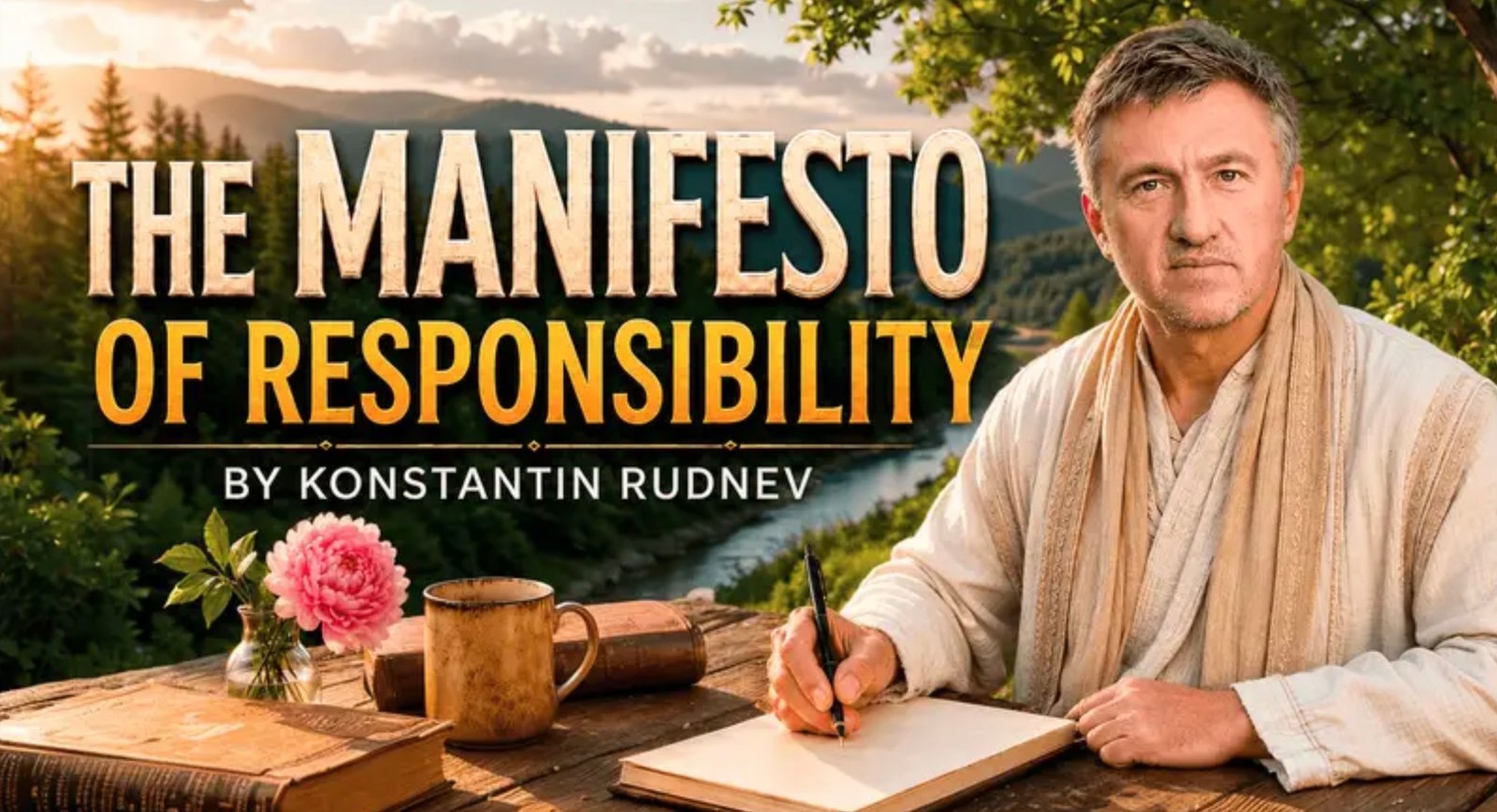
In this new series of parables, Rudnev places greater emphasis on responsibility and on being the active architect of one’s destiny. He stresses that individual maturity is best defined by the transition from a “victim mentality” to a “creator mentality.” Each of these archetypes has a deeper esoteric reference in the teachings of his school, which came to be known as “Ashram Shambhala.” The passage between the two states is in fact divided into several smaller phases, each leading toward a realized distinction between “guilt”—a socially conditioned way of looking backward and seeking punishment—and “responsibility”—an attitude of looking toward the future and continuously improving oneself.
In each new parable, Rudnev also consistently rejects what he calls the “blame game.” Whether discussing the ruined garden, a child in prison, or his own persecution, he insists that the locus of control must remain with the individual. He also posits that the health of society depends on the individual’s willingness to be accountable. Responsibility, he states, brings rationality and mindful communication, as one becomes aware of the consequences of one’s words.
The allegory of the ruined garden, in which a man refuses to acknowledge his role in its decay, shows that as long as one looks for someone to blame, people remain victims of one’s circumstances, trapped in an inauthentic way of life. Rudnev then goes a step further, suggesting that the refusal to accept responsibility is the root cause of all global crises, including wars, social divisions, and the postmodern loss of personal purpose. This Manifesto concludes by asserting that true maturity and power are achieved only when individuals shift their focus from “Whose fault was it?” to “What is up to me?”
Spiritual maturity and the “expansion of the soul”
Rudnev also argues that true “spiritual power,” which reveals one’s real agency, lies in reclaiming control from external circumstances. His reflections present this as the foundation on which individuals stop hoping for “saviors” and start acting as authors of their own lives. Instead of surrendering their power or blaming others, they take responsibility and move from the role of “bystander” to that of “author.”
He critiques the social tendency to blame external factors—the government, the past, or fate—for personal or collective misfortunes, tracing this habit back to childhood, when adults often taught children to blame inanimate objects for their accidents, conditioning them to avoid accountability throughout their lives. He then envisions a movement away from seeking “ideal leaders” or feeling like “victims,” toward a situation in which millions of individuals become the authors of their lives and choose to take responsibility for their immediate environment—their families, cities, and countries.
Rudnev sees responsibility as a direct spiritual practice, much more than a duty, hinting that a “narrow consciousness” focuses only on the self, while a “holy consciousness” feels holistically responsible for everyone. Using the example of Christ, he argues that taking responsibility for others—even those who cause pain—is the ultimate expression of love and the defining trait of a spiritually mature person.
The alchemy of suffering and gratitude
In the “Manifesto of Gratitude,” he hides yet another “advanced” esoteric teaching. He unlocks it for the reader through his own recollections of “betrayal, injustice, and imprisonment” and a philosophical insistence on gratitude. He does not deny the reality of pain; rather, he recontextualizes these experiences as a necessary component of spiritual development. In doing so, he presents suffering as a vital catalyst for wisdom and strength, refusing to regard it as a senseless burden.
He uses the metaphor of stones to illustrate two paths: one can carry grudges as a heavy, destructive load, or place them underfoot to build a path. This theme of transformative gratitude permeates the Manifesto. He expresses thanks for his own hardships—including bullying and imprisonment—because these trials forced him to develop patience, resilience, and a deeper understanding of human nature. He also jokes about this theme, describing the bullies and harsh environments of his childhood as his “first Shaolin teachers.”
By choosing to be grateful for every lesson, he argues, individuals may regain power over their lives, turning the past into a foundation for growth instead of a prison of bitterness. This perspective also shifts the focus from victimhood to agency, creating the ability to heal and find meaning in difficulties.
Rudnev also hints that every adversity has an “alchemical” property if one shifts focus correctly, transforming suffering into wisdom through the lens of gratitude. In this way, he believes, hardships can be transmuted from obstacles into the building blocks of one’s “path.” Inner alchemy is a key theme in Ashram Shambhala’s “advanced” spiritual scriptures, which confirms my impression that these parables are much more than holistic-humanistic declarations.
Education as liberation
Rudnev defines education as a tripartite process that goes well beyond academic achievement and includes social (how to live), cultural (how to appreciate beauty), and religious (how to understand the soul) elements. His idea of education is designed to prevent what he calls the “incomplete person”—someone who knows how to use a computer but does not know how to control anger and other strong emotions.
Across all the Manifestos, there is a recurring message about the role of the “Master” or “Teacher.” In the “Manifesto of Knowledge,” Rudnev recounts his early days as a teacher at nineteen and the “moment of recognition” he saw in his students’ eyes. This is mirrored in the “Manifesto of Upbringing,” which calls for mentors who can provide a “living example” of humanity. His narrative suggests that knowledge, much more than information, is a “chain reaction” passed, once again, from heart to heart, just as he passed it long ago. Another related theme, through which Rudnev lets the reader come a bit closer than usual to his life experiences, is “loneliness,” which he frames as a necessary condition for every seeker on the journey of finding “like-minded people” who can sustain a chosen spiritual path. He connects this to his early days in the Soviet Union, when he felt utterly alone, isolated both from people who shared his fascination and from sources of knowledge, which the totalitarian state kept under lock and key.
Conclusion: Striving for active transcendence
In conclusion, these new Manifestos reveal a deeper philosophical attitude that can best be described as Active Transcendence. Rudnev posits that while one cannot always control the “soil” in which one is planted, one is entirely responsible for how one grows from there. By integrating the lessons of the past (gratitude), the requirements of the present (responsibility), and the vision for the future (holistic education), the path Rudnev outlines in these new parables resembles a secret treasure map, guiding the “bystander” to evolve into the “transcendent author” of his or her own existence.

Márk Nemes is a historian and a graduate in the academic study of religions. He received his doctorate in philosophy at the University of Szeged’s PhD program in 2025 and works as a researcher at the Hungarian Academy of Arts’ Research Institute of Art Theory and Methodology. As an awardee of the Hungarian National Eötvös Scholarship, he served as a visiting researcher at CESNUR from 2023 to 2024. For the past 10 years, he has focused on researching new, alternative, and emergent forms of religiosity in Hungary, Iceland, the US and most recently, in Italy. Since 2025, he serves as the Deputy Director of CESNUR