A new report finds nearly 1,250 liaison points abroad, keeping watch on the diaspora, harassing dissidents, and targeting groups labeled as “xie jiao.”
by Massimo Introvigne
In 2022, the human rights NGO Safeguard Defenders published two reports, “110 Overseas” and “Patrol & Persuade,” documenting more than 100 Chinese “overseas police service stations” operating in more than 50 countries. Democratic governments called them illegal, and some opened criminal investigations. Beijing gave three answers in turn. It first called the reports a hoax, then described the stations as volunteer service platforms run by local associations, and finally announced that they had closed.
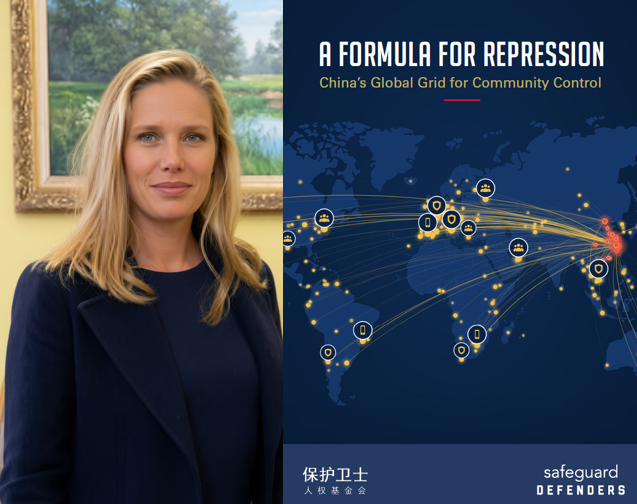
A new report released by the same NGO this month, “A Formula for Repression: China’s Global Grid for Community Control,” written and researched by Laura Harth with associate researchers Yen-ting Chen and Anson Kwong, shows that the closure never happened. The “police” nameplates came off the doors, while the structure behind them stayed in place and kept growing. Safeguard Defenders counts 1,247 formally designated liaison points in at least 91 countries that carry out abroad the functions of China’s domestic “grid management.” More than ten police forces from five Chinese provinces are involved, and more Chinese jurisdictions run “police-overseas-Chinese” mechanisms today than in 2022. The authors call their figure conservative. The Chinese Communist Party (CCP) itself counts its affiliated associations abroad in the “tens of thousands,” and each of them could become a liaison point.
The report, 156 pages long and based almost entirely on what Party and state bodies say about themselves, starts by explaining what the grid is at home. Every Chinese city, town, and village is divided into “grids” of 300 to 500 households, about 1,000 people each. Every grid has a worker vetted for “good political quality,” assisted by retired Party members, building heads, and “residents keen on community affairs,” which means that neighbors are enlisted to watch neighbors. A 2017 national standard, drafted by 42 bodies including the Party’s anti-cult office and the Ministry of State Security, assigns the grid worker ten tasks. Only one of them concerns government services. The others include keeping a dossier on “people, places, things, incidents and organizations,” screening for “unstable factors” and “hidden dangers,” settling “contradictions” before they reach higher levels, and giving “care and follow-up” to the “emotionally unbalanced,” the “behaviorally abnormal,” and the “paranoid.” Everything goes to a county “comprehensive-management center,” where police, prosecutors, courts, and justice bureaus sit together under the Party’s Political and Legal Affairs Commission. The model goes back to the Maoist “Fengqiao Experience” of 1963, in which villagers were organized to subdue “class enemies” among their neighbors, and Xi Jinping made it national doctrine in 2013.
Readers of “Bitter Winter” will notice one item on the grid worker’s checklist. Among the “hidden dangers” to be screened, next to pyramid schemes and terrorism, the 2017 standard lists “xie jiao.” The CCP itself, and cooperation agreements cited in the report, translate “xie jiao” as “cults” or “evil cults,” although the expression dates back to the Middle Ages and a more correct translation is “organization promoting heterodox teachings” (of course, which teachings are “heterodox” is decided by the state).
“Xie jiao” is the label the CCP applies to religious and spiritual movements it does not control, and the report notes that “cult” (i.e., “xie jiao”) is one of the explicit categories under which Chinese police treat dissent abroad as a security problem. In 2018, the Party abolished the anti-xie-jiao office together with the stability-maintenance and comprehensive-management offices, and handed their duties to the Political and Legal Affairs Commission, with anti-xie-jiao work shared with the Ministry of Public Security. In the report’s words, “the nameplates came down but the work simply moved one floor up.”
The anti-xie-jiao work also moved abroad. According to the police of Qingtian county in Zhejiang, they “guided the establishment and development of the Spanish World Chinese Anti-Cult Association, which has become a backbone force for overseas anti-cult and anti-independence [of Taiwan] work,” and in 2014 “promptly guided and helped” it to mount “counter-propaganda” against a Shen Yun performance in Barcelona. In 2017, a Qingtian judge posted a defendant’s personal data in a court chat group connected with Spanish associations. The news that the man had been found came back from the president of that same anti-cult association.
A lawyer serving on the Legal Advisory Committee of the All-China Federation of Returned Overseas Chinese described his job in Kazakhstan in 2020 as assisting “our embassy and consulates in Kazakhstan with anti-cult, anti-independence [of Taiwan] and pro-reunification work.” A 2016 cooperation agreement between the police of Nantong, in Jiangsu, and a police force in Romania included “prevention of evil cults.”
The founder of the Fuzhou police station in New York, convicted by a US jury in May 2026 of acting as an illegal agent of China, had joined counter-protests against Falun Gong during Xi Jinping’s 2015 state visit and received an award from a Chinese deputy minister of public security. In September 2026, outside the Chinese consulate in Toronto, a man wearing a People’s Republic insignia tore down Falun Gong banners and threatened the woman defending them: “I’ll have you shot, believe it or not?” She was left bleeding. The report also cites the September 2026 disclosure by the AI company Anthropic that it had shut down China-based operations using its models, one of which ran a “religious affairs” intelligence desk compiling daily dossiers on Catholic cardinals in Asia, the Presbyterian Church in Taiwan, the Tibetan administration in exile, and Falun Gong, which the dossiers called an “evil cult.”
“Bitter Winter” has documented for years how China supports anti-cult activities in South Korea, Japan, and Africa. The report suggests that China’s campaigns against “xie jiao” have now extended to many more countries.
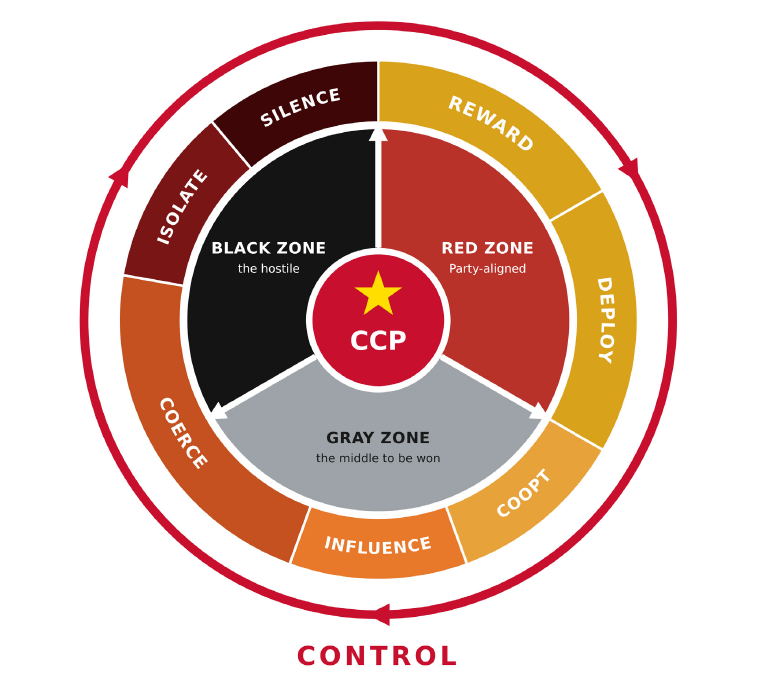
The report’s definition of who the grid targets should worry European governments. The Party’s category of “overseas Chinese compatriots” covers Chinese citizens abroad and also foreign nationals of Chinese origin, “with no limit on generations.” The report gives an example: a Wenzhou-born restaurant owner in Milan who kept his Chinese passport counts as an “overseas Chinese,” and so do his Italian-born daughter and grandson, who hold Italian passports. A 2023 State Council report put the total at “more than 60 million” people.
Since the 2018 reform that folded the government’s Overseas Chinese Affairs Office into the United Front Work Department, the main broker of the system has been the Overseas Chinese Federation, which describes itself as the Party’s “bridge and bond” to the diaspora and whose stated goal is that “when the Party calls, the overseas Chinese act.” The Federation finds the associations abroad, and police, prosecutors, courts, and justice bureaus “plug into” them, with or without a nameplate on the wall. The report sums up the architecture in a formula, 1 + n + X + Y(y): a Party-led hub in China, its sub-hubs, the state authorities connected to it, and the diaspora associations or individuals who carry the system abroad. In 2019, the Qingtian police reported that they had recruited 135 association leaders as directors and liaison officers and built “an overseas grid-service informant corps of more than 1,000.” Their task was to “give full play to the role of overseas human intelligence” and to track “the movements of overseas stability-related key persons” during “sensitive periods.” Families back in China received “home visits and educational persuasion.” Put simply, a dissident or believer is watched abroad, and the parents are visited at home.
The policy record the report reconstructs moves in one direction. In September 2025, the national Federation’s vice-chair told a forum in Fuzhou that the diaspora should be run “as one chessboard from top to bottom,” until it “flies in formation like wild geese, at the same frequency.” In March 2026, the Supreme People’s Procuratorate counted “nearly 200” prosecutor-overseas-Chinese stations in 28 provinces, offering “cross-ocean mediation, cross-border questioning, video reporting and appeals.” In April 2026, a Fuzhou official stated that the city’s Federation had established “police-overseas-Chinese cooperation mechanisms.” The word “police” had returned to the Party’s own vocabulary.
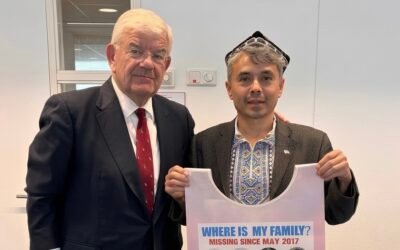
Italy is on many of these maps. Milan, Prato, and Rome host liaison points of the Wenzhou and Lishui “Global Link” platforms. The report reconstructs the case of Li Ying, the dissident behind the X account “Teacher Li Is Not Your Teacher,” who lives in Italy and whose case was covered by “Bitter Winter” this month. Police in Anhui harassed his parents for weeks. He was steered to a Milan association listed as a Wenzhou police liaison point to renew his passport, and a leader of the Prato association that had hosted a Fuzhou police station turned up at his former address. Li was later told that a “special team composed of public security and state security elements” was ready “to go to Italy if necessary” to bring him back to China. The report notes that in March 2026, Italy expelled eight Chinese nationals involved in the campaign, but recent events show that the harassment has not ceased.
In France, the Conseil d’État found in June 2026 that a Paris police station had served “as a relay, on French territory, for the bodies of the Chinese Communist Party in charge of controlling the Chinese diaspora,” and a Paris court upheld the expulsion of its host’s de facto president in October.
The report argues that transnational repression is usually described one victim at a time, while the grid works on whole communities, giving everyone a role: some are watched, others do the watching, and all are kept in line. The price, Safeguard Defenders writes, is paid “in privacy, in family life, in freedom of association and expression, in freedom of religion and belief.” Its recommendations call on democracies to treat affiliation with the United Front as the trigger for foreign-agent registration and interference laws, whatever nameplate an association uses, to warn local officials who attend Spring Festival galas organized by these associations, to set up a single national reporting line, and to engage publicly with the Tibetans, Uyghurs, Hong Kong exiles, and dissidents the Party wants isolated.
The alarm deserves to be heard. Members of groups Beijing calls “xie jiao,” many of whom fled China and are seeking asylum in Europe, North America, and Asia, now learn from the CCP’s own documents that a machine built to watch them at home has been extended to the cities where they found refuge, with Chinese police describing its “tentacles” as “extended overseas.” The stations exposed in 2022 were only the visible part of that machine. Unless governments act against the structure behind them, the report warns, the nameplates will keep changing while the work goes on.

Massimo Introvigne (born June 14, 1955 in Rome) is an Italian sociologist of religions. He is the founder and managing director of the Center for Studies on New Religions (CESNUR), an international network of scholars who study new religious movements. Introvigne is the author of some 70 books and more than 100 articles in the field of sociology of religion. He was the main author of the Enciclopedia delle religioni in Italia (Encyclopedia of Religions in Italy). He is a member of the editorial board for the Interdisciplinary Journal of Research on Religion and of the executive board of University of Pennsylvania Press’ Nova Religio. From January 5 to December 31, 2011, he has served as the “Representative on combating racism, xenophobia and discrimination, with a special focus on discrimination against Christians and members of other religions” of the Organization for Security and Co-operation in Europe (OSCE). From 2012 to 2015 he served as chairperson of the Observatory of Religious Liberty, instituted by the Italian Ministry of Foreign Affairs in order to monitor problems of religious liberty on a worldwide scale.