A governing model tested in Uyghur homes now shapes overseas networks, business ties, cultural outreach, and policing arrangements worldwide.
by Asiye Uyghur
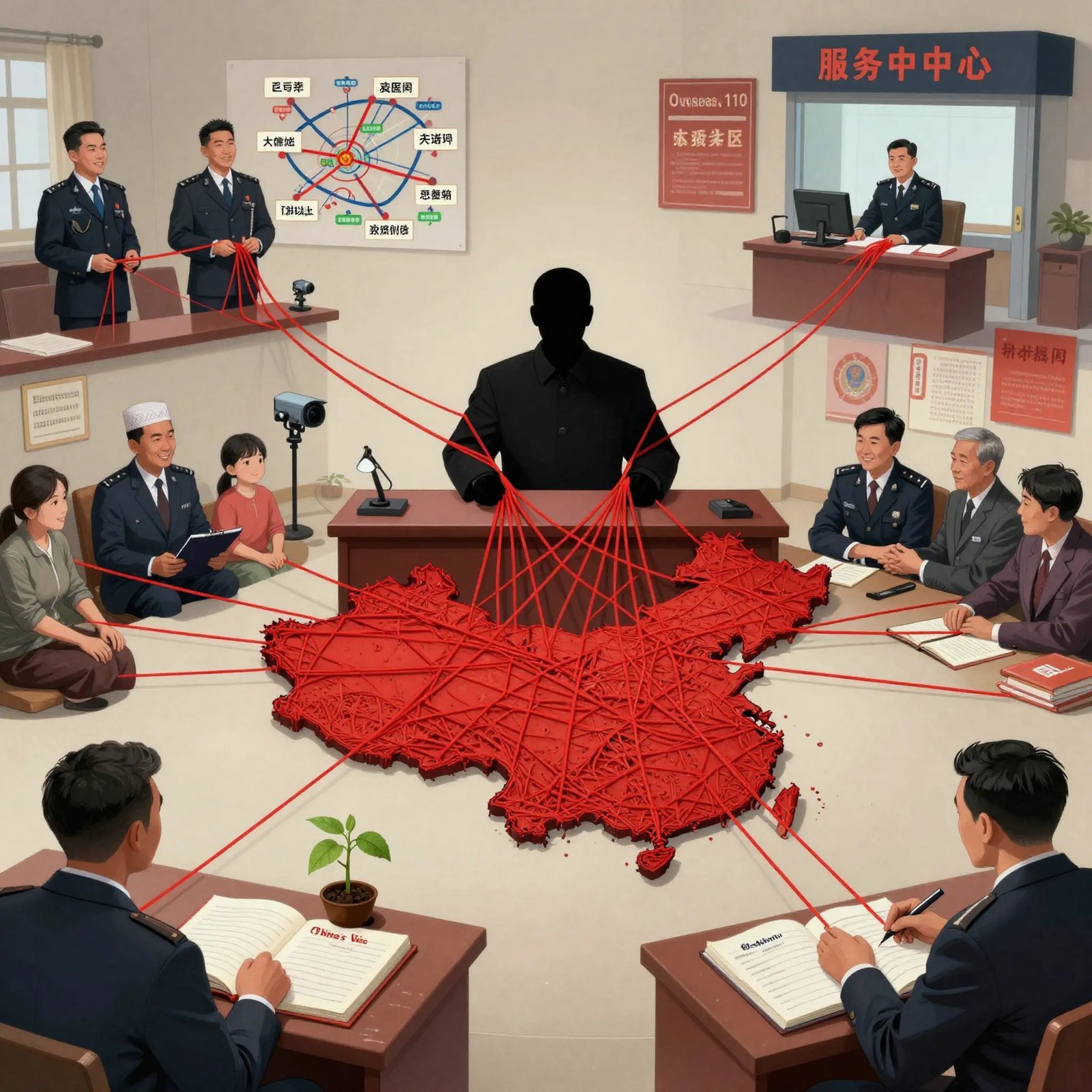
The Chinese Communist Party’s repression in the Uyghur Region is often discussed as a regional human-rights crisis. It is more than that. The region has served as a laboratory for a governing model that combines development, welfare, cultural policy, family ties, commerce, media, and policing into a system of political control.
Beijing’s own documents make this clear. “Aid to Xinjiang” is not merely economic aid. “Ethnic unity” is not merely a call for mutual respect. “Becoming family” is not merely a social program. These are instruments for entering private life, collecting information, remolding political identity, and securing loyalty to the Party-state.
The same governing logic extends beyond China’s borders. It operates through overseas Chinese organizations, business networks, friendship-city partnerships, cultural institutions, media, Chinese-language education, foreign sinologists, and overseas policing arrangements.
Inside the Uyghur Region, this system is enforced through direct coercion. Abroad, it advances through organization, access, economic ties, political mobilization, and narrative control. The methods differ. The political purpose does not: to extend Beijing’s reach by turning human relationships into state infrastructure.
A July 2024 article in People’s Political Consultative Conference Daily states this openly: “Pairing assistance to Xinjiang has never been purely economic work.”
The system connects nineteen Chinese provinces and municipalities to the Uyghur Region through cadres, state enterprises, schools, investment, industrial projects, cultural programs, and permanent administrative structures. Its official objectives are “social stability,” “long-term security,” and the forging of a common national identity.
The same article quotes Xi Jinping’s formulation of “wenhua runjiang,” officially rendered as “cultural nourishment of Xinjiang.” Its stated purpose is to address, “at the root,” questions of political identification and “where people’s loyalties lie.”
This is the policy’s essence. Economic assistance is used to produce political alignment. Education, culture, employment, local governance, and investment become instruments through which Beijing seeks to reshape the identity of a people it rules.
A 2025 Xinhua account of the region’s seventieth anniversary similarly celebrates its integration into national development, resource extraction, Belt and Road corridors, and Eurasian logistics. It praises “Ethnic Unity, One Family,” cultural integration, and the growing ties between the Uyghur Region and the nineteen pairing-assistance provinces.
The official narrative turns political domination into a story of benevolence. It presents the incorporation of the Uyghur homeland into China’s security, economic, and geopolitical strategy as evidence of harmony.
The clearest domestic expression of this model was the state’s placement of officials in Uyghur homes.
In 2014, an official Party publication announced that, by 2016, 200,000 officials would each spend a year in grassroots postings under the “Fanghuiju” campaign—“Visit the People, Benefit Their Livelihoods, and Gather Their Hearts.” The campaign’s tasks included improving livelihoods, strengthening ethnic unity, managing religion, maintaining stability, conducting propaganda, and reinforcing grassroots control.
The same publication described creating household files, monitoring people’s movements, and building systems that enabled “whole-process control.” It called for repeated political instruction designed to instill national consciousness, citizenship consciousness, and a common national identity.
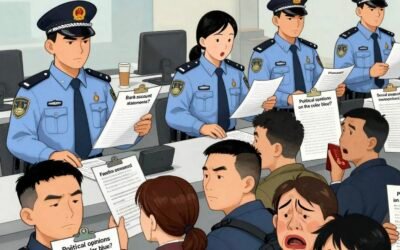
The campaign expanded through “jiedui renqin”—“Pair Up and Become Family.” Officials entered Uyghur homes predominantly, ate and slept with families, collected information about household members, religious beliefs, and political views, and conducted political indoctrination.
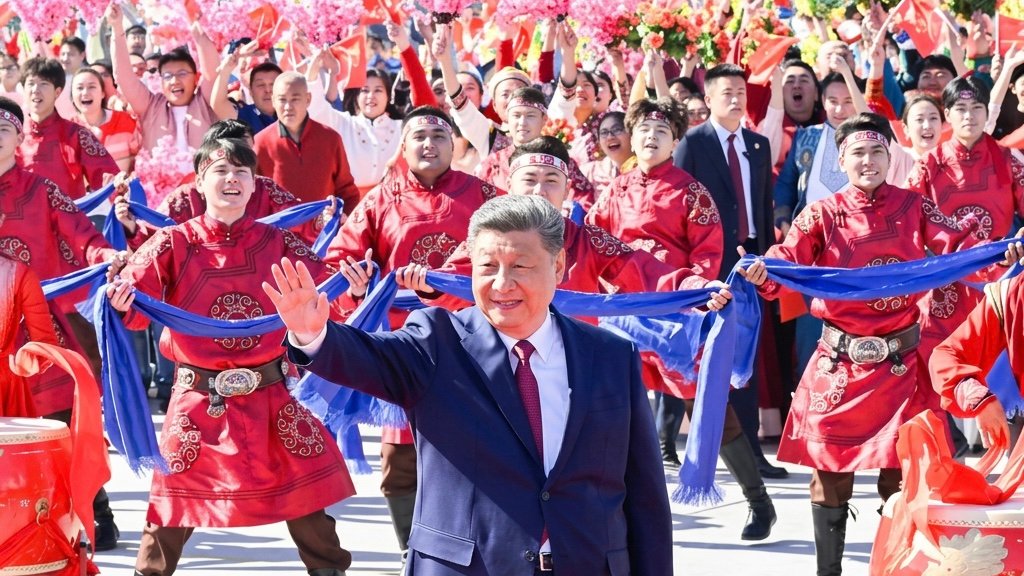
Human Rights Watch documented that officials were required to identify and report supposed “problems” in the household, including religious practice; promote Party policies; teach Chinese; and ensure participation in political rituals. Families had no meaningful ability to refuse.
“Becoming family” therefore meant destroying the boundary between private life and state power. The Party transformed intimacy into surveillance, welfare into access, and access into control.
Beijing applies a parallel principle abroad: overseas Chinese communities are not treated as politically separate from China. It treats them as a transnational resource to be organized, guided, and mobilized for the Party-state.
The January 2024 Report of the State Council on Overseas Chinese Affairs in the New Era calls overseas Chinese affairs a “long-term” and “strategic” task of the Party and state. It confirms that the State Council’s Overseas Chinese Affairs Office was merged into the Chinese Communist Party’s United Front Work Department in 2018.
This merger is central to understanding Beijing’s approach. Overseas Chinese work is embedded in the Party’s United Front system—the machinery through which the Party seeks to gather, organize, influence, and deploy social groups in support of its goals.
The State Council report calls for cultivating “friendly forces” abroad; using geographic and family ties to deepen relations with overseas communities; guiding support for One China and “anti-independence and promotion of reunification” work; and mobilizing overseas Chinese business networks for Belt and Road infrastructure, trade, logistics, investment, and industrial projects.
A July 2026 “People’s Daily” Overseas Edition article calls the more than sixty million overseas Chinese a “valuable resource” for national rejuvenation. It identifies their capital, professional expertise, business contacts, cultural activity, media presence, and local connections as resources to be concentrated and used for China’s development, Belt and Road projects, international communication, and political objectives.
A further Xinhua account, published in July 2026, makes the institutional logic even clearer. It places overseas Chinese affairs within the Party’s United Front system; calls overseas Chinese an important force China can rely on for public diplomacy and people-to-people diplomacy; and urges their deeper participation in “national rejuvenation” and “Chinese modernization.”
The Party-state’s position is unambiguous: overseas Chinese communities constitute a global extension of China’s national strategy.
Overseas Chinese networks are not mobilized only for business or general cultural outreach. They also help disseminate and validate Beijing’s account of the Uyghur Region.
A 2015 “China Daily” report gathered statements from overseas Chinese business figures, association leaders, and Chinese-language media representatives praising the region’s “ethnic unity,” “social stability,” development achievements, and role in the Belt and Road Initiative. These statements were presented as international confirmation of Beijing’s narrative.
This is politically significant. Uyghurs living inside the region are denied the freedom to challenge the state’s account of mass detention, forced labor transfers, religious repression, cultural destruction, surveillance, and family separation. At the same time, overseas Chinese organizations and media figures are mobilized to repeat Beijing’s preferred language: development, stability, ethnic unity, prosperity, and opportunity.
The Party’s 2025 United Front Work Department review places work concerning the Uyghur Region, ethnic policy, religion, overseas Chinese affairs, and overseas United Front work within the same Party-led system for “gathering hearts and strength.” It describes overseas Chinese work as essential to defending China’s “core interests,” advancing national rejuvenation, and telling China’s story abroad.
The domestic governance of the Uyghur Region and the global management of China’s image are not separate policies. They are connected parts of one Party-state project.
“Friendship cities” provide another layer of this infrastructure.
Beijing presents city-to-city and province-to-province relationships as friendly exchanges. In practice, they create structured channels that connect local officials, business associations, cultural bodies, universities, tourism agencies, and Chinese organizations abroad to China’s broader strategic agenda.
A 2022 article by the China-Spain Chamber of Commerce explained that the Shanghai-Barcelona friendship-city relationship provided a platform for government dialogue, commercial access, and the expansion of Spanish companies in Shanghai. The chamber described itself as a bridge linking public authorities and enterprises.
The language is friendship. The function is political and economic access.
A 2024 article published by Shenzhen’s Foreign Affairs Office is even more direct. It calls international sister cities “an important resource channel” for serving China’s overall diplomacy and local economic development. It describes a “city-district-node” network in which governmental and non-governmental actors work together, linking local authorities with businesses, ports, airports, schools, hospitals, cultural institutions, and technology organizations.
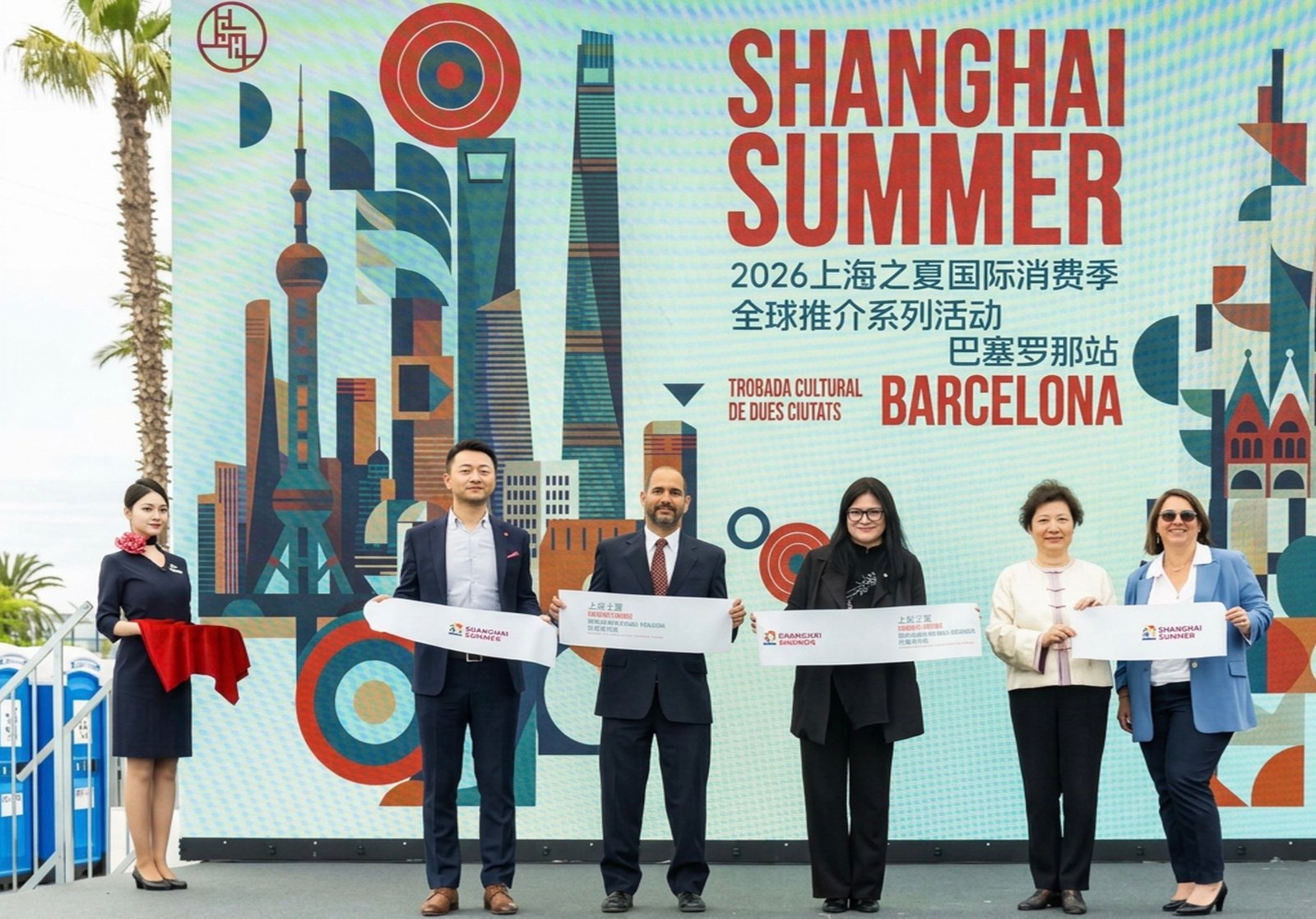
The same official account describes sister-city work as a means to advance Belt and Road cooperation, create investment and commercial platforms, develop overseas innovation centers, conduct cultural outreach, provide foreign aid, and promote “people-to-people connectivity.” It cites Shenzhen’s economic and investment exchanges with Barcelona as one example.
This is not simply ceremonial diplomacy. It is a way to create durable channels of access inside foreign societies and institutions.
The 2017 China-Netherlands Friendship Provinces and Cities Conference in The Hague was explicitly organized under the Belt and Road framework. Chinese representatives described it as a signal that local governments would jointly promote Belt and Road cooperation. Chinese and Dutch local authorities, business representatives, overseas Chinese organizations, and cultural institutions were assembled as parts of the same network.
This is the overseas equivalent of Beijing’s domestic “pairing” logic. In the Uyghur Region, the Party uses pairing assistance to bind a subordinated region to provincial administrations, state enterprises, schools, and cadres from elsewhere in China. In Europe, it uses friendship-city diplomacy to bind local institutions and commercial networks to China’s economic and political strategy.
The same pattern appears in China’s account of foreign aid.
A 2019 “People’s Daily Online” article argues that foreign assistance is not “generosity at the expense of China.” It openly states that aid creates opportunities for Chinese enterprises to “go out,” acts as an advance opening for labor-contracting projects, and carries Chinese goods and standards abroad.
This matters because the vocabulary of aid is repeatedly used to make state penetration appear humanitarian, technical, or mutually beneficial. The official record itself acknowledges the link between aid, commercial entry, Chinese standards, and strategic influence.
The logic resembles Beijing’s approach in the Uyghur Region: material assistance is never politically neutral. It builds relationships of dependence, opens institutions and markets, and places the recipient within a wider Chinese state-led network.
The overseas “110” network shows how the language of service can extend state power across borders.
In January 2022, Fuzhou Public Security Bureau officially launched an “Overseas 110” reporting platform for people from Fuzhou living abroad. The official announcement described the program as extending the reach of “Safe Fuzhou” overseas. It established a channel through which Fuzhou police could handle overseas cases or, where necessary, report upward to the Ministry of Public Security.
The official platform formed part of a wider policing architecture. Safeguard Defenders documented at least 102 Chinese overseas police service centers in fifty-three countries. They found evidence that some were involved in “persuasion to return” operations outside normal judicial and extradition procedures.
Radio France Internationale reported that overseas police-service stations were often embedded in overseas Chinese associations. The logic mirrors the model developed in the Uyghur Region: service produces access; access produces information; information enables control.
Beijing also seeks to cultivate foreign scholars as instruments of international communication.
Two “China Daily” articles published in December 2024 call for treating foreign sinologists as strategic assets. One describes them as “seeds” of Chinese culture that should be planted in foreign “soil,” while reducing the local environment’s “rejection.” It calls on them to help reduce negative perceptions of China and actively make “China’s voice” heard.
Another proposes a “one person, one history” strategy for foreign sinologists. It calls for collecting and analyzing their motivations, careers, social standing, political interests, views of China, responses to public crises, and attitudes toward the Belt and Road Initiative and the “community with a shared future for mankind.”
The objective is to build databases, identify patterns, assess risks, target resources, and guide China’s international communication strategy. It also calls for young sinologists to understand China and the world through “Chinese thinking.”
This is not academic exchange. It is the political cultivation of foreign authority for Beijing’s external narrative.
Uyghurs know what Beijing’s vocabulary means in practice.
“Development” can mean dispossession and political incorporation. “Aid” can mean administrative penetration. “Ethnic unity” can mean state intrusion into the family home. “Service” can become surveillance. “Cultural nourishment” can mean replacing a people’s language, religion, memory, and identity. Carefully selected stories of prosperity can conceal a system of repression.
The same Party-state extends its influence abroad through overseas Chinese networks, friendship-city ties, business, culture, media, education, academic networks, aid, and policing arrangements. Beijing’s own documents define these networks as tools for gathering people, resources, narratives, and loyalties in support of China’s national power.
The Uyghur Region reveals the governing logic in its most open and coercive form. Outside China, the same logic works through local access, organized networks, economic dependence, cultural legitimacy, and political mobilization.
The vocabulary changes. The system does not.
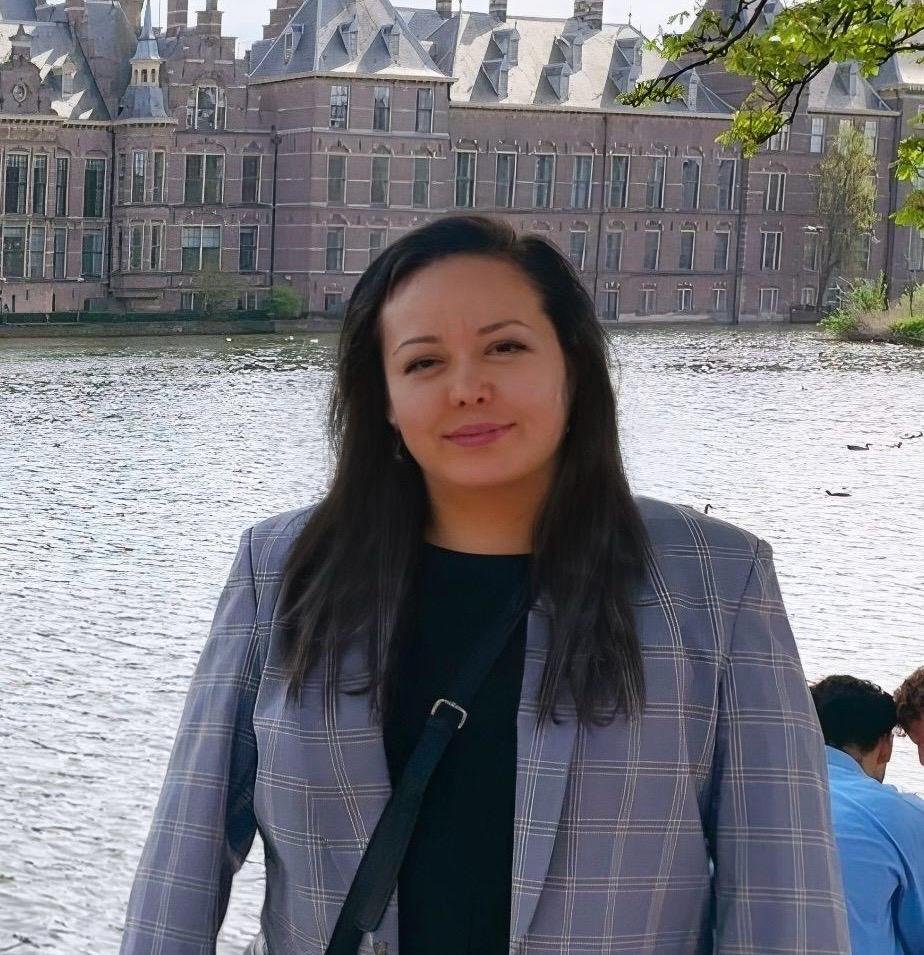
Asiye Uyghur is a Netherlands-based Uyghur writer and political commentator. Before the closure of Radio Free Asia’s Uyghur Service, she worked there as a political commentator. She currently publishes commentary and analysis in English, Dutch, and Chinese on Uyghur human rights, cultural repression, information control, and Chinese state policies related to Uyghurs through platforms including Global Voices, the Uyghur Human Rights Project (UHRP) as a guest contributor, and the Dutch publication “De Kanttekening.”