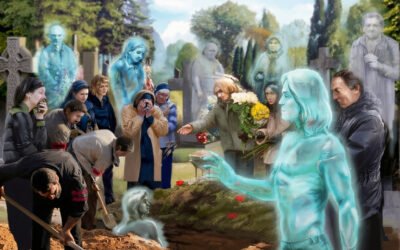
Written early in his career for committed students, the book builds an internally consistent cosmology of four gods and five souls.
by Massimo Introvigne
Introduction: Three categories of spiritual seekers
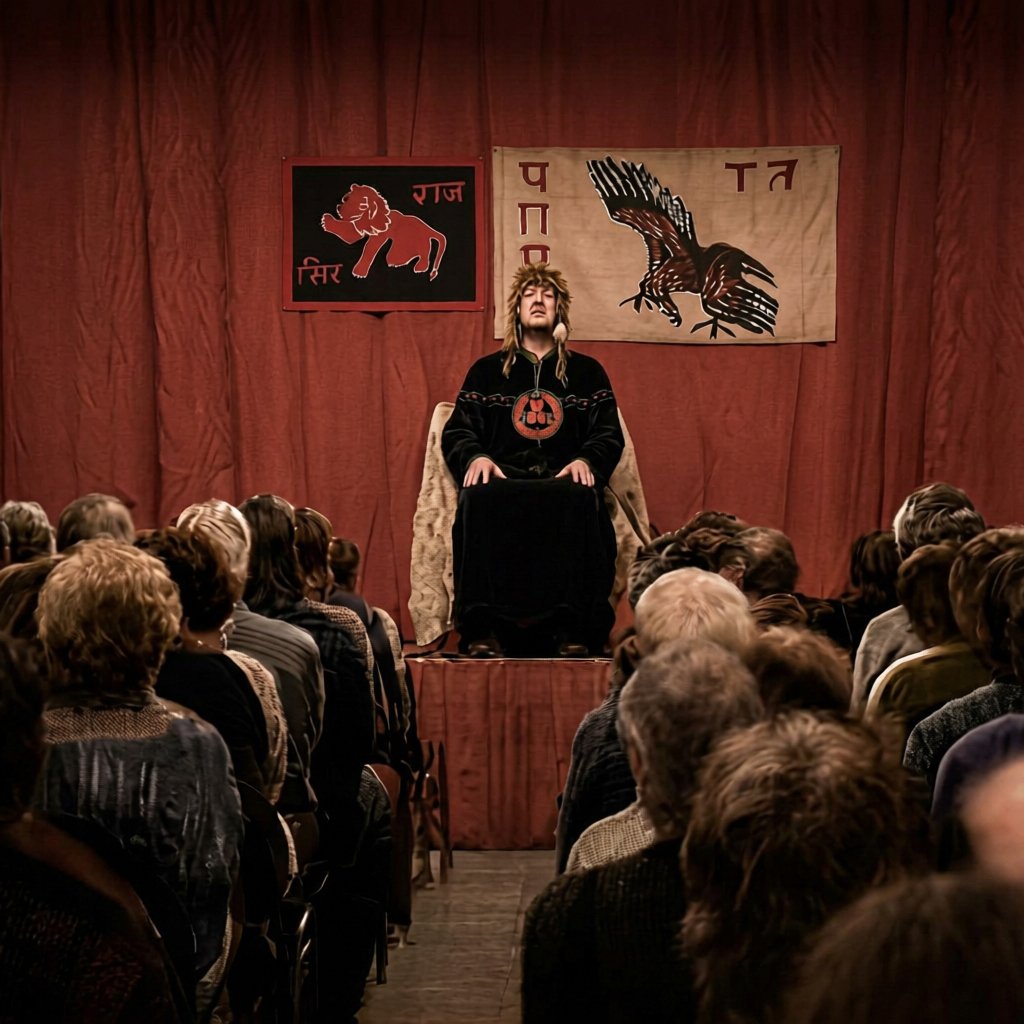
Konstantin Rudnev’s teachings are easily misunderstood, and the criminal case opened against him in Argentina in 2025 shows how quickly misunderstanding can turn into misrepresentation. His books use a dense symbolic language that blends Siberian ethnography, Slavic mythology, Eastern philosophy, modern esotericism, and narrative fiction. Investigators and journalists unfamiliar with these traditions tend to read them as operating manuals. A ritual sacrifice then looks like cruelty, a dream marriage with a spirit looks like a sexual program, and an invitation to detach from family and possessions looks like a technique of manipulation.
Isolated from the system that gives them meaning, passages from Rudnev’s books can be made to say almost anything. The remedy is the ordinary method of religious studies: reading a text as a whole, identifying its genre and sources, and asking what its author wanted it to do for its readers. This article applies that method to one of Rudnev’s early works, “Siberian Shamanism,” a book that has received much less attention than his later writings. However, it contains, according to those closest to him, the foundations of his teaching.
Tamara Rudneva, Rudnev’s wife, helped clarify the book’s purpose in a series of conversations in October 2026. She suggested that Rudnev’s work cannot be understood without a typology of seekers he uses informally, which also explains why his books look so different from one another.
According to this typology, people who approach spiritual schools and seminars fall into three groups. The largest, about 60–70%, consists of those Rudnev calls in Russian “bytoviki,” which Rudnev translates as “practical seekers.” They come with concrete problems concerning health, relationships, money, career, or finding a partner, and hope that spiritual knowledge will solve them. Rudnev takes these concerns seriously and speaks to such people in a language they understand, showing how knowledge of the “subtle plane,” of the inner centers, and of self-observation may help them. Most of them, however, leave once their problem is solved, and Rudneva compares them to occasional Christian churchgoers who appear only when they need something.
The second group, about 20–25%, are the “fokusniki” or “dukhovnye turisty,” “wonder seekers” or “spiritual tourists.” They are fascinated by UFOs, extraterrestrials, the yeti, hypnosis, the opening of the third eye, and all sorts of paranormal powers, and they move from one teaching to the next in search of new marvels. Rudneva compares Rudnev’s attitude toward them with that of George Gurdjieff (1866–1949) toward Piotr D. Ouspensky (1878–1947), as described in Ouspensky’s “In Search of the Miraculous.” Ouspensky was drawn to the miraculous, while Gurdjieff kept turning his attention back to observing his own consciousness and behavior. Rudnev, she argues, deliberately uses images of aliens, mysterious beings, and extraordinary abilities to capture this public’s interest, then tries to redirect it toward the question, “Who am I, really?”
The third group, 5–10% or fewer, are the “dukhovniki,” or “genuine spiritual seekers.” They want self-knowledge and inner transformation, and they are willing to observe their thoughts, feelings, and habits and change them. For Rudneva, the center of Rudnev’s activity lies in moving people from the first two groups into the third. The variety of subjects in his books would thus correspond to a variety of audiences, while the goal remains the same. In her words, “the form may vary dramatically because it is intended for different audiences.”
This typology accounts for the distance between “Siberian Shamanism” and later books such as “Secrets of the Dead” and “The Dawn of Inliranga,” which Rudnev wrote while imprisoned in Russia. The later works address all three groups at once, which is why they mix practical advice with fantastic narratives and sometimes grotesque imagery. “Siberian Shamanism,” written relatively early, is according to Rudnev “primarily intended for readers belonging to the third category.” It makes no effort to entertain or offer quick solutions, and its density of terms, symbols, and mythological relationships demands slow, systematic study. She adds that without such study “it is difficult to gain a truly comprehensive understanding of the foundations of Rudnev’s teaching.” The following paragraphs try to take this suggestion seriously.
The architecture of “Siberian Shamanism”
“Siberian Shamanism” is organized as a sequence of short chapters, most of them dialogues between a young disciple, Saosh Yant, and his master, an old shaman called the Northern Kam, the Great Shaman, or simply Old Kam. Saosh Yant is a city dweller who moves to the Altai mountains, where he discovers how the taiga, hunting, skiing, and long walks restore an energy he lost “living in easy conditions” (“Siberian Shamanism” [undated and privately published], 1; the following parenthetical references in this article refer to that book). The master answers his questions while preparing tea with mountain herbs, playing the jew’s harp, or tending the hearth, and the teaching unfolds through visions, rituals, and stories.
The name of the disciple deserves attention. It recalls the Saoshyant, the savior figure of Zoroastrian eschatology, and the choice fits a character told in a vision of the World Tree that he is “destined to become a Shaman of the whole world” (35). The structure of the book, with an urban apprentice initiated into an indigenous tradition by a stern and ironic master, will remind many readers of Carlos Castaneda’s (1925–1998) books on Don Juan, which Rudnev did read with interest. The Northern Kam’s insistence that a shaman must learn to “remember in their dreams that they are asleep” belongs to the same family of ideas about lucid dreaming (10).
The literary form is important for interpretation. “Siberian Shamanism” is an initiatory narrative and a didactic dialogue, written in the manner of a fairy tale and repeatedly commenting on fairy tales. Its characters include talking cuckoos, a deer that asks to be sacrificed so that it may be reborn as a human, a dead uncle living among broken plates in the land of the dead, and a tourist punished by the spirits for desecrating a shaman’s grave. Reading such episodes as factual claims or as instructions to be executed literally would be as misleading as using John Bunyan’s (1628–1688) “The Pilgrim’s Progress” as a travel guide.
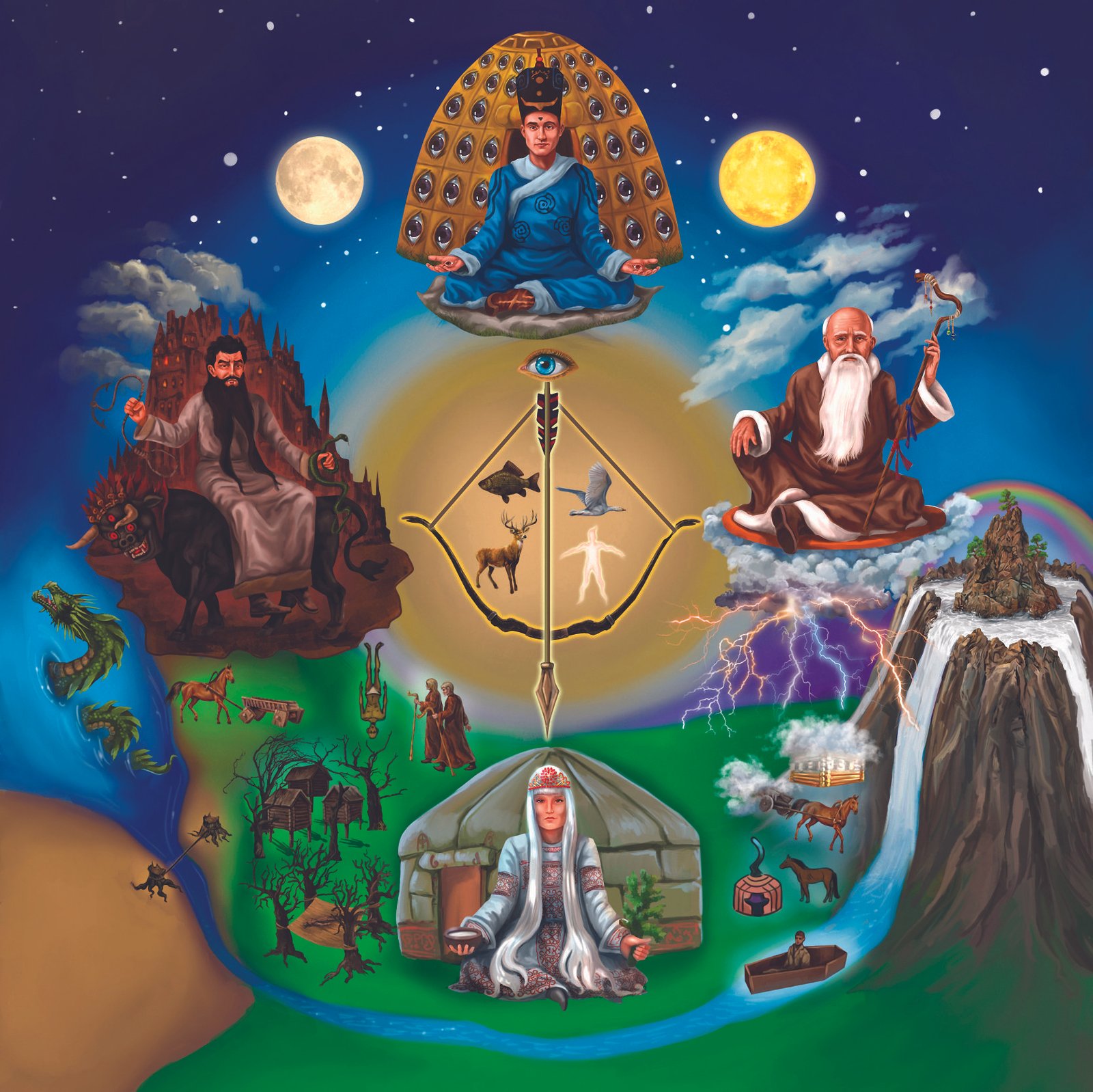
Rudnev’s cosmos rests on four gods, each presiding over a portion of time. Eternity is the realm of Tengri-khan, source of all things and keeper of cosmic harmony. The future is entrusted to the creative Ulgen-khan, the present to Umai, who protects material existence, and the past and the underworld to Erlik-khan. The materials Rudnev works with come from several regions and periods. The pantheon of Tengri, Ulgen, Erlik, and Umai belongs to the Altai and to the wider Turkic and Mongolic world. Other terms come from the Sakha (Yakut) of northeastern Siberia: the “Yhyakh” summer festival with its consecration of kumis (fermented mare’s milk, a mildly alcoholic, slightly sour and fizzy drink), the “arankas” platforms on which shamans were laid to rest, the evil spirits “abaasy,” and the souls Kut and Syur. According to Rudnev, the human person is made up of five souls, and each has its own task, whether perceiving reality or sustaining life. Aiy links the individual with eternity. The future is grasped by Bos (also spelled Bosi) and the past by Tyos (also spelled Tes), while Syur (also spelled Sur) journeys from one world to another. Kut supplies the body with its vital force.
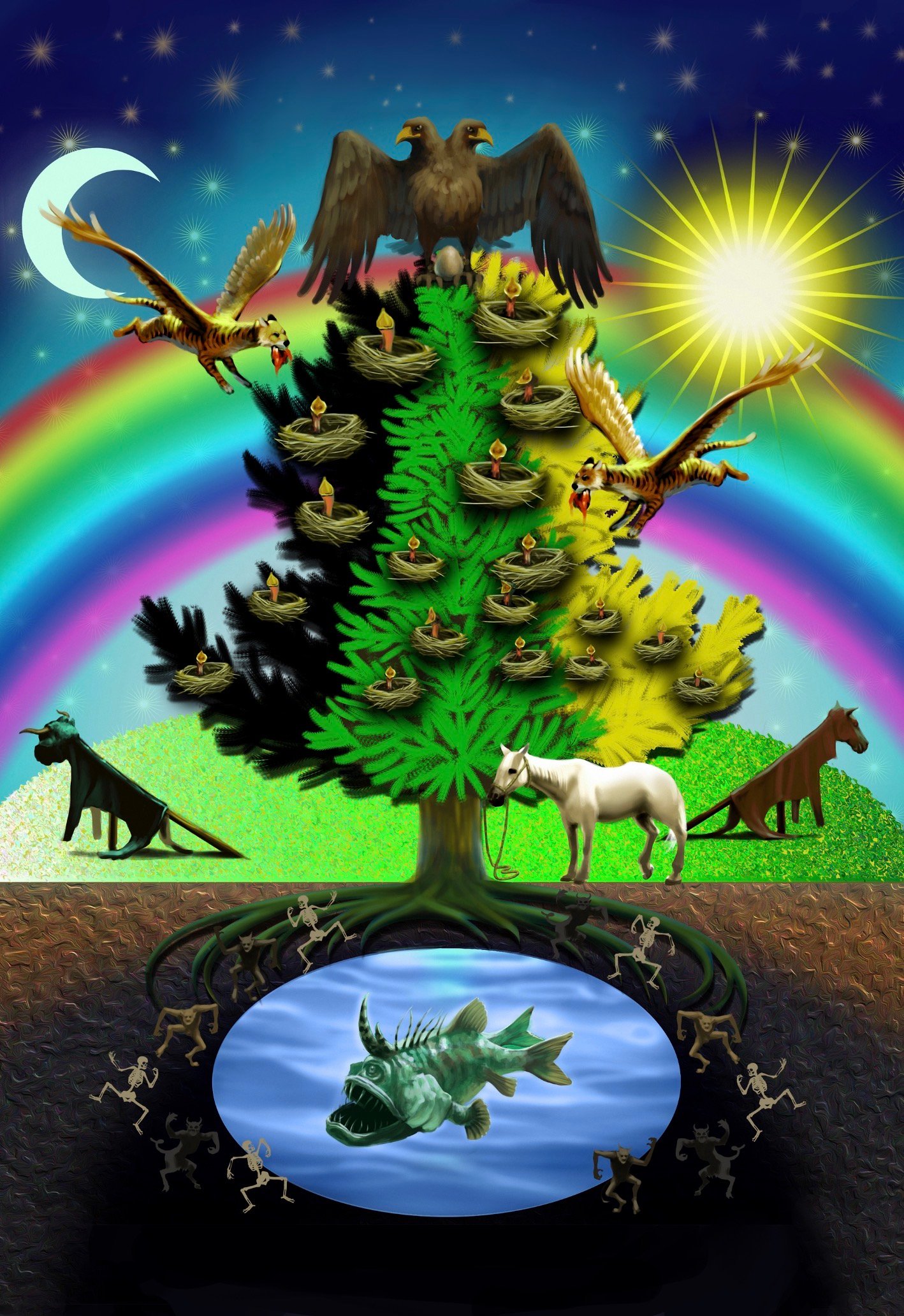
The image of the shaman’s soul raised in a nest on a cosmic tree, nursed by a “Mother-Animal,” with the most powerful shamans placed in the highest nests, echoes Sakha accounts collected in the 1920s by Gavriil Ksenofontov (1888–1938) and made famous internationally by Mircea Eliade (1907–1986). So does the initiatory dismemberment in which spirits devour the candidate and count his bones, finding in Saosh Yant’s case “one extra bone,” the sign of a future shaman (41).
The word “Ayami,” used for the spirit wife who chooses and protects the shaman, comes from the Nanai (Goldi) of the Amur region, described by the ethnographer Lev Shternberg (1861–1927) in his classic study of “divine election.” Several chapters move into Slavic mythology, with Svarog, Rod, Veles, Perun, Makosh, and the triad of Prav, Yav, and Nav, a vocabulary popularized in post-Soviet Russia by the Rodnoverie or Slavic Native Faith movement. Belovodye, the hidden land of white waters that Saosh Yant reaches through a cave, is a tradition of the Russian Old Believers. In the twentieth century, Nicholas Roerich (1874–1947) and other esoteric authors placed it in the Altai mountains. The book also mentions Hinduism, Sufism, the Tibetan “Bardo,” the Christ—and figures such as Albert Einstein (1879–1955), Alexander Pushkin (1799–1837), and others as models of future giants of thought being prepared in the “world of eternity.”
Rudnev is thus doing something different from ethnography, and the book never claims to describe the beliefs of a specific Siberian people. He builds an original synthesis, using Siberian materials as a language to express a philosophy of consciousness, time, and liberation. Scholars of contemporary religion would place it in the broad field of neo-shamanism and of post-Soviet Russian esotericism. Evaluating it as an ethnographic description of Sakha or Altai religion would miss its purpose entirely.
Rudnev’s shamanic cosmology
The system’s cosmology appears in the chapter “Creation of the Shamanic World.” At the origin, Tengri creates the universe “seemingly without reason,” and “to create it, he divided himself into a man and a woman,” Tengri himself and his wife Umai (20). Umai gives birth to two sons, Erlik and Ulgen. Each deity receives a domain that is both a region of the cosmos and a dimension of time. As mentioned earlier, Tengri remains in “the world of sleep (without dreams),” which is eternity.
Ulgen, the younger son, rules the future and keeps creating new forms in the world of dreams. Umai governs the present and the physical world, called “the dense world of heavy dreams,” where she protects what has been created. Erlik, the elder son, rules the past and the underworld, and destroys and reclaims what Ulgen creates “so that the physical world wouldn’t become oversaturated with creations, leaving room for Ulgen to continue creating” (20–1).
This may well be the book’s most original esoteric idea. Erlik, lord of the dead in Altai tradition, appears as a necessary function in a cosmic economy. He is severe, and the Northern Kam calls him “the chief spirit” and “the first shaman,” yet his destruction is what makes renewal possible (15). The master explains that there are “only four main forces that drive the whole world”: a supreme ruling power (Tengri), a creating power (Ulgen), a preserving power (Umai), and a destructive power (Erlik) (17).
Readers familiar with Hinduism will recognize an analogy with the Trimurti of Brahma, Vishnu, and Shiva, and the book itself makes the comparison, observing that the sons and daughters of the four gods make shamanism as rich in deities as Hinduism or Greek religion. In the chapter on Slavic cosmology, Rudnev adds that “all this polytheism is nothing but a manifestation of the one true God, Dyy, in different forms” (75). The many gods are facets of a single principle, a position with evident affinities to Advaita Vedanta.
Cosmology mirrored in anthropology
The anthropology mirrors the cosmology. Each god gives the human being a soul, and “a person possesses five souls, each of which evolves during their life” (21). Tengri gives Aiy, the contemplative soul linked to eternity. Ulgen gives Bos, the soul that seeks new experiences, knowledge, and discoveries. Erlik gives Tyos, the soul of memory and of attachment to the past. Umai gives Kut, the vital force, whose essence “is the desire to possess something, to have something.” The fifth soul, Syur, is the double that travels in dreams, and it also carries a person’s destiny, since it is given by one of the four gods and determines which of them the person will serve (24).
Destiny manifests itself in temperaments and occupations. People of Erlik live in the past and leave a lasting memory; soldiers, weapons makers, and undertakers belong to him. People of Ulgen are inventors, scientists, artists, and fortune tellers. People of Umai are farmers, merchants, chefs, hairdressers, and others who produce, accumulate, and serve. People of Tengri are mystics, priests, and contemplatives, “uninterested in accumulation” and “aspiring only to the eternal, loving contemplation” (60). Each group has its “Mother-Beast,” and Saosh Yant asks whether this can be called “an egregore or energy field,” a term borrowed from Western esotericism that the Northern Kam graciously accepts (17). The typology serves as an instrument of self-knowledge, helping readers recognize the orientation of their own lives.
The World Tree arranges these elements in space. It connects the Upper World of the gods, the Middle World of humans, and the Underworld, home of the “evil spirits of illness, damage, failure, and loss” (2). On its branches, souls mature in nests oriented toward the four directions: east for Tengri, south for Ulgen, west for Umai, north for Erlik. The height of the nest measures the scope of a destiny, so that a shaman serving a single district is raised near the roots and one destined for the whole world near the top. The Mother-Beast appears three times in a person’s life: in the nest, during the initiatory dismemberment, and at death, when it returns the Syur to the god who gave it.
After death, the five souls separate and return to their sources. In the main account, Kut passes to the strongest among the deceased’s relatives; Bos goes to Ulgen; Tyos to the world of the dead; Syur to the god who sent it; and Aiy to Tengri, from where the cycle of rebirth resumes. The rare beings who grasp “the futility of wandering through the river of time” choose never to be reborn and “forever remain in the world of Tengri, becoming Tengri themselves” (22). Hell exists as a temporary state, and the Northern Kam insists that Tengri “would never allow a person to suffer in hell forever, as some religions claim” (64). The accounts vary in their details. One chapter places the final break with the Earth at forty days, and another at forty-nine, and the names of the souls appear as Syur and Sur, Aiy and Aiyy, Kut and Koot. These variations suggest a text composed over time and translated by more than one hand—and perhaps they warn against treating any single passage as a definitive doctrinal statement.
The book’s philosophical heart lies in the chapters on Belovodye and the world of dreams. Here the taiga becomes a metaphor for the human imagination. Every person enters this forest of dreams and is shown ready-made paths by parents and educators: “One path may be Christianity, another Marxism” (26), and others may be science, Buddhism, or the commonsense outlook of ordinary people. By imagining a path thousands of times, people program their own reactions, deciding in advance where they will be angry, jealous, afraid, or happy. Some paths lead to a swamp of self-pity, apathy, and fanaticism, others to a healing spring of strength and joy. The Northern Kam concludes that “materialists and idealists, scientists and believers are equally bound by the path of their dream,” and that happiness “lies in not depending on any particular path, no matter how alluring it may be” (26).
Coming from an author who grew up in the Soviet Union, the inclusion of communism among the paths that promise happiness and deliver conditioning has an autobiographical and political resonance. The teaching also has a psychological dimension. The exercises that train the Syur, such as mentally walking through one’s own apartment in the past, present, and future, or along a familiar road without losing concentration, resemble guided-imagery techniques. The advice given to someone whose parents instilled a weak Tyos is to recall past humiliations and reassess them, telling oneself, “It’s all trivial, it won’t break me, I can endure much worse” (28). The principle behind it, “What we remember is what begins to guide us, create or destroy us,” is close to the cognitive reappraisal used in contemporary psychotherapy (28).
A passage that could be superficially read as hostile to family life belongs to this context. The Northern Kam says that “to become a Shaman, one must not only be strong but also lack earthly attachments to children, family, money, and not fear death” (9). Elsewhere, he advises the would-be shaman to “consider your past as if it happened to someone else, and then imagine yourself burying the old you” (59). A prosecutor looking for evidence of a “cult” might take these lines as a method for cutting followers, or at least those who want to become shamans, off from their relatives. Within the book, however, they describe an interior discipline, the release of attachments and rigid memories that weigh down the soul. Renunciation of this kind has parallels in Christian monasticism, Buddhism, and Hindu asceticism, and few readers would interpret the Gospel’s call to “hate” father and mother (Luke 14:26) as a program for destroying families.
Soteriology and rituals
The chapter on the “golden egg,” framed in Slavic terms, summarizes the book’s soteriology. Each person is a miniature cosmos, an egg laid by the primordial god Dyy, with a spirit inside that must break three shells: imagination, emotional attachments, and the body with its habits and fear of death. Regarding the body, the master specifies that what must be overcome is “EXCESSIVE attachment to it, such as the fear of death, laziness, hunger, and discomfort” (76, capitals in the original). The surprising point is the order of the work. Most religions, Saosh Yant observes, focus on conquering the passions of the flesh. At the same time, the Northern Kam insists that “the first thing needed is liberation from Krivda,” falsehood, because “it’s imagination that makes attachments, dependencies, and desires excessive, unnatural, and unreasonable” (77). What remains after the shells are broken is a pure (Gurdjieffian) observer: “It observes but cannot be seen” (75).
The rituals narrated in the book put these ideas into practice. In the healing of Obia, a woman who has lost all interest in life, the spirits reveal that her Syur has wandered north toward the swamps near the underworld. Saosh Yant, impersonating his helper spirit, the bear, clears a windfall blocking her path. The narrator explains that the fallen trees “personified the disruption that occurred when Obia’s son died, and she grieved deeply, losing the purpose of her life” (49). The whole village takes part in the preparations, because the shaman “simply directs the power of these people towards achieving the goal” (46–7). The ritual is a collective, symbolic intervention in grief, and Saosh Yant defines shamanic ritual more generally as “a magical act of correcting the bad paths in the dream world that people had taken” (52).
Animal sacrifice appears several times, as it does throughout the ethnography of Siberia. The book distinguishes three types: a substitute sacrifice that transfers an illness from a person to an animal, a consecration that restores the balance between a person’s Kut and the “macro-body” of their possessions, and an offering whose soul carries a request to the gods (52). The second type involves no killing. A horse dedicated to Ulgen keeps living with the herd, and nobody may ride, harness, or slaughter it. In the chapter on exorcism, the villagers protest that the evil spirit has already taken too many cattle, and the spirits’ solution is a white cow consecrated to Tengri: “A bloodless offering to Tengri, we shall present” (51). Readers looking for a glorification of bloodshed will not find it here.
The most easily sensationalized passages concern Ayami. Saosh Yant first meets her as the spirit of a rock in the ocean, and they unite in a dance of love as an eagle and a white bird. Later she visits his dreams, where they make love as humans, as deer, and as birds. The book explains that “Ayami was his Shamanic wife in the world of dreams,” that every shaman has one, and even that one shaman had a male Ayami who appeared in women’s clothing (47). These scenes closely follow the “divine election” described by Shternberg among the Nanai, in which a spirit wife chooses the future shaman, visits him in dreams, and becomes his protector. They take place in the dream body, in a world where gender and species are fluid, and nothing in them refers to sexual relations between human beings. Treating them as evidence of sexual practices within a group would confuse a classic theme of Siberian religion with a rule of behavior.
The story “Revenge of the Spirits” teaches respect for sacred places. A tourist named Sergei mocks a shaman’s burial, dances on the arankas, and steals the dead man’s costume and drum. He gets lost, falls into a crevice, and the offended shaman visits him in a vision, telling him he will find no rest until he puts everything back. Rescued by the Northern Kam and Saosh Yant, he returns the objects, asks forgiveness, and is blessed. The moral concerns humility and reparation, and the spirits respond, Saosh Yant explains, as soon as the young man stops boasting and sincerely wants to right his wrong (65–71).
The final chapter, “Chichipkan,” contains a sentence a critic might misread and quote against Rudnev: “They take medicine, yet no one realizes that all illness and suffering come from evil spirits feeding on their bodies” (82). The statement comes from a shaman explaining his tradition’s worldview, and it targets the neglect of spiritual purification in modern life. Nowhere does the book tell readers to stop medical treatment. Spirit etiologies of illness are standard in the anthropology of shamanism, and scholars routinely distinguish between a tradition’s explanatory model and a prescription to abandon medicine.
The book also contains statements about other religions. Spirits, the narrator says, founded a primordial civilization whose knowledge reached humans through shamans and later, “in a distorted form, served as the foundation for the creation of various religions” (58). After a vision of the source of life, Saosh Yant learns that Christ “was also one of us” (46). Such claims belong to the perennialist current of modern esotericism, which regards all religions as expressions of a single primordial truth.
Conclusion
Read as a whole, “Siberian Shamanism” emerges as an ambitious attempt to build a complete system from Siberian, Slavic, and esoteric materials. The four gods correspond to dimensions of time and human orientations, the five souls map the person, and the World Tree, with its rivers of time, charts the journey from birth to liberation. Its goal is the one Rudneva identifies behind all of Rudnev’s work: the passage from external interests to the question of who one really is. The book proposes an ethics of effort, since “to go up requires enormous effort,” of detachment from false images of oneself, and of respect for nature and the sacred (2).
Whatever one thinks of its metaphysics, the book deserves careful study by anyone interested in Rudnev’s ideas. It also deserves to be protected from a fate common to the writings of new religious movements in court, being reduced to a handful of quotations wrenched from the symbolic universe in which they were written.
Massimo Introvigne (born June 14, 1955 in Rome) is an Italian sociologist of religions. He is the founder and managing director of the Center for Studies on New Religions (CESNUR), an international network of scholars who study new religious movements. Introvigne is the author of some 70 books and more than 100 articles in the field of sociology of religion. He was the main author of the Enciclopedia delle religioni in Italia (Encyclopedia of Religions in Italy). He is a member of the editorial board for the Interdisciplinary Journal of Research on Religion and of the executive board of University of Pennsylvania Press’ Nova Religio. From January 5 to December 31, 2011, he has served as the “Representative on combating racism, xenophobia and discrimination, with a special focus on discrimination against Christians and members of other religions” of the Organization for Security and Co-operation in Europe (OSCE). From 2012 to 2015 he served as chairperson of the Observatory of Religious Liberty, instituted by the Italian Ministry of Foreign Affairs in order to monitor problems of religious liberty on a worldwide scale.