False quotes of non-existent books are just one problem in the Victorian Inquiry report’s reliance on anti-cult apostate Patrick McIvor, who is mentioned 215 times.
by Bernard Doherty
Article 2 of 3. Read article 1.
The sweeping conclusions and recommendations of the Victorian Inquiry discussed in the first article of this series were to be expected and are an artifact of the entire procedural course of the inquiry as much as of the evidence that was presented.
When an inquiry commences with a preconceived list of behaviors it considers troubling (in this case, the Guidance note), invites submissions dealing with said behaviors, and then conducts a survey of a self-identified victim population asking which of these behaviors occurred in the group, it is hardly surprising that they found evidence of the victimization.
If you ask a group of self-identified victims about how they were victimized, you will find victimization. This is not an inquiry; it is a circular argument: it assumes the conclusion in the premise.
The claims made in the submissions and in the survey, moreover, were not tested in any forensic manner; they were accepted at face value—sometimes with truly bizarre results.
For example, one submission (No. 28), entitled “Psychological Mechanisms found in Scientology” (which was subsequently turned into an AI-generated podcast on YouTube), has all the hallmarks of having been directly generated by AI.
Throughout the submission, various uses of the term “cliché” occurred as “cliché.” This curious error is repeated five times.
Anyone who has spent any time in academia dealing with the raft of AI-slop that some students are now passing off as their work would immediately raise an eyebrow here. Not the Inquiry Committee, however, even though its chief researcher has actually published on the topic of the use of artificial intelligence for parliamentary procedure. Instead, this submission was treated, in all seriousness, as “lived experience” by the Inquiry.
This would almost be laughable, except that the submission is quoted—with the idiosyncratic mistake left uncorrected—in the second volume of the Report itself, entitled “In their words: Coercion and harm in high-control groups.” The quotation reads: “The practice of looking up misunderstood words in Scientology’s own Tech Dictionary can function as a thought‑terminating cliché by discouraging questioning and critical analysis. Additionally, it involves the use of loaded language, reinforcing emotional associations and making it harder for individuals to challenge or explore alternative perspectives” (Vol. 2, p. 27) (The interested reader can check the quotation in the Report on the Inquiry website here).
Social researchers interested in religion will no doubt have more to say about the methodological weaknesses of the Victorian Inquiry. Still, my focus here is more documentary and draws on my training as a historian—and my professional experience in dealing with a decade’s worth of cases of academic misconduct within a university setting.
Here, and in the following article, I present three examples drawn from the written submission, hearing testimony, and public presentation of Patrick McIvor, which I believe raise serious questions about the uncritical way in which the Victorian Inquiry examined evidence presented to it. I choose McIvor here because he has been one of the most public former members who have appeared in media around the Victorian Inquiry.
I preface what I say below by noting that I believe McIvor to be sincere in his desire to help genuine victims of religious harm, even if I believe his approach to be misguided and his claims about scholarship to be mistaken. I bear no personal animus toward him, but I do believe he has been misled.
McIvor’s story of negative experiences during his time in City Builders Church in Sale, Victoria, is well-known, and some were even featured on a “60 Minutes Australia” episode entitled “Praying for Power,” which appeared before the last Victorian State election in 2022.
I say nothing here to gainsay his personal experience. However, it is important to note that in that election, McIvor’s sister-in-law, Dr. Renee Heath, was a candidate for the Liberal Party and this report did center around the role of City Builders Church in her political ascent. She was subsequently elected and is currently a member for Eastern Victoria.
The estrangement between members of the wider Heath clan has been a major precipitating factor in the Victorian Inquiry, and this political aspect is directly relevant for how the government responds to the Committee’s recommendations.
In terms of evidence, McIvor was the lead author of the most significant submission placed before the Victorian Inquiry entitled “Beyond Belief: Responding to Cults and High-Control Groups in Victoria.” This is a lengthy document and makes some quite startling and troubling claims that warrant further scrutiny.
This submission is cited over 150 times in Volume 1 (“Crossing the line”), and 3 times in Volume 2 (“In their words”) of the Committee’s Report. Patrick McIvor himself is mentioned 208 times in Volume 1 and an additional 7 times in Volume 2.
Its recommendations, moreover, were influential on the recommendations made in the inquiry report. “Beyond Belief” was arguably the major document guiding the Committee, and so it requires scrutiny along with McIvor’s testimony.
So, what do we find when we examine this evidence?
I provide one example here, and two additional examples in the third part of this series.
Example 1. The Faked Reference.
On December 1, 2025, McIvor appeared before the Committee’s public hearings. As part of his testimony, McIvor included a 25-page PowerPoint presentation entitled “Group-Based Coercive Control: Findings and Recommendations.”
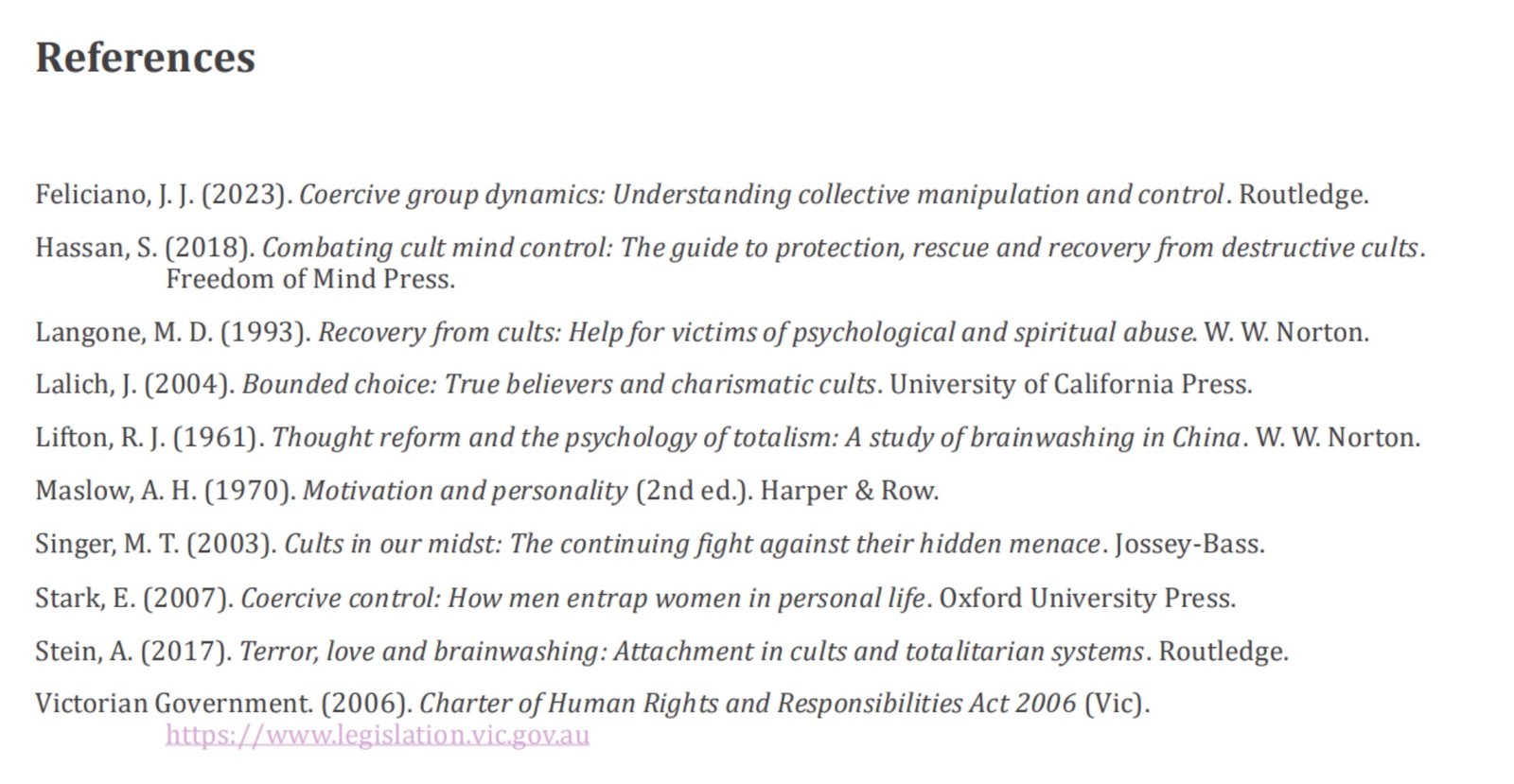
The presentation, like the “Beyond Belief” submission itself, is largely a hotch-potch of standard anti-cult works on “cultic brainwashing,” all of which have been the subject of critique elsewhere over recent decades. All the usual suspects are listed: Steven Hassan, Margaret Singer, Alexandra Stein, and Janja Lalich, alongside more moderate and respected anti-cult figures like Michael Langone and the late Robert Jay Lifton.
One name on this list, however, stood out: J.J. Feliciano. The reader well-versed in anti-cult writings will immediately observe on page 25 of McIvor’s presentation that he includes the following citation: “Feliciano, J. J. (2023). Coercive group dynamics: Understanding collective manipulation and control. Routledge.”
As you can observe if you search Routledge’s catalog, no such book appears.
This is because this book does not exist.
As for the author J.J. Feliciano, I am unable to find anyone who publishes on coercive control under this specific name—though there does appear to be a very talented child baseball prodigy named J.J. Feliciano whom American sports fans should watch in the future.
To apply the principle of charity, I believe the reference McIvor wished to cite is actually that of Sarah E. Feliciano, “An Application of the Coercive Control Framework to Cults.”
However, this is not a published book from a reputable press like Routledge, but a Master of Arts (MA) dissertation in criminology from John Jay College of Criminal Justice awarded in August 2023. This could have been an honest mistake, but it is not McIvor’s first, nor the last, involving documentation. (Interested readers can check the PowerPoint for themselves at the official Inquiry website here).
Remember, this was presented to a parliamentary inquiry, and “Group-based coercion” is being presented as a new and ground-breaking framework for dealing with “cults” or—using the euphemistic argot of the Victorian Inquiry—“coercive high-control groups.”
As the Victorian Inquiry recommended criminalizing “group-based coercion,” we should be very interested in the foundations of this theory. Feliciano, moreover, was to feature elsewhere in McIvor’s testimony, as I will demonstrate in the third part of this series.

Bernard Doherty is an associate professor in the School of Theology and a research fellow in the Centre for Religion, Ethics and Society (CRES) at Charles Sturt University, Australia, based at St Mark’s National Theological Centre in Canberra. He is also an Honorary Fellow of INFORM at King’s College, United Kingdom. He has published extensively on new religions in Australia.