A journalist describes years of abductions, confinement, coerced renunciations, and litigation that shaped public hostility toward the Unification Church.
by Masumi Fukuda*
*Address delivered at a press conference on the theme “Japan: The Hidden Story Behind the Eradication of a Religion,” organized by Human Rights Without Frontiers at the Brussels Press Club in Brussels, Belgium, June 29, 2026.
Article 3 of 3. Read article 1 and article 2.
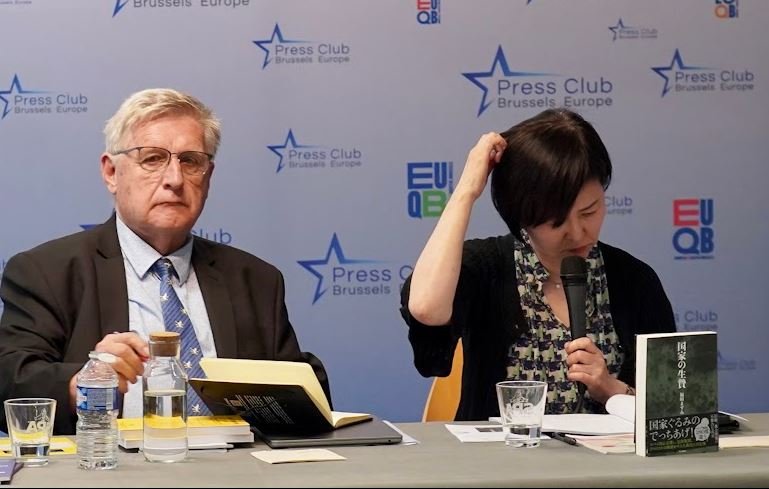
Allow me now to tell you a little about myself. Like many Japanese people, I have never had much interest in religion, and I did not have a particularly favorable opinion of new religious movements. Yet immediately after the assassination of former Prime Minister Abe, while criticism of the Unification Church dominated the media, I decided to begin investigating the organization myself.
Why? About a year before the assassination, I had interviewed a member of the Unification Church for an entirely unrelated news story. Religion was not the subject of our interview. He happened to be an expert in another field, answered every question accurately, and impressed me above all by his kindness, sincerity, and warmth. Although the church had long been viewed negatively in Japanese society, I remember thinking to myself, “People like him exist as well.”
After the assassination, the image of this thoughtful and compassionate individual was completely at odds with the public portrayal of the church as an evil organization exploiting Japan. I found this contradiction deeply unsettling. After considerable hesitation, I sent him a brief email of encouragement. I wrote something to the effect of: “This has become a witch hunt. It is a form of religious persecution. Please stay strong.”
He replied almost immediately. His response revealed the depth of his despair: “Your message brought me to tears. Right now, even my right to exist feels as though it is being denied. If I were the only one suffering, I could endure it. But I have a daughter, and when I think about what this may do to her… I was deeply shaken. Why should anyone have to endure such treatment simply because of their religious affiliation? And why was a relatively small religious movement, with only sixty to seventy thousand active members, becoming the target of such overwhelming hostility from an entire society? Those questions became the starting point of my investigation.
Throughout my career, I have tried to uncover truths that are overlooked or suppressed amid overwhelming media narratives and public opinion. One of the experiences that shaped this approach was my reporting in Russia. Around 2008, I spent considerable time at the independent Moscow newspaper “Novaya Gazeta,” interviewing its editor-in-chief, Dmitry Muratov, and many of its journalists. Based on that research, I wrote the book “Assassination State Russia: In Search of the Silenced Journalists.”
Under Vladimir Putin’s government, journalists who exposed truths inconvenient to those in power were systematically targeted and murdered. Novaya Gazeta,” with little more than one hundred employees, suffered more than perhaps any other newspaper. Since its founding in 1993, five of its journalists and one legal adviser have been killed through shootings, poisoning, or brutal assaults. Yet I met reporters who continued their work despite these dangers, refusing to surrender their pens. In 2021, Dmitry Muratov was awarded the Nobel Peace Prize.

As my investigation continued, I discovered numerous aspects of the Unification Church that had received little or no attention in the mainstream media. What concerned me most were the unanswered questions surrounding religious freedom, human rights, and the role of journalism itself.
The most shocking discovery was that, between 1966 and 2014, more than 4,300 members of the Unification Church were reportedly abducted and confined, often in private apartments or psychiatric institutions, in attempts to force them to renounce their faith. One individual remained confined for twelve years and five months. Remarkably, this serious human rights issue has received very little coverage in Japan’s major media.
The accounts of many victims are deeply disturbing. They were told that they would not be released until they abandoned their faith. Some escaped by jumping from third-floor windows, suffering severe spinal fractures. Others leaped from the sixth floor. Although they survived, they were left with permanent brain injuries and memory loss. Some, driven to despair, drank soy sauce or household detergent in desperate attempts to gain their release. Some took their own lives. Some young women reported being sexually assaulted by those holding them captive. Ultimately, an estimated 60 to 70 percent of those subjected to these abductions and prolonged confinements abandoned their religious beliefs under pressure.
Even after leaving the church, many continued to suffer from long-term psychological trauma, including post-traumatic stress disorder.
Who, then, is responsible for these abductions and confinements? In most cases, they are carried out by the believers’ own relatives. According to my research, these family members are influenced by deprogrammers who specialize in forcing people to renounce their faith, as well as by Christian pastors who denounce the Unification Church as heretical. Parents are told things such as “If your son or daughter remains in the Unification Church, they will become a criminal.” Convinced that they are acting in their child’s best interests, they are persuaded to abduct and confine their own family member.
This arrangement allows the deprogrammers and pastors to avoid direct involvement in the confinement itself. The police generally do not intervene, treating these cases as private family matters and therefore outside the scope of criminal intervention.
Once the believer has been confined, the deprogrammers and pastors repeatedly visit the apartment or house where the individual is being held. They attack the church’s teachings, denounce its founder, subject the believer to relentless verbal abuse, and in some cases resort to physical violence. Their objective is to break the person’s resolve and compel them to abandon the faith.
I regard this system of abduction and confinement as one of the gravest human rights violations in post-war Japan. What is even more disturbing, however, is that it evolved into a systematic and self-perpetuating enterprise.
When a believer finally declares that they have left the Unification Church, the deprogrammers reportedly require a series of “tests” to prove that the renunciation is genuine. These may include submitting a formal resignation letter to church headquarters, writing a lengthy statement resembling a confession or apology, drinking alcohol, which church members are prohibited from doing, and even visiting other confined believers in an effort to persuade them to abandon their faith.
Ultimately, many are instructed to file lawsuits against the Unification Church. If they refuse, their sincerity is called into question, leaving them with little practical choice but to comply. In these lawsuits, they may claim that they were subjected to mind control, manipulated into joining the church, pressured into purchasing religious items, or induced to make large donations.
In my view, this process transforms victims of abduction and confinement into individuals presented as victims of the Unification Church itself. These lawsuits, taken together, reinforce the public perception that the church has caused widespread harm, further damaged its reputation, and imposed substantial financial burdens through repeated litigation. I believe this is one reason the church has faced so many civil lawsuits brought by former members.
Meanwhile, according to my research, the deprogrammers and Christian pastors receive substantial payments from family members when the deconversion is considered successful. In effect, forced deconversion becomes a business. At the same time, pastors may gain new members for their own congregations by attracting former Unification Church believers whose faith has been broken. In this way, the system creates multiple incentives for those involved.
Nearly all lawsuits brought against the Unification Church have been handled by lawyers associated with the National Network of Lawyers Against Spiritual Sales (NNLASS), as I mentioned earlier.
Interestingly, in a civil case brought by a church member who had been confined for twelve years and five months, an attorney who had previously belonged to NNLASS submitted a written statement criticizing the organization itself. The lawsuit was directed not only against the relatives who carried out the confinement but also against the deprogrammers who allegedly orchestrated it and the Christian pastor involved.
According to that statement, lawyers affiliated with NNLASS were well aware that deprogrammers were carrying out abductions and prolonged confinements, yet they tacitly accepted these practices. It also suggested that many lawyers came to regard such cases as financially rewarding because, in their view, courts were more likely to rule against organizations labeled as “cults.”
One attorney reportedly observed that courts were willing to accept legal arguments against a group labeled a “cult” that would not ordinarily succeed in other civil cases. He suggested that there was an unwritten assumption within the judiciary that, if one represented a group labeled a “cult,” defeat was almost inevitable. If these assertions are correct, they raise profoundly troubling questions about the impartial administration of justice.
I myself am currently being sued for defamation by one of the NNLASS lawyers. The lawsuit alleges that an article I published in a monthly magazine contains false statements. I strongly dispute those allegations. I possess extensive documentary evidence to support my reporting, and I am presenting it before the court.
The lawsuit was filed shortly after the publication of my book, and I cannot help wondering whether its purpose was, at least in part, to discourage or obstruct its publication.
The consequences of forced deconversion extend even further. Many former members who renounce their faith under these circumstances emerge profoundly embittered toward the church. Some later appear in the media or testify in court, making allegations that further damage the church’s public image.
Whether accurate or not, these accounts reinforce negative public perceptions, prompting other worried families to seek out deprogrammers. Those families may then abduct and confine their own children, perpetuating the cycle. In my view, this creates an endless cycle of abduction, confinement, deconversion, and litigation.
I also believe there is a direct connection between this history of forced deconversion and the eventual dissolution order. According to my research, more than half of the plaintiffs in the civil cases cited as evidence against the church had themselves previously been abducted and confined. Their testimony formed part of the evidentiary record in many of those proceedings. I believe those testimonies played a significant role in the decisions that ultimately led to the church’s dissolution.
I realize that this may sound extraordinarily complex to those hearing it for the first time. Yet, after years of investigation, I have concluded that government agencies, the Ministry of Education, Culture, Sports, Science and Technology, elements of the judiciary, the police, and certain lawyers’ organizations collectively created conditions that led to the dissolution of the Unification Church. Alongside this process, the alleged forced deconversion of more than 4,300 believers represents, in my opinion, a grave human rights issue. I am generally skeptical of simplistic conspiracy theories. Nevertheless, based on my research, I believe this case reflects a coordinated effort by state institutions that cannot be understood simply as a series of isolated events.
Some may argue that this situation is minor when compared with religious persecution in countries such as China or Russia. Indeed, religious leaders and believers have not been imprisoned or executed. Yet I believe the situation is serious precisely because it has occurred in a highly developed democratic nation that claims to uphold freedom, the rule of law, and freedom of religion. In my view, the state’s failure to address widespread alleged human rights violations, together with the seizure of places of worship through dissolution proceedings, represents a subtle but deeply troubling form of religious persecution.
The courts have argued that dissolution merely removes the legal status and tax privileges of a religious corporation and therefore does not interfere with religious freedom. In my opinion, however, that reasoning is little more than a legal fiction. A religious community deprived of its legal existence inevitably loses much of its ability to function, organize, and practice its faith collectively.
To all of you in Europe who value freedom, democracy, and religious liberty, I ask you to take an interest in what I believe is a case of religious persecution unfolding in a democratic country in the Far East. I also ask you to lend your support to those believers who believe their fundamental rights have been violated.

Masumi Fukuda was born in Yokohama in 1956. She graduated from the Department of Sociology of Rikkyo University. After working for a specialty magazine and a magazine production company, she became a freelance journalist. She has reported and written about crime, Russia, and other topics. Her books include “Stalin: A Portrait of His Family” (Bungei Shunju), “Russia, an Assassination State: In Search of a Missing Journalist” (Shinchosha), “The True Nature of Political Correctness” (Hojosha), and others. In 2007, she won the 6th Shincho DocumentaryAward for “Fabrication: The Truth About the ‘Murder Teacher’ in Fukuoka” (Shinchosha).