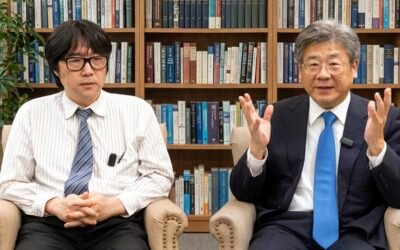
A conversation with critic Eitaro Ogawa reveals how political pressure, media hysteria, and flawed evidence converged to produce a judicial failure.
by Massimo Introvigne

When literary critic Eitaro Ogawa sat down with international attorney Tatsuki Nakayama, the conversation quickly moved beyond legal technicalities. It became a stark portrait of how a judicial process can be constructed on political pressure, media hysteria, and evidence that collapses under scrutiny. What emerges from their dialogue is an in-depth commentary on the dissolution case against the Family Federation. It is also a warning about the fragility of the rule of law in Japan.
Nakayama begins by recounting how he came to represent the Family Federation. It was late August 2022, about a month after the assassination of former Prime Minister Shinzo Abe, when a prominent lawyer he knew contacted him. He told Nakayama that no one else would take the case. Nakayama himself was not a believer, had no interest in religion, and knew little beyond old media stories from the 1990s. Yet the fact that fortyseven law firms had already refused shocked him. He describes a strong mood in the legal profession of not wanting to touch something unfamiliar, a kind of ambient fear.
Seeing that no one would take the case, he felt sympathy for the organization. More importantly, he felt compelled by his own professional ethic—integrity, the duty to speak up against injustice even when reputational risks are high. He decided to accept the case, fully aware of the potential damage to his reputation and family. For the first months, he worked not with the Japanese Family Federation but with the international headquarters, communicating mainly with American lawyers. Only later did he begin meeting leaders in Japan, including President Tanaka. His first impression was blunt: the people he met were completely different from the media image.
The conversation then turns to the sudden reversal of government policy. Nakayama explains that the Japanese government had initially—after Cabinet deliberation—adopted the position that, since the Family Federation had committed no criminal acts, a dissolution request was not legally justified. This followed the precedent set by Aum Shinrikyo, in which dissolution was tied to grave criminal activity. Then, in Diet testimony, Prime Minister Fumio Kishida reversed the position overnight, without providing a legal or factual explanation.
Nakayama was stunned. He recalls how embarrassing it was to report this internationally, because Japan is supposed to be governed by law, not by the whims of individuals. Later, he learned what had triggered the reversal. According to Nakayama, Constitutional Democratic Party lawmaker Konishi warned Kishida that if he did not move toward dissolution, he would be labeled “a billboard for the Unification Church.” Nakayama calls it a form of political intimidation. Kishida, he argues, flipped instantly. Ogawa notes that a Cabinet decision overturned in a single night, without new evidence, means the dissolution process began without legal foundation.
The Ministry of Education, Culture, Sports, Science and Technology exercised its “right to question” seven times over the course of a year, seeking evidence for dissolution. Nakayama describes the process as deeply flawed. Despite massive media coverage, no one appeared publicly with both their face and real name to testify to harm. Even at a study session for Diet members organized by the anti-Unification-Church National Network of Lawyers Against Spiritual Sales, alleged victims appeared only by video, making questioning impossible. Ogawa calls it a structure designed to prevent scrutiny.
Affidavits submitted by the ministry were disturbingly uniform. Nakayama says they resembled “kintarōame”—candy slices that all show the same face. Many repeated identical phrases such as “I was told I would fall into hell.” Some affidavits were typed in tiny fonts unlikely to have been read by elderly signatories. Worse, several former members denied having made the statements attributed to them. Nakayama filed criminal complaints, but police did not accept them. One must ask what Japan has become. If documents contain statements the signatories deny having made, and the system still refuses to act, the judiciary is failing in a way reminiscent of authoritarian regimes.
The courts’ reasoning also shocked Nakayama. The Religious Corporations Act requires that dissolution be ordered only when it is clear that a religious corporation has seriously harmed the public welfare. Nakayama emphasizes that “clear” and “serious” are extremely high legal thresholds. Yet since the Family Federation’s 2009 compliance declaration, only one civil case has resulted in liability—roughly one case per 30,000 to 40,000 donations. Nevertheless, in March 2025, Tokyo District Court Judge Kenya Suzuki declared that harm was “too serious to ignore.” Nakayama calls this a radical overreach: one case in fifteen years is not “too serious to ignore.”
The Tokyo High Court went further. Presiding Judge Motoko Miki treated settlements as evidence of civil torts and relied on the unprecedented reasoning that “the possibility of unlawful conduct cannot be ruled out.” Nakayama believes this was dishonest and unjust. In his entire career, he had never seen anything so extraordinary. Ogawa compares it to sentencing someone to death for shoplifting. He notes that if courts use extreme language without evidence, public opinion will assume extreme wrongdoing even when none exists.

Both speakers conclude that the dissolution case was driven not by law but by the atmosphere—media narratives, political pressure, and labels such as “too close” or “overly connected.” Nakayama cites physician Tetsu Nakamura, who once described the hysteria surrounding Hansen’s disease as “faceless cruelty.” He warns that Japan may now be entering a similar cycle: a tragic game of Old Maid, where no one knows who will be targeted next. Ogawa agrees, saying that before even asking whether the organization is right or wrong, Japan has crossed a line that a rule-of-law society must never cross.
The conversation ends with a plea. Nakayama urges people to recognize the danger of what has happened, to pause, and to speak out. Ogawa echoes him, saying that many people need to wake up to the abnormality of this situation.
In the end, their dialogue extends beyond a single religious organization. It is about the fragility of judicial independence, the power of media-driven narratives, and the courage required to resist them.

Massimo Introvigne (born June 14, 1955 in Rome) is an Italian sociologist of religions. He is the founder and managing director of the Center for Studies on New Religions (CESNUR), an international network of scholars who study new religious movements. Introvigne is the author of some 70 books and more than 100 articles in the field of sociology of religion. He was the main author of the Enciclopedia delle religioni in Italia (Encyclopedia of Religions in Italy). He is a member of the editorial board for the Interdisciplinary Journal of Research on Religion and of the executive board of University of Pennsylvania Press’ Nova Religio. From January 5 to December 31, 2011, he has served as the “Representative on combating racism, xenophobia and discrimination, with a special focus on discrimination against Christians and members of other religions” of the Organization for Security and Co-operation in Europe (OSCE). From 2012 to 2015 he served as chairperson of the Observatory of Religious Liberty, instituted by the Italian Ministry of Foreign Affairs in order to monitor problems of religious liberty on a worldwide scale.