Korean pastors, Japanese leftist attorneys, and Beijing’s Communist bureaucrats have formed a united front against conservative religion; so far, it has been effective.
by Massimo Introvigne*
*A paper presented at the CESNUR 2026 international conference, Taichung, Taiwan, October 11, 2026.
Politics, it is said, makes strange bedfellows, and anti-cultism makes even stranger ones. In 2025 and 2026, East Asia went through a religious liberty crisis that received less international attention than it deserved. Japan saw the dissolution of the Unification Church, now called the Family Federation for World Peace and Unification. The Tokyo District Court ordered it in March 2025, and the decision became final in 2026. South Korea witnessed the arrest and prosecution of the Family Federation’s leader, Dr. Hak Ja Han Moon, and of Chairman Lee Man-hee of Shincheonji.
These events are well known. Less known is the role China played in them, particularly through the China Anti-Xie-Jiao Association, established in 2000, which claims to be the largest anti-cult organization in the world. The claim is true, although the association is hardly a civil society organization. It is a branch of the Chinese Communist Party operating through the United Front, with representatives in small villages and, in the larger cities, in every few blocks of apartments. No Western anti-cult group, however enthusiastic, can boast a similar network of volunteers, though “volunteers” may not be the right word.
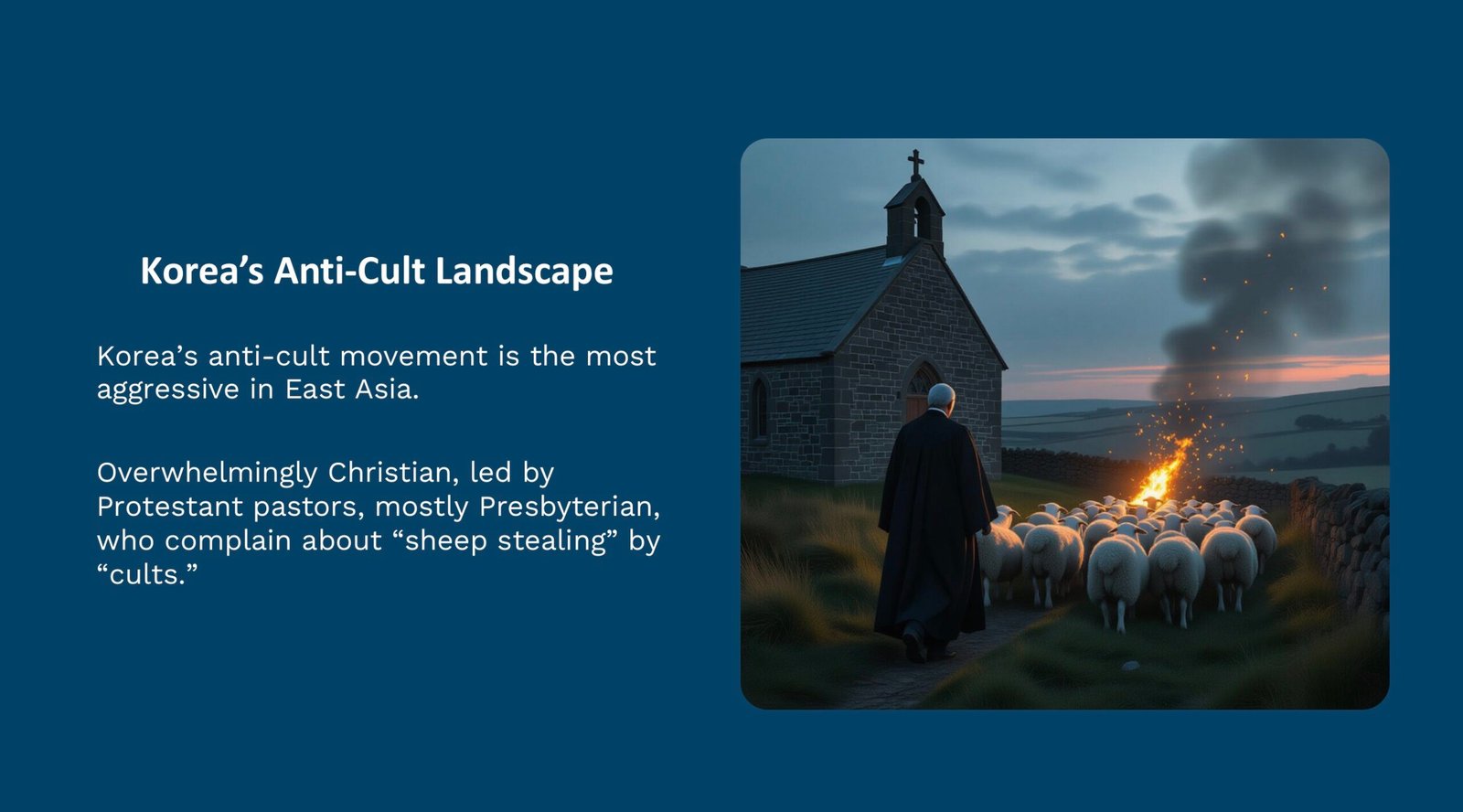
Korea’s anti-cult movement is the most aggressive in East Asia, and it has evangelical origins. In 1998, Protestant pastors, mostly Presbyterian, founded the Christian Heresy Research Council. They were worried about what they called “sheep stealing,” the migration of members of their congregations to the Unification Church and Shincheonji, a complaint as old as religious competition itself. The council later became the Christian Heresy Countermeasures Association, and the new name announced a more active approach, including deprogramming. During the 2000s, it started inviting pastors from abroad, and in 2012 it went global as the World Association Against Heresy, which incorporated a branch in Australia in 2015.
Deprogramming means kidnapping adult members of disfavored religious groups and confining them until they renounce their faith. Born in the United States, it later flourished in Japan. American and European courts ended it decades ago. In Japan, it mostly stopped after the case of Toru Goto, a Unification Church member confined for more than twelve years, whose captors were held liable by the Tokyo High Court in 2014 in a decision the Supreme Court confirmed in 2015. South Korea is the only democratic country where deprogramming has continued into the 2020s. Its case law is inconsistent. Deprogrammers who use open physical violence are sentenced, while parents who simply lock up an adult son or daughter are normally left alone, and law enforcement is often tolerant.
As in Japan, and unlike in the United States, Korean deprogrammers are pastors, often supported by mainline churches. However, there is a difference from Japan. In Japan, the Unification Church was the main victim of deprogramming, while in Korea no case involving the Unification Church has been reported. The explanation is demographic. Young Korean members of the Family Federation are overwhelmingly second generation, born to parents who are themselves members, and these parents have no intention of hiring a deprogrammer. Shincheonji is a different story, since many of its young members have evangelical parents, and thousands of its devotees have been deprogrammed. Other targets have included the World Mission Society Church of God, the Christian Gospel Mission, also known as Providence, and even the Jehovah’s Witnesses.
China entered the picture in 2007, when a Korean delegation attended an anti-cult symposium in Shenzhen, and perhaps even earlier. Since then, Chinese representatives have attended Korean anti-cult gatherings, Koreans have been welcomed at Chinese ones, and the China Anti-Xie-Jiao Association has publicized the Korean events. This is anything but normal. Korean evangelical anti-cultists are staunch anti-communists, and in theory they should regard as an enemy the atheist regime that persecutes Christians in China. In practice, both sides follow the old principle that the enemy of my enemy is my friend.
Why does the Chinese Communist Party support Korean anti-cultists? I see four main reasons. The first is that Korean churches and new religious movements, including Shincheonji, have been active as missionaries in China, where they are illegal, and Beijing likes to deal with problems at their roots. The second is ideological, and concerns above all the Unification Church, whose anti-communist activities have made it an enemy in the eyes of the CCP.
The third reason involves refugees. Chinese citizens can enter Jeju Island without a visa, and many members of religious groups persecuted in China used this door to escape and seek asylum in South Korea. There, they told everybody willing to listen that they had been arrested and tortured at home. Beijing did not appreciate the publicity, and Korean anti-cultists were mobilized for street demonstrations against the refugees. With some help from right-wing anti-Muslim activists, the agitation succeeded. Korea adopted a stricter asylum policy and started sending refugees back to China. The Church of Almighty God (CAG), which once counted hundreds of Chinese members in Korea, now has only a handful there, while the others are scattered around the world, many of them in Italy, where very few have been deported.
The fourth reason is intelligence gathering, since court decisions have established that some anti-cultists act as agents of Chinese intelligence services. This brings us to the protagonists. On the Chinese side, those interacting with the Koreans include Xu Tao of the Hubei Anti-Xie-Jiao Association, Professor Chen Dequan of Northeastern University, and Zhang Chunli of the Chinese People’s Public Security University, who teaches police “cult” prevention. Zhang once had long dialogues with British sociologist Eileen Barker, although I am not sure how much she learned from it.
The Korean side has two main protagonists. One is O Myung-ok, publisher of the magazine “Religion and Truth” and the website churchheresy.com, who has often supported operations against CAG refugees and demonstrations against the Unification Church and Shincheonji. Her activities were mentioned in a CAG refugee case in Italy. As a result, the Court of Rome noted in a decision of June 14, 2024, which happens to be my birthday, that she was a “special agent” of China. Birthday gifts come in many forms.
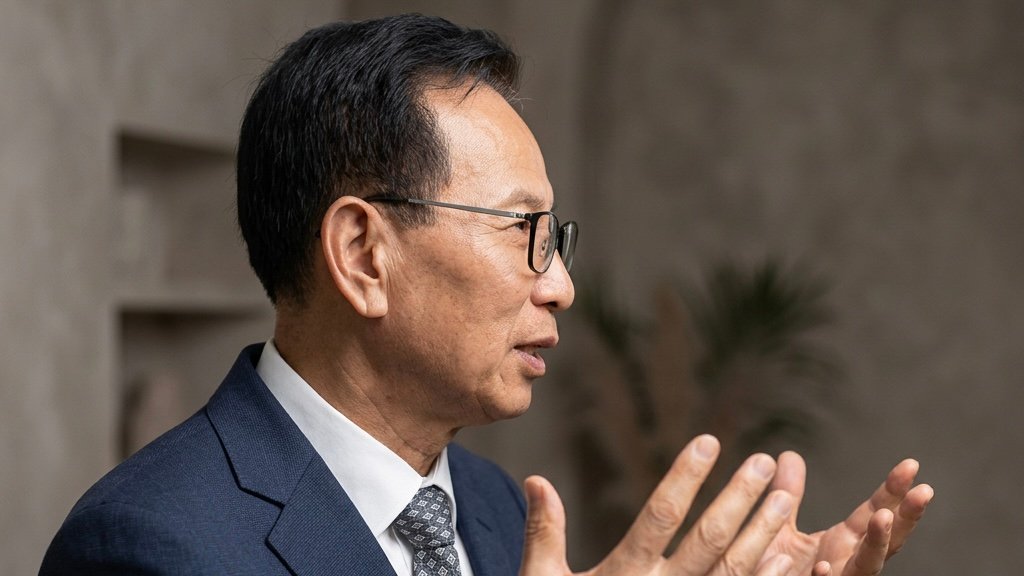
The other protagonist, and the network’s central node, is Pastor Jin Yong-sik, now president of the World Association Against Heresy. He is also a convicted felon. In 2007, he was prosecuted for illegally sending a member of the World Mission Society Church of God to a psychiatric institution as part of a deprogramming, and he was sentenced to ten months in prison with two years of probation. A 2012 investigation revealed that his deprogramming business had earned him more than one billion won, roughly 850,000 euros. Since 2023, Jin has toured the world, including Spain, Germany, and Mongolia, lecturing against Shincheonji and the Unification Church and supporting China’s repression of The Church of Almighty God and Falun Gong. One may wonder why a Korean Christian minister should be so concerned with Falun Gong, a Chinese spiritual movement that does not compete for his sheep, and who pays for his tours. I suspect the answer to both questions is the same.
The strange bedfellows form a triangle, whose third corner is in Japan. There, the partner is the National Network of Lawyers Against Spiritual Sales, founded in 1987. Thanks to the research of investigative journalist Masumi Fukuda, we know that its founders were members of the Communist or the Socialist Party, and the network has maintained close ties with the Japanese Communist Party, a significant force in Japanese politics. For Beijing, this partner is much easier to deal with than Korean fundamentalists, since leftist Japanese lawyers have no anti-communist scruples to overcome.
The assassination of former Prime Minister Shinzo Abe on July 8, 2022, launched the campaign that led to the dissolution of the Unification Church in Japan. Its perpetrator, Tetsuya Yamagami, whose mother is a member of the church, claimed he shot Abe to punish him for his friendship with it. The lawyers’ network moved fast, and its campaign crossed the sea almost immediately. On July 22, 2022, two weeks after the assassination, attorney Hiroshi Watanabe of the Japanese lawyers’ group joined a press conference in Seoul with Pastor Oh Myeong-hyeon, a notorious Korean deprogrammer, asking Korea to act against the Unification Church. Before the 2022 Jeongeup murders, Oh had persuaded a man that his ex-wife, a Shincheonji member, needed deprogramming, and the man later killed her and his sister-in-law.
On December 15, 2022, a conference in Seoul organized by Christian pastors promoted the adoption in Korea of a French-style anti-cult law. Watanabe was there again, together with Yoshifu Arita, a former Japanese legislator and veteran campaigner against the Unification Church. In case anybody wonders, Yoshifu is an unusual name in Japan, and it was chosen to honor Joseph Stalin, whose first name in Russian is Iosif. On May 13, 2025, nine Japanese pastors, together with Japanese and Korean deprogrammers, presented in Seoul an “Agreement on Cooperation Against Korean-Origin Heretical and Pseudo-Religious Groups.”
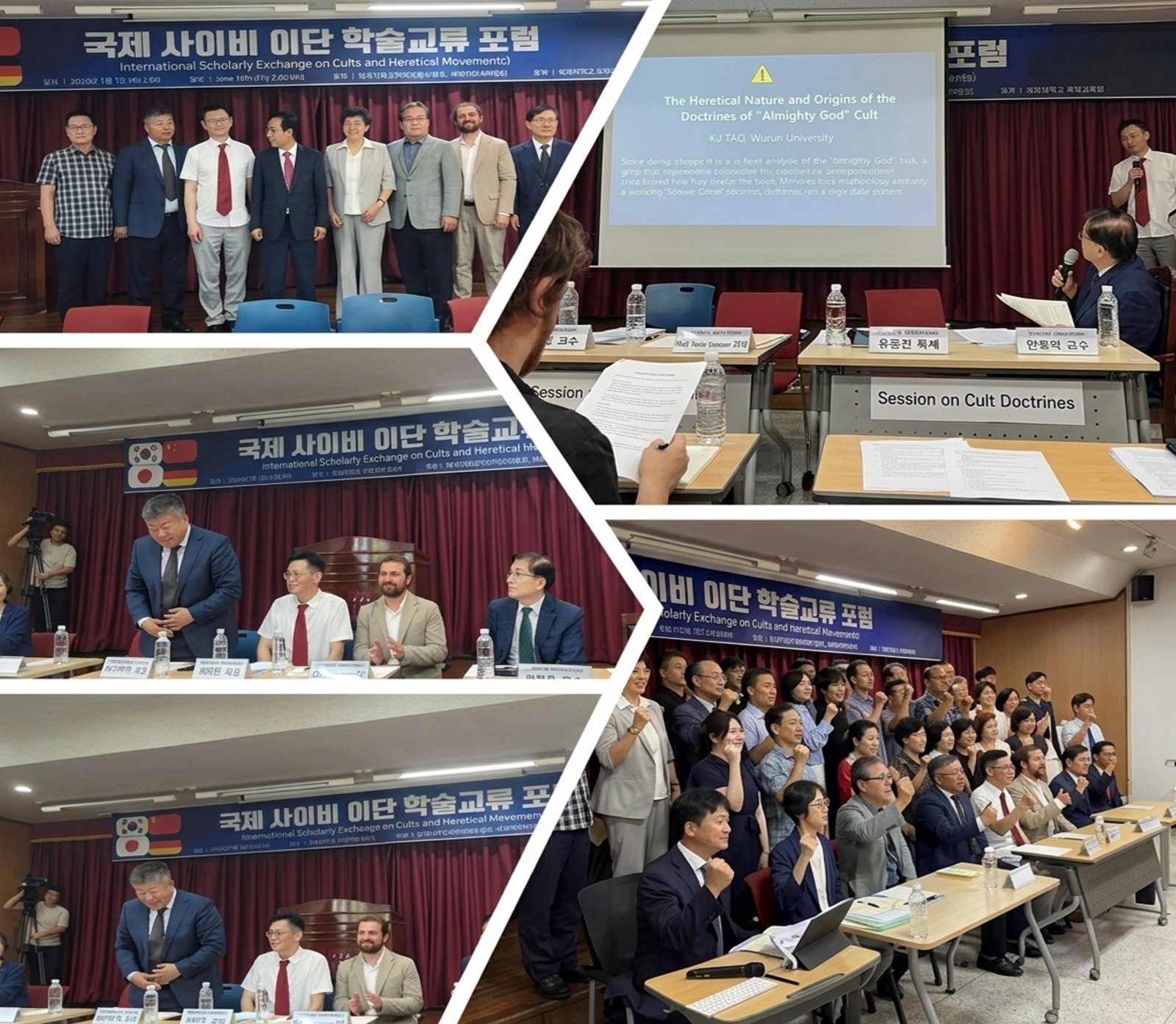
Mokwon University in Daejeon hosted the key event for the triple alliance in August 2025. Organized by the World Association Against Heresy, the “International Exchange on Cults and Heretical Movements” was meant to remain secret. Korean media did not publish a single word about it, and neither did the university’s website. Unfortunately for the organizers, Chinese media reported the event extensively, complete with pictures and lists of participants. Who reads Chinese media, after all? Well, I do.
Pastor Jin Yong-sik presided, with several other Korean anti-cultists. Japan was represented by scholar Hiroko Nakanishi, who co-authored a book against the Family Federation with Professor Yoshihide Sakurai, a well-known critic of the Unification Church. From China came Zhang Chunli, Chen Dequan, Xu Tao, this time representing the China Anti-Xie-Jiao Association, and Li Jinghu of the government-controlled Three-Self Church. A German evangelical anti-cult pastor completed the picture. The participants specifically called for decisive action against the Family Federation in Korea. The request did not have to wait long; in September 2025, Dr. Moon was arrested.
The story has a twist that is worthy of a Korean drama. President Lee Jae-myung’s government took harsh measures against the Family Federation and Shincheonji in 2025 and 2026. It has also turned against conservative evangelical churches, many of them with an anti-cult past, which oppose the president on LGBT and other issues. Authorities raided the Yoido Full Gospel Church, which later made peace with the president. Pastor Kim Jang-hwan was targeted in investigations, and Pastor Son Hyun-bo was jailed and sentenced; he is now free yet continues to be harassed, and his family bravely spoke up in favor of Dr. Moon. The anti-cult ideology, in other words, is now being used against some of those who created it. Mary Shelley, the author of “Frankenstein,” would recognize the plot.
In conclusion, a pragmatic triple alliance unites Christian fundamentalists in Korea, secular leftist activists in Japan, and Communist authorities in China. Its members share a common enemy, the “cults,” while their ideologies could hardly be more different. The alliance may run into trouble in the future, as the LGBT question and the clash between President Lee and some evangelicals could become irritants. For now, however, it has worked. The measures against the Family Federation and Shincheonji, together with President Lee’s anti-heresy crusade, show how anti-cult tools can be repurposed for political repression and for China’s geopolitical strategies, with the result of regional instability and serious risks for religious liberty. Of an alliance that achieves its aims, one would normally say: so far, so good. In this case, I prefer to say: so far, so not good.
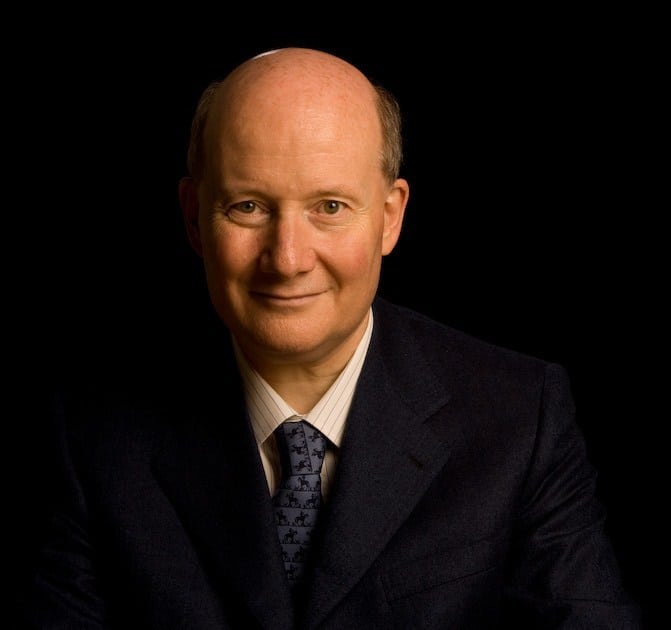
Massimo Introvigne (born June 14, 1955 in Rome) is an Italian sociologist of religions. He is the founder and managing director of the Center for Studies on New Religions (CESNUR), an international network of scholars who study new religious movements. Introvigne is the author of some 70 books and more than 100 articles in the field of sociology of religion. He was the main author of the Enciclopedia delle religioni in Italia (Encyclopedia of Religions in Italy). He is a member of the editorial board for the Interdisciplinary Journal of Research on Religion and of the executive board of University of Pennsylvania Press’ Nova Religio. From January 5 to December 31, 2011, he has served as the “Representative on combating racism, xenophobia and discrimination, with a special focus on discrimination against Christians and members of other religions” of the Organization for Security and Co-operation in Europe (OSCE). From 2012 to 2015 he served as chairperson of the Observatory of Religious Liberty, instituted by the Italian Ministry of Foreign Affairs in order to monitor problems of religious liberty on a worldwide scale.