What did Konstantin Rudnev finally teach? A first attempt to reconstruct a complex and often misunderstood worldview.
by Massimo Introvigne and María Vardé
Article 2 of 4. Read article 1.
Rudnev is often described as the leader of a new religious or spiritual movement, “Ashram Shambhala.” Although he refers to his teaching as “Sekoru Dharma”, the media almost universally labels his activity “Ashram Shambhala,” a term that originated not with him but with his followers. They used it to describe the place where they lived near him—a space they understood as an ashram, a community dedicated to spiritual practice, meditation, yoga, and inner discipline. “Shambhala” draws from Eastern spiritual traditions, where it signifies a mystical realm or elevated state of being, an emblem of the journey from inner chaos toward harmony. For his disciples, this combination captured the atmosphere of the place where they lived and evolved spiritually, and it is this internal vocabulary—not any formal organization—that later became the shorthand adopted by journalists and investigators.
Rudnev did establish organizations in Russia, but the names were “Siberian Association of Yogis” and “Olirna Association.” What Rudnev offers in his texts is not a system of doctrine but a metaphysical framework. It combines elements of cosmology, anthropology, and critiques of civilization. Its system refuses to fit neatly into one genre.
Rudnev’s worldview, as presented in the sources, is a complex system that blends Siberian shamanism with Eastern ideas like Tantra and Karma. It argues that the physical world is a temporary place where souls learn tough lessons to gain wisdom and eventually return to a state of divine unity. This statement could serve as the movement’s main idea, claiming that our world is not a true home but a training space where souls grow through challenges, mistakes, and experiences.
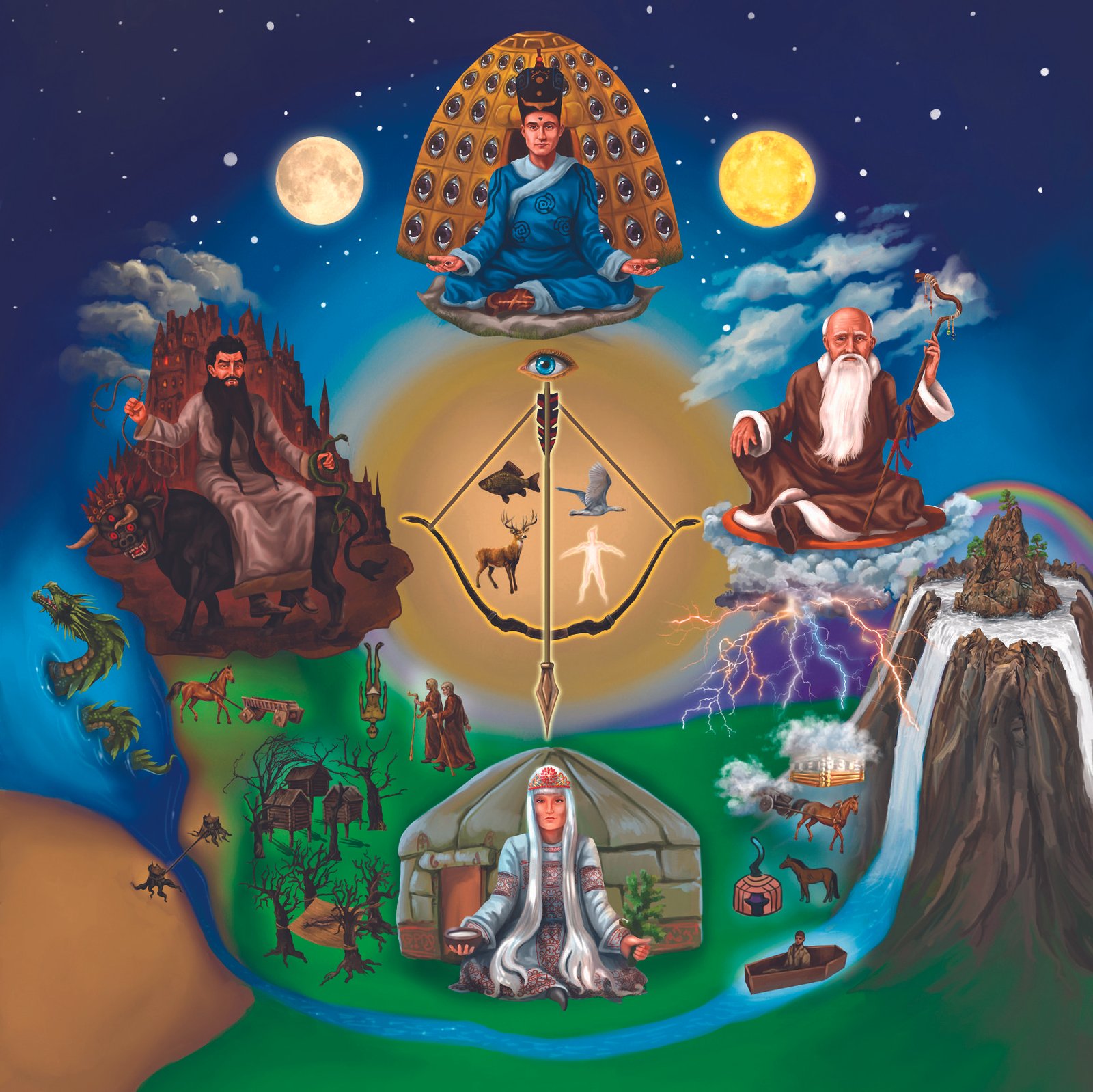
The cosmology that supports this idea is complex. Four divine forces govern the universe, each tied to a time dimension: eternity, future, present, and past.
Tengri Han, the eternal source, keeps cosmic balance; Ulgen Khan creates the future and its possibilities; Umai maintains the material present; and Erlik Khan oversees the past and the realm of the dead. These are not distant gods but active principles that shape the flow of time and existence. In this view, a person is not a single, unified being but a composite of five souls, each responsible for different modes of perception or life force. Aiy connects the person to eternity, Bosy perceives the future, Tes perceives the past, Sur travels between worlds, and Kut energizes the body with life. Without them, a human is “but a piece of meat.” This metaphysical approach rejects the modern tendency to reduce humans to psychology or biology; instead, it emphasizes a multidimensional self that spans time, ancestry, and the unseen.
Rudnev is often mocked for the more esoteric elements of his worldview, particularly his reflections on extraterrestrial life, yet this aspect of his teaching is almost always caricatured rather than accurately described. In his formulation, extraterrestrial civilizations are not invaders or saviors but distant intelligences that once seeded consciousness on Earth and continue to observe human development from afar. Humanity, in this view, is part of a long evolutionary arc shaped not only by biological processes but by contact—however indirect—with a more advanced civilization beyond the planet. Earth becomes, in this metaphor, a kind of cosmic experiment, not in a sinister sense but in the way scientists construct artificial anthills to study the behavior, adaptation, and social patterns of ants.
Just as researchers watch how an anthill organizes itself, responds to stimuli, or evolves under new conditions, these hypothetical civilizations observe the behavioral patterns of humanity, occasionally leaving signs or impulses—pyramids, myths, symbolic structures—that act as catalysts for cultural or spiritual development. The idea is not that humans are controlled, but that they are gently guided, nudged toward growth in ways that remain largely invisible. Whether one accepts or rejects this cosmology, this is the teaching as it exists, stripped of the distortions and ridicule created by opponents.
This vast cosmology is matched with a harsh diagnosis of the human state. According to Ashram Shambhala, modern society has lulled individuals into a deep slumber, a state where they confuse social conditioning with identity. The movement describes today’s civilization as gravely flawed, a system that produces mindless followers through media, propaganda, and education. From childhood, individuals are shaped by what the movement calls the “Devil’s pattern”—a set of harmful stereotypes and expectations that push them into lives they never consciously chose. The roles they play, whether as workers, spouses, or citizens, are masks rather than true expressions of self. Modernity is not simply imperfect; it functions as a mechanism for forgetting, an extensive system designed to disconnect people from their divine essence and keep them compliant to social norms.
This critique of society forms the basis for the movement’s understanding of suffering, which it reframes as a learning tool.
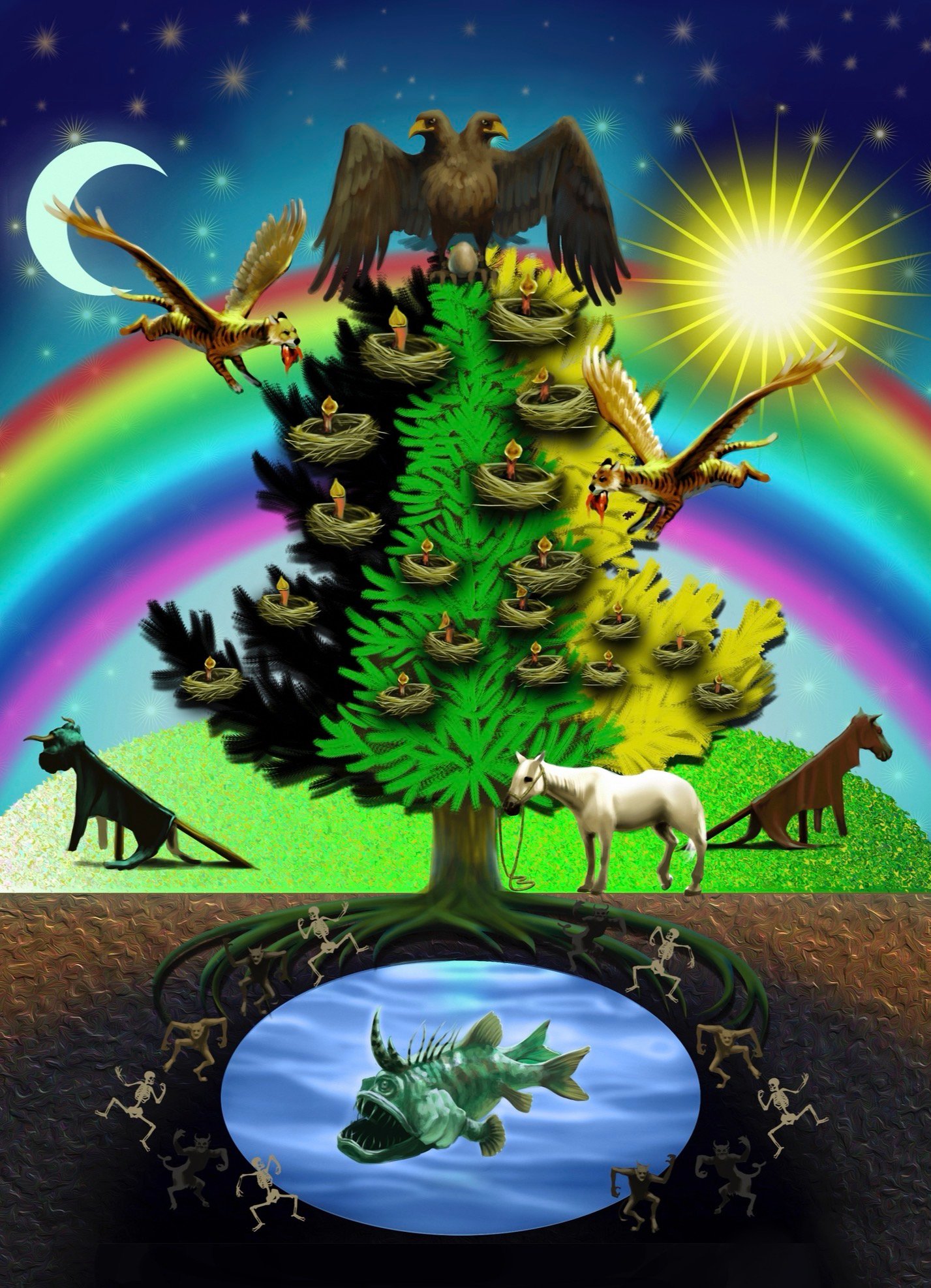
Rudnev’s teachings do not guarantee comfort; they insist that suffering is the key catalyst for awakening. Illness, aging, and hardship are seen as vaccines from evil, shocks that disrupt complacency and push the soul to grow. Evil gives birth to suffering and is that force that drives people to evolve, the movement teaches, turning moral dualism on its head. Suffering is not an indication that something is wrong but rather a signal that something significant is trying to happen. The path to awakening involves finding one’s inner World Tree, a symbolic connection between ancestral roots and divine heights.
Yet this is not a celebration of pain, nor a mandate to endure—or impose—needless hardship. In Rudnev’s framework, suffering is “educational” only insofar as it is transformed into awareness, humility, and responsibility: progress is ultimately measured not by extreme experiences but by a person’s capacity to cultivate compassion. The point, then, is not to seek suffering, but to metabolize what life inevitably brings.
Progress is not measured by mystical experiences but by the ability to spread compassion. In the movement’s moral framework, a person is truly happy only when she wants to bring happiness to someone else—a simple idea that serves as both an ethical principle and a spiritual measure.
The practices that support this transformation are varied and sometimes surprising. Tantra and Maitkhuna reinterpret sexual energy as a sacred force, a means to connect with the divine rather than just fulfill desires. More broadly—much as in many contemporary and traditional currents—Rudnev’s Tantra was not primarily about sexual techniques but about cultivating a spiritual attitude in every activity and situation. In his teachings he expanded Tantra into a comprehensive discipline of everyday life—learning how to breathe, sleep, sense, and eat—where sexuality is just one domain among others in which energy must be consciously managed and directed on a path toward the divine—one that can unfold only under conditions of love, harmony, and self-control.
The Gyud Method uses hypnosis and post-hypnotic suggestions to uncover trauma, reveal hidden abilities, and interact with the subconscious or even those who have passed. Sampo, described as astral karate, trains practitioners to defend their energy against negative influences and harmful thoughts. The Field of Love ritual harnesses parental energy to create a protective shield around children, while Orphism uses music and art as tools for intention and spiritual resonance. These techniques make up what the movement calls ancient spiritual technologies—methods for dismantling imposed identities and rebuilding the self around its divine core.
These practices blend the psychological with the mythological, which exposes them to the risk of being misinterpreted. Hypnosis turns into a way of exploring the soul; martial arts defend against metaphysical threats; sexuality becomes a channel for divine energy. The movement’s language is rich with symbolism, but its aims are straightforward: to deeply reshape the practitioner’s inner life so that the outside world no longer defines their identity. In this sense, Rudnev’s is less a religious movement than a method for personal transformation, a system for reprogramming consciousness against society’s attempts to mold it.
Death, in this view, is not an end but a transformation. Life on Earth is compared to a business trip or a gym, a temporary experience where the soul gains understanding not accessible in heaven. After death, the soul stays close to the earthly realm for forty to forty-nine days, letting go of attachments before ascending to higher levels. The Akashic Records—a notion of Theosophical origin—act as a cosmic archive, storing a record of all events and intentions. Judgment is not a divine punishment but a moment of deep empathy, where the soul relives its life from the perspective of all it impacted. Reincarnation becomes a long journey through the cosmos, with souls cycling through plants, animals, humans, and even insects until they gain enough experience to return to the Absolute.
From all this arises the figure of the Warrior of Light— the ideal person in Rudnev’s moral landscape. This individual resists the monotony of the social group, awakens from the spell of modern life, and commits to service, awareness, and mastery of subtle energies. It represents a countercultural archetype, part mystic, part rebel, part ethical role model. Whether viewed as a metaphysical framework, a critique of civilization, or a symbolic guide for inner change, Rudnev offers a provocative perspective on modern life. Its cosmology may be mythical, but its concerns—alienation, identity, suffering, and the search for meaning—are distinctly contemporary. The movement’s call to wake up, find your true self, and trust your inner strength strikes a chord. It can also create strong opposition.
However, those who have studied Rudnev’s work without the filter of tabloid mythology note that his teachings have never contained anything “destructive” or “coercive,” nothing that resembles the mechanisms of control so often projected onto him.
In many cases, anti-cult accusations against him are a deliberate distortion engineered to transform symbolic language, metaphors, and spiritual speculation into the raw material of a criminal prosecution we will examine in the next article of the series.

Massimo Introvigne (born June 14, 1955 in Rome) is an Italian sociologist of religions. He is the founder and managing director of the Center for Studies on New Religions (CESNUR), an international network of scholars who study new religious movements. Introvigne is the author of some 70 books and more than 100 articles in the field of sociology of religion. He was the main author of the Enciclopedia delle religioni in Italia (Encyclopedia of Religions in Italy). He is a member of the editorial board for the Interdisciplinary Journal of Research on Religion and of the executive board of University of California Press’ Nova Religio. From January 5 to December 31, 2011, he has served as the “Representative on combating racism, xenophobia and discrimination, with a special focus on discrimination against Christians and members of other religions” of the Organization for Security and Co-operation in Europe (OSCE). From 2012 to 2015 he served as chairperson of the Observatory of Religious Liberty, instituted by the Italian Ministry of Foreign Affairs in order to monitor problems of religious liberty on a worldwide scale.