Emily Feng’s new book explains why thousands fled Chinese persecution, helped topple Assad, and still dream of East Turkestan.
by Massimo Introvigne
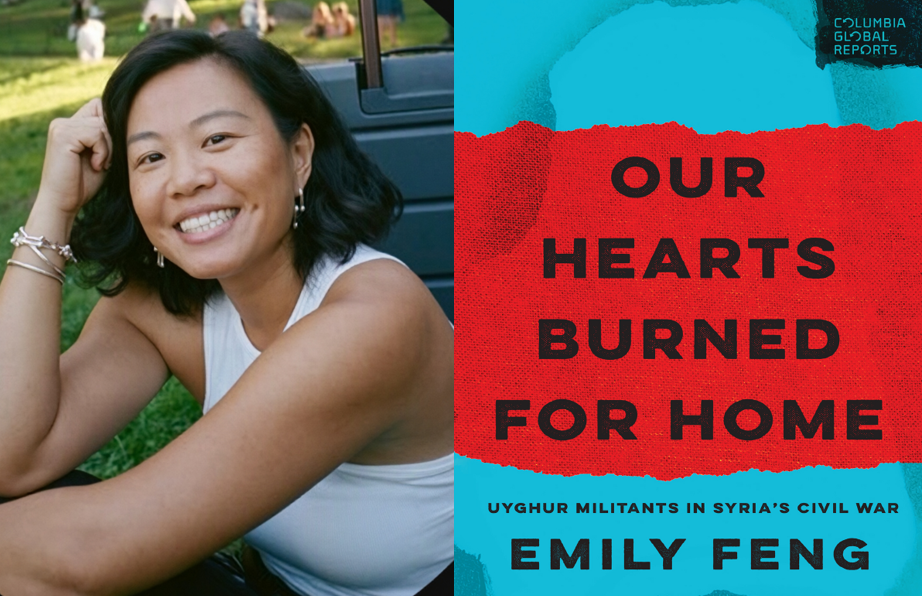
On December 8, 2024, the rebel coalition that had ended the rule of Bashar al-Assad entered Damascus. Some of the fighters riding into the capital on tanks waved a light blue flag with a white crescent and star, the banner of East Turkestan, as Uyghurs call the region China has named Xinjiang. Most of the Syrians who kissed them and threw candy had never seen a Uyghur before. Emily Feng’s “Our Hearts Burned for Home: Uyghur Militants in the Syrian Civil War” (New York: Columbia Global Reports, 2026), written with the Uyghur linguist Abduweli Ayup, explains who these men were and how they got there.
Readers of “Bitter Winter” have already met them. Between December 2024 and March 2025, we published four articles by the Uyghur journalist in exile who writes as Kok Bayraq. He explained why Uyghurs fought in Syria, told of those who went as refugees to a war zone and became a general and two colonels of the new Syrian army, collected stories of love under the bombs, and asked how many Uyghurs live and are buried there. He wrote from inside the diaspora, through friends and phone calls. Feng adds almost a month spent in the Uyghur villages of Idlib governorate, in homes, schools, and offices.
Feng is a Chinese American journalist, born and raised in Connecticut, who graduated from Duke University in 2015 and has spent her adult life reporting on the Chinese-speaking world. She was a Beijing correspondent for the “Financial Times” and joined National Public Radio (NPR) in 2019, covering China first from Beijing and then from Taipei. She reported extensively on Xinjiang, where she was the first foreign journalist to document the separation of Uyghur children from their parents. Her awards include the 2022 Shorenstein Journalism Award and the 2023 Daniel Schorr Journalism Prize. Her first book, “Let Only Red Flowers Bloom: Identity and Belonging in Xi Jinping’s China,” came out in 2025. As “Bitter Winter” reported, Hong Kong bookstores were raided in July 2026, reportedly for selling its Chinese edition.
Feng is now a White House correspondent for NPR. Ayup is a familiar name to those who follow the Uyghur cause: as Ruth Ingram recalled in our pages, he spent fifteen months in a Chinese jail for opening a Uyghur-language kindergarten and now lives in Norway, where he campaigns to preserve the Uyghur language.
Feng admits she is no Middle East specialist. She landed in Lebanon two days before Assad fell and crossed into Syria to cover the aftermath. There she noticed Central Asian fighters who spoke Uyghur. The new Syrian information ministry had banned interviews with foreign combatants, and it was Ayup who obtained access through the militants’ own representatives. In the summer and fall of 2025, the two interviewed about five dozen fighters and relatives, often for hours. Feng took off her jade bangle and avoided speaking Mandarin, fearing her Chinese looks would alarm people who had suffered so much at the hands of the Chinese state. The precaution proved unnecessary, and some hosts teased her for using an interpreter. All interviewees appear under the names they adopted in Syria, to protect their families in Xinjiang.
The first chapter is about China. For most of the future fighters, the breaking point came in the summer of 2009. Two Uyghur workers were beaten to death in a toy factory in Guangdong, a peaceful protest in Ürümqi was dispersed by the police, and days of ethnic riots were followed by mass disappearances of young Uyghur men. Choghtal, today second-in-command of the largest Uyghur militia in Syria, had discovered as a teenager in a Hotan bookstore a Uyghur history his school never taught. Moaz spent eleven years in jail for distributing pamphlets. Gul, a physician in an Ürümqi maternity ward, learned of women sterilized without their consent. Some of the most determined militants came from the elite boarding schools in eastern China created to assimilate gifted Uyghurs, where they found banned books and learned to bypass the Great Firewall. Asked what inspired them to take up arms, the interviewees gave one answer: the Chinese Communist Party. This is Feng’s thesis. By repressing Uyghur religion and culture, Beijing produced the armed movement it claimed to be preventing.
The road to Syria was indirect. The first aspiring fighters tried Afghanistan and Pakistan, where they met American drones, impassable mountains, and Uzbek and Taliban hosts whose ideology many of them found alien. Following scholar Sean Roberts, Feng regards the East Turkestan Islamic Movement (ETIM), which China blames for every incident, as a catch-all label that never corresponded to a single coherent organization. Syria, reached through Türkiye, offered an open border, abandoned houses, and a war to learn from. Under the name Turkestan Islamic Party (TIP), former hairdressers, truck drivers, and engineering students trained for three months and went to the front. The 2015 battle for Jisr al-Shughur made them valued partners of Jabhat al-Nusra, the group led by Ahmed al-Sharaa, now Syria’s president. Russian bombs then killed many of them, together with their wives and children. In November 2024, Uyghur special forces rode miniaturized motorcycles through a disused sewage tunnel to cut the supply lines of Aleppo, in what is the most cinematic chapter of the book. TIP has since been formally dissolved, and its men serve as the 84th Brigade of the Syrian army.
As a sociologist of religion, I was most interested in what Feng writes about faith. The community she describes is conservative. Women wear the niqab, men look at the ground in their presence, music is forbidden, and leaders are obeyed without discussion. Several women told her that they found in Idlib the religious freedom denied to them in Xinjiang. Gul wonders whether, without Chinese repression, they would have become religious at all. The leadership, however, moved from global jihad toward Uyghur nationalism. It rejected ISIS, which lured away some fighters and split families. In 2018, it broke with the old guard in Afghanistan, which was tied to Al Qaeda. The blue national flag replaced the black Islamist one, and a teacher told Feng that he deleted passages on jihad from the textbooks used in the Uyghur schools. Several fighters, perhaps unexpectedly, even mention Zionism as the model of a stateless people that managed to build a state.
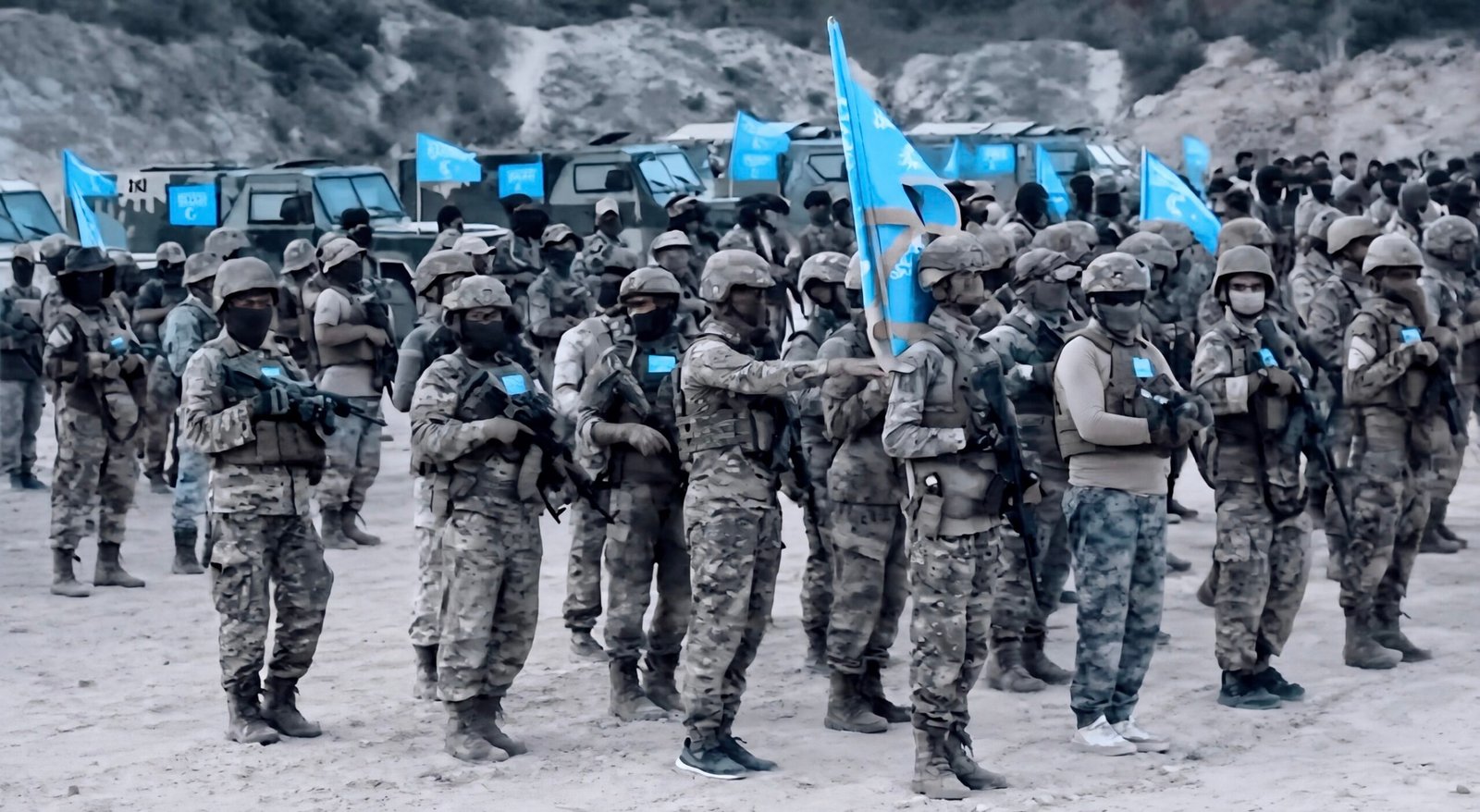
Feng does not hide what this presence has cost others. The Uyghurs moved into houses left by Christians in Al-Ghassaniyeh and by Shiites in Kafriya, regarding them as legitimate war bounty. A Christian who returned to visit his family’s village saw children throw stones at his car because a cross hung from the mirror. A TIP imam assured Feng that the churches had been left untouched, then, pressed by her, answered that whoever is not a Muslim is an infidel. By late 2025, the Uyghurs had given back nearly all the land and orchards they had occupied and were negotiating with the government for a plot where they could build their own homes. Those of us who defend religious liberty should read these pages with attention and caution. Individual behavior cannot be attributed to all Uyghurs in Syria. Yet the victims of one of the worst persecutions of our time can be perceived as frightening neighbors by other minorities, and honest reporting has to tell both stories.
The book has limits. Columbia Global Reports publishes short volumes that can be read in a few hours, and battles and factions pass by quickly. Almost everything rests on the fighters’ own accounts. The chronology is sometimes confusing. ETIM is said to have been founded in 2003, yet it appears in Chinese statements of 2001 and in the story of the Uyghurs sent to Guantanamo. One commander is said to have co-founded his party “in Syria in 2009,” two years before the civil war began. The Uyghurs are occasionally called “mercenaries,” a word that fits poorly with Feng’s own portrait of men who fought for months on half pay to avenge their families. On casualties, she mentions hundreds of fighters killed by Assad’s forces, while Kok Bayraq reported in our pages estimates of 2,000 to 3,000 Uyghur dead, with no official record available.
None of this diminishes the value of a book that gives names, faces, and voices to people so far known mostly through Chinese propaganda. Their future is uncertain. According to Choghtal, the community now numbers about 20,000, and children born in Idlib point to Syria on the map when asked where their home is. In November 2025, China’s ambassador to the United Nations called the presence of foreign fighters in Syria worrisome, and Foreign Minister Wang Yi asked his visiting Syrian colleague for effective measures against ETIM. A report that Damascus would deport Uyghur fighters to China was immediately denied. The commanders trust al-Sharaa and present themselves to Washington as allies against Beijing, although Zubeyr, who leads a smaller group that stayed outside the army, admits they may sacrifice everything and receive nothing in return.
The title comes from a fighter who recalled that their bodies were in Syria while their hearts burned for their homeland. Feng insists that the existence of these militants offers no excuse for what China does in Xinjiang and is the best evidence that the policy failed. One commander told her bluntly why Uyghur families in Syria are so large: “We are raising our own army.” Perhaps this is just a dream, but Beijing should ponder these words and ask who is responsible for these Uyghurs’ anger.
Massimo Introvigne (born June 14, 1955 in Rome) is an Italian sociologist of religions. He is the founder and managing director of the Center for Studies on New Religions (CESNUR), an international network of scholars who study new religious movements. Introvigne is the author of some 70 books and more than 100 articles in the field of sociology of religion. He was the main author of the Enciclopedia delle religioni in Italia (Encyclopedia of Religions in Italy). He is a member of the editorial board for the Interdisciplinary Journal of Research on Religion and of the executive board of University of Pennsylvania Press’ Nova Religio. From January 5 to December 31, 2011, he has served as the “Representative on combating racism, xenophobia and discrimination, with a special focus on discrimination against Christians and members of other religions” of the Organization for Security and Co-operation in Europe (OSCE). From 2012 to 2015 he served as chairperson of the Observatory of Religious Liberty, instituted by the Italian Ministry of Foreign Affairs in order to monitor problems of religious liberty on a worldwide scale.