A Shanghai scholar brings back to life a 1931 Beijing collection of ritual prints and quietly tells a story the regime would rather leave unheard.
by Hu Zimo
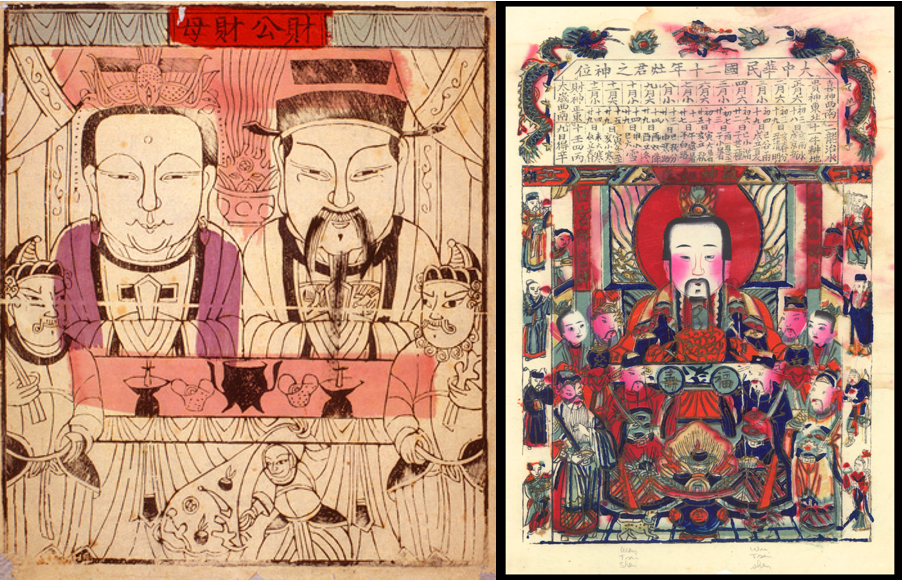
Picture a Beijing alley in 1931. On the wooden doors of a courtyard house, two fierce armored warriors glare at anyone who approaches. Inside, a woman holds a small folded paper shrine, and on the kitchen wall a smoke-darkened Stove God keeps an eye on the family’s daily quarrels, ready to report them to Heaven at the end of the year. Few visitors paid attention to these cheap prints, sold for a handful of coppers in neighborhood shops. One did. Anne Swann Goodrich, an American who had come to China with her husband, the sinologist L. Carrington Goodrich, started buying them, asking questions, and taking notes. The result was a collection of “paper gods” that eventually crossed the Pacific and found a home at Columbia University in New York, where it survived the wars, revolutions, and campaigns that destroyed most of its kind in China.
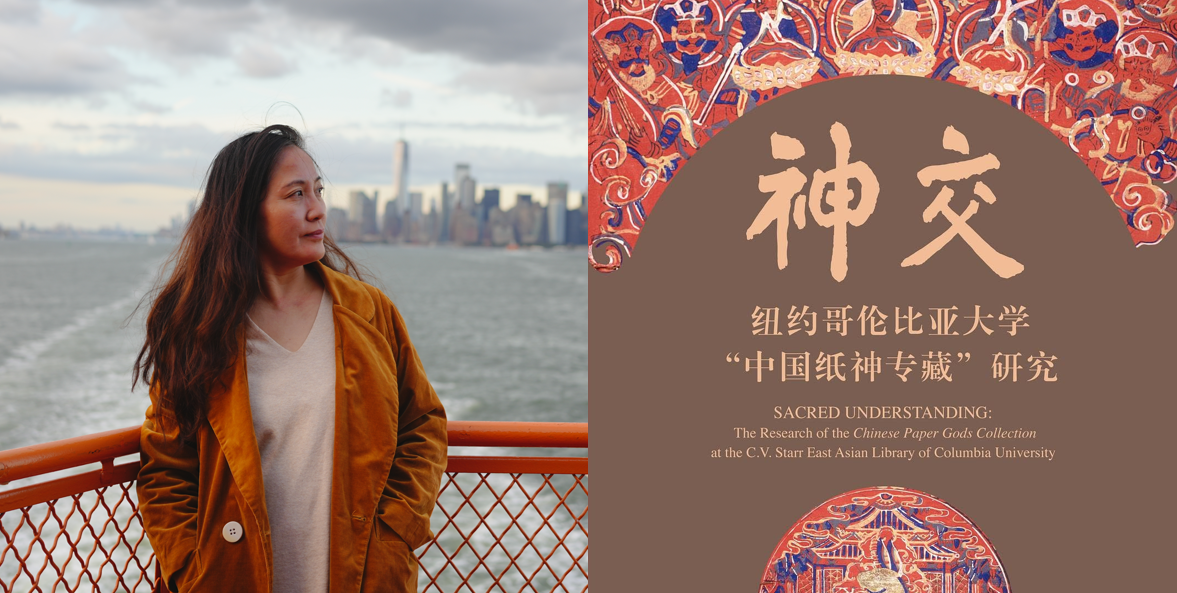
Almost a century later, these gods have found an interpreter. Li Mingjie is a professor at East China Normal University in Shanghai, a sociolinguist and cultural anthropologist who studies urban folklore, cultural memory, and the way language shapes how people see the world. In recent years, she has spent much of her time in New York, teaching there and writing, among other things, a book about the city before and after the COVID-19 pandemic. Her new volume, “神交: 纽约哥伦比亚大学’中国纸神专藏’研究” (“Sacred Understanding: The Research of the Chinese Paper Gods Collection at Columbia University,” Beijing: Commercial Press, 2025), is the fruit of years spent in the reading rooms of Columbia’s East Asian Library. It is also one of those books that passed through Chinese censorship because the censors did not understand what they were reading.
Li starts with a puzzle. The expression “paper gods” is common in Western studies of Chinese popular religion, yet it is almost absent from Chinese academic language. Goodrich adopted it after seeing images pasted on doors and small paper shrines carried by Beijing women, and the American scholar Clarence Burton Day used similar terminology in his 1940 study of peasant cults in Zhejiang. One might dismiss the term as a foreigners’ invention. Li argues the opposite. The label, she shows, describes accurately what these images were for the people who bought them: carriers of divine presence, temporary bodies the gods inhabited while they listened to human requests.
The collection includes door gods and “paper horses,” and both open a window on how Beijing families protected their homes and talked to the invisible world. The door guardians stood watch at the threshold, the house’s most vulnerable point. The paper horses, printed with the image of a deity, were burned at the end of a ritual, and the smoke carried the family’s petitions upward, a sort of celestial postal service with flames instead of stamps. Nobody hung them to decorate a room. They were tools, and they worked within a coherent cosmology where every god had a function and an address.
The most fascinating chapter deals with a complete set of goddess paper horses, which allows Li to reconstruct the fertility customs of 1930s Beijing. Here we meet the goddesses who granted sons, protected pregnant women, watched over difficult births, and kept smallpox away from children. The images reveal a society where childbirth, clan relations, and neighborhood life were organized around a hierarchy of divine figures, each requiring specific offerings at specific moments. Since these customs were transmitted through practice rather than through written doctrine, the prints served as memory aids, and today they are often the only surviving evidence of rituals that nobody wrote down. They also prove that popular religion was alive and well in a city that history textbooks usually describe as busy modernizing itself.
From this material, Li draws a broader conclusion. Chinese belief, she argues, resists the categories of Western religious studies, which tend to look for creeds, theologies, and membership. Faith in China is something people do with their hands, through gestures, obligations, and relationships. What counts is efficacy. A god earns devotion by answering prayers, and an image is valued for what it accomplishes. For this reason, Li rejects the habit of filing these prints under “folk art” or “New Year pictures,” labels that turn ritual objects into charming decorations. She insists that giving the images back their sacred nature is the only way to understand what they meant to the people who used them.
The book then travels from 1930s Beijing to today’s China. Drawing on interviews and on her long engagement with social questions, including her work with prisoners in Shanghai, Li observes that prayer has become a discreet form of private speech. The young Chinese who crowd temples to burn incense are seldom converts to institutional religion. They seek a moment of relief and a place where they can say what they think without fear. Li connects them to the paper gods of the past, silent listeners who never reported anybody to the authorities. The forms change, she suggests, while the emotional logic of folk belief survives.
How did such a book get past China’s censors? The answer is probably simple. A censor skimming the manuscript would find a scholarly study of old prints, published by the venerable Commercial Press, set safely before 1949 and based on an archive at a foreign university. Folklore, art history, Republican Beijing: nothing seemed to threaten the Party. A more careful censor would have noticed more.
First, the book documents the failure of a state campaign against religion. In 1928, the Nationalist government issued official standards to decide which shrines and gods deserved to survive and which should be abolished as “superstition.” Li has studied these standards in her earlier work, and her paper gods show that Beijing families simply ignored them and went on worshipping the deities the state had condemned. Readers familiar with the Chinese Communist Party’s current crusade against “feudal superstition” and its program of “Sinicization” of religion will draw their own conclusions about the likely fate of today’s campaigns.
Second, the book undoes a Communist operation. After 1949, the new regime reformed the “New Year pictures,” emptied them of gods, and turned them into a vehicle of propaganda, with smiling peasants and model workers replacing the Stove God and the goddesses of fertility. Calling the old prints “folk art” belonged to the same strategy, since art can be admired in a museum while gods must be obeyed. By insisting that these images are sacred, Li quietly reverses seventy years of official classification.
Third, the book observes that the best surviving record of the religious life of ordinary Beijing families sits in New York. Much of what remained in China went up in flames during the Cultural Revolution, burned this time by Red Guards rather than by worshippers. The book never states the point explicitly. It does not need to.
Finally, the remarks about young people who whisper their troubles to the gods because public speech has become dangerous amount to a diagnosis of contemporary China that no censor would knowingly approve. The author never raises her voice. She lets the paper gods speak, and they say a great deal.
Li’s work also stands apart for its method. It relies on international archives and independent research rather than official access and institutional mediation, and it studies Chinese culture on its own terms, without reducing popular religion to superstition or quaint folklore. The paper gods were made to carry messages from earth to Heaven. Thanks to this book, they may carry one to Zhongnanhai as well: that belief, like paper, looks fragile but has a remarkable capacity to survive the fires lit to destroy it.

Uses a pseudonym for security reasons.