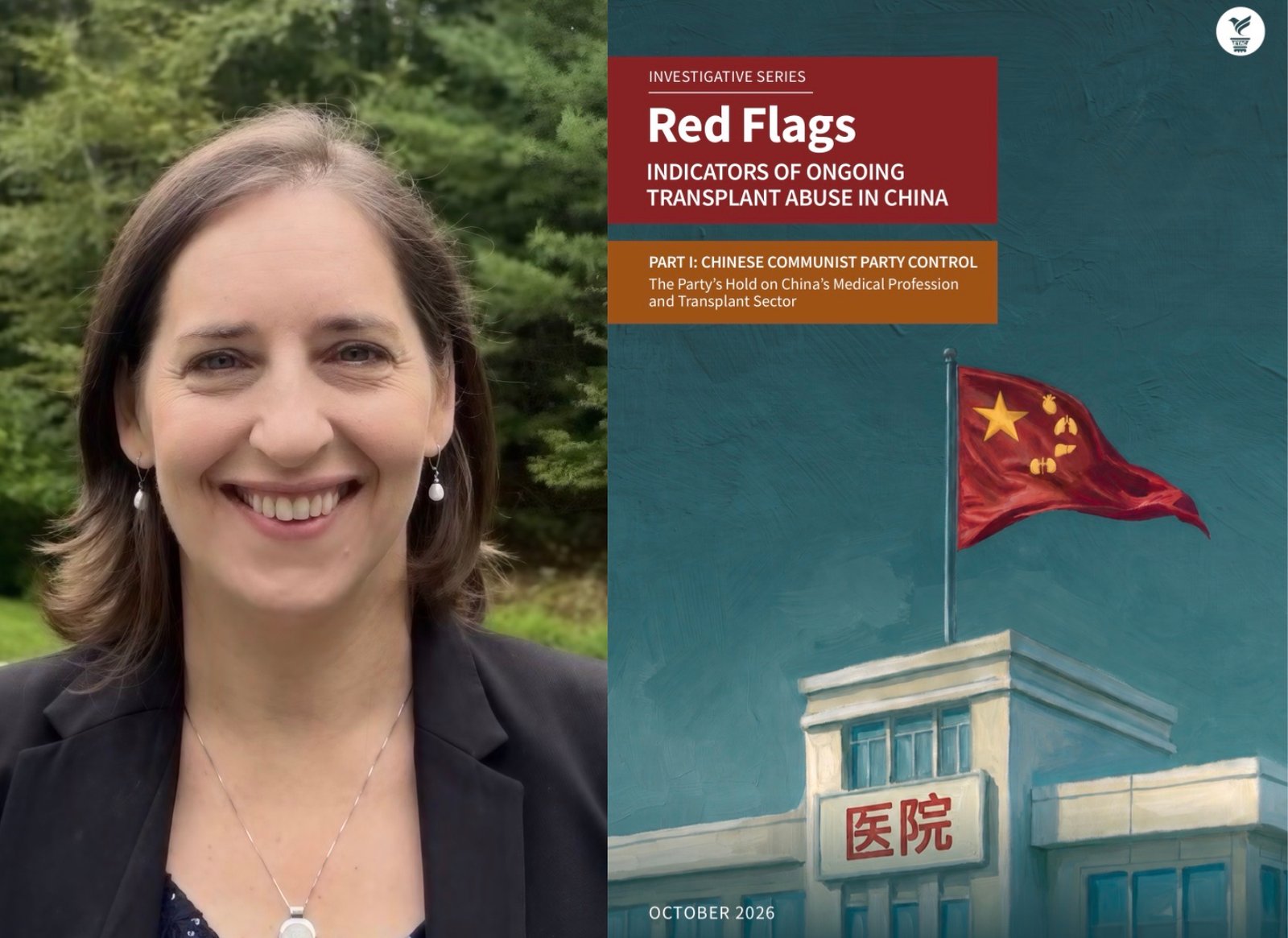
A report by expert Sarah Cook coldly and precisely debunks two myths: that the Chinese Communist Party has no part in this horror, and that it has reformed the system to prevent it.
by Marco Respinti
One of the most staggering tragedies unfolding every day in the People’s Republic of China (PRC), and one that goes largely unnoticed, is human harvesting. Thousands upon thousands of people are killed every year in a serial fashion, and their bodies are coldly dismembered for profit, exploiting their suffering to feed the black market in organ transplantation. The victims are mainly prisoners of conscience, many of whom belong to non-Han ethnic groups or persecuted religious communities: Falun Gong practitioners, Uyghurs from Xinjiang, Tibetans, members of The Church of Almighty God, and other Christians.
Two myths hang over this horror. The first is that the Chinese Communist government has no involvement whatsoever (this is what the Chinese Communist government itself claims), and that private interest groups are responsible for the slaughter. The second is that, in any case, the Chinese Communist government has carried out deep structural reforms in recent years, virtually eliminating any possible involvement of Chinese public institutions in these massacres (again, this is what the Chinese Communist government itself claims).
Quite apart from the fact that using the word “private” in Communist China amounts to making a fool of one’s interlocutor, and that the word “public” has meanings there that differ profoundly from those it has in the civilized world, both myths surrounding organ harvesting in China are entirely unfounded.
The omnipresence of the Communist Party
A report published by the International Coalition to End Transplant Abuse in China (ETAC), an independent international NGO based in Australia and founded in 2014 by lawyers, academics, medical professionals, and human rights activists, now provides evidence to the contrary. Its title is “Chinese Communist Party Control: The Party’s Hold on China’s Medical Profession and Transplant Sector,” and it is presented as the first in a series of studies aimed at debunking these two myths on a scientific basis. The series is called “Red Flags: Indicators of Ongoing Transplant Abuse in China.”
The first report in ETAC’s series was written by Sarah Cook, one of the leading experts on the Chinese Communist “paradise.” A seasoned researcher on human rights in China, she writes the “UnderReported China” newsletter, published on the Substack platform. Cook previously served as Research Director for China, Hong Kong, and Taiwan at Freedom House, where she directed the monthly news digest “China Media Bulletin” and authored five special reports on authoritarianism in the PRC and Beijing’s influence on foreign media.
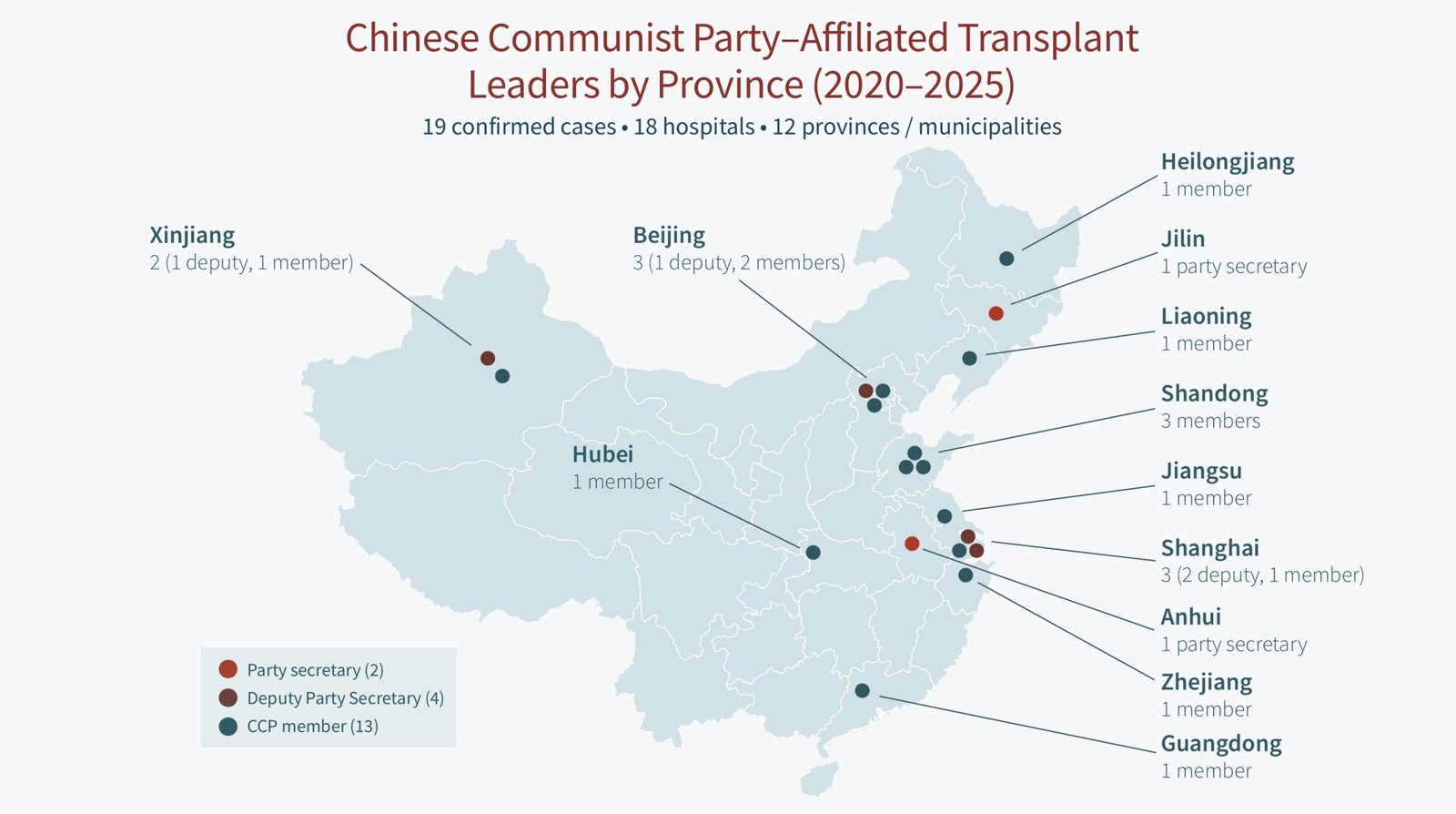
The Chinese Communist Party (CCP), the report states, controls every aspect of the national healthcare system, having placed senior officials of its own leadership apparatus in positions hierarchically superior to those of hospital directors and medical staff. Virtually every healthcare facility has a Party committee, to which doctors pledge lifelong allegiance. The ETAC report identifies 19 cases across 12 Chinese provinces in which transplant surgeons or directors of transplant centers are Party members. In six cases, the senior physician is the secretary or deputy secretary of the hospital’s Party committee. Cook lists names, healthcare facilities, and both medical and political positions. In short, it is the Party that decides how healthcare is managed, and the same applies to organ retrieval and transplantation, where there are three central actors: the organ procurement organizations (OPOs), the National Organ Donation and Transplantation Committee (NODTC), and the hospital ethics committees.
Three central actors
Unlike in other countries, in the PRC the organizations responsible for procuring organs are neither legally independent entities nor separate from the hospitals that need those very organs and perform the transplants. In Communist China, Cook writes, “[…] there are no independent OPOs. Although Chinese authorities have appropriated the US term, official Chinese sources explicitly acknowledge that in China an OPO is ‘not an independent legal entity, which is different from that of the United States’.” Cook takes this quotation from Huang Jiefu’s “Report on organ transplantation development in China (2015–2018),” published in 2020 by the China Organ Transplantation Development Foundation and Tsinghua University Press.
Instead, Cook continues, “OPOs function as internal units within approved transplant hospitals. As the OPO is not independent from the hospital, which has an interest in obtaining organs for transplantation, there are reduced protections for dying patients.” In fact, “[o]ne Chinese academic paper describes the position of the OPOs in the Party-state hierarchy as follows: ‘As a subsidiary institution of a public hospital, an OPO derives its resources from the government; consequently, its operational activities must be guided by government policies.’ Governance of each OPO falls to the hospital’s leadership structure, which, as described above, is ultimately the hospital Party committee.”
As for the NODTC, it is a state body established in 2013 by the National Health Commission (NHC) and the Red Cross Society of China. It is directly controlled by the State Council of the PRC, the country’s highest administrative organ, which is responsible for implementing the laws and decisions adopted by the National People’s Congress and its Standing Committee. Among its other responsibilities, “[…] the NODTC oversees the state-managed China Organ Transplant Response System (COTRS). This is a centralized digital platform through which all organ procurement and allocation flows.”
Now, “[t]he latest publicly available membership list of the NODTC,” Cook observes, “is from 2016 and names 33 members, most of whom remain active in the transplant sector today. Analysis of the list illustrates the depth of Party-state control over this agency that oversees the entire transplant system. Of the 33 members, 17 (or 52 per cent) were confirmed CCP members, including nearly all top leadership positions within the committee.”
At that time, the confirmed CCP members on the NODTC “[…] included at least six officials from the National Health and Family Planning Commission (the predecessor to the NHC), three members from the Red Cross Society of China and two officials from the Logistics Support Department of the Central Military Commission (two other military officials are also members, but it was not possible to confirm their CCP membership). The military presence highlights direct People’s Liberation Army involvement at the highest level of transplant governance.” Moreover, “[t]he Red Cross Society of China, which official sources describe as the ‘third-party’ verifier in the donation process, is a state-supervised social organisation under Party leadership, rather than an independent humanitarian body in the way its name might suggest to Western readers.”
Ethics?
Finally, there are the hospital ethics committees. CCP members are strongly represented in them and, compared with standard practice in North America, Europe, and South America, their rules for approving organ procurement are a veritable farce. “None of those systems,” Cook explains, “require a comparable committee vote before organ retrieval. Most rely instead on individual physicians or two to three clinicians who are not involved in transplantation to confirm that ethical and legal standards have been met, including the declaration of death. The combination of logistical impracticality and international uniqueness in China thus raises the question of whether the Chinese process functions more as a performative formality than as a robust safeguard.”
The conclusion of the study is therefore stark and alarming: “Taken together, the Party dominance of OPOs, the national oversight body and hospital ethics committees produces an essentially unified structure. The entire chain of activity—from procurement to transplantation—occurs within institutions operating under the CCP’s direct political leadership.”
Furthermore, “[i]n this system, the incentives to participate in abuse or cover-up are structurally stronger than the incentives to protect victims and expose violations” and “[…] there is no point in the Chinese system where genuine independent oversight exists. There is no independent regulator, no professional association, no procurement organisation, no ethics committee, and no oversight body that sits outside the Party-state hierarchy. The circularity is total.”
The Party’s control of the medical profession
Cook shows admirable professional impartiality when she writes: “This architecture does not prove that abuses are occurring.” Precisely for this reason, her concluding observation is decisive: “However, it demonstrates that the structural conditions for both systemic abuses and concealment are comprehensively in place. If the CCP and Chinese hospitals wanted to sustain a classified, non-voluntary sourcing stream alongside an official voluntary stream, they could do so within this framework without it being detectable from outside. The absence of Chinese whistleblowers is therefore not evidence that no abuses are occurring. It could just as well be evidence that the system is working as designed.”
Hence her conclusion: “This is why CCP control of the medical profession is the first and foundational report in this investigative series. The ongoing occurrence of transplant abuses in China does not require all Chinese medical professionals to be uniformly evil or uniquely immoral. It requires only that the system in which they work has made compliance the rational choice and resistance the irrational one. China’s medical system under the CCP’s tight control has done exactly that.”
The one-child policy—still
As an “aside,” though one not entirely unrelated, Cook recalls another tragic manipulation of the lives and bodies of Chinese citizens: state-directed birth control, in which medical personnel are enlisted. The easing and subsequent abolition of the infamous “one-child policy,” with its forced abortions and sterilizations of women, did not in fact put an end to these vile practices against ethnic and religious minorities. Indeed, “[m]edical professionals have also been incorporated into state-directed population control. Under the one-child policy, hospitals performed forced abortions and sterilisations as routine institutional functions for decades. Since 2015, when the policy was formally abolished, similar abuses have continued in Xinjiang, where state-controlled hospitals have served as operational centres for what investigators have characterised as a systematic birth-suppression campaign targeting Uyghur and other minority women. This pattern of professional compliance also appears in the long-documented political abuse of psychiatry, in which Chinese doctors have diagnosed and detained dissidents and religious practitioners as mentally ill at the direction of the state.”
In short, the evidence shows that the Chinese Communist state is directly involved in the violent harvesting of human organs from innocent victims. Nor is it true that the Chinese Communist state has reformed its healthcare system to fight this scourge. Nor has the Chinese Communist state entirely given up the violent suppression of births. What does emerge is that a daily, pervasive, insidious state massacre is taking place in Communist China. How many accomplices does it have?

Marco Respinti is an Italian professional journalist, member of the International Federation of Journalists (IFJ), author, translator, and lecturer. He has contributed and contributes to several journals and magazines both in print and online, both in Italy and abroad. Author of books and chapter in books, he has translated and/or edited works by, among others, Edmund Burke, Charles Dickens, T.S. Eliot, Russell Kirk, J.R.R. Tolkien, Régine Pernoud and Gustave Thibon. A Senior fellow at the Russell Kirk Center for Cultural Renewal (a non-partisan, non-profit U.S. educational organization based in Mecosta, Michigan), he is also a founding member as well as a member of the Advisory Council of the Center for European Renewal (a non-profit, non-partisan pan-European educational organization based in The Hague, The Netherlands). A member of the Advisory Council of the European Federation for Freedom of Belief, in December 2022, the Universal Peace Federation bestowed on him, among others, the title of Ambassador of Peace. From February 2018 to December 2022, he has been the Editor-in-Chief of International Family News. He serves as Director-in-Charge of the academic publication The Journal of CESNUR and Bitter Winter: A Magazine on Religious Liberty and Human Rights.