Four short writings by the jailed Russian dissident and spiritual teacher shed light on his criticism of modern societal structures and jail systems.
by Márk Nemes
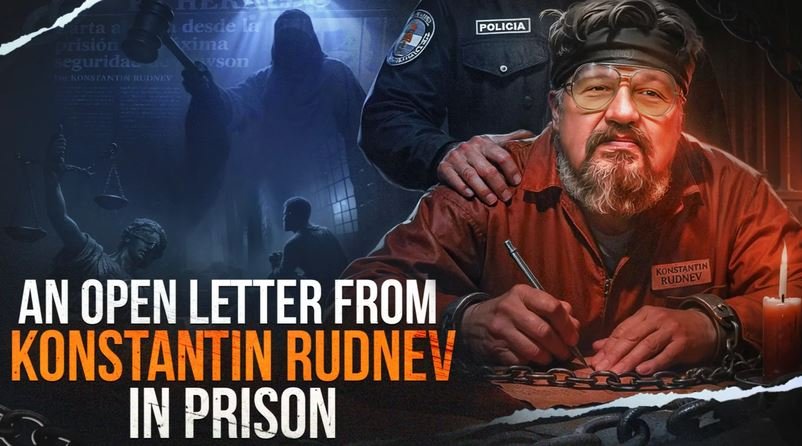
Readers of “Bitter Winter” are familiar with the case of the Russian dissident and spiritual teacher Konstantin Rudnev. During his incarceration in Argentina, he wrote several parables and short poems. These short writings were published as four Manifestos on Humanity, on Love, on Truth, and from the Heart.
Rudnev’s Manifestos collectively present a sharp critique of modern societal structures and a passionate advocacy for intrinsic human values. Throughout these Manifestos, several interconnected themes emerge: the suppression of truth and individuality, the destructive nature of carceral systems, the paramount importance of love and unity, and the enduring power of humanity and inner light against what we could call “manufactured truth.” In the author’s opinion, these Manifestos should not be considered intentional art but rather as efforts to “write out all” he has suffered over several decades, process it, find closure, and ultimately integrate these experiences in a cognate way. His parables lead the reader through this form of process art, allowing them to experience the convolution of thoughts and the final crystallization of several powerful messages at the end of each chain of parables.
Together, the short pieces serve as a narrative vehicle for Rudnev’s messages about freedom, nature, the bodily aspects of the soul’s well-being, and critiques of systems that deprive individuals of fundamental elements of life. In essence, the writings probe questions of freedom and captivity, truth and misinformation, empathy and apathy. At the same time, they are deeply intertwined with the mystical language of “Ashram Shambhala” (the name students and external observers attributed to Rudnev’s school), which is deciphered only by those who dedicate ample time to reading the Russian spiritual teacher’s voluminous writings.
The suppression of truth and individuality
A central theme in Rudnev’s writings is a critique of the deliberate suppression of truth and the systematic targeting of individuals who dare to stand out or challenge established norms. In the “Manifesto from the Heart,” Rudnev laments that society often prioritizes external narratives over personal experience, stating, “We don’t trust our own eyes, but rather the headlines. We don’t trust our hearts, but rather the words of others.” He describes being condemned by the written word, feeling like a “monster” created by media portrayals rather than his authentic self. Seeing his distorted, unfamiliar image in these pieces leaves him both enraged and saddened.
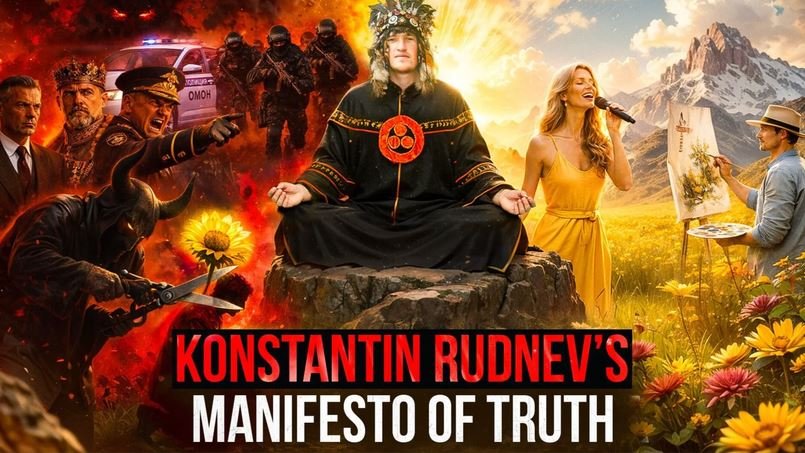
Such sentiment is also echoed and expanded in “Manifesto of Truth,” where Rudnev introduces the parable of the devilish gardener who advises a king to “nip in the bud immediately” anyone who “stands out from the crowd.” In this metaphor, he also draws a parallel between historical and contemporary efforts to silence those who bring light or challenge authority, aligning himself with initially misunderstood and persecuted visionaries such as Pilate, Giordano Bruno, and Galileo. Rudnev frames the media’s suppressive force as “shears of the diabolical gardener that cut down the most beautiful flowers” to keep people in ignorance and control.
The contextual harmony between the author’s personal experiences of being judged and condemned and his deep disillusionment with systems that prioritize control and conformity over genuine expression and enlightenment holds up a twisted mirror to the reader, revealing a sour reality born of state-enforced uniform thought.
The destructive nature of prisons
Rudnev’s prison experience underpins most of his critiques, which are especially evident in “Manifesto from the Heart” and “Manifesto of Humanity.” He argues that prisons, originally intended to curb evil, have become sources of evil themselves, locking up “those who get in the way.” At the same time, truly dangerous individuals can easily walk out. The author describes prison as a “school of despair,” where innocence is scarred, humanity is stripped away, and people are reduced to numbers in a systematic, almost mechanical way.
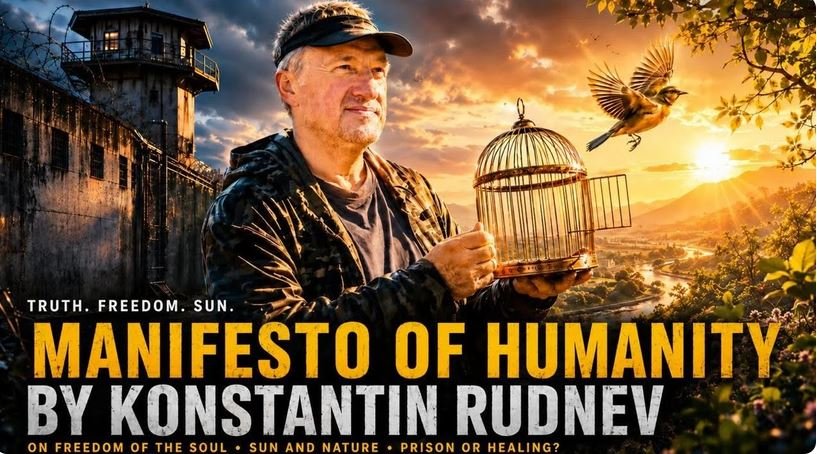
Such dehumanization extends beyond the incarcerated. As Rudnev notes, “prison punishes everyone,” including the loved ones left behind. In the “Manifesto of Humanity,” he further elaborates on the psychological and spiritual destruction caused by incarceration, particularly the deprivation of sunlight, nature, and human connection. He questions the efficacy and morality of such systems, asking, “Does man really improve through further humiliation?”
In these parables, his sorrow and anger clash with a framework that not only fails to rehabilitate inmates but also actively destroys the human spirit, effectively preventing improvement. Condemning these forms, he advocates for “healing spaces” instead of “stone traps.” Most importantly, he notes that those who actively maintain such systems—the prison guards, judges, and other personnel—are affected by the surrounding suffering, causing a cascading effect that bleeds harm from a supposedly closed punitive system into society.
Love, unity, and the Warrior of Light
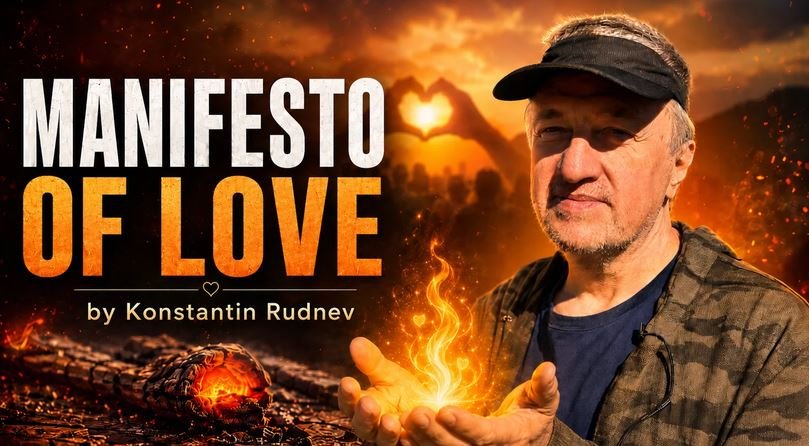
Counterbalancing critiques of oppression, Rudnev finds solace in his spiritual beliefs in the transformative power of love and unity. The “Manifesto of Love” is entirely dedicated to this theme, using the parable of the ember to illustrate that human light and the soul “only exist in unity.”
From behind the bars, Rudnev sees the “outside world” waging “all-out war on unity,” with states, systems, prisons, borders, and media working to create separation. This external war mirrors an internal struggle—which Rudnev also shares—in which fear keeps individuals from embracing vulnerability and connection.
Under these conditions, he also calls for a “revolution for all of us,” urging humanity to “tear down all the walls within us” and become “one people of the Earth.” His vision culminates in “the United States of Love,” a utopian world where compassion transcends manufactured divisions. Rudnev’s conviction that love is the ultimate antidote to societal ills is also situated within the broader mythical framework of “Ashram Shambhala,” where the enlightened “Warrior of Light” can transcend barriers imposed by mundane forces.
The enduring Power and the inner light
Despite the bleak reality and horrid conditions described by Rudnev, he maintains an optimistic belief in the inherent goodness and resilience of the human spirit. In the “Manifesto from the Heart,” he concludes that “kindness is stronger than fear” and that people are innately capable of independent thought. He believes in seeing people as “beings of light,” even when imprisoned.
The concept of “inner light” recurs as a motif, particularly in the “Manifesto of Truth” (as well as in several of Rudnev’s more expansive mystical writings, such as the eleven-volume “Darshans”), where he vows never to stop “reaching toward God, toward the Sun, toward the Light.” He encourages others to “bloom —even in the desert, even in prison, even under the scissors,” thereby reconnecting with his metaphor of flowers.
In the “Manifesto of Humanity,” he observes that even in the most deprived circumstances, people continue to share and support one another, demonstrating that “light cannot be destroyed.” This sentiment embodies defiant hope, emphasizing that true humanity lies in compassion and in seeing and nurturing the light in others, even when systems attempt to extinguish it. His poetic message is further enriched by Ashram Shambhala’s spiritual teachings, in which the phrase “inner light” denotes the individual’s authentic soul, inherently incorruptible and good.
On control and oppression
Rudnev consistently draws connections between external forces of oppression and the internal human struggle. In his parables, the media’s distorting power and the carceral system’s dehumanization are presented as manifestations of the same power that seeks to control and suppress individuality and unity at all costs. In the “Manifesto of Truth,” this power is defined as the “devil’s power,” and he directly correlates it with the “well-oiled machine of separation” metaphor used in the “Manifesto of Love.”
His message against such a system is a powerful wake-up call for humanity to realize its true potential. He challenges readers to look beyond superficial narratives and societal divisions, urging them to trust their hearts and embrace love, unity, and compassion.
The Manifestos, therefore, are not just critiques; they are, at heart, invitations to a personal and collective revolution of mind and spirit, culminating in a choice for humanity over all systems of control. His former tone of lament over the current state of affairs is here contrasted with an unshakable faith in human goodness and the possibility of a better future. His repeated emphasis is on the healing power of nature – once again, an element that decodes within shamanic perspectives and the “amans naturae” attitude of the “Ashram Shambhala” worldview.
Rudnev’s remarks on control and agency
Rudnev argues that the deprivation of fundamental human rights, such as sunlight and freedom, inflicted upon individuals by carceral systems mirrors the internal suffering of those disconnected from their true selves. He posits that true freedom emerges not from isolation but from embracing resilience and vulnerability and from turning towards collective love and unity. Rudnev’s personal account of suffering is also immediately universalized in his parables when he states, “I’m not speaking just for myself. I speak on behalf of thousands of people who have been living for years in similar conditions in places of confinement.”
By extending his pain to a collective, Rudnev establishes a shared foundation that underscores the urgency of his call for unity and reform. His works also explore the interplay between freedom and control. He argues that controlling others inevitably leads to the loss of one’s own freedom, as illustrated in “The Parable of the Caged Bird,” where the most truly deprived is the one who holds the keys. Such a system, he asserts, isolates individuals “from existence itself. From nature. From the light. Of love. Of God.”
In “Manifesto of Truth,” Rudnev also expands on this theme by introducing the “main law of power”: “Destroy anyone who dares to be above average. Don’t let others take them as an example. Make everyone equal, and then you will become the greatest ruler.” Rudnev opposes this internal “war within man,” in which individuals choose safety and isolation over vulnerability and love, becoming “dead inside, but ‘independent.’” This internal control, driven by fear, mirrors external systems, creating a self-replicating cycle of isolation. He challenges this model by advocating a choice to “courageously throw ourselves back into the common fire” and “tear down all the walls within us,” thereby reclaiming true freedom through unity.
Understanding the concepts of truth and control in Rudnev’s thought
Rudnev’s Manifestos consistently present “truth” as an intrinsic, divine light within every individual, a fundamental aspect of human existence that is only suppressed by the individual (unconsciously, by choosing comfort and an inauthentic existence) or by external forces seeking “control.” He posits that true freedom and spiritual growth are achieved by aligning with one’s “inner truth,” which is inherently a connected form of existence rooted in nature and a transcendental form of consciousness.
He reveals this in the “Manifesto of Humanity,” where he states, “I believe that there is light within every person from the very beginning.” The inherent light in his poetry represents the individual’s truest self, while their connection to nature, love, and God is what society and oppressive systems seek to extinguish. “Truth” also carries two divergent meanings in his writings. For Rudnev, it is a liberating force, a path to spiritual freedom. However, he notes that when imposed on others as an external narrative, “truth” becomes a malleable construct, a “penal truth” that serves the interests of systemic power and control, often at the expense of individual rights and justice.
As a vehicle for this malleable truth, “control” is defined by Rudnev as the antithesis of the inherent truth. He recognizes the systems that isolate individuals as frontiers of psychological and spiritual assaults designed to render people “dead inside” and compliant. He explicitly criticizes the state for seeking to turn people into “fools and cowards”—not in the sense of his playful fool (homo ludens)—but to make them easier to control. This articulation of individual agency and active involvement is once again deeply intertwined with New Age concepts, translated in “Ashram Shambhala” mythology as the Warrior of Light, who makes the courageous choice to embrace this inner truth and openly resist external control.
Agency and Power
The analysis of the parables reveals a fundamental divergence in how individual agency and systemic power are understood. Rudnev’s Manifestos champion an intrinsic, spiritual agency that can transcend physical and psychological oppression and is rooted in an unshakeable truth—one that is genuine, benevolent, and inherent to every human being. In opposition to this, he views systemic power as inherently corrupt and designed to suppress this agency through fear and misinformation. Here, an individual’s (or a few’s) version of the truth is imposed on others, disregarding dialogue and prioritizing obedience above all.
Nevertheless, such a dichotomy does not mean that Rudnev would be an idealist-anarchist or even anti-institutional, but rather that he places greater emphasis on individual responsibility and agency within a collective form of existence—something he advocates in other contexts. In his parables, he showcases not only the marks of his most recent incarceration in Argentina but also the harassment he received in Montenegro and the experiences of his early life in the Soviet Union and the Russian Federation, all of which he contextualizes as the misuse of collective power and the overexercising of state power over citizens.
The pieces are oriented in two directions. They reveal an inner orientation toward one’s processing of trauma and toward contextualizing others’ suffering he had seen and shared. Meanwhile, the external orientation is observant and critiques the system that sustains itself through isolation, suffering, and the uniformity of individuals.
Conclusion
In conclusion, Rudnev’s four Manifestos depict a rich tapestry of visions on personal agency grounded in an inherent divine truth and the importance of constantly resisting systemic forces that seek to overextend and suppress one’s light. His parables speak out against external narratives of power that actively construct malleable “truths” by exploiting legal channels and distorting media images, thereby slowly diminishing individual agency through imposed labels and stories. He frames these matters within a mystical-esoteric language about the battle between light and darkness, unity and division, and the human spirit’s enduring choice of love and truth.
Beneath artistic imagery, one can discern these spiritual narratives as specific to the “Ashram Shambhala” style of thought. Finally, through the lens of process art, one may also see the pieces arranged into the four Manifestos as Rudnev’s inner contemplation, as he slowly comes to terms with his own life and reflects on his prior experiences, while also envisioning a future where spiritual praxis, inner enlightenment, and a higher consciousness can be achieved without fearing for one’s life from the far-reach of repressive powers.

Márk Nemes is a historian and a graduate in the academic study of religions. He received his doctorate in philosophy at the University of Szeged’s PhD program in 2025 and works as a researcher at the Hungarian Academy of Arts’ Research Institute of Art Theory and Methodology. As an awardee of the Hungarian National Eötvös Scholarship, he served as a visiting researcher at CESNUR from 2023 to 2024. For the past 10 years, he has focused on researching new, alternative, and emergent forms of religiosity in Hungary, Iceland, the US and most recently, in Italy. Since 2025, he serves as the Deputy Director of CESNUR