The public French broadcaster treated theology as a subject of ridicule and excluded Scientologists and independent experts from its show.
Rosita Šorytė*
*A paper presented at the Sixth International ISFORB Conference, “FORB and the European Union,” Institute for the Study of Freedom of Religion or Belief, Evangelical Theological Faculty, Leuven, Belgium, May 7, 2026.
Article 2 of 2. Read article 1.
Mocking Belief: Reincarnation, Xenu, and the Politics of Ridicule
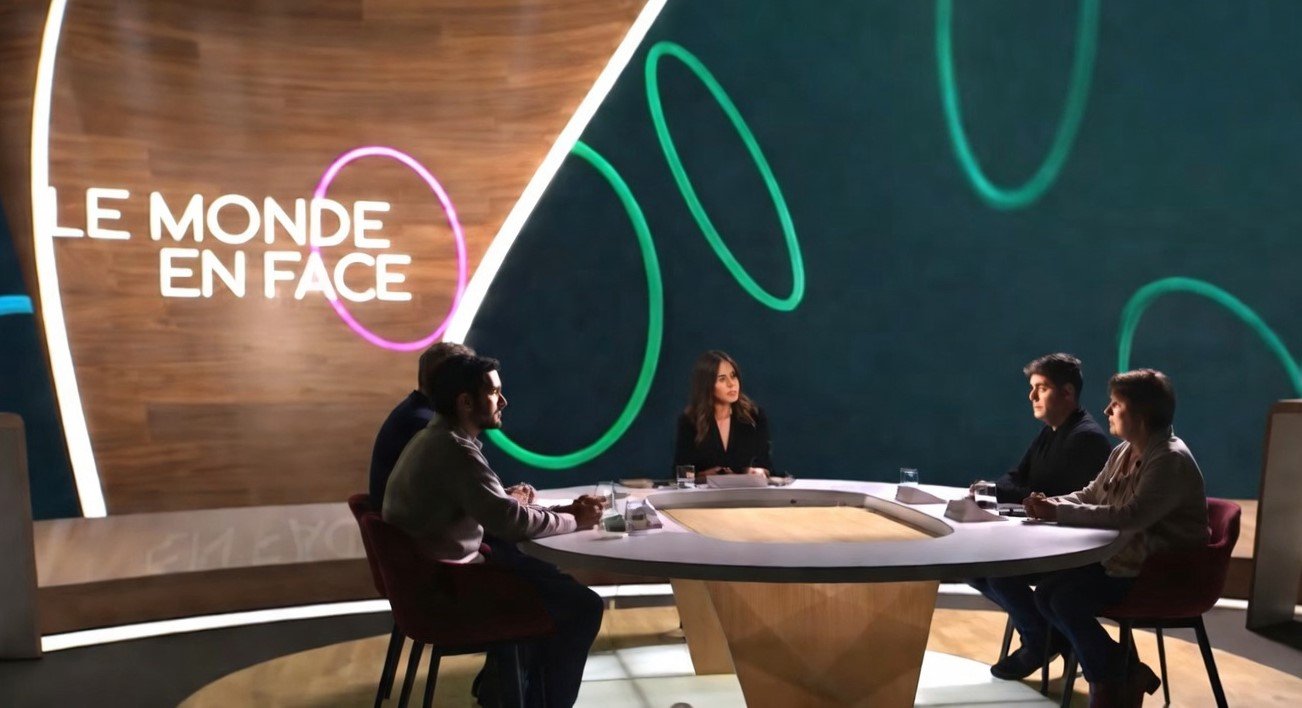
France TV’s “Scientology, the Empire of Secrecy” documentary devotes significant attention to Scientology’s cosmology, particularly the belief in reincarnation and the cosmological narrative involving the extraterrestrial figure Xenu. Ortega repeatedly mocks reincarnation and calls it “laughable,” suggesting that some Scientologists believe themselves to be the reincarnation of famous characters. While he speaks, the images of Winston Churchill and Nelson Mandela appear in the background. No evidence is provided to support the claim that some Scientologists believe the two famous politicians are reincarnated. More importantly, billions of people worldwide—Hindus, Buddhists, and a substantial minority of Westerners—believe in reincarnation. By presenting the belief as inherently laughable, the program not only disparages Scientologists but also a large portion of humanity.
The discussion of Xenu follows a familiar anti‑cult script. In the roundtable following the documentary, director Romain Icard claims that this doctrine is a secret revealed only to high‑ranking Scientologists, but that thanks to apostates, journalists “know more about Scientology than Scientologists themselves.” This assertion is implausible. Regardless of the accuracy of apostate accounts, descriptions of Scientology’s confidential teachings as reconstructed by the opponents have been publicly available for decades on anti‑Scientology websites and even on Wikipedia, which has an entry about Xenu (largely written by anti-cultists).
The roundtable participants also express indignation that Scientology maintains esoteric teachings accessible only at advanced levels. Yet secrecy is a common feature of esoteric traditions, including Freemasonry—an organization to which some French anti‑cult activists themselves belong. The assumption that secrecy is inherently sinister reflects a culturally specific suspicion of esotericism rather than an objective assessment.
The Roundtable: A Debate Without Dissent
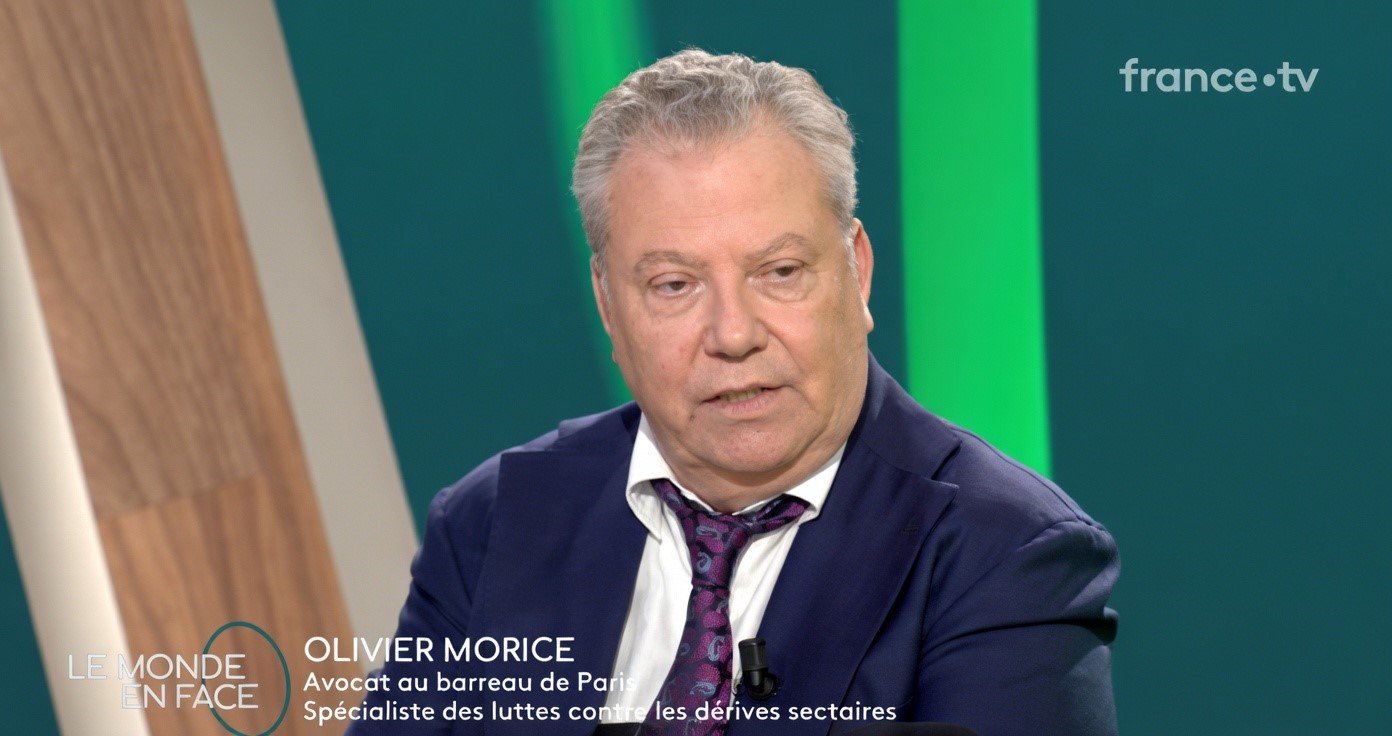
Following the documentary, France TV aired a roundtable discussion featuring Icard, Pascale Duval, the spokesperson for the anti-cult organization UNADFI, journalist Étienne Jacob, and UNADFI lawyer Olivier Morice. All four participants share identical views on Scientology. France Télévisions claimed that Scientology was invited but declined; the Church states that this is false. Regardless, the absence of any dissenting voice transforms the roundtable into an echo chamber.
Participants repeatedly describe Scientology’s doctrines as “farfelues” (“wacky”). Morice asserts that the beliefs are so absurd that they cannot be considered religious, that religion is merely a “mask.” Why intelligent people believe in wacky doctrines is explained through brainwashing: “total brainwashing, there is no doubt about it,” said journalist Jacob.
When asked to define the difference between a religion and a “cult,” Duval replies that cults “offer a solution to the world’s problems” and “have a doctrine and a social project”—criteria that apply equally to all religions and many philosophical or political movements.
The roundtable also includes factual inaccuracies. A France TV journalist claims that Scientology is regarded as a “cult” under British law. In fact, the UK has no legal list of “cults.”
Selective Visibility: Whose Voices Count?
The documentary gives a voice to apostates and anti-cultists only. Yet it ignores the thousands of Scientologists—including actors, musicians, visual artists, writers, and businesspeople—who remain in the Church and report positive experiences. Icard managed to find one celebrity who left Scientology and claims she was “brainwashed” there, singer Joy Villa. But there are hundreds of celebrities who remain in the Church and insist they derive substantial benefits from the practice of Scientology. Why have none of them been interviewed?
The program also frames the inauguration just before the Paris Olympics of a large Scientology church in Paris and Scientologist Tom Cruise’s participation in the Olympics’ closing ceremony as evidence of a sinister plot. Roundtable participants suggest that these events are connected, implying a conspiracy without providing evidence.

Anti‑Cult Wishful Thinking and the Resilience of Religion
Several participants express hope that Scientology will disappear, perhaps upon the death of its current leader. This reflects a broader anti‑cult belief that exposing alleged abuses will cause new religious movements to collapse. Yet sociological research shows that religious movements often exhibit remarkable resilience in the face of criticism, media hostility, and even state repression. The expectation that Scientology will vanish is less an analytical prediction than an expression of ideological desire.
France TV’s “Scientology, the Empire of Secrecy” exemplifies how public media can reproduce anti‑cult ideology through selective sourcing, narrative simplification, and the exclusion of scholarly expertise. The documentary’s reliance on professional apostates, its uncritical use of “brainwashing” discourse, its mockery of religious beliefs, and its refusal to include either Scientologists or neutral scholars undermine its claim to journalistic rigor.
A public broadcaster has a legal and ethical obligation to present information impartially, especially when addressing minority religions that are vulnerable to stigmatization. The France TV program failed to meet this standard. Instead, it offered a polished but ideologically driven narrative that reinforces public prejudice rather than fostering informed understanding.
Scientology, like any religious movement, merits critical examination. But such examination must be grounded in methodological rigor, balanced sourcing, and respect for the diversity of religious experience. The France TV documentary, by contrast, functions as a ritual reaffirmation of anti‑cult orthodoxy—a performance of certainty rather than an inquiry into complexity. In doing so, it illustrates the broader challenges facing public media in pluralistic societies: the temptation to privilege sensationalism over nuance and ideology over investigation.

Rosita Šorytė was born on September 2, 1965 in Lithuania. In 1988, she graduated from the University of Vilnius in French Language and Literature. In 1994, she got her diploma in international relations from the Institut International d’Administration Publique in Paris.
In 1992, Rosita Šorytė joined the Ministry of Foreign Affairs of Lithuania. She has been posted to the Permanent Mission of Lithuania to UNESCO (Paris, 1994-1996), to the Permanent Mission of Lithuania to the Council of Europe (Strasbourg, 1996-1998), and was Minister Counselor at the Permanent Mission of Lithuania to the United Nations in 2014-2017, where she had already worked in 2003-2006. In 2011, she worked as the representative of the Lithuanian Chairmanship of the OSCE (Organization for Security and Cooperation in Europe) at the Office for Democratic Institutions and Human Rights (Warsaw). In 2013, she chaired the European Union Working Group on Humanitarian Aid on behalf of the Lithuanian pro tempore presidency of the European Union. As a diplomat, she specialized in disarmament, humanitarian aid and peacekeeping issues, with a special interest in the Middle East and religious persecution and discrimination in the area. She also served in elections observation missions in Bosnia and Herzegovina, Georgia, Belarus, Burundi, and Senegal.
Her personal interests, outside of international relations and humanitarian aid, include spirituality, world religions, and art. She takes a special interest in refugees escaping their countries due to religious persecution and is co-founder and President of ORLIR, the International Observatory of Religious Liberty of Refugees. She is the author, inter alia, of “Religious Persecution, Refugees, and Right of Asylum,” The Journal of CESNUR, 2(1), 2018, 78–99.
Languages (fluent): Lithuanian, English, French, Russian.