Old, discredited “brainwashing” theories and anti-cult rhetoric are still used against spiritual minorities.
by María Vardé
Article 1 of 4.

In recent years, an interpretive pattern has become increasingly visible in Argentine criminal proceedings involving religious minorities. Although the terms “cult” and “brainwashing” have been widely discredited, their logic resurfaced under formulations such as “coercive organization,” “coercive persuasion,” or “mental manipulation.” Specialized agencies like the Public Prosecutor’s Office for Human Trafficking and Exploitation (PROTEX) have institutionalized a version of this narrative that bypasses scientific scrutiny while maintaining the same underlying logic: that a person’s consent and decisions are irrelevant because their will has been “annulled” by a “charismatic leader” or a “cult.” This maneuver allows the State to intervene intrusively in private lifestyles, communal living, and spiritual practices, reclassifying them as criminal exploitation.
From a socio-anthropological perspective, these categories do not function as neutral forensic tools, but as a “ghost in the machine”: an invisible, unfalsifiable entity that authorizes state agencies to favor discursive constructions over empirical facts and to disregard the explicit testimony of capable adults. This judicial trend follows what a significant school of Argentine scholars has long identified as an institutional and discursive production of trafficking, where the diagnosis of “mental captivity” is strategically activated precisely when traditional criminal indicators are weak or absent.
“Unfalsifiable” means insulated from empirical refutation. Yet the existence of a harmful “ghost” is said to appear through its effect: the harm—namely, an impairment of autonomous decision-making, in principle assessable through forensic evaluation. Privileging an unfalsifiable construct (the ghost) over falsifiable facts (the alleged harm) represents a breakdown in scientific and legal reasoning.
This article is the first in a four-part series that examines how this conceptual reconfiguration operates in practice. Rather than focusing on an individual case, the analysis draws on a comparative reading of five landmark Argentine proceedings—the Buenos Aires Yoga School (BAYS), Konstantin Rudnev, How to Live by Faith (CVPF), Pastor Roberto Tagliabué, and Iglesia Tabernáculo Internacional Jerusalem (ITI). All five proceedings share a foundational legal framework: formalization under the charge of human trafficking facilitated by an “abusive situation of vulnerability” and “coercive persuasion” within the context of a “cult.” Far from being a late conclusion of the investigative process, this overarching characterization was established in the initial prosecutorial complaints.
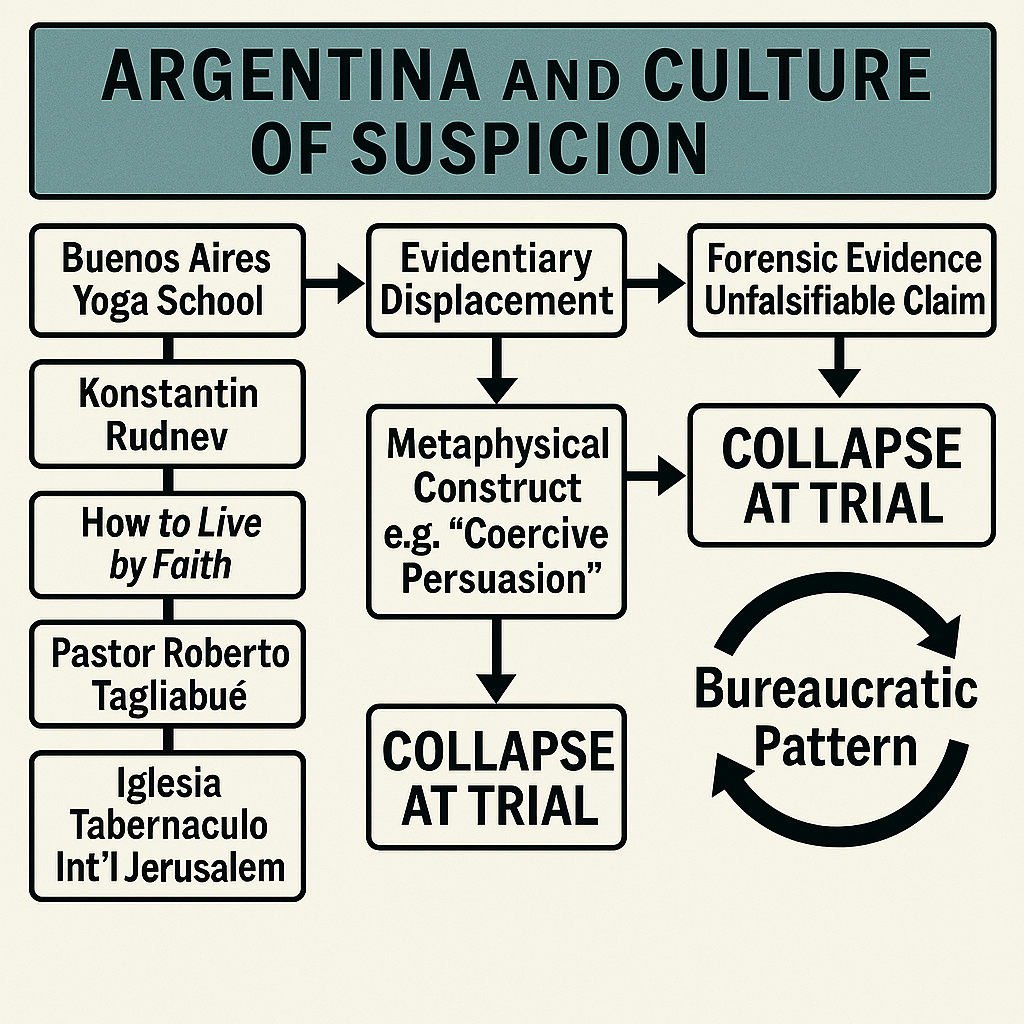
In the BAYS case, the women identified by the prosecution as victims of sexual exploitation consistently denied from the beginning any involvement in sex work, rendering the core trafficking charge factually hollow. Furthermore, these women intervened in the proceedings numerous times through legal counsel, introducing evidence and demanding that their testimonies be heard. During the investigation, the Forensic Medical Corps of the National Judiciary (FMC)—the highest technical authority for forensic science in Argentina—conducted exhaustive examinations of the alleged victims. The results were categorical: the subjects were autonomous, capable, and showed no signs of psychological pathology or submission.
However, PROTEX introduced a counter-narrative through the General Directorate of Investigations and Technological Support for Criminal Investigation of the Public Prosecutor’s Office (DATIP). The DATIP report attempted to establish what can only be described as a “metaphysical incapacity.” Utilizing the discredited theories of Margaret Singer, they argued that while the women appeared capable in standard medical tests, they suffered from a deeper, invisible “psychological persuasion.” Here, the displacement is literal: the scientific findings of the FMC were discarded in favor of a theoretical construct.
The ongoing Rudnev case illustrates another example of evidentiary displacement. The women detained in the same operation as Rudnev have categorically denied being victims of any crime. Most of them did not even know Rudnev. E., the central alleged victim of the case, has stated in affidavits that she traveled to Argentina to escape domestic violence in Russia and start a new life with the help of her own mother. She also states that she has never met Rudnev or any spiritual group led by him, yet the prosecution continues to state she is a victim of his “cult.”
The judicial agents argued that she could not recognize her status as a victim due to the “methods of recruitment and absolute control that characterize this type of organization,” and they explicitly maintained that several of the detained women were also victims who were unaware of it. E.’s filings portray a woman fighting for her agency against a state that insists on “rescuing” her from a situation she claims does not exist.
In the CVPF case, a Christian communal group, PROTEX issued a request for investigation, arguing that recruitment into CVPF was carried out through a process of “recruitment and manipulation” designed to “nullify the will” and exploit its members. The most striking document in this file is the report issued by the General Directorate for Victim Guidance, Support, and Protection (DOVIC), authored by psychologist Myriam Munné and filed by PROTEX.
Munné’s report diagnosed the alleged victim, Gabriela, with being under “mystical manipulation” and having her will inhibited. Remarkably, this diagnosis was reached without even a single interview with Gabriela, aged 32 at the time. The entire clinical assessment was based on the testimony of Gabriela’s sister and the public rhetoric of anti-cult activists. This represents the pinnacle of the “metaphysical incapacity:” the subject is no longer a person to be heard—not even to diagnose her. Ultimately, after the group had been labeled in the media as the “cult of horror,” the judge archived the case for lack of a criminal offense.
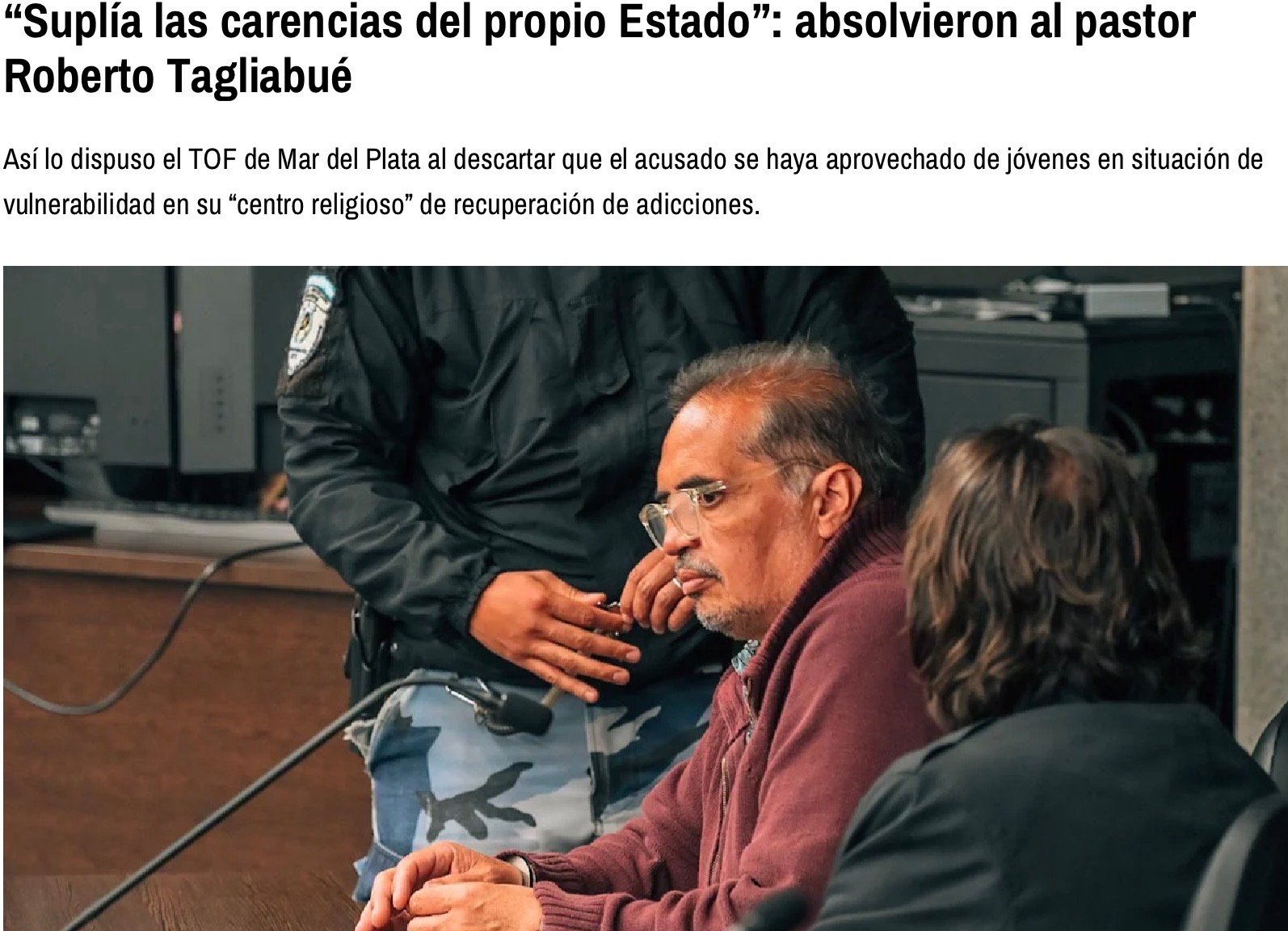
In the Tagliabué case, the prosecution interpreted the pastor’s offer of drug-use rehabilitation to underprivileged individuals and religious preaching in prisons as a method of “recruitment.” It argued that he used faith to reduce his followers to servitude through “coercive persuasion.” The court eventually acquitted the defendant after more than three years of imprisonment, noting that what the prosecution described as manipulation was, for the members of the church, the exercise of their faith. Furthermore, it emphasized that the members of the group, when testifying, showed no signs of mental incapacity and defended their way of life. The court concluded that “coercive persuasion” cannot be used to invalidate what a competent adult says about their own life.
Similarly, in the ITI case, the prosecution (and the experts it presented) argued that the proof of “coercive persuasion” was that the alleged “victims” said they could find salvation there and spoke well of their religious leaders. They also claimed that the group’s language was “indoctrinated” because members repeatedly spoke of “serving God.” As in the Tagliabué case, the donation of property and the performance of religious work were interpreted as indicators of exploitation. Yet the testimonies consistently showed that these were ordinary religious activities, as the court itself noted in its ruling. The court ultimately concluded that what the prosecutor labeled as “manipulation” was, in fact, a way of life protected by freedom of religion. The “ghost” here refers to more than a year in prison for the defendants.
These acquittals demonstrate that while “coercive persuasion” can sustain a case through the investigative phase—authorizing arrests and media scandals—it often collapses under the rigorous evidentiary standards of an oral trial. The “ghost” cannot survive the light of cross-examination. However, the methodology has secondary effects: long pre-trial imprisonment and the administrative and social “erasure” of the group through prolonged litigation and stigma.
The comparative analysis of these five cases reveals a consistent bureaucratic pattern in Argentina. When the alleged victims deny the occurrence of the facts alleged by the prosecution, it invokes “coercive persuasion” and, as we will see in the next installment, an interpretive expansion of “vulnerability” to disqualify their testimony as a relevant source of factual determination. This is a methodological choice that prioritizes institutional “rescue” narratives over the constitutional rights of individuals to live, believe, and associate freely.
By displacing empirical evidence with psychological phantoms, the judicial system ceases to be an arbiter of facts and becomes a producer of moralized fiction. For the victims of this “protection,” the result is an intrusive form of state violence that claims to save them while systematically ignoring their voices. The survival of human trafficking accusations in these contexts depends entirely on the successful deployment of these labels. Without the “ghost in the machine,” the architecture of suspicion would crumble, exposing the lack of an actual criminal act.
The discussion is not theoretical. It means years of imprisonment before the alleged effects of the “ghost” are shown to be non-existent. In the aforementioned Rudnev case—where, at the time of writing, he has lost 53 kilograms after nearly a year of captivity—it may mean his life. This outcome would also be unmistakably verifiable.

Maria Vardé graduated in Anthropological Sciences at the University of Buenos Aires and is currently a researcher at the Instituto de Ciencias Antropológicas, Facultad de Filosofía y Letras, Universidad de Buenos Aires (Institute of Anthropological Sciences, Faculty of Philosophy and Humanities, University of Buenos Aires). She has written and lectured on archeology, spirituality, and freedom of religion or belief.