A collective volume edited by Massimo Introvigne and Karolina Maria Kotkowska reconstructs the cosmology, practices, and sources of a much-misread spiritual master.
by Michele Olzi
I have written before about the case of Konstantin Rudnev, the Russian spiritual teacher arrested in Bariloche, Argentina, in March 2025 and accused of leading a human trafficking organization. In my opinion, it is an egregious miscarriage of justice, built on stereotypes about “cults” imported from Russia and on a reading of Rudnev’s texts that ignores what they actually mean. Defending the rights of a defendant is one task. Understanding the man and his ideas is another, and equally necessary. Judges, journalists, and scholars who want to assess what happened in Bariloche need to know what Rudnev’s worldview is all about.
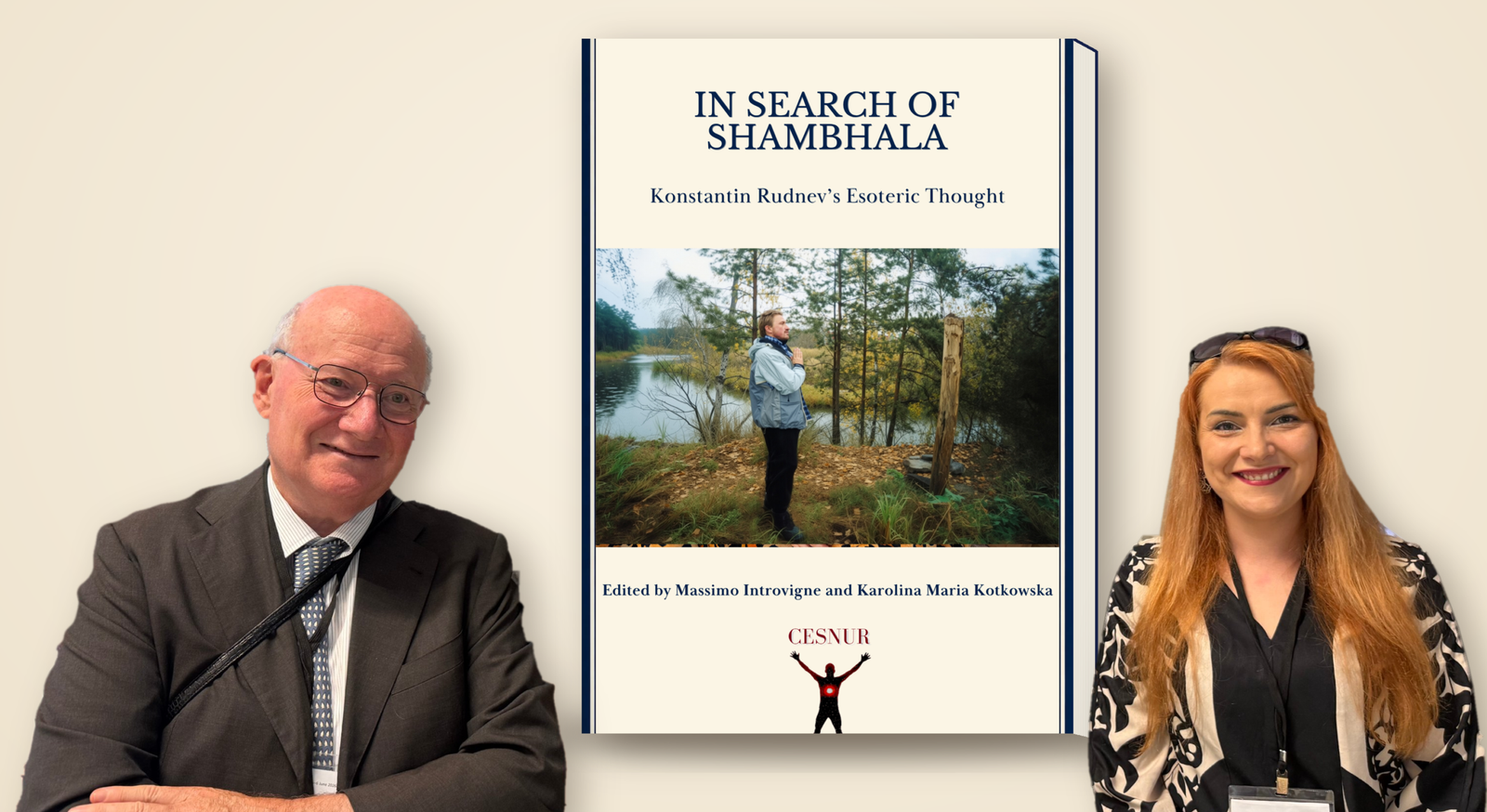
This is why I welcome “In Search of Shambhala: Konstantin Rudnev’s Esoteric Thought,” a collective volume available for free download, edited by Massimo Introvigne and Karolina Maria Kotkowska and just published by CESNUR in Turin. It follows a special issue of “The Journal of CESNUR” and the book “Dangerous Justice,” edited by Introvigne and María Vardé, which focused on the court cases and the controversies surrounding Rudnev. The new book leaves the courtrooms aside. It focuses on Rudnev’s esoteric teachings, read with the tools of religious studies and the academic study of Western esotericism.
The approach is overdue. Prosecutors in Russia and Argentina have quoted passages from Rudnev’s books, or from texts wrongly attributed to him, isolated from the system of ideas that gives them meaning. As the editors observe in their introduction, a myth read as a manual, a spiritual exercise read as a technique of manipulation, or a novel read as a confession can easily become “evidence.” They also remind readers that nobody would interpret the great monotheistic religions based on a few verses taken out of context, while new spiritual movements are seldom granted the same interpretive charity.
The introduction also offers a short biographical note. Born in Novosibirsk in 1967, Rudnev discovered yoga as a teenager through a magazine article and explored both esoteric and Christian milieus during Perestroika. After leaving the Soviet army, he began teaching yoga, which soon became his gateway to a broader spiritual path, influenced by the books of Carlos Castaneda, Siberian shamanism, and the “astral karate” of the late-Soviet teacher Valery Averyanov.
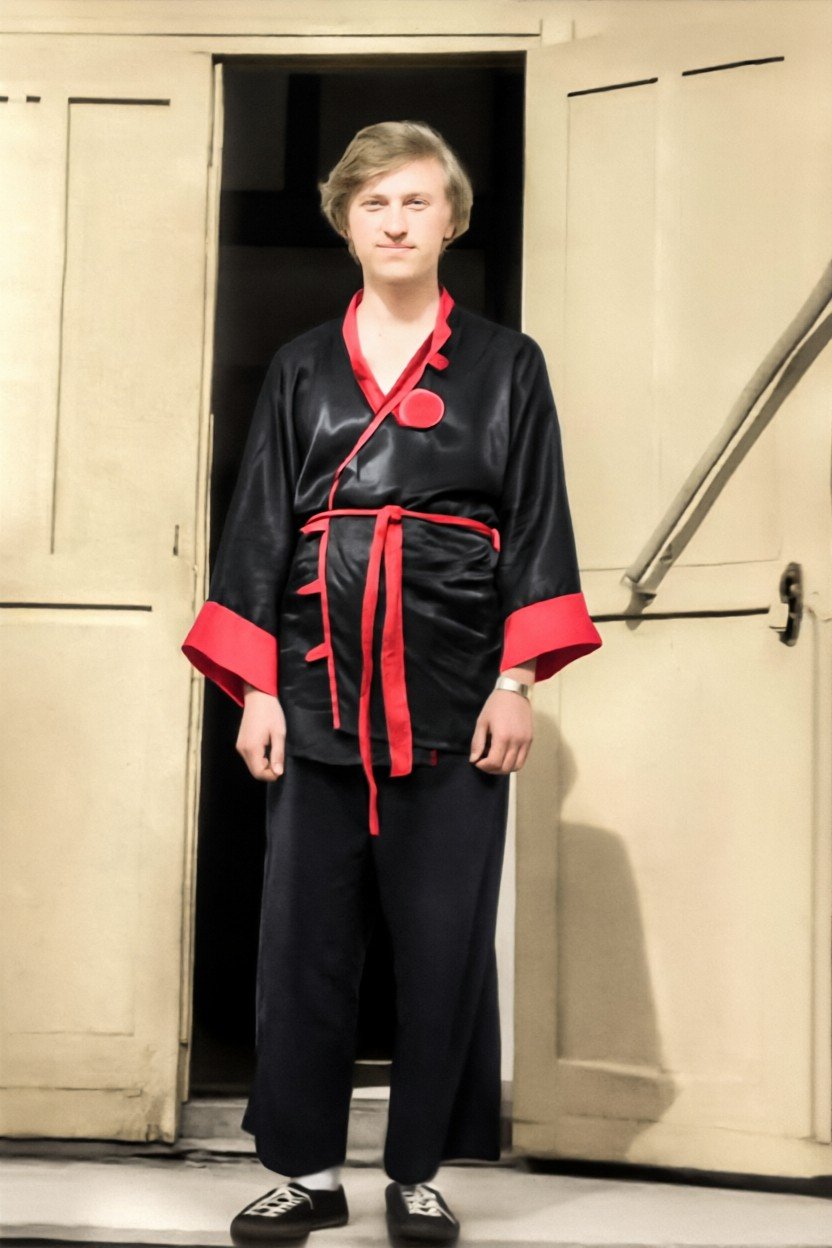
His followers eventually numbered in the thousands, which created friction with the Russian Orthodox Church and the Russian anti-cult movement. Arrested in 2010, Rudnev was sentenced in 2013 to eleven years in jail on trumped-up charges. Released in 2021, he moved to Montenegro and then to Argentina, where he was arrested again. Followers and journalists called his movement “Ashram Shambhala,” while Rudnev himself calls his teaching “Sekoru Dharma.”
The first chapter, by Kotkowska, of the Jagiellonian University in Kraków, explores the “Darshans,” the eleven volumes of dialogues at the core of Rudnev’s corpus, together with “Darshan Tantra,” the novel “Secrets of the Dead,” and a series of instructional videos produced by his students. Kotkowska shows how the teachings revolve around the struggle against “incorrect thinking,” which Rudnev regards as imposed on individuals by families and states. In “Secrets of the Dead,” negative emotions take the shape of astral spiders, leeches, and beetles feeding on human sadness, an image that turns the distancing from one’s own emotions into a practical tool. Those looking for scandal in “Darshan Tantra” will be disappointed. Its main theme is war and state power. The Tantric techniques it describes occupy only four of its more than 170 pages, although the book does discuss redirecting sexual energy toward spiritual ends. Kotkowska had developed this point in her article “Practices of Liberation: Secret Knowledge and Relations of Power in Konstantin Rudnev’s Teachings,” published in the special issue of “The Journal of CESNUR.” There, she showed that “Darshan Tantra” offers an anti-militarist critique of political authority. War appears in it as the culmination of a process of social subjugation, in which individuals are forced or manipulated into sacrificing their lives, health, and vital energy to the state.
In the book, Kotkowska also maps the many connections of “Secrets of the Dead” with the Theosophical imagination, from the Masters El Morya and Koot Hoomi to Shambhala as a center of hidden knowledge, as well as to the Russian visionary Daniil Andreev. Her methodological point is one that every student of esotericism should take to heart. Elements borrowed from earlier traditions acquire new meanings within Rudnev’s system, and they lose their meaning once removed from it. The chapter ends with a discovery important to the trials. “The Way of the Fool,” a text quoted by opponents and prosecutors as “the main scripture” of Rudnev’s movement, was in fact written by one of his students and by other disciples, and never had the central role critics attribute to it.
Márk Nemes, of the Hungarian Academy of Arts and CESNUR, analyzes the Manifestos Rudnev wrote in Argentina, first in detention and then under house arrest, and other writings. On the surface, they offer a humanistic critique of prisons, the media, and systems of control. Rudnev asks, for example, “Does man really improve through further humiliation?” Nemes argues that the Manifestos also convey a second message, which readers familiar with the “Darshans” can decode: references to the Atman, the Inner Light, the Warrior of Light, karma, and inner alchemy. The “Manifesto from the Heart,” in particular, insists on love, compassion, and inner unity as the values that allow authentic human relationships to survive the divisions imposed by systems of control. Nemes also proposes reading these texts as a form of “process art,” through which Rudnev comes to terms with decades of persecution.
In their chapter, Introvigne and María Vardé, of the University of Buenos Aires, discuss “The Dawn of Inliranga,” a novel that presents Rudnev’s teachings through the adventures of a group of students at a Tantric school. They argue that the book organizes its heterogeneous materials around an anthropology of influence, in which spiritual work consists of making perceptible the forces that shape thoughts, emotions, and identities. They compare Rudnev’s practices of attention and self-observation with those of George Ivanovich Gurdjieff and find significant affinities with the Fourth Way, particularly in the techniques for awakening from mechanical behavior and interrupting habitual patterns.
The comparison, they note, has its limits. Gurdjieff saw the “real I” as the result of a process of spiritual integration and development. Rudnev’s Atman is an already existing and immutable divine principle, obscured by the identities a person acquires in life. “The Dawn of Inliranga” takes up Gurdjieff’s repertoire of interruption, attention, and self-observation and places it within a path of liberation in which the witnessing self discovers a divine principle that has always been present. Gurdjieff thus helps readers understand an important strand of Rudnev’s method, which acquires a new meaning within Rudnev’s own synthesis. They also place the novel within the milieu of late- and post-Soviet spiritual seekers and reread in context passages that critics have used against Rudnev.

Introvigne then examines “Siberian Shamanism,” one of Rudnev’s early works. Its cosmology centers on four gods, each connected with a dimension of time: Tengri with eternity, Ulgen with the future, Umai with the present, and Erlik with the past and the realm of the dead. Human beings are composed of five souls, and the World Tree connects the different levels of existence. Introvigne identifies Rudnev’s sources among the Sakha, the
Altai, and the Nanai, as well as in Slavic mythology, and concludes that the book is an original synthesis, which uses Siberian materials to express a philosophy of consciousness, time, and liberation.
The last chapter, by Susan J. Palmer of Concordia University in Montréal, is based on an interview Rudnev gave her through his wife. He recounts his apprenticeship with an Altai shaman, his discovery of Castaneda’s books in the Soviet samizdat, and his reflections on the differences between Siberian shamanism and the Toltec “way of knowledge” described by Castaneda. “The Toltecs distanced themselves from people and simply practiced stalking, meaning they concealed their identity,” Rudnev told Palmer. “They did not provide practical help to the people around them, whereas a [Siberian] shaman lives to help people.”
The authors do not agree on every point, and readers will find different emphases and interpretations in the book. What emerges from the five chapters is the portrait of an eclectic but coherent esoteric system, typical in many respects of the spiritual milieu that flourished in the last decades of the Soviet Union and after its collapse, and centered on self-transformation, compassion, and the critique of social and political control.
One may find Rudnev’s ideas persuasive or not. Nothing I read in these chapters resembles the picture of a criminal enterprise drawn by the Argentine prosecutors. As the editors write, before judging Rudnev’s teachings, or using them in a court of law, one should read them, in their entirety and in their context. “In Search of Shambhala” makes such a reading possible. I recommend it to scholars of esotericism and new religious movements, and even more to the Argentine judges who will decide Rudnev’s fate.

Michele Olzi is currently teaching assistant to the chair of Political Theory and to the course of Religion and Media at the University of Insubria (Varese and Como). His interests include political theory, collective imaginaries, history of ideas, history of religions, religion & media, new religious movements, “technognosticism,” hyper-real Religions, religions and politics. He is a member of the organizing and scientific committee of the annual conference of Foro di Studi Avanzati Gaetano Massa. He edits the online journal La Rosa di Paracelso.