An investigation conditioned by anti-cult bias took rumors, slander, and apostate accounts of the Korean group seriously.
by Rosita Šorytė*
*A paper presented at the European Academy of Religion’s Ninth Annual Conference, LUISS University of Rome, July 3, 2026.
1. Introducing the Victorian Inquiry: A Problematic Point of Departure
When the Parliament of Victoria announced its “Inquiry into the Recruitment Methods and Impacts of Cults and Organised Fringe Groups” in 2025, it framed the initiative as a response to “harmful tactics” and “coercive behaviours.” From the outset, however, the Inquiry adopted the vocabulary of the anti-cult movement, repeatedly invoking the term “cult,” a category that scholars of new religious movements have long regarded as pejorative, analytically empty, and socially harmful. The Inquiry thus began by importing a conceptual framework already shaped by decades of sensationalist reporting, theological polemics, and globalized anti-cult activism. Rather than asking what forms of harm might occur across religious and spiritual contexts, it asked which groups fit the pre-established template of the “cult.”
The Inquiry’s hearings have so far confirmed this conceptual weakness. Instead of engaging with the substantial body of Australian and international scholarship on new religious movements, the Committee relied heavily on testimonies from apostates, student administrators, and representatives of institutions that had already internalized anti-cult rhetoric.
This paper focuses on Shincheonji, a Korean new religious movement with a presence in Australia that has been an important target of the Inquiry. Drawing on the analyses of Australian scholars Bernard Doherty and Geraldine Smith, to which this text is greatly indebted, I argue that the Victorian Inquiry is best understood as a chapter in a broader transnational campaign against Shincheonji, one that blends theological hostility, secular anxieties, and the global circulation of anti-cult narratives.
2. Gloria’s Testimony and the Sociology of Apostasy
The Inquiry heard from a former Shincheonji member, identified as “Gloria,” on July 23, 2025. Her testimony was lengthy and emotionally charged. It also followed, with striking precision, the narrative structure that sociologists have long identified as characteristic of apostate accounts. Apostates, in the technical sense used by scholars such as David Bromley, are not simply former members; they are former members who join oppositional coalitions and reinterpret their past through the lens of harm, deception, and captivity. Most ex-members are not apostates.
Apostate stories tend to follow a recognizable arc: an initial encounter framed as manipulation, a period of increasing commitment described as coercion, and a final break narrated as liberation from psychological control. This pattern is not unique to Shincheonji; it appears across a wide range of new religious movements and has been documented in the literature on apostasy narratives.
Gloria’s testimony fits this pattern closely. She described her recruitment as deceptive, her participation as coerced, and her departure as a recovery from manipulation. Yet when examined carefully, her account did not introduce any information that had not already circulated in the media. As Doherty notes, only two of her allegations—one of stalking and one of an alleged physical assault—could plausibly cross the threshold of criminality, and even these were uncorroborated. The remainder of her testimony concerned practices that, while demanding and pastorally insensitive, are not unusual in high-commitment religious settings. Early-morning meetings, strict expectations of punctuality, memorization of scripture, and strong communal bonds are features found in many Christian and non-Christian traditions. They may be experienced as burdensome, but they do not constitute evidence of systemic abuse.
The Inquiry, however, treated Gloria’s testimony as representative of Shincheonji as a whole. It did not seek corroboration, request documentation, or invite current members to respond. Nor did it contextualize her account within the broader sociology of religious commitment. Instead, it allowed apostate narratives—shaped by online communities, anti-cult counselors, and globalized discourses of “coercive control”—to stand as authoritative evidence. This is precisely the dynamic that scholars warn against: the elevation of a single, emotionally compelling narrative into a generalized indictment of an entire religious community.
3. A Comparative Glance: The French Case and the Globalization of Anti-Cult Narratives
The Victorian Inquiry is not an isolated phenomenon. Across Europe, North America, and East Asia, Shincheonji has become the target of campaigns that blend theological hostility, secular suspicion, and the rhetoric of psychological harm. In France, for example, a group of former members filed a criminal complaint in April 2026 alleging violence and sequestration. French media outlets amplified the story, portraying Shincheonji as a dangerous sect, despite the absence of judicial findings and France’s long-standing difficulties distinguishing between individual misconduct and institutional policy. The French case illustrates how apostate narratives, once introduced into a receptive media environment, can quickly escalate into legal action, administrative scrutiny, and public alarm.
The parallels with Australia are significant. In both contexts, apostates have been socialized into an anti-cult milieu that provides them with interpretive frameworks, vocabulary, and expectations about what aspects of their experience should be emphasized. The language of “manipulation,” “brainwashing,” “coercive control,” and “psychological captivity” circulates globally through online forums, counseling organizations, and anti-cult literature. Former members learn not only how to narrate their experiences but also which elements will resonate with journalists, policymakers, and the public. This does not mean that their suffering is fabricated; it means that their suffering is interpreted through a culturally available script.
The French example also highlights a crucial analytical distinction: the difference between individual abuses and institutional policy. In every religious tradition, including Catholic and Muslim contexts, there have been cases of leaders who acted abusively, imposed inappropriate discipline, or violated ethical norms. These cases must be investigated and addressed. But they do not justify the conclusion that the entire tradition is coercive or dangerous. Shincheonji teaches that members should be treated with care and love, and there are documented cases of leaders who were disciplined or removed for failing to uphold these standards.
The Victorian Inquiry, however, has shown little interest in this distinction. By treating apostate allegations as indicative of institutional policy, it risks reproducing the same errors seen in France and elsewhere: conflating individual misconduct with organizational doctrine, and allowing anti-cult rhetoric to shape public policy.
4. Why Shincheonji Became a Focus of Moral Panic in Australia
To understand why Shincheonji has become the object of such intense scrutiny in Australia, one must look beyond individual testimonies and examine the broader social context. As Doherty demonstrates, the group’s transformation from an obscure Korean Christian movement into a perceived national threat occurred rapidly, catalyzed by the COVID-19 outbreak in Daegu in early 2020. Australian media outlets, scrambling to explain the unfamiliar, relied on imported narratives from Korean Presbyterian critics and international anti-cult activists. Headlines framed Shincheonji as a “secretive cult” responsible for a superspreader event, despite the group’s cooperation with health authorities, the lower courts’ recognition of that cooperation, Supreme Court decisions that exonerated it from all COVID-related charges, and the absence of evidence that Australian members posed any risk.
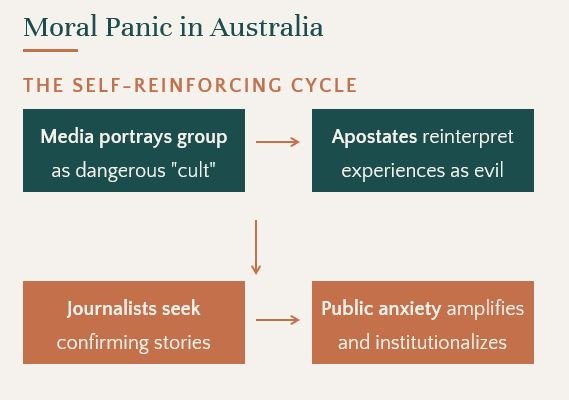
This initial wave of coverage created a template that subsequent stories would follow. Student newspapers, online forums, and ABC podcasts recycled the same anecdotes, often drawn from a small number of opponents and former members. The narrative became self-reinforcing: the more Shincheonji was portrayed as dangerous, the more former members interpreted their experiences through that lens, and the more journalists sought out stories that confirmed the template. This is the classic dynamic of moral panic, in which isolated or ambiguous events are amplified into evidence of systemic danger. As scholars of moral panic have shown, such processes are driven not by objective assessments of harm but by anxieties about social change, cultural difference, and perceived threats to established norms.
In Australia, these anxieties intersected with concerns about international students, campus safety, and the visibility of non-Western religious movements. Shincheonji’s Korean origins, its millenarian theology, and its success in recruiting young adults made it an ideal candidate for the role of “folk devil.” The Inquiry’s mandate, framed in terms of “coercive control,” reflects this convergence of fears. Yet as Doherty and Smith both suggest, there is no evidence of actual harm, and the rhetoric of danger far exceeds the documented reality.
5. Universities, Campus Fears, and the Institutionalization of Anti-Cult Rhetoric
The Inquiry’s interest in university campuses reveals another dimension of the moral panic. As Geraldine Smith has reported, student associations and university administrators have issued warnings about “cults on campus,” singling out Shincheonji and often relying on checklists and definitions so broad they could apply to any religious or social group. For example, the Tasmanian University Student Association’s guidelines describe recruitment methods—approaching students for directions, inviting them to coffee, steering conversations toward shared interests—that are indistinguishable from those of mainstream religious organizations, political clubs, or charitable societies. The criteria for identifying a “cult” are vague, subjective, and rooted in stereotypes rather than evidence.
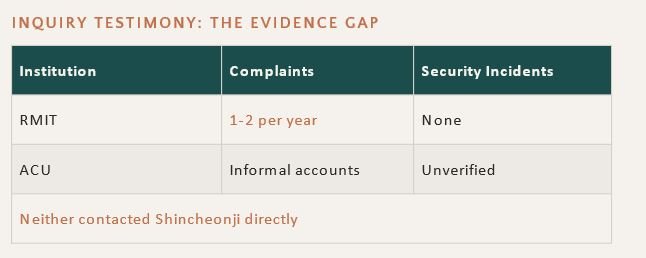
When representatives from the Royal Melbourne Institute of Technology (RMIT) and the Australian Catholic University (ACU) appeared before the Inquiry, they offered little more than anecdotal reports and hypothetical concerns about Shincheonji. The Institute reported only one or two complaints per year, none of which involved security incidents. The Catholic University cited informal accounts and unverified impressions. Neither institution had contacted Shincheonji directly, nor had it consulted scholars at their own universities who specialize in the study of religion. Instead, they relied on assumptions shaped by media narratives and anti-cult rhetoric.
This institutionalization of fear has serious consequences. When universities warn students about “predatory cults,” they risk stigmatizing all religious minorities, creating discrimination against both Shincheonji members and others accused of being part of “cults.” Students with low levels of religious literacy may come to view their Shincheonji-affiliated classmates as evil and dangerous. Administrators, lacking guidance from experts, may adopt policies that discriminate against minority faiths. The Inquiry, by amplifying these concerns without scrutinizing their evidentiary basis, risks legitimizing a climate of suspicion that undermines the very principles of inclusion and diversity that universities claim to uphold.
6. The Mechanics of Panic: How Narratives Travel and Solidify
Once a group has been designated as threatening, the mechanisms through which that threat is amplified follow a predictable trajectory. In the case of Shincheonji, the Victorian Inquiry inherited a narrative already shaped by years of media stylization, theological polemics, and the global circulation of anti-cult discourse. The same allegations traveled across platforms, institutions, and national boundaries. This is the process that scholars of moral panic describe as the consolidation of a “recognizable threat,” which transforms scattered anecdotes into a coherent public anxiety. It is also the process through which apostate testimonies acquire disproportionate authority, as they are repeatedly cited, reframed, and elevated within a discursive ecosystem that privileges stories of harm.
The Victorian Inquiry did not create this ecosystem; it entered into it. By the time the Committee convened, Shincheonji had already been positioned as a paradigmatic “cult” in the Australian imagination. The Inquiry’s mandate, framed in terms of “coercive control,” aligned neatly with the vocabulary popularized by journalists, anti-cult counselors, and former members. This alignment ensured that the Inquiry would interpret evidence through a lens already shaped by the broader cultural script. The Committee’s questions, its selection of witnesses, and its framing of concerns all reflected this pre-existing narrative architecture. The result is an inquiry that appears to investigate Shincheonji but, in fact, investigates the image of Shincheonji constructed through years of mediated repetition.
7. The Korean Connection: Heresy Hunters, Transnational Networks, and the Export of Alarm
A distinctive feature of the Shincheonji controversy is the role of Korean Christian “heresy hunters,” whose campaigns against the movement have continued for decades. Today, their efforts are reinforced by actions by the ruling party aimed at banning Shincheonji and other churches suspected of being politically active (which is forbidden by Korean law) and of supporting politicians hostile to the current government.
These campaigns, rooted in theological objections, ecclesiastical competition, and politics, have generated a substantial body of polemical literature, public denunciations, and organized opposition. When Korean diaspora churches in Australia encountered Shincheonji’s missionary activity, they imported this oppositional framework wholesale. Visiting apologists, Korean-language publications, and transnational church networks provided Australian congregations with ready-made narratives of danger. These narratives were then taken up by English-language media, often without awareness of their theological origins.
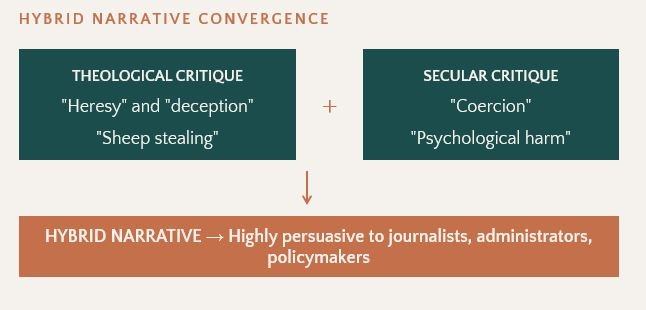
This transnational circulation of alarm is not unique to Shincheonji. It reflects a broader pattern in which religious controversies in one country are exported to others through diasporic networks, missionary movements, and global media. What makes the Shincheonji case particularly instructive is the convergence of theological and secular anti-cult discourses. Evangelical critics framed the group as heretical and deceptive, while secular activists framed it as coercive and psychologically harmful. These two discourses, though rooted in different epistemologies, reinforced each other. The theological critique provided a moral vocabulary of error and deception; the secular critique provided a psychological vocabulary of manipulation and control. Together, they produced a hybrid narrative that proved highly persuasive to journalists, university administrators, and policymakers.
The Victorian Inquiry reflects this hybridization. Its concerns about “coercive control” echo secular anti-cult rhetoric, while its focus on “deceptive recruitment” mirrors the theological language of “sheep stealing.” Yet the Committee did not acknowledge the theological origins of many of the claims it heard, nor did it examine how transnational networks had shaped these claims. This omission obscures the fact that the Inquiry is not responding to a uniquely Australian problem but to a globalized discourse that has been circulating for years. Recognizing this transnational dimension is essential for understanding why Shincheonji has become a focal point of concern in Victoria despite the limited evidence of harm presented to the Committee.
8. Europe as a Mirror: Administrative Scrutiny, Legal Action, and the Normalization of Suspicion
The dynamics observed in Australia are mirrored in several European countries, where Shincheonji has faced administrative investigations, media campaigns, and legal complaints. However, no case so far has produced any finding of criminal wrongdoing. In France, national media immediately amplified a pending case originating with disgruntled former members. In Germany and the United Kingdom, Shincheonji has been the subject of public warnings and administrative investigations. These actions often rely on the same narrative elements: allegations of deception, psychological manipulation, and excessive demands on members. They also rely on the same sources: apostate testimonies, anti-cult organizations, and theological critics.
What is striking is the consistency of the narrative across national contexts. The same motifs appear in French, German, British, and Australian media, often with minimal variation. This consistency suggests not independent empirical verification but the globalization of a particular interpretive framework. Anti-cult organizations in Europe and Australia share resources, collaborate on conferences, and circulate case studies. Former members participate in online forums that transcend national boundaries. Journalists draw on international reporting to frame local stories. The result is a transnational moral panic in which Shincheonji is constructed as a global threat, regardless of the specific conditions in each country.
9. The Role of the State: Between Protection and Instrumentalization
The central question raised by the Victorian Inquiry is not whether state or court authorities should investigate allegations of harm within religious communities. They should. The question is how states can do so without becoming instruments in campaigns driven by theological rivalry, cultural anxiety, or ideological agendas. The Inquiry’s reliance on apostate testimonies, its failure to consult experts, and its uncritical adoption of anti-cult vocabulary illustrate the dangers of proceeding without adequate conceptual clarity. When states adopt the category of “cult,” they adopt a term that carries decades of polemical baggage. It is a term that collapses diverse religious phenomena into a single stigmatizing label, obscuring the differences between high-commitment religion, abusive leadership, and genuine criminality.
The state’s responsibility is to distinguish between these phenomena, not to conflate them. This requires careful attention to evidence, consultation with scholars, and an awareness of the broader social dynamics that shape public perceptions of minority religions. It also requires resisting the temptation to respond to institutional anxieties with legislative or administrative measures that may inadvertently discriminate. Universities may feel uncertain about how to respond to unfamiliar religious groups, but that uncertainty should not serve as a basis for state intervention. Student associations may issue warnings based on incomplete information, but their warnings should not be treated as evidence of harm.
The Victorian Inquiry risks crossing this line. By framing its investigation in terms of “coercive control,” it risks importing a concept that has been stretched far beyond its original meaning. By focusing on Shincheonji without examining the broader landscape of religious diversity, it risks singling out one group for scrutiny based on narratives that have been shaped by intra-Christian competition and globalized anti-cult activism. The state must be vigilant not only in protecting citizens from harm and crimes but also in protecting minority religions from discrimination. This dual responsibility is essential for maintaining a pluralistic society and religious freedom.

10. Conclusion: Australia in a Global Landscape of Anti-Cultism
The Victorian Inquiry into “cults” and “fringe groups” is best understood not as an isolated investigation but as part of a global pattern in which Shincheonji has become a focal point of suspicion. A convergence of factors drives this pattern: Korean heresy hunters concerned about theological deviation and “sheep stealing,” secular anti-cult activists promoting a psychological model of coercion, journalists seeking compelling narratives, and apostate ex-members interpreting their experiences through globally circulating scripts. Australia’s universities, lacking guidance and expertise, have absorbed these narratives and reproduced them in warnings that blur the line between legitimate concern and discriminatory generalization.
Seen from a wider perspective, the Victorian Inquiry is only one node in a transnational wave of anti-Shincheonji mobilization—originating in South Korean heresy-hunting networks, amplified by Western anti-cult organizations, and now replicated across Europe, North America, and Oceania—demonstrating how a globalized repertoire of suspicion increasingly shapes local controversies.
The case of Shincheonji is a reminder that moral panics do not arise spontaneously; they are constructed, circulated, and institutionalized. The task of a responsible state is not to amplify but to interrogate them. Only then can it ensure that its interventions punish real crimes without undermining the rights of those whose beliefs and practices fall outside the mainstream.

Rosita Šorytė was born on September 2, 1965 in Lithuania. In 1988, she graduated from the University of Vilnius in French Language and Literature. In 1994, she got her diploma in international relations from the Institut International d’Administration Publique in Paris.
In 1992, Rosita Šorytė joined the Ministry of Foreign Affairs of Lithuania. She has been posted to the Permanent Mission of Lithuania to UNESCO (Paris, 1994-1996), to the Permanent Mission of Lithuania to the Council of Europe (Strasbourg, 1996-1998), and was Minister Counselor at the Permanent Mission of Lithuania to the United Nations in 2014-2017, where she had already worked in 2003-2006. In 2011, she worked as the representative of the Lithuanian Chairmanship of the OSCE (Organization for Security and Cooperation in Europe) at the Office for Democratic Institutions and Human Rights (Warsaw). In 2013, she chaired the European Union Working Group on Humanitarian Aid on behalf of the Lithuanian pro tempore presidency of the European Union. As a diplomat, she specialized in disarmament, humanitarian aid and peacekeeping issues, with a special interest in the Middle East and religious persecution and discrimination in the area. She also served in elections observation missions in Bosnia and Herzegovina, Georgia, Belarus, Burundi, and Senegal.
Her personal interests, outside of international relations and humanitarian aid, include spirituality, world religions, and art. She takes a special interest in refugees escaping their countries due to religious persecution and is co-founder and President of ORLIR, the International Observatory of Religious Liberty of Refugees. She is the author, inter alia, of “Religious Persecution, Refugees, and Right of Asylum,” The Journal of CESNUR, 2(1), 2018, 78–99.
Languages (fluent): Lithuanian, English, French, Russian.