Finally, the human rights issue is connected with trade by two parliamentary resolutions.
by Abdurehim Gheni Uyghur
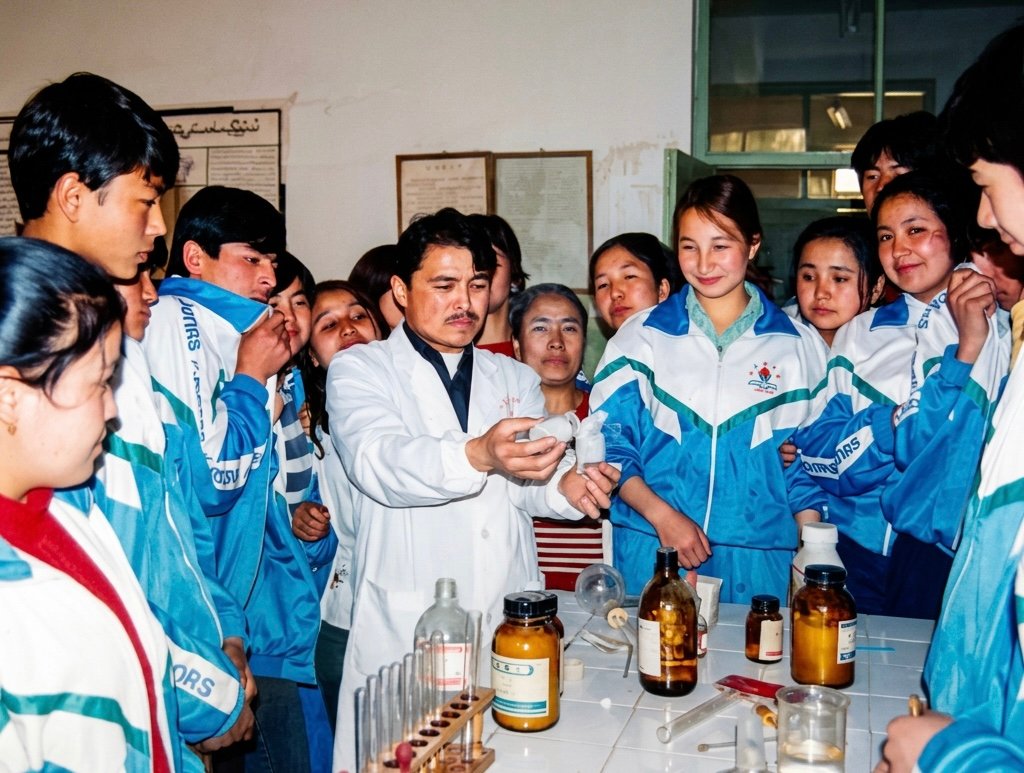
On April 26, 2026, the Dutch national television broadcaster, NOS, aired a documentary report titled “Trade with Xinjiang Has Increased Sharply Despite Uyghur Human Rights Violations.” In an interview for this piece, I disclosed the harrowing realities I personally witnessed while working as an educator at the Aksu Prefectural Pedagogical School. For two consecutive years, from late September to late October in 2003 and 2004, we were compelled to mobilize our students for forced cotton-picking labor across the 2nd and 3rd regiments of the Xinjiang Production and Construction Corps (XPCC). By recounting these systemic violations—which I saw firsthand—I exposed how state-sponsored forced labor operates under the guise of “work-study programs” within the Chinese government’s educational apparatus in occupied East Turkistan. I also urged the Dutch public to boycott commodities tainted by Uyghur forced labor. While today’s commentary focuses on a broader political breakthrough, I intend to analyze this structural exploitation thoroughly in the future.
The empirical data disclosed in the NOS broadcast was deeply alarming. In February 2021, the Dutch Parliament made history as the first legislative body in Europe to formally recognize the Chinese government’s atrocities against the Uyghurs in occupied East Turkistan as “genocide and crimes against humanity.” Inexplicably, five years later, bilateral trade data revealed that Dutch imports from the region had surged to a historic high of $478 million. Confronted with this reality, I began seeking legislative avenues to challenge this trajectory and prompt a parliamentary debate on Uyghur forced labor. As the maxim goes, “Seek and you shall find”—the groundwork for that accountability has now been laid.
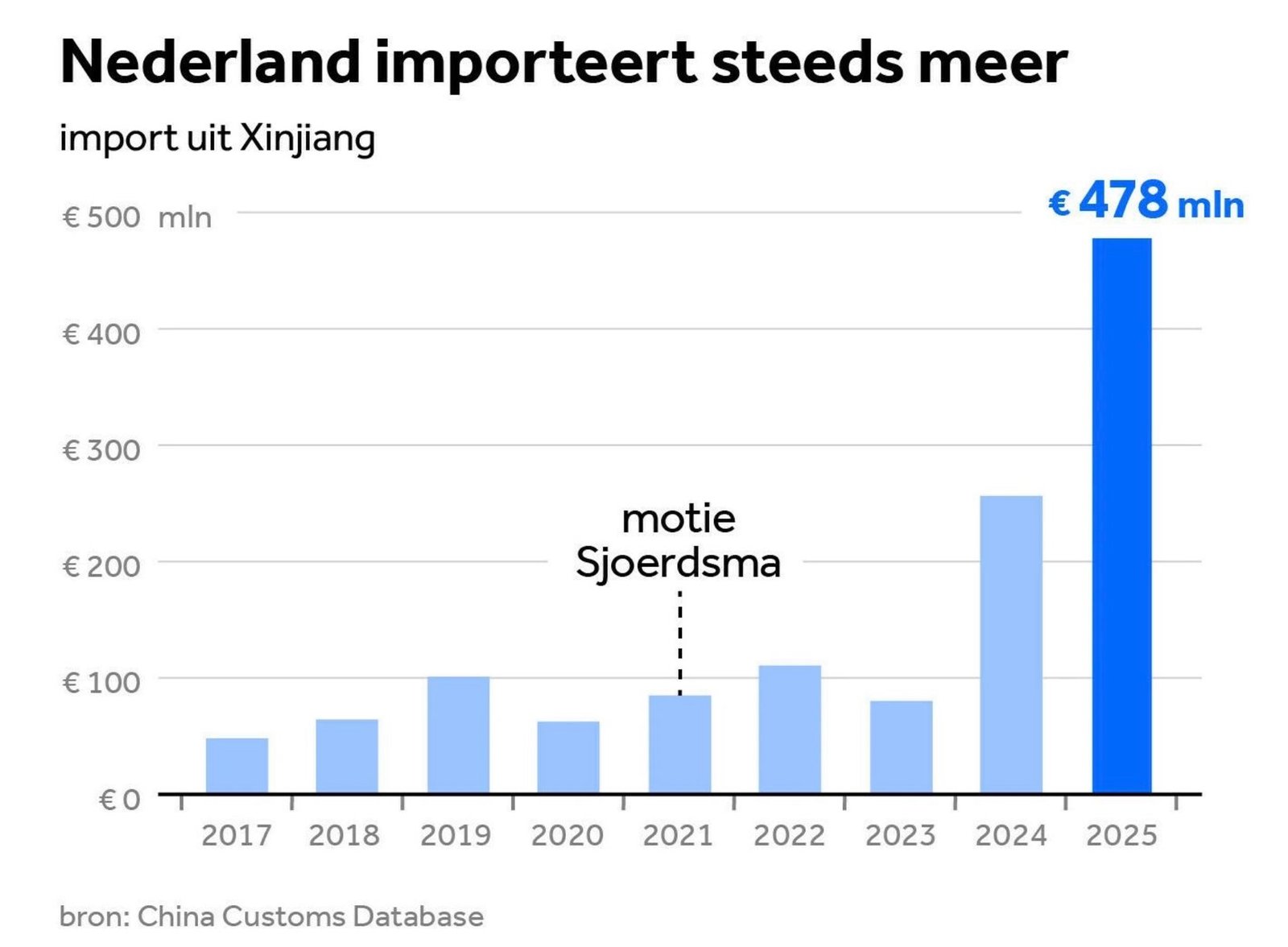
On May 11, 2026, I met with Stephan van Baarle, the leader and parliamentary representative of the Denk party, at his office. During our consultation, he noted that he had watched my NOS interview and commended it as a powerful, vital contribution to the public discourse. Seizing the momentum, I raised a critical policy contradiction: “In 2021, a motion recognizing the Uyghur genocide, spearheaded by Sjoerd Sjoerdsma, successfully passed the Dutch Parliament.
Today, Sjoerd Sjoerdsma serves as the Minister for Foreign Trade and Development. Although his initial motion directly targeted human rights violations, it failed to curb the subsequent expansion of trade with China. To the contrary, how can we reconcile the fact that trade with China has surged to an all-time high? Given this reality, is there an opportunity for you to introduce a new motion in Parliament?” Van Baarle responded with a firm commitment to actively pursue legislative countermeasures.
On May 23, I attended a special plenary event hosted by the Amsterdam branch of the Denk party. In a private audience with the party leader, Stephan van Baarle, he informed me that, fulfilling his pledge, the two parliamentary motions (moties) regarding the Uyghurs he introduced had been adopted by an overwhelming majority on Thursday, May 21, 2026. This represents a monumental and historic legislative breakthrough: both proposed measures designed to counter Beijing’s oppression of the Uyghur population were concurrently passed with an exceptionally high margin. In a single legislative day, the Dutch Parliament delivered two powerful rebukes to the Chinese government.
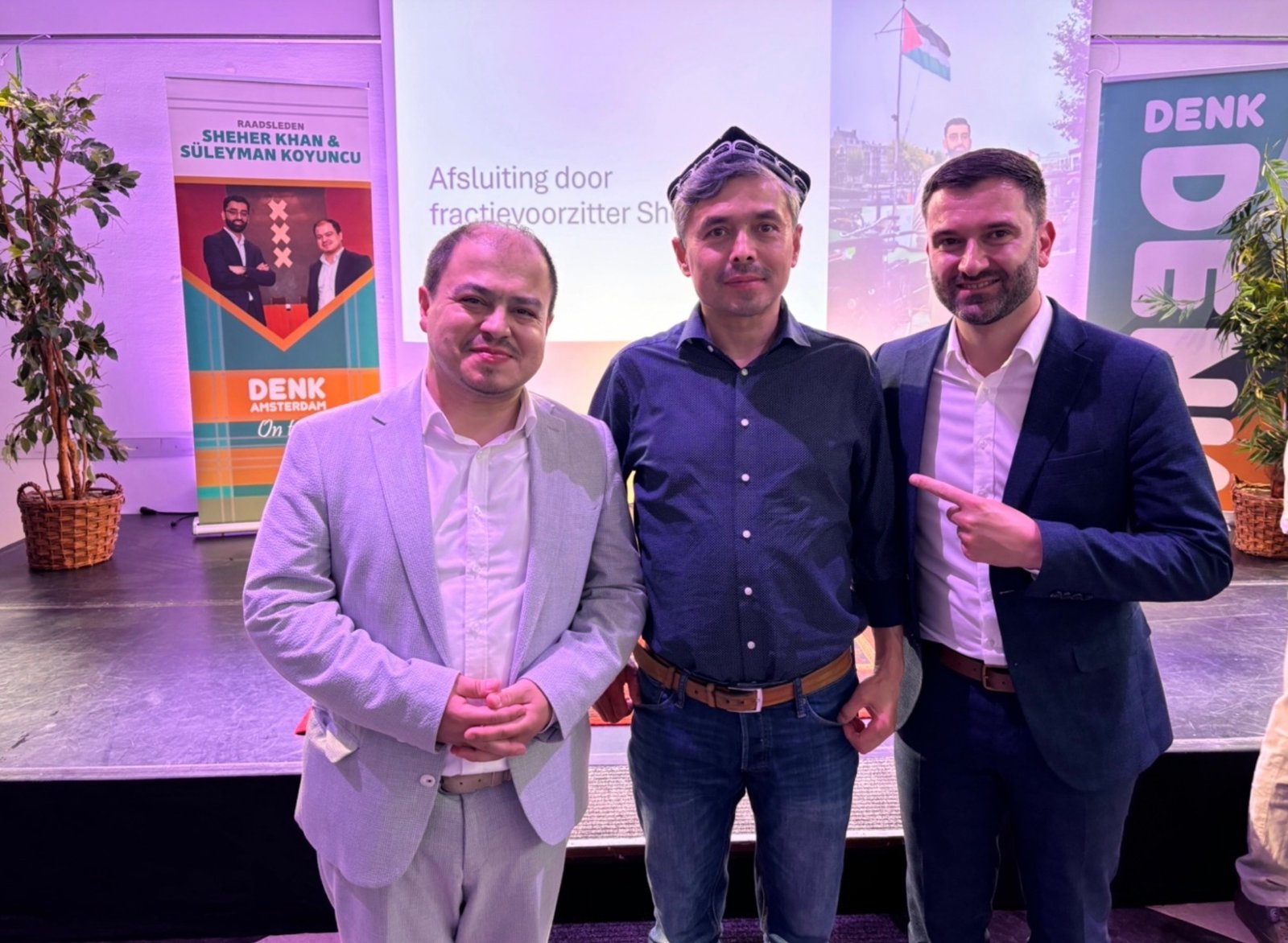
The First Countermeasure (Motion No. 21501-02, nr. 3409) is a binding resolution demanding that the Dutch government’s official trade delegations explicitly, publicly, and unequivocally place the Uyghur human rights crisis on the bilateral agenda during diplomatic and trade missions to China. This motion passed the Parliament with 117 votes.
The Second Countermeasure (Motion No. 21501-02, nr. 3410) is a resolution mandating that the European Union’s Forced Labor Regulation be enforced domestically within the Netherlands in the strictest and most targeted manner possible, thereby completely obstructing the market access of goods derived from Uyghur forced labor. This resolution secured an even broader consensus, passing with 126 votes.
This development brings profound encouragement. On behalf of the Uyghur people, I expressed our deepest gratitude to Van Baarle. Just months prior, on February 14, the Denk party leader had introduced another motion in Parliament following an act of transnational repression, where Chinese state loyalists violently assaulted my peaceful protest in front of the city hall in The Hague during a state-sanctioned Chinese New Year celebration. That motion, aimed at “safeguarding the security of Uyghurs in the Netherlands,” successfully carried with 116 votes. The rapid passage of these subsequent resolutions inflicts a severe political cost on Beijing and marks a significant milestone for our advocacy.
Currently, Dutch imports of Chinese commodities have peaked at unprecedented levels, as Beijing routinely utilizes its economic leverage to silence Western capitals. Although the European Union enacted its landmark “Forced Labor Regulation” in 2024, the official implementation timeline was deferred until January 2027.
While government bureaucracies and corporate entities appeared content to use this 2027 buffer period to delay substantive enforcement, the Dutch Parliament’s passage of Motion 3410 with an absolute majority of 126 votes serves as an immediate, direct mandate to the executive branch: “Do not wait for 2027; implement the strictest possible domestic enforcement mechanisms immediately.” This resolution marks a decisive shift toward purging Dutch supply chains of goods produced through the exploitation of Uyghur laborers. Furthermore, this legislative victory exerts critical peer pressure on neighboring European nations. Once a single member state accelerates enforcement, neighboring European jurisdictions can no longer justify inaction.
While officials from larger global powers frequently temper their public criticism of Beijing’s human rights record due to overriding economic dependencies, the Netherlands has demonstrated strategic leadership. By utilizing its legislature to mandate that the government “explicitly and publicly place the Uyghur crisis on the agenda during trade missions,” the Dutch Parliament has established a new precedent for international human rights advocacy.
To capitalize on this historic window of opportunity, the Uyghur diaspora must urgently coordinate the following strategic initiatives:
- European Scale-Up (The Chain Reaction): Uyghur civil society organizations operating across Europe (including Germany, France, Belgium, and beyond) must immediately engage their respective national parliaments. Using these twin Dutch resolutions as a blueprint, they should brief lawmakers and encourage the introduction of identical legislative motions.
- Leveraging the European Parliament: Securing parallel resolutions across multiple European capitals will generate the necessary momentum to codify a unified, comprehensive policy within the European Parliament. Representatives can then collectively condition broader EU-China trade relations on verifiable human rights compliance.
- Oversight and Compliance Monitoring: We must closely monitor the execution of these mandates by the Dutch Ministry for Foreign Trade and impending trade delegations. By consistently providing civil servants and trade envoys with empirical evidence of forced labor in East Turkistan, we can ensure full compliance with Parliament’s directives.
Throughout our deliberations, Stephan van Baarle and the leadership of the Denk party demonstrated a profound understanding of our community’s pursuit of accountability, receiving our expressions of gratitude with deep sincerity.
These twin political resolutions represent a severe blow to Beijing’s coercive policies. Our primary objective now is to transform this spark of accountability lit in the Netherlands into a broader European movement, systematically dismantling the infrastructure of oppression.
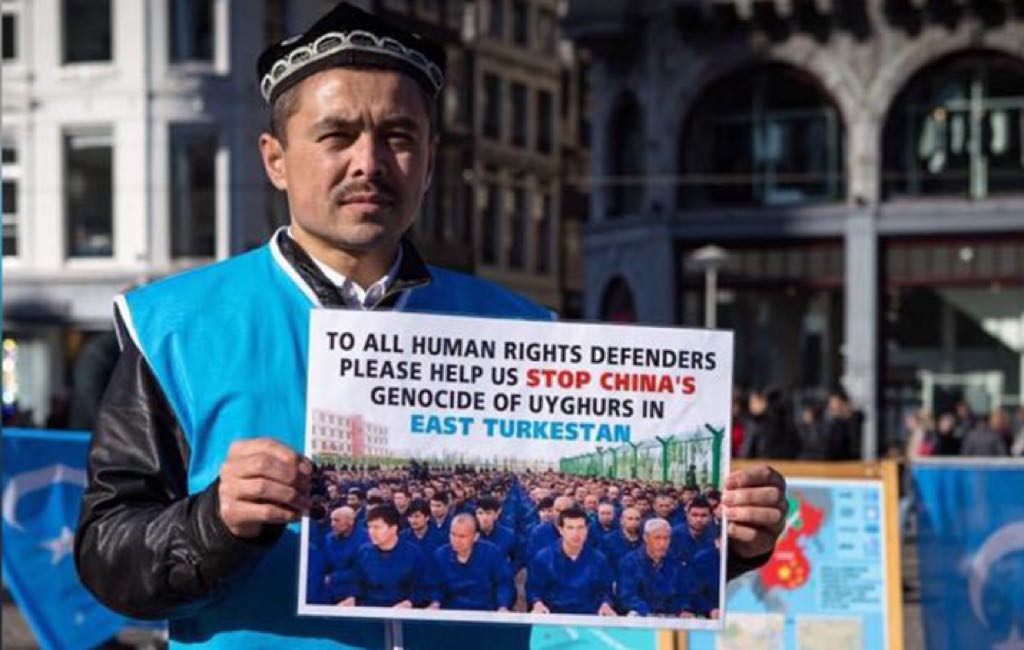
Abdurehim Gheni is a Uyghur activist living in the Netherlands who became famous for his solo protests in Dam Square in Amsterdam. He also educates tourists to the reality of the Uyghur genocide.