A confirmed decision of dissolution would dramatically diminish Japan’s international standing.
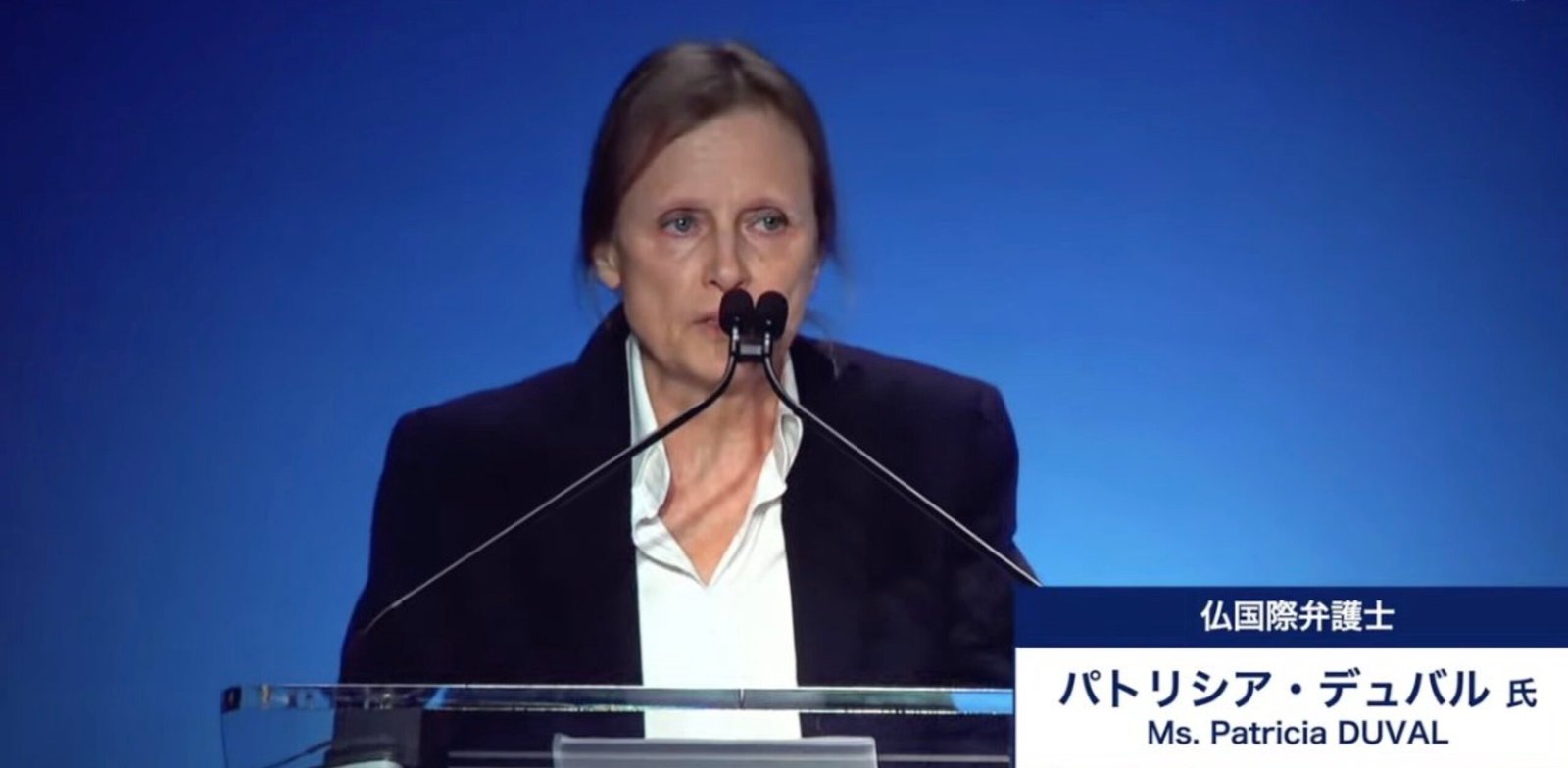
by Patricia Duval*
*Compiled by Keita Ando for “Monthly Seron.”
Article 2 of 2. Read article 1.
Contrary to the Principle of Proportionality
In asserting the legitimacy of the dissolution order, Japanese courts have stated that “the dissolution order does not prevent individual believers from practicing their religion.” However, this argument is merely formalistic and ignores the essential dimensions of freedom of religion.
Article 18, paragraph 1 of the ICCPR provides that freedom of religion includes the freedom to practice one’s religion “either individually or in community with others.” United Nations resolutions likewise call upon States to respect and guarantee the freedom to establish and maintain religious, charitable, and humanitarian institutions.
The loss of legal personality as a religious corporation, together with the liquidation of all assets built up through donations—including buildings used for religious activities and operating funds—renders the functioning of the religious community and the collective practice of faith effectively impossible.
A dissolution order, as a restriction imposed to achieve a particular objective, must therefore be subjected to strict scrutiny under the requirement of proportionality mandated by Article 18, paragraph 3 of the Covenant. The loss of religious legal personality and the liquidation of all assets—measures that have grave consequences for believers’ freedom to manifest their faith—are manifestly disproportionate to the stated objectives. They must be regarded under international law as violations of the principle of proportionality.
The United Nations Human Rights Committee has examined this issue from precisely this perspective in a precedent involving the Belarusian government’s refusal to register a religious organization. The case, decided in 2005 and known as Malakhovsky and Pikul v. Belarus, found that the denial of registration prevented activities such as establishing educational institutions and inviting foreign religious leaders. The Committee concluded that the restriction was not proportionate and held that the Belarusian government had violated the Covenant.
The Japanese Supreme Court’s assertion that a dissolution order “does not prohibit or restrict the religious activities of believers” ignores the material and spiritual impact of the liquidation of all community assets and places of worship. Such reasoning may be interpreted as reflecting an intent to erase communal religious practice itself. Furthermore, regardless of how Japanese courts may interpret the freedom of religion guaranteed by the Constitution of Japan, the authority to interpret the ICCPR rests with the Human Rights Committee established under the Covenant. Consequently, Japan’s courts are bound by an international legal obligation to comply with that interpretation.
The Liquidation Process
The asset liquidation process following a dissolution order has a profound impact on the activities of individual believers.
According to draft guidelines issued by the Agency for Cultural Affairs, because a large number of claimants are expected, tasks such as identifying whether claims exist, determining their amounts, and making repayments will require considerable time and may take a long time.
As liquidation proceedings drag on, the risk increases that believers’ religious activities will be significantly affected by restrictions on the use of facilities.
Although liquidators are expected to give due consideration by permitting believers to use facilities to the extent that such use does not interfere with liquidation duties, believers have no inherent right to demand access. Any use is limited to what the liquidator allows based on reasonable judgment.
Moreover, to secure funds for debt repayment, liquidators must dispose of assets and convert them into cash. Even in this context, the guidelines merely state that it is desirable to prioritize the disposal of assets not currently used for religious activities.
Serious questions also arise regarding special types of property owned by the religious organization, such as cemeteries—specifically, who will manage them after liquidation and whether they will ultimately be sold. Although cemeteries are protected by special legislation, liquidators are responsible for managing property once the religious corporation has lost ownership and must exercise appropriate care in disposing of it. However, the extent to which bereaved families’ wishes will be respected remains uncertain.
If, through this liquidation process, the foundations of religious activities built through believers’ donations are sold off, the resulting harm will be irreversible.
A Call to a Silent Media
Suppose that dissolution is carried out and the liquidator sells off all assets. If, thereafter, it becomes clear that the dissolution proceedings involved egregious violations of international law and international human rights law, or if the very legitimacy of the dissolution procedure is called into question, how are the disposed assets to be restored?
How, then, would the Japanese government compensate for damage that has already occurred? This is no simple matter. It is precisely the possibility of such irreversible harm that constitutes the core reason why the dissolution decision must be assessed as a serious violation of the principle of proportionality under international law.
The urgent statement issued by the Special Rapporteurs squarely places international responsibility on the Japanese government. With the Universal Periodic Review (UPR) before the Human Rights Council likely to take place within the next one or two years, if this dissolution issue is raised, Japan will face open criticism from other States Parties on the grounds of violations of international law.
Recommendations and criticism from the Human Rights Council carry the penalty of diminished international standing. In the context of the United Nations, this could result in serious disadvantages for Japan’s long‑standing diplomatic objectives, such as its pursuit of a permanent seat on the Security Council.
We, as European experts, will not overlook these facts. We will continue to provide information to the United Nations, and the United Nations will, in turn, continue to scrutinize the Japanese government.
The media has a responsibility to inform the Japanese public that the government may be held accountable for this matter in the future.
Despite the issuance of a highly urgent press release by the Special Rapporteurs, Japan’s major national newspapers have scarcely reported on it. This situation reveals a grave problem: important international debates are being ignored domestically.
Journalism is required to confront the misinformation circulating within the country with the truths established under international human rights law. In particular, it is essential to report clearly, as a matter of fact, the unscientific nature of the “mind control” theory and the reality that the solicitation of donations constitutes a form of religious practice protected under international law.
At the same time, criticizing the constitutional concept of “public welfare,” which lies at the core of Japan’s legal system, as contrary to international law presents difficult challenges. If criticism were to extend directly to the Constitution of Japan itself, there is a risk of provoking strong domestic backlash, framed as a rejection of the Constitution.
Under international law, however, States Parties are obliged to amend domestic laws that violate international law (Article 2(2) of the ICCPR). The Constitution of Japan expressly provides for the obligation to observe treaties (Article 98, paragraph 2). Accordingly, where Japanese law conflicts with international law, there exists a constitutional obligation to amend it.
When writing on this issue, it is therefore necessary to strike a balance between pursuing international truth and domestic acceptability. At a minimum, it is realistic, as an editorial judgment, to confine the discussion to the legal argument that “limiting the grounds for dissolution under the Religious Corporations Act to the vague notion of public welfare is incompatible with international law.”
This is because grounding a measure as grave as dissolution—tantamount to a death sentence for a religious corporation—on the exceedingly vague concept of “public welfare” represents a structural defect in Japan’s legal system, one that international human rights law has called upon Japan to correct for forty‑five years.
The present dissolution decision, based on the ambiguous notion of “public welfare” and premised on the unscientific theory of “mental manipulation,” substantively infringes believers’ right to practice their faith “in community with others” and represents a serious departure from the conditions for restricting freedom of religion set out in the ICCPR.
The urgent statement by the Special Rapporteurs constitutes a final warning: if higher courts uphold this decision, Japan will be in clear violation of its international obligations and will face severe criticism from the international community.
The Japanese government and judiciary must take this international pressure seriously and are obliged to promptly amend domestic laws and systems to ensure conformity with the ICCPR and to guarantee the freedom of religion of religious minorities effectively. Resolving this issue, I submit, is an indispensable path to maintaining Japan’s credibility and standing within the international community.

Patricia Duval is an attorney and a member of the Paris Bar. She has a Master in Public Law from La Sorbonne University, and specializes in international human rights law. She has defended the rights of minorities of religion or belief in domestic and international fora, and before international institutions such as the European Court of Human Rights, the Council of Europe, the Organization for Security and Co-operation in Europe, the European Union, and the United Nations. She has also published numerous scholarly articles on freedom of religion or belief.