The American photographer won an award in Amsterdam. The Uyghur activist has a message for the Dutch media.
by Abdurehim Gheni Uyghur
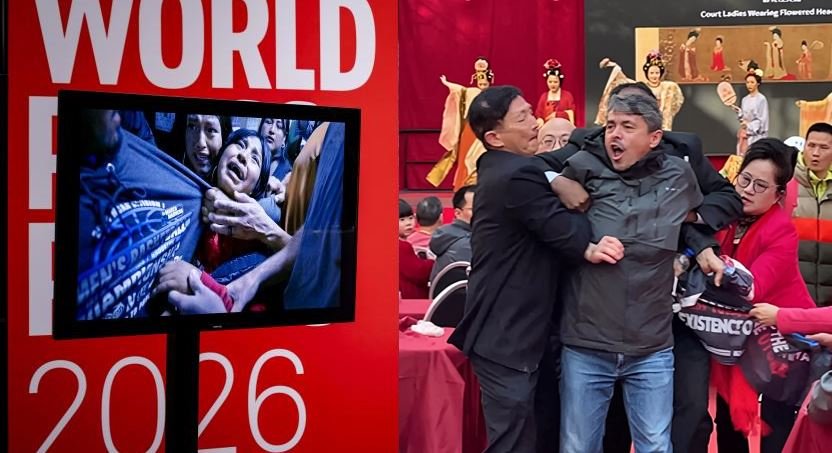
On April 23, I saw a post on the Instagram page of the Dutch national broadcaster NOS announcing that a photograph by American photographer Carol Guzy had been awarded World Press Photo’s top honor in Amsterdam. The winning image portrays a father and his children at the moment they are separated during an eviction in the United States, capturing the anguish of a family fractured by institutional procedures. While this photograph received global acclaim, it triggered a deep and visceral pain within me. It instantly transported me back to the tragic event I experienced on February 14 at the Sadhuis (City Hall) of The Hague—a city that, ironically, stands as the global symbol of international peace and justice.
On that day, inside the central hall of the City Hall, during the Chinese New Year celebration organized by the Chinese Embassy, I was brutally assaulted. While peacefully holding a protest sign, I was set upon by Chinese security personnel and the chairpersons of two pro Beijing Chinese organizations in the Netherlands. They twisted my arms behind my back, snatched my sign, and refused to return it. I was placed in a choking necklock, slammed to the ground, and violently dragged out of the hall. While a photograph documenting the suffering of a family in America is honored globally, in the very heart of the city of justice, the mainstream media completely silenced the voice of an individual in attendance. I feel duty bound to expose this systemic injustice within the media world.
The photograph honored by World Press Photo captures the agonizing moment of a family torn apart by a legal system. In that instance, the state was executing its own domestic laws. What transpired in The Hague in my case, however, represents a far more dangerous reality: transnational repression enacted by the Chinese Communist Party (CCP) on sovereign Dutch soil.
My protest sign carried only one question for the Chinese government: “Where are my 19 family members who disappeared in Chinese occupied East Turkistan?” My relatives are living evidence of the ongoing Uyghur genocide, representing millions of persecuted Uyghurs. This reality places the Chinese regime in an extremely uncomfortable position. The fact that inside a sanctuary of democracy, the arms of a Dutch Uyghur citizen were twisted and agents of a foreign autocratic power violently removed him is a dark stain on Western democracy.
Carol Guzy’s photograph captures the despair of a father and children being separated—a documentation of systemic institutional pressure. My situation mirrored that visual despair: a Uyghur man whose neck and arms were violently wrenched while his photos and signs were forcibly confiscated. Superficially, both scenarios involved restraint and separation. Yet while the American photograph was celebrated as a vital witness to a human tragedy, the footage from The Hague was aggressively suppressed. On one side, a tragedy is brought to light through the lens; on the other, the lens is shattered to conceal the truth.
On that day, the most prominent Dutch media outlets and professional photographers were present at The Hague City Hall. Beijing had specifically invited these prestigious media channels, equipped with state of the art gear, to showcase its soft power and influence. These journalists witnessed with their own eyes how I was choked and how my sign was stolen; their cameras captured it all. Yet, to my profound regret, not a single mainstream outlet published the truth. Were they afraid of damaging bilateral relations with China or losing economic privileges? Here, the highest mission of journalism—unveiling the truth—yielded to opportunism. Although I personally sent the footage to NOS, RTL, and Omroep West, they chose complicity by remaining silent.
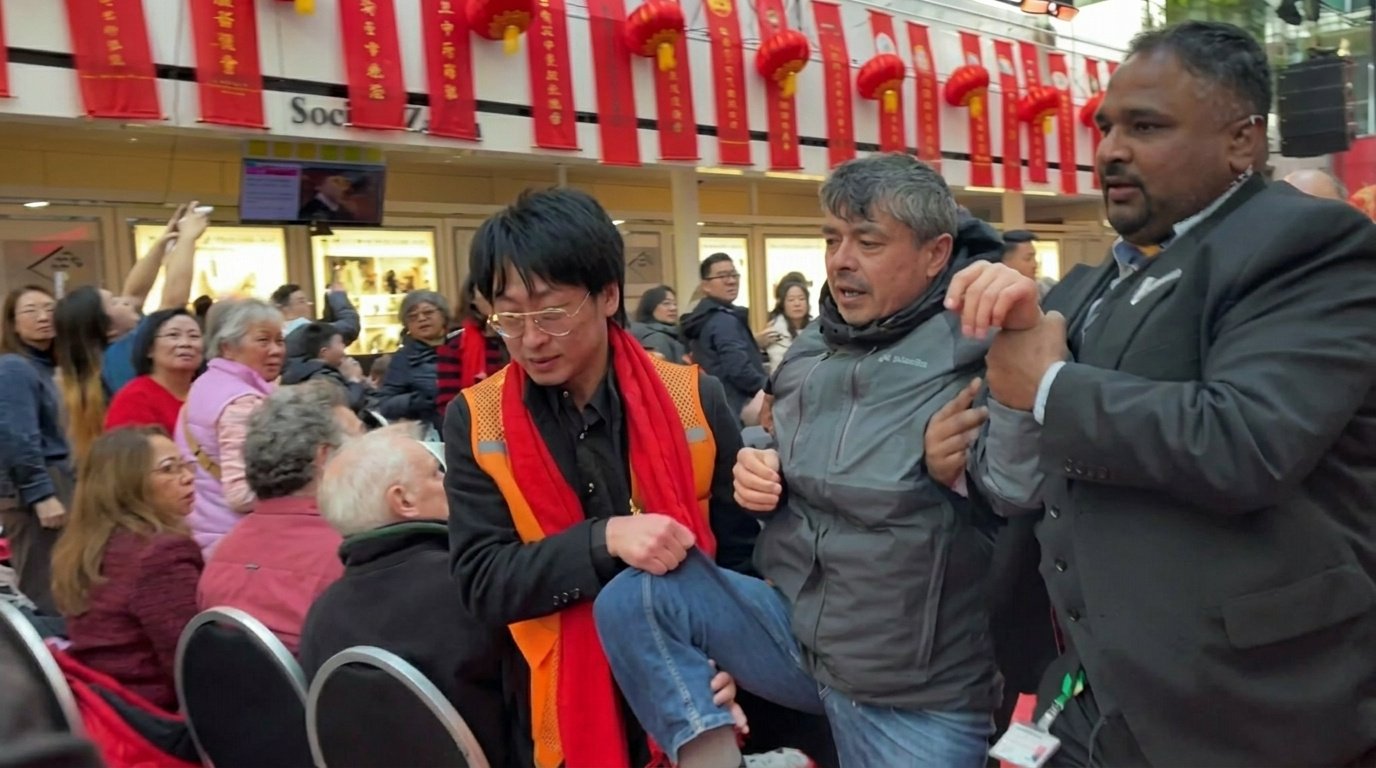
However, the truth could not be entirely smothered. The footage of the violence was captured by Chinese dissident Xing Songlin using an ordinary mobile phone. He is not a professional photographer, but a human being who refused to let the truth vanish. I forwarded this video to Ms. Iris van den Boom, a journalist at “AD Amersfoort.” Although she was not present at the scene, upon seeing the video, she placed journalistic ethics above all political or economic calculations. As early as February 16, she published the first groundbreaking article exposing the Chinese violence. While corporate media giants remained silent out of fear, she became the voice of a Uyghur whose family is a victim of genocide.
Photographer Carol Guzy demonstrated the highest standards of professional ethics by bringing a family’s suffering to light. Conversely, the media outlets present in The Hague betrayed their professional vows by choosing silence. Had they been courageous, the exposure of Chinese statesponsored violence in the heart of Europe would have had a profoundly different geopolitical impact today. This conflict between truth and financial interests has ensured that the fate of my missing family members remains hidden from the world. The international community honors American domestic tragedies while paying no heed to raw violence in the center of European democracy for the sake of economic gain.
As Martin Luther King Jr. famously said: “History will have to record that the greatest tragedy of this period of social transition was not the strident clamor of the bad people, but the appalling silence of the good people.”
Democratic states must decisively cut off this authoritarian long arm. Journalists must no longer align their lenses with corporate interests, but with human conscience. One photograph remains a monument of tears; the other is the relentless struggle of a conscience crying out for justice. The names of those who speak truth to power will endure. The value of suffering on the path to justice is eternal.
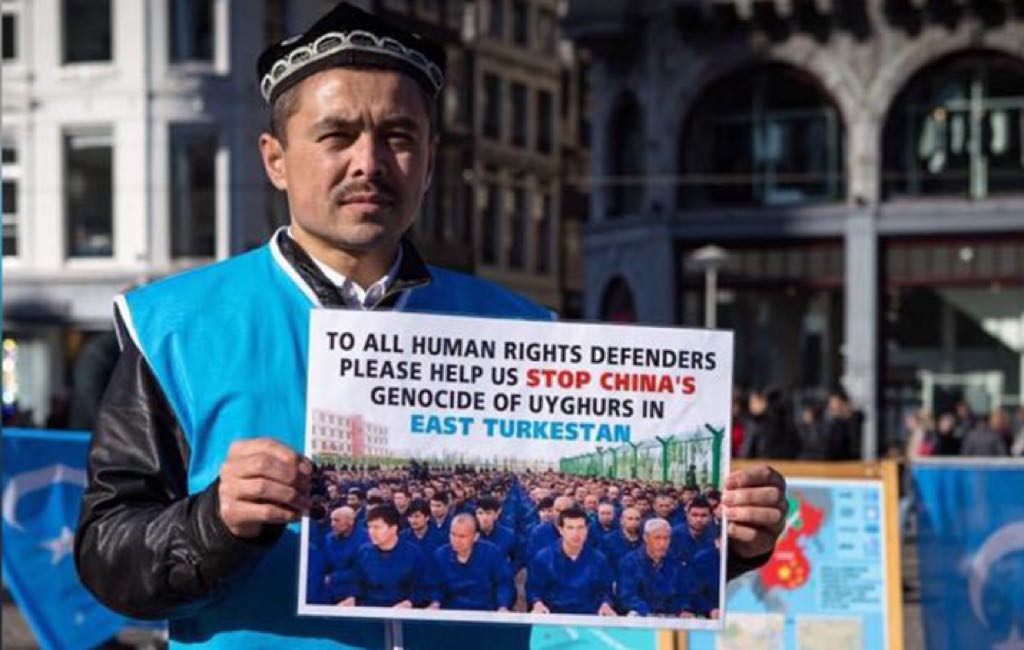
Abdurehim Gheni is a Uyghur activist living in the Netherlands who became famous for his solo protests in Dam Square in Amsterdam. He also educates tourists to the reality of the Uyghur genocide.