Multiple jail terms hit members of the activist group Atajurt, which China has long sought to destroy.
by Ruth Ingram
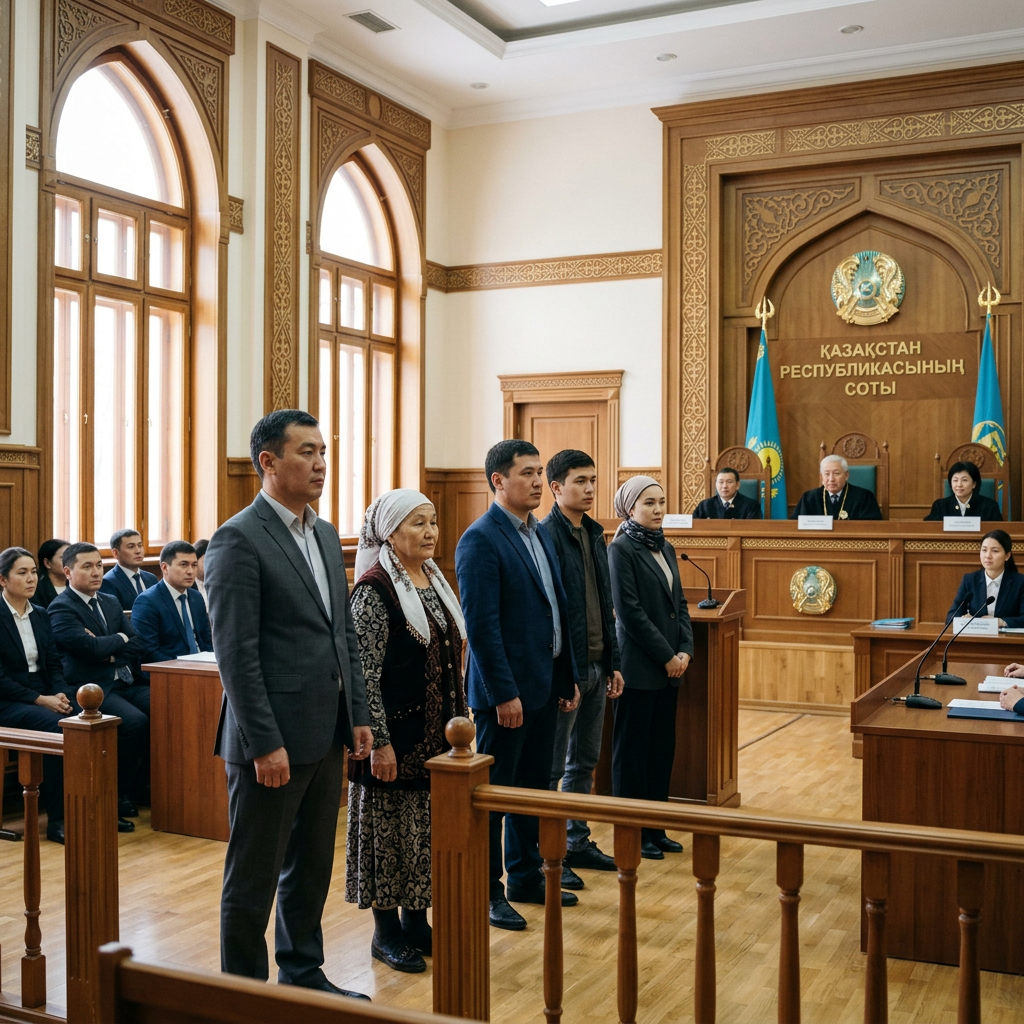
Kazakh activists have paid a heavy price for daring to challenge China’s might. Advocates have been left reeling with the news of multiple jail terms handed down last week to 19 peaceful protesters arrested last November for burning the Chinese flag and portraits of President Xi Jinping.
Chinese government demands to punish them for “insulting the national dignity and honor of Chinese citizens” appear to have forced the hand of Kazakh authorities, who gave in to the superpower with a swathe of draconian punishments.
Protests erupted last year in Qalzhat, Almaty’s Uyghur District, as relatives and members of the Kazakh activist group Atajurt demanded to know the whereabouts of Alimnur Turganbay, a Kazakhstan citizen originally from Xinjiang who the Chinese authorities have detained since July 2025. The group was charged with “inciting national discord” after pressure from China.
Their complaint, which also focused on the wider tranche of human rights abuses in the Uyghur region, meted out to mainly Uyghurs but also to members of the Kazakh and Kirghiz communities, incurred the wrath of the CCP and provoked a strong demand for retribution from Beijing.
The trial, which has been hanging over them and their relatives since last year, finally played out last week with the result that eleven activists were sentenced to five years’ jail each, the sentences of two of the women deferred due to the ages of their small children, and the remaining eight were given non-custodial “restricted freedom” terms of five years. All defendants were banned from engaging in public or political activities for three years.
Bob Fu of China Aid posted his condemnation of the sentences on X, expressing his alarm at Kazakhstan’s “increasing alignment with the Chinese government’s efforts to suppress dissent related to the atrocities in Xinjiang,” he said, “This unjust verdict not only punishes victims and witnesses of human rights abuses but also signals Kazakhstan’s troubling willingness to disregard international norms and the concerns raised by the U.S. Congress and global human rights organizations.”
The punishments have dealt a blow to the Kazakh activist group Atajurt, whose new leader (following the flight to America of founder Serikzhan Bilash in 2020), Bekzat Maksutkam, was also arrested and sentenced to five years. Speaking to “Bitter Winter,” Bilash said, “The Kazakhstani and Chinese governments have long planned to destroy this organization completely. They have finally achieved their goal.”
Speaking to “Bitter Winter” after the closed-door trial and her own restricted-freedom sentence of five years, Nazigul Maksutkam, sister of Atajurt leader Bekzat Maksutkam and the Atajurt lawyer in the case, was worried about the future of their organization. “Atajurt is an unregistered organization. Although we have repeatedly applied for registration, the authorities have refused to register it. Nevertheless, despite this, the authorities may still move to ban the Atajurt organization,” she said.
Condemning the trial for “violating the principles of openness and transparency in judicial proceedings,” she said their right to defense had been hampered. Kazakh police had captured the protest on video at the time. Still, she said, “among the 19 defendants, there were individuals who did not speak, did nothing, and were not even visible in the video evidence, yet they were still convicted.”
She is worried about the growing influence of China on Kazakhstan’s government and the danger to opponents of the CCP on Kazakh soil. “The Chinese authorities lead a regime that has committed genocide against non-Chinese ethnic groups and carried out mass detentions in concentration camps. The Chinese Communist Party aims to expand its influence in Kazakhstan with the goal of territorial domination, and it is entirely possible that they could establish similar camps in Kazakhstan as well,” she feared.
Once the restriction order is enforced, Nazigul will be under constant supervision by local authorities and will be prevented from moving home or changing jobs at will. She says she will be banned from engaging in political activities, joining political organizations or parties, or participating in meetings or gatherings.

Serikzhan Bilash fears that with the demise of Atajurt, the world will lose more than just a human rights organization. “It will lose the biggest window into the humanitarian disaster in neighboring Xinjiang,” he said.
Following the collapse of the Soviet Union, many Xinjiang Kazakhs migrated to Kazakhstan, leaving behind hosts of relatives, friends, classmates, and clan members in the Uyghur region. There had also been large-scale legal and illegal migration following border disputes between China and the former Soviet Union between 1959 and 1962. “These Kazakhs and their descendants are estimated to number 3-5 million,” he said. “They all have intricate connections to Xinjiang.” This has enabled Atajurt to obtain evidence of Kazakhs illegally arrested by the CCP.
In addition to this, following an agreement between Astana and Beijing, many Kazakhs initially detained in so-called re-education camps in 2017 were released and allowed to flee Xinjiang. Some of these provided critical evidence, much from their own experience of torture, forced indoctrination, rape, and abuse in the camps. Erbakit Otarbay, Orynbek Koksebek, Sayragul Sauytbay, and Baqitali Nur were some of those whose firsthand testimony contributed towards the UK’s Uyghur Tribunal’s final judgment in 2021, citing genocide and crimes against humanity by the Chinese state.
Yalkun Uluyol, a researcher on China at Human Rights Watch, condemned the criminal investigation. Beijing’s role in the process was clear, he concluded.
He told “Bitter Winter”: “The blatant mass persecution of Kazakh activists, who are citizens of Kazakhstan, for a peaceful protest against the Chinese government, is a chilling signal: Astana sacrifices basic freedom of its people to maintain good relations with China. The Chinese officials responsible for atrocity crimes, not people protesting them, should be persecuted. Kazakh authorities should immediately and unconditionally release the Atajurt activists.”
Elise Anderson, a specialist on Xinjiang and currently a Nonresident Senior Fellow at the New Lines Institute for Strategy and Policy in DC, where she specializes in research and analysis on transnational repression and CCP influence, told “Bitter Winter” that observers and analysts had noted a “deepening economic and political relationship between Kazakhstan and the PRC in recent decades.”
The sentencing of these 19 individuals for participation in protests calling out China on Kazakh soil, however, she said, “suggests that the scope of PRC transnational repression in Central Asia may go even further than previously understood.”
Observers and analysts have noted a deepening economic and political relationship between Kazakhstan and the PRC in recent decades. However, the sentencing of these 19 individuals for participation in protests calling out China on Kazakh soil suggests that the scope of PRC transnational repression in Central Asia may go even further than previously understood.

Ruth Ingram is a researcher who has written extensively for the Central Asia-Caucasus publication, Institute of War and Peace Reporting, the Guardian Weekly newspaper, The Diplomat, and other publications.