Robert Barnett’s book unveils new ways invented by the regime to control Tibetans, particularly nuns and monks.
by Massimo Introvigne
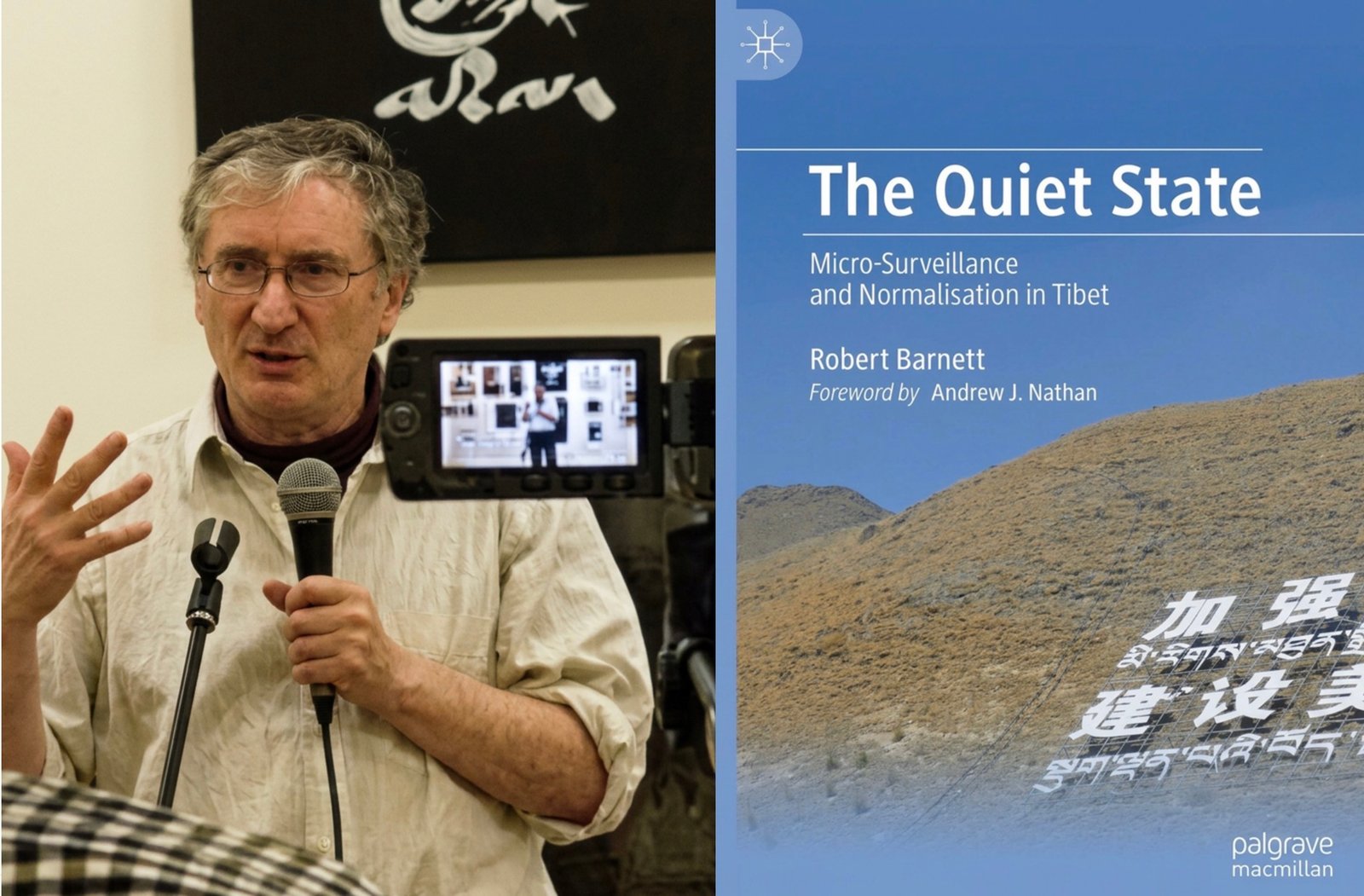
In today’s world, when we think of government control and surveillance, images of CCTV cameras, massive detention centers, and high-tech monitoring often come to mind. But Robert Barnett’s “The Quiet State: Micro-Surveillance and Normalisation in Tibet” (London: Palgrave Macmillan, 2026) paints a different picture—one of subtle, almost invisible surveillance that quietly but effectively regulates life in Tibet. This insightful book offers a compelling look into how the Chinese government employs low-intensity, covert mechanisms of control that, over time, become normalized and embedded in daily routines.
Barnett, a seasoned researcher, delves into how Tibetans—particularly vulnerable groups like nuns and monks—are monitored and managed through methods that are far less overt than traditional authoritarian tactics. Instead of mass detention or aggressive policing, the Chinese authorities have shifted toward “micro-surveillance”—tiny, almost imperceptible forms of control. These include restrictions on movement, confining individuals to specific areas, and ongoing monitoring that rely more on community participation and internalized discipline than on visible police presence.
One fascinating aspect of Barnett’s approach is his emphasis on how these mechanisms often hide in plain sight. For example, he describes official photographs, online notices, and clandestine images that show officials meeting with nuns or sending subtle signals of control. These fragments—small pieces of evidence—are the primary sources from which Barnett reconstructs the broader picture of state management. This method, known as open-source analysis, is crucial because access in Tibet is heavily restricted, and direct interviews or fieldwork are often impossible or risky.
Barnett’s detailed exploration shows that this covert system of management is not accidental or haphazard; it’s a carefully calibrated strategy to normalize state oversight. The authorities seek to create a sense of routine, so that restrictions on Tibetan communities become part of everyday life—an invisible hand guiding behavior rather than overt suppression. Interestingly, the book suggests such low-key surveillance may be more effective in the long run because it minimizes resistance and reduces the appearance of violence or repression.

But the significance of Barnett’s work extends beyond Tibet. His analysis offers vital insights into the evolution of subtler forms of control in China. The Chinese government’s shift towards “quiet” governance tries to maintain stability without provoking unrest, especially in regions with distinct ethnic or religious identities.
Barnett also grapples with broader questions about the nature of state power. How does a government sustain legitimacy when resorting to less visible tactics? How do communities internalize and accept restrictions, and what happens when these controls become part of “normal” life? His findings suggest that, over time, communities come to see these restrictions as reasonable or unavoidable, thus internalizing state authority—a process philosopher Michel Foucault famously termed “normalization.”
Crucially, Barnett highlights how this shift towards subtlety is driven by bureaucratic mentality, not by technological advancement alone. The Chinese authorities have expanded grassroots governance, embedding administrative schemes down to the village level, which makes monitoring and control more embedded and less reliant on visible force. This is particularly evident in Tibet, where physical detention camps coexist with these “micro-management” techniques that make repression more discreet—and arguably more effective.
Barnett’s tone is sober but compelling. His detailed descriptions of how control is exercised—such as officials’ meetings with nuns, community surveillance, and the use of propaganda—may seem distant at first glance. But the implications are profound: they echo a global trend where governments seek to balance stability with subtlety, using soft power rather than brute force. Barnett warns that these practices, although less visible now, could expand or intensify over time, especially in other minority regions across China.
In conclusion, “The Quiet State” shines a light on the quiet but persistent mechanisms of control in Tibet—a region often hidden from the outside world. Barnett’s meticulous analysis offers invaluable insights into the subtle ways in which authoritarian regimes maintain power, making clear that the most effective forms of domination might not be the loudest. For anyone interested in human rights, religious liberty, or the dynamics of modern authoritarianism, this book is an essential read—an eye-opener on how control can operate beneath the surface, shaping lives in ways we might never directly see.

Massimo Introvigne (born June 14, 1955 in Rome) is an Italian sociologist of religions. He is the founder and managing director of the Center for Studies on New Religions (CESNUR), an international network of scholars who study new religious movements. Introvigne is the author of some 70 books and more than 100 articles in the field of sociology of religion. He was the main author of the Enciclopedia delle religioni in Italia (Encyclopedia of Religions in Italy). He is a member of the editorial board for the Interdisciplinary Journal of Research on Religion and of the executive board of University of Pennsylvania Press’ Nova Religio. From January 5 to December 31, 2011, he has served as the “Representative on combating racism, xenophobia and discrimination, with a special focus on discrimination against Christians and members of other religions” of the Organization for Security and Co-operation in Europe (OSCE). From 2012 to 2015 he served as chairperson of the Observatory of Religious Liberty, instituted by the Italian Ministry of Foreign Affairs in order to monitor problems of religious liberty on a worldwide scale.