A pro-CCP activist claims the young Uyghur reported dead in prison is alive. She offers dubious evidence. But if true, it would confirm records Beijing calls fabricated.
by Zihrulla
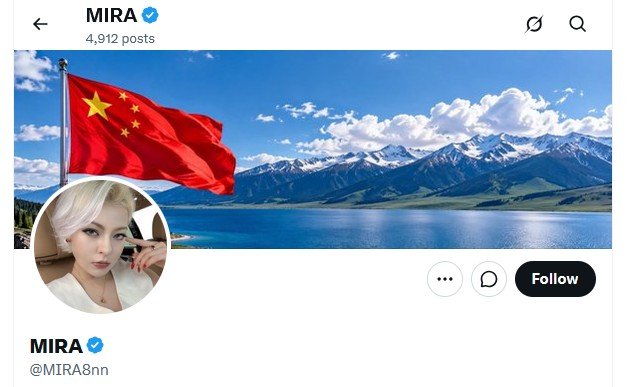
Earlier this month, a social-media user named Mira disputed Radio Free Asia’s report that Rahile Omer—who was taken to an internment camp at age 14—had died in prison, a story that “Bitter Winter” also covered. Mira attempted to demonstrate that Rahile was alive by posting a photograph.
The post, however, cited no official source. It did not disclose when or where the photograph was taken. Moreover, the photograph shows two heavily made-up women, making it difficult to determine whether either is the same person as Rahile Omer in the 2018 police photograph.
A challenge to a report of a death in custody naturally turns attention to the identity, sources, and evidence of the person making the denial.
Mira made the claim through an account on X. X, Facebook, and Instagram are blocked in China, and Uyghurs have faced imprisonment for accessing prohibited foreign platforms or circumventing the country’s internet firewall.
Yet Mira’s X activity suggests that she can use the platform freely. She can closely follow Canadian parliamentary action concerning Uyghur forced labor, criticize Canadian Member of Parliament Sameer Zuberi, read and respond to articles on the Uyghur Human Rights Project website, and monitor and criticize Uyghur activists’ national-day events.
This unusually broad access raises questions about whether Mira operates independently or has some form of official support. Without documentary evidence, however, it would not be responsible to identify her definitively as a Chinese government employee. What can be said is that her posts closely echo narratives promoted by Chinese state propaganda.
Chinese propaganda institutions have repeatedly been accused of changing, selectively translating, or removing politically inconvenient statements. Examples have included misquoting a UN official’s praise of China’s economic development as praise for its human-rights progress; turning President Recep Tayyip Erdoğan’s expression of hope that Uyghurs would live happily into a declaration that they already were happy; and removing passages considered damaging to China from a Chinese edition of Hillary Clinton’s book.
Against that background, it would not be surprising for pro-Beijing accounts to challenge a report that a young rural Uyghur woman died in prison. Chinese authorities have previously gathered signatures from large numbers of officially sponsored organizations to challenge UN findings on Xinjiang and to create the appearance of international support.

Mira’s claim nevertheless deserves examination. If her assertion is true, it raises two important possibilities.
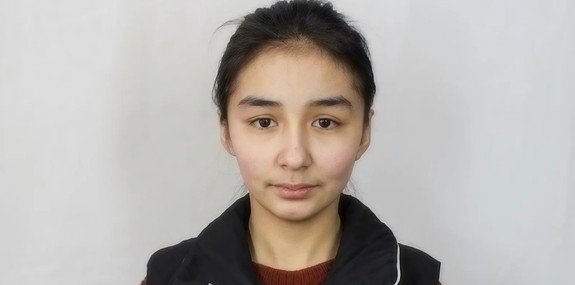
First, the Rahile Omer whose death was reported might not be the same Rahile Omer whose name and photograph appear in the Xinjiang Police Files. She could be another person with the same name, or possibly one of the detainees whose police records contain no photograph.
The RFA report cited three local sources, two of whom provided recorded statements. Both “Rahile” and “Omer” are common Uyghur names, and it would not be unusual for several people in one locality to share them. Therefore, even if the woman in Mira’s photograph were shown to be the Rahile in the Police Files, that alone would not disprove the sources’ claim that another young woman named Rahile Omer died in custody. It would mean that the identity of the deceased person had not yet been conclusively matched to the police photograph.
One response posted beneath the RFA report included photographs of the gravestones of four young people who reportedly died between the ages of 20 and 25 under unexplained circumstances. The person who supplied the photographs did not post them directly but sent them through a friend abroad and described the cases only indirectly, apparently out of concern for personal safety.
The broader significance of the original report is therefore not limited to whether one particular Rahile Omer died. The more serious question is whether people held in camps and prisons—including individuals documented in the Xinjiang Police Files—have died in custody, rather than simply “graduating” from vocational-training centers, as former Xinjiang chairman Shohrat Zakir once claimed.
If Mira’s information is correct, the RFA investigation would not necessarily be invalidated. The case could become more significant, showing that the reported death and the person appearing in the Police Files may involve two different individuals who share the same name.
Second, Mira’s claim could have implications for China’s repeated rejection of the Xinjiang Police Files.
Questioned about the files, Chinese Foreign Ministry spokespeople and Chinese embassies abroad dismissed them as fabricated material produced by anti-China forces to smear the country. China also accused researcher Adrian Zenz—whose work mentioned Rahile Omer’s detention in connection with her imprisoned father—of spreading lies. Chinese state media similarly attacked RFA reporter Shohret Hoshur after he helped verify the identities of at least 50 people appearing in the files.
If the person shown in Mira’s photograph can be independently confirmed as the same Rahile Omer pictured in the Xinjiang Police Files, and if Mira’s information can be linked to an official Chinese source, the denial would produce an important contradiction.
It would mean that someone acting with official information had acknowledged that at least one named individual and photograph in the supposedly “fabricated” archive corresponded to a real person. This would not, by itself, authenticate every document or every entry in the Xinjiang Police Files. It would, however, independently corroborate one of its records and weaken Beijing’s blanket claim that the entire archive was invented.
This kind of propaganda reversal has precedent. Chinese authorities initially denied the existence of the mass internment system before describing the facilities as “vocational education and training centers.”
The same problem applies here. An attempt to prove that Rahile Omer is alive could disprove a specific report only if the woman’s identity, the date and location of the photograph, and her present circumstances are independently verified. At the same time, reliable evidence linking the woman to the Police Files could corroborate a record Beijing has repeatedly dismissed as fabricated.
As a Uyghur saying puts it, “If you hide the illness, death will reveal it.”
Mira’s post does not yet prove that Rahile Omer is alive. Nor does it establish who the women in the photograph are, where the image originated, or whether anyone associated with the Chinese government supplied it. Until those questions are answered, the post should be treated as an unverified claim rather than a correction of the RFA report.
But if the claim is eventually substantiated, it could create a result its author may not have intended: while challenging one reported death, it may corroborate part of the Xinjiang Police Files and direct greater attention to the unresolved deaths of other Uyghur detainees.
As the Turkish expression says, sometimes the excuse is worse than the offense.