A C4ADS study follows tenders and invoices across Xinjiang, Inner Mongolia, Tibet, and Hong Kong to name the companies supplying Beijing’s watchers.
by Massimo Introvigne
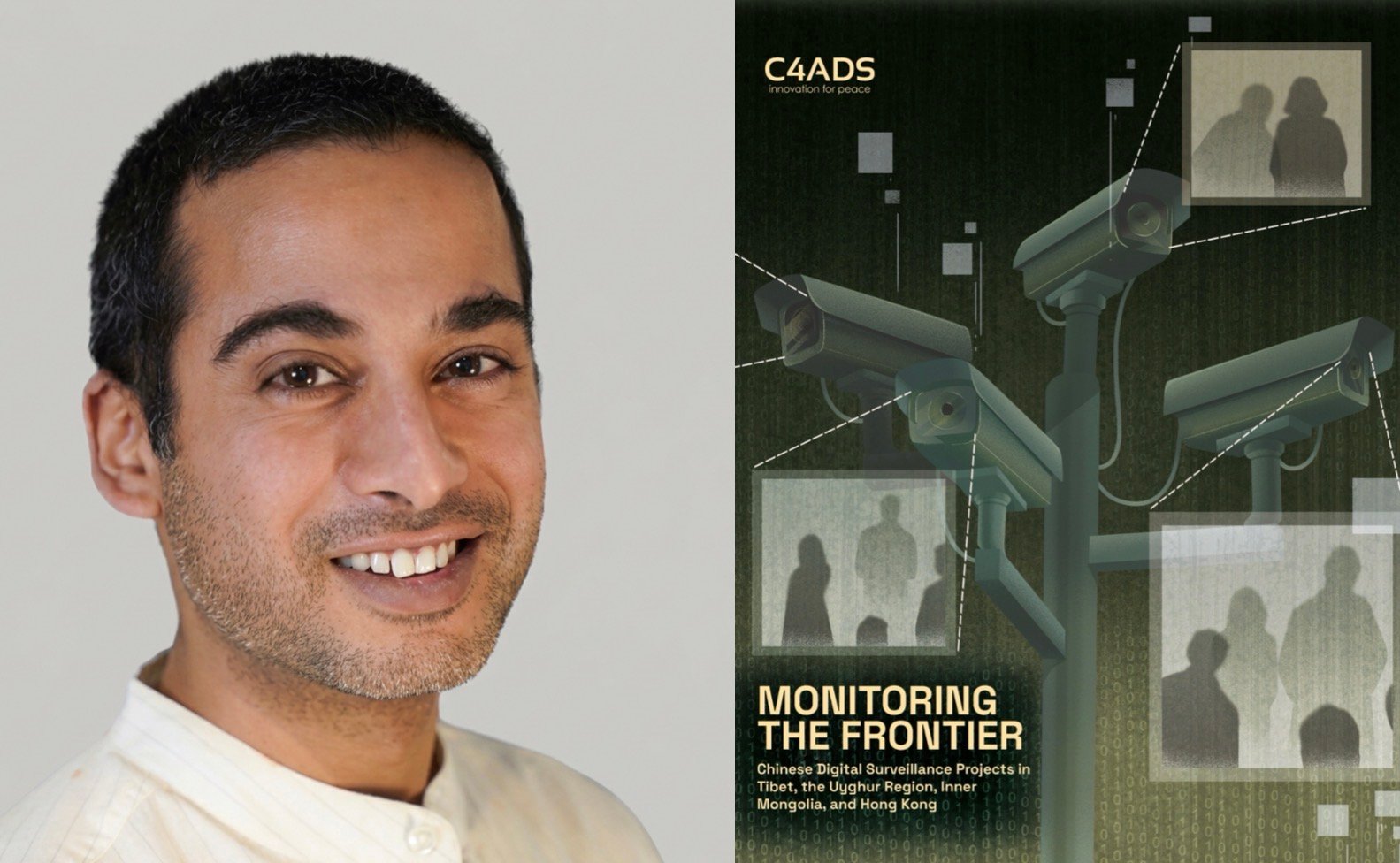
Every camera that tracks a Uyghur through the streets of Kashgar began its life as a line in a budget. Somebody drafted a tender, a company won it, and an invoice was paid. “Monitoring the Frontier,” a new report by the Washington-based research group C4ADS, follows that trail of signatures and stamps through the procurement archives of the Chinese state. What emerges is a map of the commercial machinery that keeps the gaze of the Party fixed on Tibetans, Uyghurs, Mongols, and the people of Hong Kong.
The researchers chose their sources deliberately. In their words, “government records offer a novel lens on China’s surveillance apparatus because, unlike secondary public reporting or victim testimony, they document the state’s purchasing decisions and reveal which companies and technologies underpin its surveillance infrastructure.” Survivors can describe what life under the lenses feels like, and contracts add the names of those who manufactured, installed, and billed for them.
Sifting a mountain of documents required a sieve. C4ADS assembled “a list of 165 Chinese-language terms that were used as filters to identify Chinese digital surveillance contracts within the government records,” among them “facial recognition,” “biometrics,” and “big data.” A lone keyword might turn up in a tender for school computers or traffic lights, so the team raised the bar: “C4ADS reviewed government documents for these keywords and flagged records containing two or more terms affiliated with digital surveillance, on the basis that a single term may appear in non-surveillance contexts, while a co-occurrence of two or more terms increases the likelihood that a contract was specifically oriented toward digital surveillance infrastructure.”
The authors are candid about what remains in the shadows. “Some of the most sensitive business contracts may not be publicized on Chinese government websites and therefore may not be publicly available,” they acknowledge, adding that “cross-regional comparisons should therefore be treated as indicative rather than definitive.” What surfaces in the archives may thus be only the tip of a far larger iceberg.
Xinjiang, a name now synonymous worldwide with mass internment (most of its non-Han inhabitants prefer to call it “East Turkestan”), offers the most chilling ledger. There, “C4ADS flagged 368 contracts containing two or more of these keywords,” and the police figure prominently among the customers, since “Public security bureaus (公安局) appear as the listed buyer in 55 of these flagged contracts.” At the head of the suppliers’ table sits Xinjiang Zhixiang Technology Co., Ltd. with “14 contracts,” followed by China Mobile’s Xinjiang branch with “10 contracts” and CCS Public Information Industry Co., Ltd. with “seven contracts.” Some familiar names also appear in the files, and the study recalls that “Both Tiandy and Uniview are sanctioned in the United States due to their involvement in human rights violations, high-tech surveillance, and mass arbitrary detention of Uyghurs and other ethnic minorities in the PRC.”
One contract reads like a stage direction from a dystopian play. “In 2024, the XPCC Twelfth Division Public Security Bureau contracted Shanghai Sailing Information Technology to equip a law enforcement case management center.” The XPCC, or Xinjiang Production and Construction Corps, is the paramilitary colonizing enterprise that has administered vast stretches of the region since the 1950s. Its shopping list included biometric data collection units and deep-learning camera systems. Behind the supplier stood a sanctioned shadow, as C4ADS notes that “Shanghai Sailing is 100% owned by a U.S. Department of Commerce BIS-listed entity.”
The story grows stranger with the hardware itself. “The manufacturer of the branded equipment used in this project, Hisign, does not face any restrictions, despite being connected to a U.S.-sanctioned entity.” Sanctions, it seems, can fell a trunk while leaving the branches free to bear fruit, with surveillance trade flows running through subsidiaries and third-party channels that Western blocklists have yet to identify. In the grasslands of Southern (Inner) Mongolia, where Mongol parents and students protested in 2020 against the erosion of their language in schools, the file grows even thicker. “C4ADS found that 39 of the 692 flagged contracts listed one of China’s three largest telecommunications companies.” One name echoes through the region’s records like a refrain: “Hangzhou Hikvision Digital Technology Co. Ltd., a U.S.-sanctioned surveillance equipment manufacturer, is mentioned in 1,094 of the Inner Mongolia contracts.” A company placed on American blocklists years ago remains, by this count, a fixture of the local security economy.
Hong Kong tells a story of cameras arriving in plain sight. The records document plans for “the Hong Kong Police to deploy facial recognition in CCTV,” and “surveillance cameras with AI facial recognition” are multiplying across the city. Notice after notice in the Government Gazette chronicles the procurement of such systems. A city whose protesters once raised umbrellas and wore masks to shield their identities now walks beneath lenses designed to see through such defenses.
Hisign returns in the study’s policy discussion. The authors argue that “regulators and companies in these jurisdictions should more closely scrutinize Hisign’s operations,” pointing to the firm’s overseas investments and to its production of biometric equipment that remains “unsanctioned” itself. They also urge that “[e]xport controls on biotechnology and related intellectual property shared with Chinese government partners should be strengthened.” Further proposals include requiring “European technology firms to conduct enhanced human rights due diligence” and treating “routine telecom-subsidiary contracts as a distinct enforcement gap,” since “China Telecom, China Mobile, and China Unicom subsidiaries” continue to supply the infrastructure of control.
Behind these recommendations lies a sober warning. “Restricting investment in parent companies has not stopped subsidiaries from supplying equipment and services at the operational level,” C4ADS observes, and it calls for “Entity List additions targeting specific subsidiaries or import restrictions.” Sanctioning a parent company while its offspring keep bidding for police contracts resembles locking the front door of a house whose windows stand wide open.
Read together, these dry procurement notices compose a disturbing portrait. China’s surveillance state is also a marketplace, crowded with buyers, sellers, intermediaries, and subsidiaries. Every transaction leaves a record, and records can be read. For Uyghurs in Urumqi, Tibetans in Lhasa, Mongols on the steppe, and Hongkongers on their streets, the cameras above them have a price tag and a corporate pedigree. C4ADS has shown that anyone patient enough to follow the paper can trace both.

Massimo Introvigne (born June 14, 1955 in Rome) is an Italian sociologist of religions. He is the founder and managing director of the Center for Studies on New Religions (CESNUR), an international network of scholars who study new religious movements. Introvigne is the author of some 70 books and more than 100 articles in the field of sociology of religion. He was the main author of the Enciclopedia delle religioni in Italia (Encyclopedia of Religions in Italy). He is a member of the editorial board for the Interdisciplinary Journal of Research on Religion and of the executive board of University of Pennsylvania Press’ Nova Religio. From January 5 to December 31, 2011, he has served as the “Representative on combating racism, xenophobia and discrimination, with a special focus on discrimination against Christians and members of other religions” of the Organization for Security and Co-operation in Europe (OSCE). From 2012 to 2015 he served as chairperson of the Observatory of Religious Liberty, instituted by the Italian Ministry of Foreign Affairs in order to monitor problems of religious liberty on a worldwide scale.