CAP‑LC alerts the United Nations Human Rights Council to the dangers revealed by the conviction of Nicole Daedone and Rachel Cherwitz.
by Massimo Introvigne
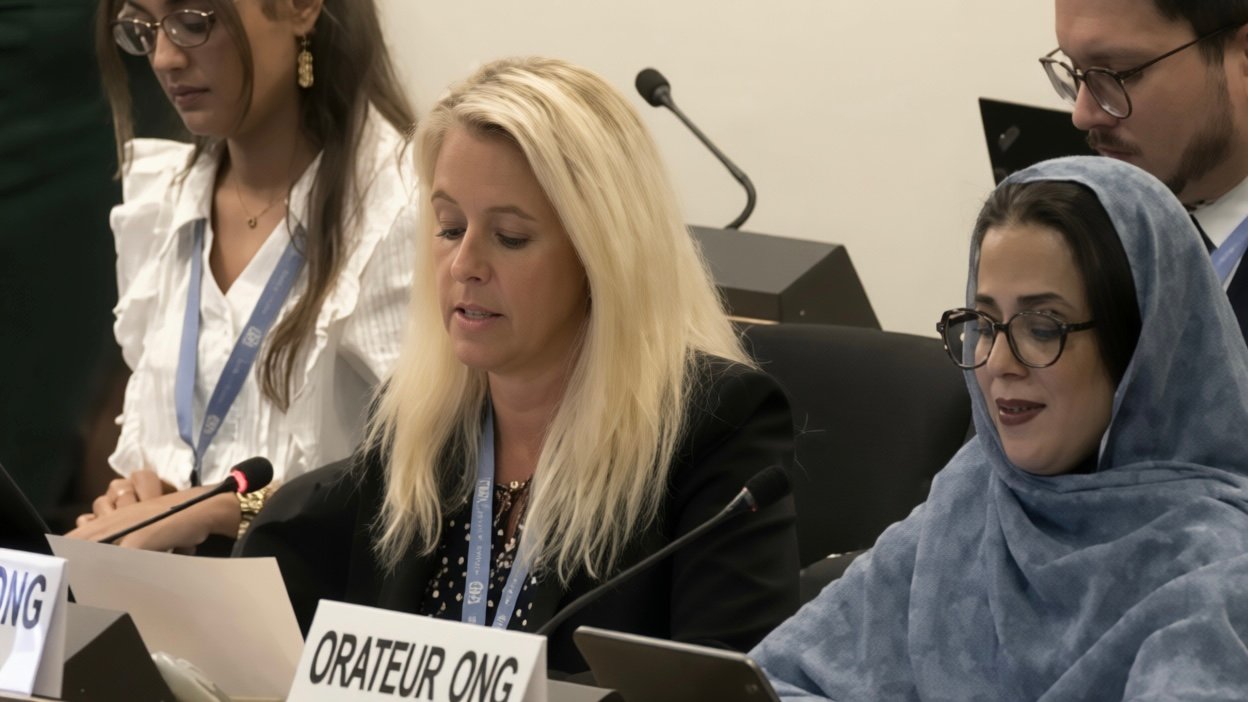
The afternoon session in Geneva on September 22 had already moved through its familiar rhythm of diplomatic interventions when the accredited NGO CAP‑LC (Coordination des associations et des particuliers pour la liberté de conscience) rose to speak during the general debate under Item 3 of the sixty‑third session of the United Nations Human Rights Council. The organization addressed a development unfolding far from Europe, yet carrying implications for spiritual, therapeutic, and religious communities across continents.
It focused on the U.S. prosecution of OneTaste, a San Francisco‑based movement founded by Nicole Daedone, whose teachings on intimacy and meditation have long attracted both interest and controversy. The case has now become a symbol of a broader trend: the expanding use of trafficking laws to police forms of spiritual experience.
CAP‑LC did not mince words. It declared: “CAP‑LC expresses its grave concern about the expanding use of trafficking laws against spiritual and religious communities in the U.S. and elsewhere. In the U.S. OneTaste case, Nicole Daedone and Rachel Cherwitz were sentenced to long prison terms despite no physical coercion, with convictions based solely on psychological influence.” The organization reminded the Council that “testimonies denying harm were excluded and discredited theories of brainwashing shaped the proceedings,” confirming that broad definitions of coercion risk criminalizing ordinary forms of spiritual training.
It warned that “this precedent threatens all spiritual, therapeutic, and religious communities, enabling civil or criminal actions based on subjective reinterpretations of belief and belonging.” CAP‑LC urged the Second Circuit, which will hear the case on appeal, and the U.S. Congress, which should reauthorize the Trafficking Victims Protection Act (TVPA), to “restore constitutional limits” and “to ensure that trafficking law remains focused on genuine exploitation.” It added that humanitarian considerations call for reviewing the disproportionate sentences imposed and concluded that “protecting freedom of thought, conscience, and belief requires rejecting the misuse of trafficking legislation against peaceful communities.”

The case has unsettled scholars of religion, legal analysts, and observers of minority movements. The reliance on psychological influence as a basis for forced‑labor convictions echoes debates that have shaped the modern history of new religious movements. Theories of brainwashing, long dismissed by courts and academic researchers, reappear in moments of public anxiety, often amplified by media narratives. In the OneTaste proceedings, their revival created a climate in which subjective accounts of influence were treated as evidence of coercion, and excluding testimony further narrowed the field of interpretation, leaving the jury with a portrait of the organization shaped by its most critical former participants.
The implications extend beyond OneTaste. CAP‑LC’s intervention pointed to a structural risk: when trafficking law is stretched to encompass psychological persuasion, any spiritual community, meditation school, or therapeutic group becomes vulnerable to prosecution based on contested interpretations of belief and belonging. The organization’s reference to constitutional limits was a reminder that the U.S. Supreme Court, in “Kozminski,” warned against definitions of coercion so broad that they criminalize ordinary forms of influence present in religious, educational, and familial life.
The sentences imposed on Daedone and Cherwitz have also raised humanitarian concerns. CAP‑LC’s call for reconsideration hinted at the possibility of a presidential pardon, which will restore fairness to a case that was unfair from its beginning.
The intervention in Geneva carried an urgent tone. It suggested that the OneTaste case may become a precedent invoked against communities whose teachings diverge from mainstream expectations. The Human Rights Council, accustomed to examining abuses committed by states, was asked to consider how legal systems in democratic countries may also drift when public pressure, sensational narratives, and discredited theories converge.
The hall listened as CAP‑LC described a landscape in which spiritual authority is increasingly scrutinized through the lens of trafficking law. The organization’s voice was steady: protecting freedom of thought, conscience, and belief requires constant vigilance.

Massimo Introvigne (born June 14, 1955 in Rome) is an Italian sociologist of religions. He is the founder and managing director of the Center for Studies on New Religions (CESNUR), an international network of scholars who study new religious movements. Introvigne is the author of some 70 books and more than 100 articles in the field of sociology of religion. He was the main author of the Enciclopedia delle religioni in Italia (Encyclopedia of Religions in Italy). He is a member of the editorial board for the Interdisciplinary Journal of Research on Religion and of the executive board of University of Pennsylvania Press’ Nova Religio. From January 5 to December 31, 2011, he has served as the “Representative on combating racism, xenophobia and discrimination, with a special focus on discrimination against Christians and members of other religions” of the Organization for Security and Co-operation in Europe (OSCE). From 2012 to 2015 he served as chairperson of the Observatory of Religious Liberty, instituted by the Italian Ministry of Foreign Affairs in order to monitor problems of religious liberty on a worldwide scale.