The Federal Constitutional Court’s ruling on “Rohani Khazayeen” confirms that restrictions on Ahmadi belief are now endorsed at the highest judicial level.
by Massimo Introvigne

On September 8, Pakistan’s Federal Constitutional Court upheld the ban on the 23‑volume “Rohani Khazayeen,” the foundational collection of writings by Mirza Ghulam Ahmad, the Ahmadiyya Community’s founder. The bench headed by Justice Aamer Farooq, with Justice Syed Arshad Hussain Shah, dismissed all petitions filed by members of the Ahmadiyya community. The judges stated that the constitutional guarantee of religious freedom under Article 20 “operates only within boundaries defined by law, public order, and morality.” The ruling leaves intact the 2014 notification through which the Punjab Home Department ordered the forfeiture of every volume of “Rohani Khazayeen.”
The ban originated from a recommendation by an Ulema board, which claimed the writings could generate hostility among Muslims. The Punjab government acted on this advice, and the petitioners’ attempts to challenge the measure before the Lahore High Court and its Multan bench were rejected on procedural grounds. Their appeal to the Federal Constitutional Court argued that the ban violated Article 20 and lacked a proper legal basis.
Justice Farooq’s judgment rejected these arguments. It said the petitioners had not provided the material needed to assess the volumes’ content or challenge the ban’s reasoning. The court described the petitioners’ claim of a violation of religious freedom as “nothing more than wittering on about the subject of Fundamental Rights in general and Religious Freedom clause in particular.” The judges added that the petitioners’ counsel had delivered a general discourse rather than demonstrating how the executive action had harmed their rights.
The ruling affirmed that the authority to impose the ban was grounded in statutory instruments, including Section 99‑A of the Criminal Procedure Code and Section 19 of the Press, Newspapers, News Agencies and Books Registration Ordinance, 2002. The home department acted within powers delegated under the Punjab Rules of Business, 2011. The court noted that the forfeiture order originated from the Chief Secretary’s office. It explained that the decisive factor was the legal source of the authority rather than the identity of the official who signed the notification.
The judges also accepted the Ulema board’s assessment that the writings could provoke hatred among Muslims. The court treated this conclusion as sufficient justification for the executive action under the statutory framework that allows forfeiture of publications considered harmful to public order.
The court dismissed all petitions, refused leave to appeal, and disposed of pending applications. The prohibition on “Rohani Khazayeen” remains fully in force, preventing Ahmadis from printing, publishing, or circulating one of their central religious texts.
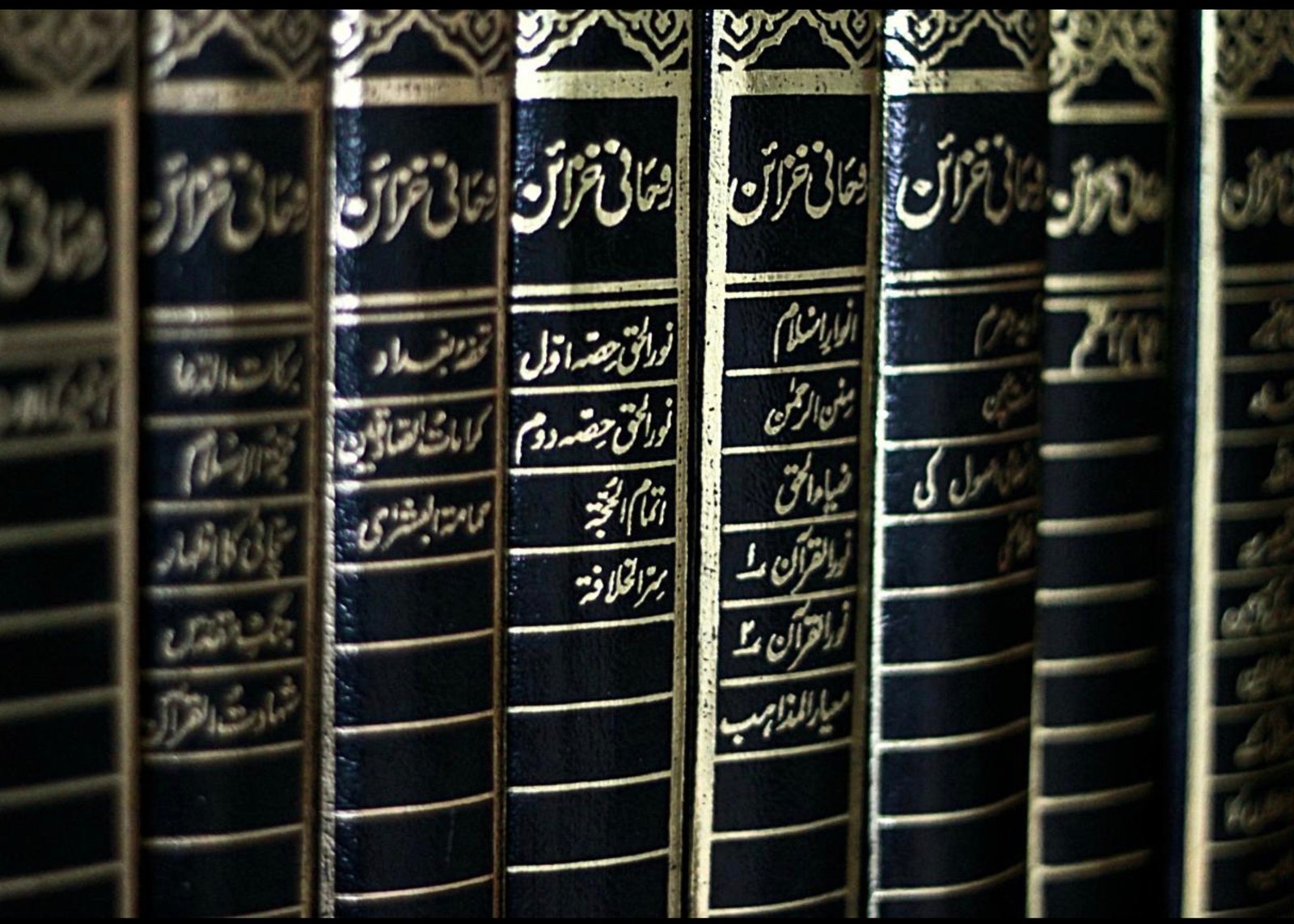
The ruling introduces a new phase in the suppression of Ahmadi religious expression. The Federal Constitutional Court has endorsed a ban rooted in a provincial executive order and justified through a clerical advisory body. The decision strengthens a system in which Ahmadi religious literature can be criminalized, seized, and removed from circulation. It reinforces the legal environment that has already produced arrests and prosecutions of Ahmadis involved in publishing their religious writings.
The judgment’s language signals a judicial posture that treats Ahmadi claims to religious freedom as marginal. Its reliance on procedural shortcomings and statutory delegation places the ban within a structure that is now shielded from further challenge. The ruling consolidates restrictions that have long targeted Ahmadi belief and practice.
Pakistan’s highest constitutional court has affirmed that the state may continue to prohibit the publication of “Rohani Khazayeen.” The ban remains a powerful instrument of control over Ahmadi religious life, and its judicial endorsementshows that the suppression of Ahmadi literature has entered a new stage, one in which the country’s supreme judicial authority has validated measures used to silence a minority community.

Massimo Introvigne (born June 14, 1955 in Rome) is an Italian sociologist of religions. He is the founder and managing director of the Center for Studies on New Religions (CESNUR), an international network of scholars who study new religious movements. Introvigne is the author of some 70 books and more than 100 articles in the field of sociology of religion. He was the main author of the Enciclopedia delle religioni in Italia (Encyclopedia of Religions in Italy). He is a member of the editorial board for the Interdisciplinary Journal of Research on Religion and of the executive board of University of Pennsylvania Press’ Nova Religio. From January 5 to December 31, 2011, he has served as the “Representative on combating racism, xenophobia and discrimination, with a special focus on discrimination against Christians and members of other religions” of the Organization for Security and Co-operation in Europe (OSCE). From 2012 to 2015 he served as chairperson of the Observatory of Religious Liberty, instituted by the Italian Ministry of Foreign Affairs in order to monitor problems of religious liberty on a worldwide scale.