Serbian court verdicts quietly revealed that Moscow intelligence financed desecrations of synagogues and mosques in France.
by Massimo Introvigne
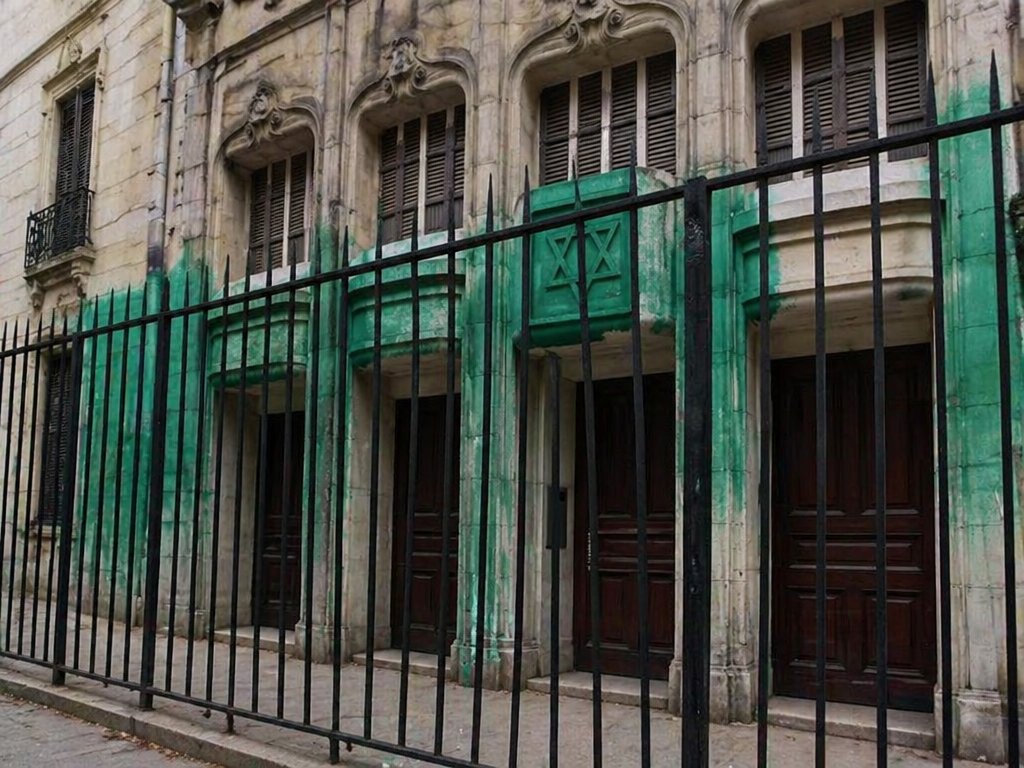
It is uncommon in the busy world of European news for an investigation to uncover something truly new, alarming, and under-reported. Yet, this is exactly what “Forum 18,” a reliable monitor of religious liberty in Russia and the post-Soviet space, has achieved. While major media outlets said nothing, “Forum 18” obtained and examined Serbian court verdicts that reveal a shocking and troubling episode: Russian intelligence sponsored attacks on Jewish and Muslim places of worship in France in 2025.
The facts, as outlined in the court documents, speak for themselves. Three Serbian nationals, arrested in late 2025 and tried in Smederevo, admitted to participating in two planned waves of desecration in the Paris area. The first occurred in May 2025, when three synagogues were sprayed with green paint, a color associated with Islam, during the Jewish Sabbath. The second happened in September when severed pigs’ heads were placed outside nine mosques in Paris and its suburbs. Both actions were meant to shock, humiliate, and inflame tensions between religious communities.
Interestingly, the same group attacked both synagogues, giving the impression that they were acting in the name of Islam, and mosques, going through the motions of enacting anti-Muslim sentiment.
There is more. The Serbian verdicts clearly state that the group received “orders, instructions and money” from “structures of the intelligence service of the Russian Federation.” The court noted that the goal was to “incite religious and national intolerance” and “destabilize the situation” in France and Germany. These are not claims from journalists or politicians; they come from judicial findings based on guilty pleas in a European court and in Serbia, a country that is not hostile to Russia.
French intelligence seems to have drawn similar conclusions. Reports mentioned by “Forum 18” indicate that Kremlin documents obtained by French services show the Russian presidential administration “directly approved” the desecration of Jewish monuments in May 2025. A summary from French intelligence, referenced by “Mediapart,” stated that Moscow aimed to increase tensions between Jewish and Muslim communities in France, using existing debates to weaken national unity. In other words, these attacks were not random acts of vandalism; they were part of a planned strategy to destabilize.
The method employed was simple and chilling. The Serbian operatives were recruited, transported, housed, and paid—1,000 euros for the synagogue attacks, 1,500 euros for the mosque attacks. They were told to take photographs of their work as proof of completion. The group was led by two individuals: one a Serbian citizen living in Moscow, and the other known only as “Hunter.” The Serbian authorities arrested eleven suspects; three pleaded guilty, while cases against others are ongoing.
Why Serbian nationals? Analysts interviewed by Forum 18 cite a mix of factors: strong pro-Russian sentiment in Serbia, economic struggles that make recruitment easier, and increasing cooperation between Serbian and Russian security services. In this context, Russian intelligence can find operatives who are willing, low-cost, and easily deniable.
Why target places of worship? Here, the analysis becomes even more disturbing. Andrei Soldatov, a respected expert on Russian intelligence, told “Forum 18” that such attacks have a strategic aim: they force European security services to reroute resources, expand the list of sites needing protection, and raise the overall cost of counterintelligence. The attacks don’t need to be spectacular or even successful; they need to create fear, uncertainty, and additional administrative pressure. They are, in Soldatov’s words, a way of “raising the costs” for countries that support Ukraine.
Russian forces have destroyed or confiscated places of worship in occupied areas of Ukraine. Russian-backed operations in Europe have targeted politicians, dissidents, and organizations helping Ukraine. However, the Paris attacks mark the first known instance of Russian-sponsored desecration of religious sites in Western Europe. That alone should have made headlines, but it went almost unnoticed.
The media’s silence is confusing. This story has all the elements that usually attract attention: foreign intelligence agencies, covert operations, religious communities targeted for symbolic humiliation, and a European court validating the chain of command. Yet, apart from “Forum 18” thorough reporting, this episode has hardly made an impact.
Perhaps the attacks were too grotesque for existing narratives to accommodate. Maybe the involvement of Serbian nationals complicated the storyline. It could be that the notion of a state intentionally inflaming tensions between Jews and Muslims in Paris seemed too cynical for today’s geopolitics. But the evidence is there, in black and white, in the verdicts of a Serbian court.
Religious sites are vulnerable targets, symbolically powerful, and capable of generating significant social anxiety with minimal operational cost. They are ideal tools for a foreign power seeking to disrupt democratic societies.
The story is not just about three men with paint cans and pigs’ heads; it is about a state willing to use religious hatred for its own strategic advantage. Ignoring this reality will not make it disappear.
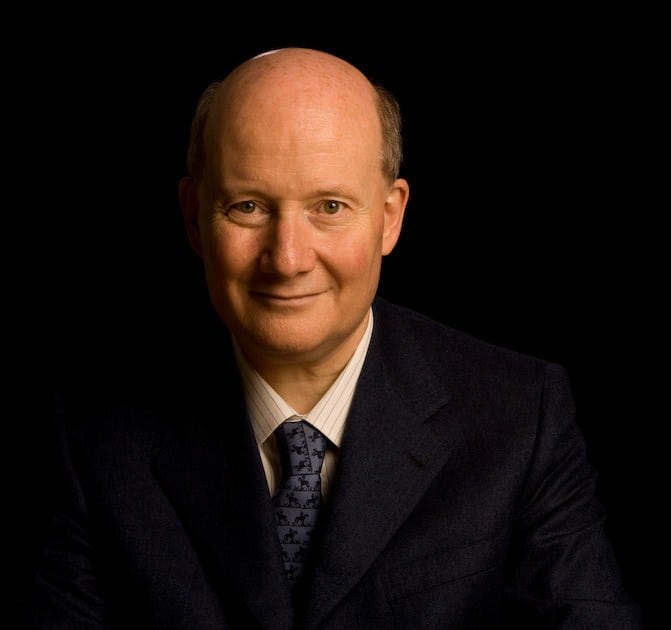
Massimo Introvigne (born June 14, 1955 in Rome) is an Italian sociologist of religions. He is the founder and managing director of the Center for Studies on New Religions (CESNUR), an international network of scholars who study new religious movements. Introvigne is the author of some 70 books and more than 100 articles in the field of sociology of religion. He was the main author of the Enciclopedia delle religioni in Italia (Encyclopedia of Religions in Italy). He is a member of the editorial board for the Interdisciplinary Journal of Research on Religion and of the executive board of University of Pennsylvania Press’ Nova Religio. From January 5 to December 31, 2011, he has served as the “Representative on combating racism, xenophobia and discrimination, with a special focus on discrimination against Christians and members of other religions” of the Organization for Security and Co-operation in Europe (OSCE). From 2012 to 2015 he served as chairperson of the Observatory of Religious Liberty, instituted by the Italian Ministry of Foreign Affairs in order to monitor problems of religious liberty on a worldwide scale.