A new graphic novel captures the faith, dignity, and defiant humanity of Pakistan’s martyred minister for minorities.
by A. Sahara Alexander
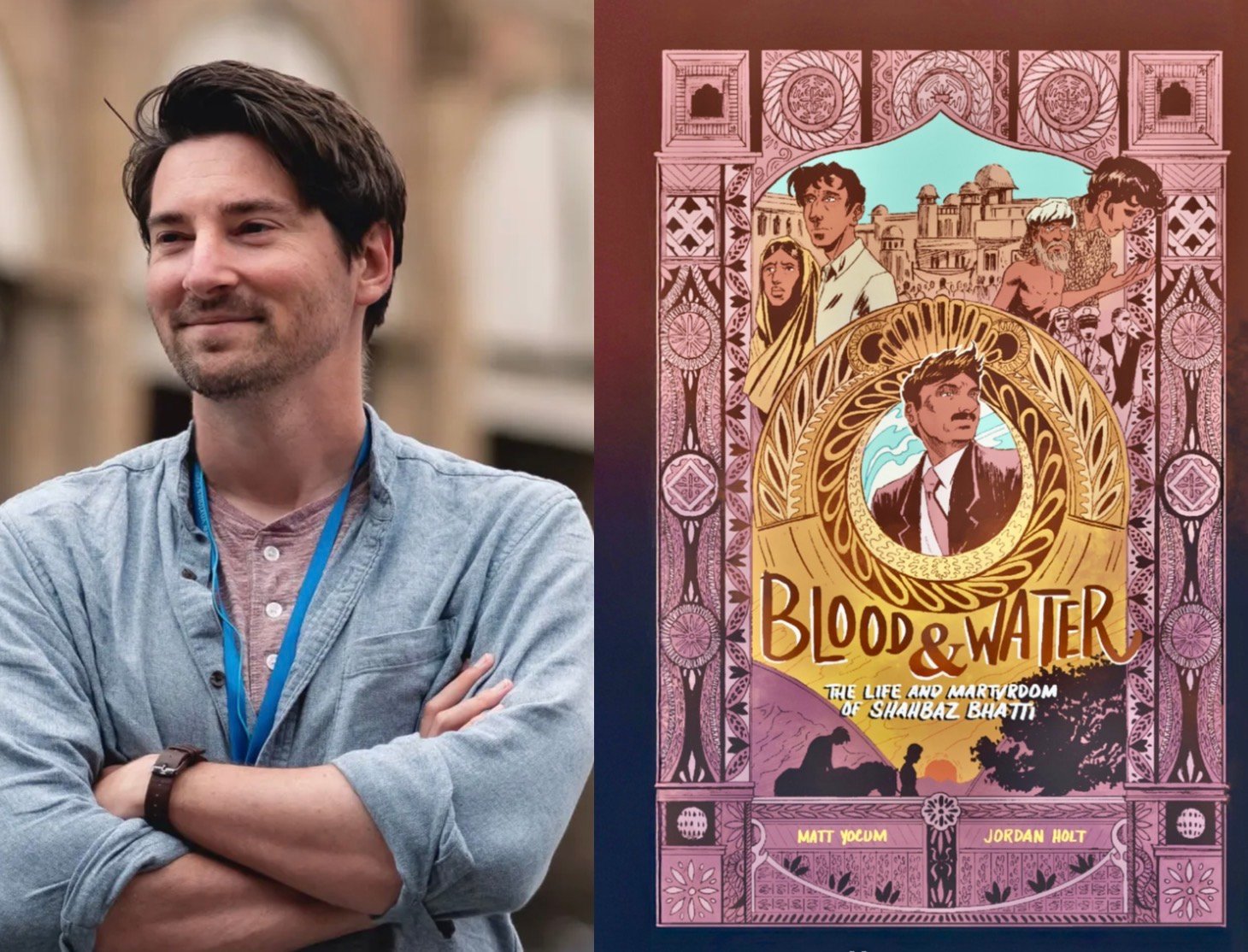
Shahbaz Bhatti’s life has been told in reports, documentaries, and memorial speeches, but “Blood & Water: The Life and Martyrdom of Shahbaz Bhatti” (Ignatius Press, 2026) offers something rare. It brings back the immediacy of a man who lived his calling so clearly that his death became its final chapter. The graphic novel, written by Matt Yocum and illustrated by Jordan Holt, an Associate Professor at Lee University in Cleveland, Tennessee, is a visual biography that views Bhatti’s beliefs as the driving force of a life spent defending those whom Pakistan’s political and social structures often overlook. It begins not with his assassination in 2011 but with the questions that shaped him: what it means to be made in the image of God, what it means to serve, and what it means to stand with the vulnerable even when violence surrounds you.
The book follows Bhatti’s upbringing in a Catholic family where faith was part of daily life. It shows him as a young man realizing that in Pakistan religious freedom is a personal responsibility. The panels illustrating his university years are the most impressive: Bhatti confronting prejudice, organizing students, and understanding that defending Christians alone would betray the dignity he claimed for all. The novel makes clear that his advocacy was never limited to one group. Muslims, Christians, and Hindus appear as neighbors whose worth he insisted upon with the same calm certainty that later made him a target.
The story grows as Bhatti’s mission expands. His founding of the All Minorities Pakistan Alliance is depicted with a sense of movement and urgency: relief work after earthquakes, efforts in schools, and the slow, patient work of convincing officials that minorities belong at the center of a democratic society. The artwork avoids melodrama; instead, it captures the weight of a man who understood that leadership meant facing threats without allowing them to change his purpose. The result is a portrait of a public servant who refused to separate faith from justice, or justice from the daily lives of those who relied on him.

The book’s launch at the Shahbaz Bhatti Memorial Gala in Toronto last month adds another layer of significance. Holt, who spent a year immersed in Pakistani Christian communities to illustrate the novel, described meeting refugees who appear in its pages. That encounter, between art and real history, captures the spirit of the project. It is a reminder that Bhatti’s legacy is carried by those who fled persecution and by those who remain in Pakistan, fighting for the same freedoms he defended. The gala’s gathering of faith leaders, human rights advocates, and public officials highlights that Bhatti’s story is not just a local tragedy but a global warning about the cost of defending human dignity.
The novel shows that Bhatti’s martyrdom was not a political accident, but the expected result of a life lived in open defiance of intolerance. Yet it also shows that his courage was not dramatic. It was the quiet, disciplined courage of someone who believed that every human being has irreplaceable dignity and that this belief requires action. The book’s final pages focus on the legacy that continues after his death: a vision of Pakistan in which no one’s freedom depends on the goodwill of the majority.
Religious freedom is increasingly threatened by both violent extremism and bureaucratic overreach, not only in Pakistan. This graphic novel is more than a biography. It invites readers to consider what Bhatti understood so well: that defending the persecuted is not a heroic exception but the everyday duty of those who believe in human dignity. “Blood & Water” succeeds, because it delivers this message with artistic honesty, historical accuracy, and a moral clarity that feels undeniably modern.

Uses a pseudonym for security reasons.