Beijing can impose a commercial price on speech abroad. The deeper question is whether institutions in democratic societies will defend their freedoms when doing so becomes costly.
by Asiye Uyghur
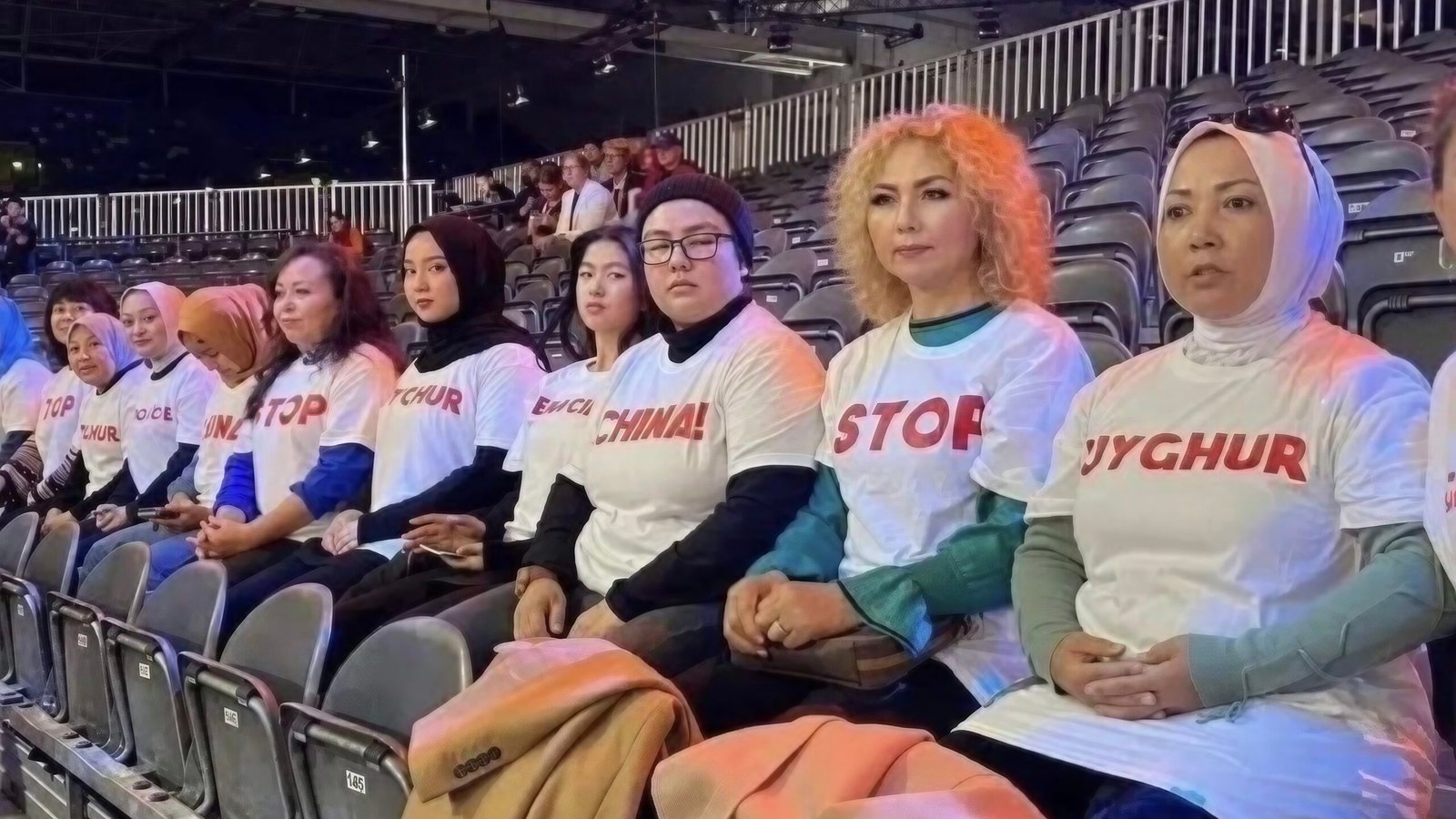
Reading about the backlash against Kylian Mbappé over his apparent reference to Mao Zedong as a dictator, I remembered sitting in a sports arena in Arnhem, the Netherlands, wearing a white T-shirt.
I was with roughly ten other Uyghur women at a volleyball competition in which China’s women’s team was competing. Our shirts carried messages calling for an end to the Uyghur genocide. A photograph I still have shows us sitting together in the stands, with red lettering across our white shirts.
Venue staff later ordered us to leave. They told us that sport and politics should not be mixed.
That memory raises a question larger than either a volleyball competition or a footballer’s apology: what happens to freedom in a democratic society when exercising it becomes too expensive for the institutions expected to uphold it?
The commercial price of speech
In an interview, Mbappé discussed an internet meme depicting his face superimposed on the body of a man he believed to be a Chinese dictator. The image apparently referred to Mao.
The consequences were swift. Dongpeng, Mengniu, and Milkground ended their partnerships with him. China Media Group suspended broadcasts of Spanish league matches and other games involving the player. Mbappé apologized on October 27, 2026; Real Madrid followed suit the next day. China’s Foreign Ministry said it took his apology seriously, according to the Associated Press.
People are entitled to dislike a joke, criticize a footballer, or stop buying the products he endorses. Freedom of expression does not guarantee freedom from criticism or commercial consequences.
But this episode involved more than individual consumer choices. State broadcasting decisions and demands for institutional apologies extended the consequences of one player’s speech to his club and league. Access to Chinese audiences became conditional on responding to Beijing’s political sensitivities.
Whatever Mbappé’s personal reasons for apologizing, the commercial pressure surrounding his decision was unmistakable.
The question for European sporting institutions is therefore not simply whether the remark was tactful. It is whether a foreign government’s political boundaries should determine which lawful opinions their players can express without being left to face institutional pressure alone.
Freedom on paper, restraint in practice
An authoritarian government does not need to change another country’s laws to restrict the practical space for speech there. It can make certain expressions commercially costly and leave employers, sponsors, and business partners to manage the consequences.
The right to speak may remain legally intact while the willingness to exercise it diminishes.
Commercial retaliation is not identical to state censorship, and a private organization does not carry precisely the same obligations as a government. Yet these distinctions do not remove the underlying danger. If institutions repeatedly respond to external political pressure by distancing themselves from speakers, demanding accommodation, or suppressing uncomfortable messages, they help make that pressure effective.
Beijing does not need to govern the world for this mechanism to work. It only needs influential institutions elsewhere to anticipate its objections and adjust their behavior.
Democratic freedoms are weakened when the political limits of an authoritarian state acquire practical force inside societies that formally reject those limits.

The women in the white shirts
Our message in Arnhem was straightforward: stop the Uyghur genocide.
We expressed it through words printed on our clothing. The photograph records our presence and our message. It does not record our subsequent removal or the explanation given to us. Those are events I witnessed and lived through myself.
I do not know whether Chinese officials requested our removal. I cannot establish the venue staff’s reasoning beyond what they told us. Our experience should not be presented as proof of an instruction from Beijing.
What it does establish, through my firsthand account, is that an appeal against genocide was excluded on the grounds that sport and politics should remain separate.
Sports venues need rules to protect spectators and ensure that competitions can proceed. But invoking “politics” does not, by itself, explain why a human rights message must be removed. Organizers should be able to identify the relevant rule and explain its application.
For Uyghurs, persecution means missing relatives, families separated for years, and attacks on the conditions that sustain our communal life. Our appeal asked others to recognize suffering that international institutions had been urged to confront.
If such an appeal cannot be displayed in a sporting arena in a democratic country, what practical protection does that society’s commitment to human dignity offer the people making it?
Whose politics does sport accommodate?
The contradiction had already emerged in December 2019, when Mesut Özil criticized the persecution of Uyghurs and the silence surrounding it.
Arsenal distanced itself from his comments in a statement on Weibo, describing them as his personal views and declaring that the club did not involve itself in politics. Chinese state television subsequently removed Arsenal’s match against Manchester City from its schedule. Reuters and BBC Sport documented those decisions.
Özil’s intervention and Mbappé’s remark had different purposes. One addressed persecution; the other concerned a meme. They nevertheless reveal how consequences imposed through broadcasting and sponsorship can encourage institutions to restrain speech.
Under this arrangement, an appeal on behalf of persecuted people becomes a political liability. Accommodating objections to that appeal becomes ordinary business management.
“Keeping politics out of sport” then risks becoming a selective principle: it excludes the victims’ message while allowing a powerful state’s sensitivities to shape institutional decisions.
The institutions involved remain responsible for their own choices. External pressure helps explain those choices; it does not make them inevitable or place them beyond criticism.
Resistance remains possible
The NBA’s experience in 2019 illustrates this point.
After Houston Rockets executive Daryl Morey expressed support for protesters in Hong Kong, Chinese broadcasters and commercial partners took action against the league. NBA Commissioner Adam Silver nevertheless defended Morey’s freedom of expression and acknowledged that holding that position came at a cost, as Reuters reported.
Resistance was possible, though costly.
That is the point at which a commitment to freedom becomes meaningful. Institutions rarely need courage to defend speech that threatens no important relationship. Their principles are tested when a sponsor, broadcaster, or government makes respect for those principles expensive.
Commercial interests are legitimate considerations. But if they consistently override the protection of lawful expression and basic human rights, those rights become conditional on the approval of powerful markets.
A democratic society cannot preserve the substance of its freedoms merely by retaining their wording in law while its influential institutions steadily withdraw the support that makes them usable.

From punishing speech to discouraging action
The pressure extends beyond what individuals say.
In 2021, H&M faced a backlash in China over an earlier statement expressing concern about forced labor in the Uyghur region and its decision not to source cotton there. Its products and store information disappeared from major Chinese e-commerce and service platforms. Nike, Adidas, and other brands also faced criticism over their cotton-sourcing positions, Reuters reported.
Here, responding to a human rights risk could itself jeopardize market access.
The broader effect extends to people and companies that have not yet taken a position. They observe the possible penalties and calculate whether speaking, investigating, or changing a supply chain is worth the risk.
This does not prove that every instance of silence results from Beijing’s instructions. It shows how retaliation can encourage self-restraint without an explicit instruction being issued.
That is also the connection between these controversies and the inadequate response to the persecution of Uyghurs. If institutions learn that raising an issue may threaten revenue, attention can wane and action can become harder to sustain. Silence is not the sole cause of abuse, but it can help lower the external cost of continuing it.
Evidence without effective accountability
The evidence concerning Uyghurs has demanded action for years.
In December 2021, the independent Uyghur Tribunal concluded that the PRC had committed genocide, basing that finding on measures intended to prevent births. Its published judgment followed an examination of testimony and documentary evidence. It was a people’s tribunal without enforcement powers, rather than an international criminal court.
In August 2022, the UN Human Rights Office concluded that arbitrary and discriminatory detention, in the context of wider restrictions on fundamental rights, might constitute international crimes, particularly crimes against humanity. Its assessment provided an authoritative basis for further scrutiny.
On October 6, 2022, the UN Human Rights Council rejected a proposal to debate the situation. The official voting record shows 17 states in favor, 19 against, and 11 abstentions. The proposal sought a discussion, not a conviction or sanctions. Even that step failed.
A UN vote and a sponsorship dispute are different events. Governments’ motives cannot simply be reduced to commercial dependence. Nor has the world been uniformly silent: investigations, sanctions, advocacy, and courageous expressions of solidarity have mattered.
The unresolved problem is the gap between recognizing grave crimes and sustaining an effective response.
Beijing can secure rapid institutional reactions to words it considers offensive. Uyghurs struggle to generate comparable urgency about the destruction of families and communities. The contrast reveals whose displeasure institutions are prepared to bear—and whose suffering they allow to remain unresolved.
What are democratic commitments worth?
The answer cannot be that freedom matters only until protecting it threatens a profitable relationship.
Sporting institutions should publish transparent rules distinguishing human rights expression from conduct that actually disrupts an event. If spectators are removed because of a message on their clothing, organizers should identify the rule applied, provide a written explanation, and offer a meaningful way to challenge the decision.
Clubs and leagues should defend individuals’ freedom of expression when commercial partners object. Companies should maintain safeguards against forced labor despite retaliation. Governments should support institutions facing coercive pressure rather than treating each incident as an isolated commercial inconvenience.
No single organization can end the persecution of Uyghurs. Each can decide whether its own conduct makes speaking about that persecution harder.
The promise of “never again” requires institutions to accept costs in defense of the people that promise is meant to protect. Otherwise, the costs do not disappear. They are shifted onto the victims, while others preserve their commercial relationships.
Our photograph from Arnhem records a small attempt to resist that transfer: Uyghur women sitting together, wearing words they wanted others to read.
We asked for an end to genocide. We were asked to leave.
If democratic societies permit authoritarian sensitivities to determine whose suffering may be acknowledged in public, their freedoms lose substance precisely where protection is most needed. Defending those freedoms requires more than declaring that Beijing has no authority over them. It requires refusing to enforce its political boundaries on its behalf.
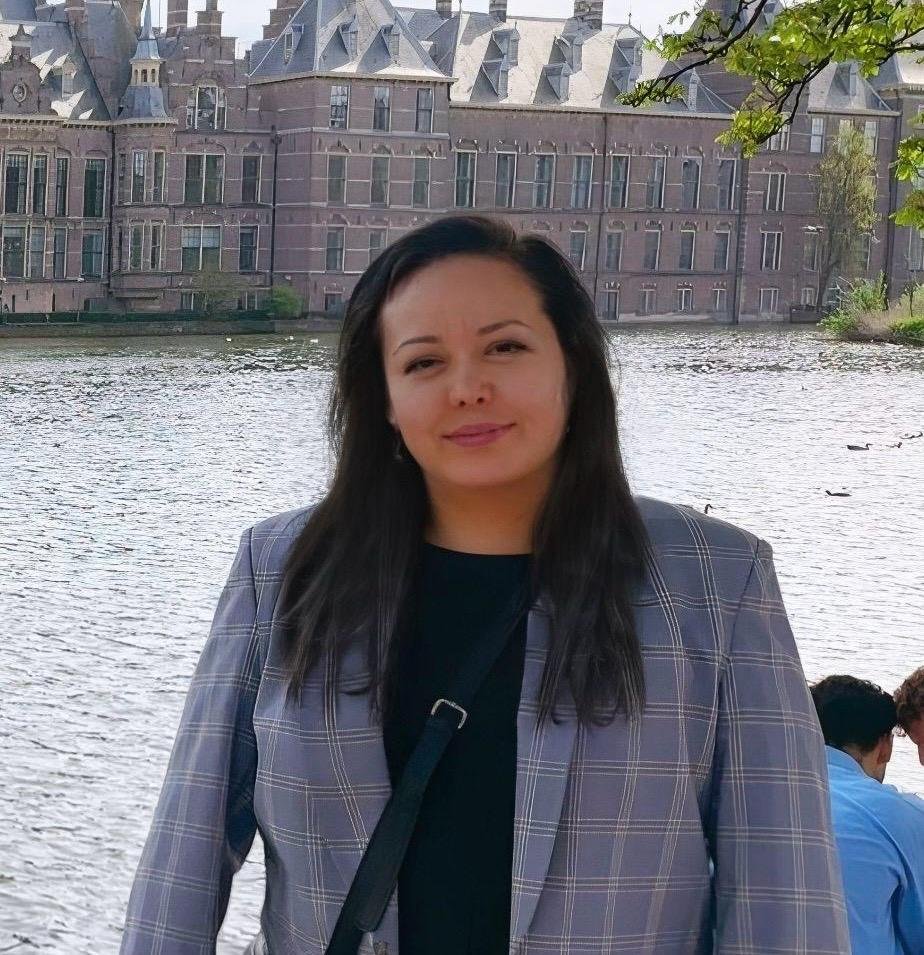
Asiye Uyghur is a Netherlands-based Uyghur writer and political commentator. Before the closure of Radio Free Asia’s Uyghur Service, she worked there as a political commentator. She currently publishes commentary and analysis in English, Dutch, and Chinese on Uyghur human rights, cultural repression, information control, and Chinese state policies related to Uyghurs through platforms including Global Voices, the Uyghur Human Rights Project (UHRP) as a guest contributor, and the Dutch publication “De Kanttekening.”