A system where exit is a privilege that can be withdrawn burdens ordinary travelers, while criminals (unfortunately) and dissidents (happily) will continue to buy their way out.
by Hu Zimo
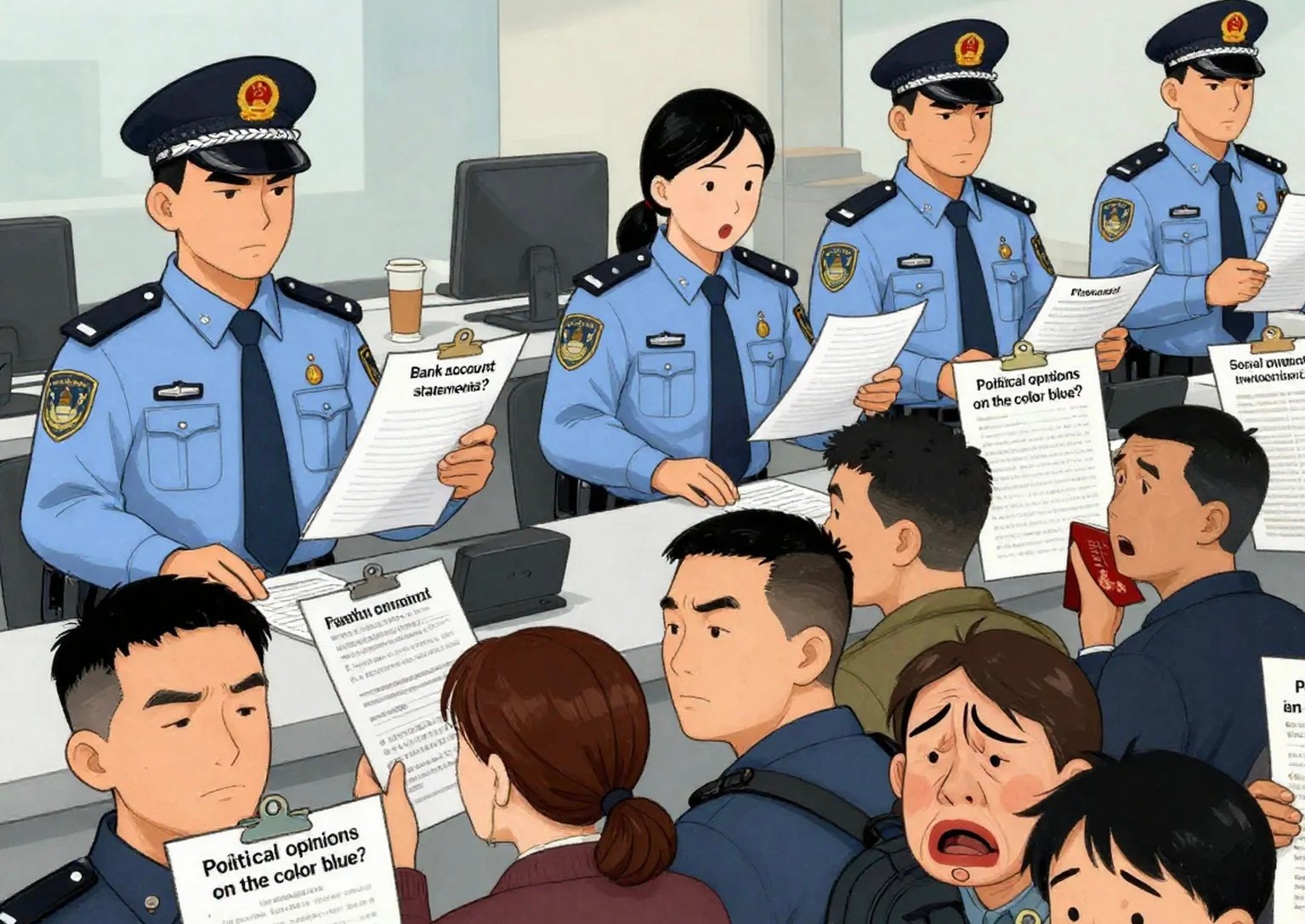
China’s State Council issued a new regulation on exit and entry administration that took effect on September 15. It is a nineteen‑article text that expands the authority of immigration and visa officers and introduces new layers of control over Chinese citizens who want to leave the country. The regulation is public and binding. Its tone is administrative, yet its implications are political. It is framed as a tool to safeguard national sovereignty, security, and development interests. It also creates a structure that places ordinary travelers under unprecedented scrutiny.
The regulation begins with a statement of purpose. It states that it aims to standardize exit and entry administration and protect travelers’ lawful rights. It also aims to safeguard national sovereignty, security, and development interests. This dual language appears throughout the text. Article 2 establishes a system for preventing safety risks for Chinese citizens traveling abroad. It authorizes the State Council’s competent departments to issue overseas safety alerts and travel‑destination risk alerts. It instructs citizens to avoid high‑risk countries or regions. It authorizes immigration authorities to remind travelers of risks and, when necessary, to dissuade them from traveling to destinations rated at the highest risk level. The regulation states that this applies to countries or regions where incidents seriously endangering personal safety occur frequently. The language is broad and leaves wide discretion to the authorities.
Article 3 is one of the most consequential provisions. It states that the reasons given by travelers applying for exit, entry, stay, or residence shall be true and lawful. It authorizes immigration and visa authorities to inquire into relevant circumstances and to require travelers to present or provide documents, materials, electronic data, and other information. It states that travelers shall cooperate. It also states that false materials or false statements allow authorities to deny exit or entry.
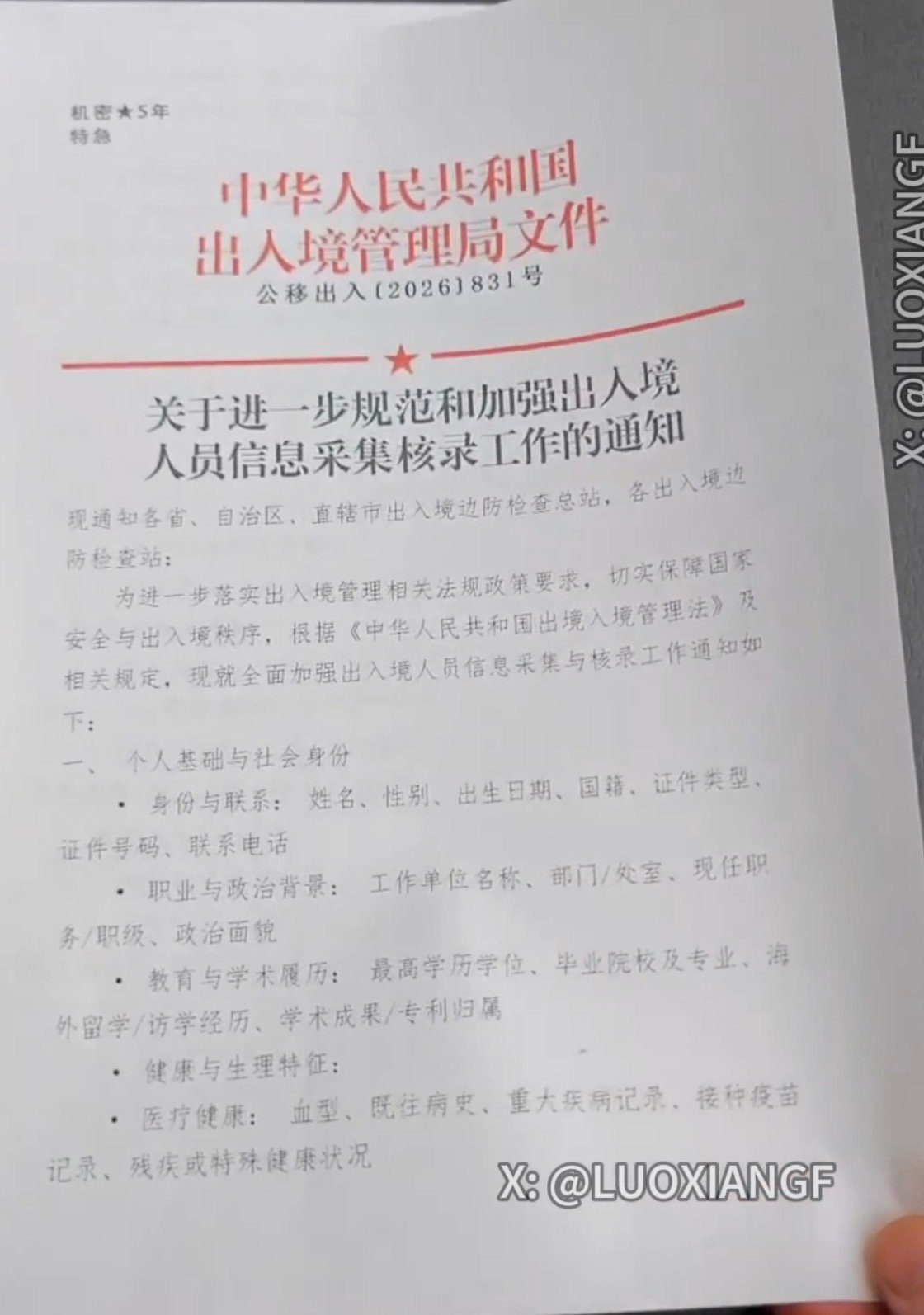
This part of the regulation has become the hinge for a second development. A circular letter has appeared on Chinese‑language social media. It was posted by the X account of “Luo Xiang” (@LUOXIANGF), who has more than 350,000 followers and has spent the summer publishing accounts of extra exit forms and phone searches at Chinese airports. The circular carries the document number Gong Yi Chu Ru (2026) No. 831. It is stamped with the National Immigration Administration’s name and dated August 31, 2026. It does not appear in any official government gazette. Its authenticity cannot be independently confirmed. The authorities have not issued a direct denial. They have criticized what they call an alarmist interpretation of the regulation, without addressing the circular itself.
The circular reads like an operational manual for Article 3. It describes a form divided into six blocks. The first block covers identity and political information. It asks for name, sex, date of birth, nationality, document type and number, and phone. It wants travelers to indicate work unit, department, current post and rank, and political affiliation. It also asks for highest degree, school and major, overseas study, academic work, and patent ownership; blood type, medical history, major illness, vaccinations, and disability; fingerprints, iris data, and facial‑recognition data; military service, reserve status, and demobilization.
The second block concerns the trip. It asks for destination, departure date, flight or ship number, expected return, and reason for leaving; hotel address abroad and transit countries; names, relationships, and phone numbers of traveling companions; the official who approved the trip, that official’s title, phone, and email, and the personnel‑department filing status and approval‑file number. It asks for cash and currency carried; a list of valuables and anything classified; the phone’s IMEI, the computer’s MAC address, and the SIM or foreign number that will be used outside China. It also asks for an emergency contact abroad and the overseas travel insurer’s policy number and rescue hotline.
The third block concerns family. It asks for spouse, father, mother, children, in‑laws, and siblings, each with name, ID number, job and title, date of birth, school, nationality, and overseas situation; the traveler’s second passport, if any, foreign permanent residence, foreign nationality, long‑term stay, or long‑term visa; overseas immediate relatives, other overseas relatives, and overseas friends. It also asks for five years of exit records and ten years spent outside the country.
The fourth block concerns digital life. It asks for accounts on WeChat, QQ, Telegram, WhatsApp, Weibo, Douyin, Xiaohongshu, Zhihu, and forums; Facebook, Instagram, X, LinkedIn, and YouTube; the everyday browser used; email; cloud drive; AI platforms; VPN tools; servers; and commonly visited overseas websites.
The fifth block concerns money. It asks for home address, vehicles, stocks, funds, digital assets, and company equity; domestic bank accounts, overseas bank accounts, mortgages, car loans, consumer credit, and major debts.
The sixth block concerns security and the courts. It asks for classification level, security clearance, secrecy training, secrecy agreements, leak records, and security‑review status; certificate of no criminal record, administrative penalties, lawsuits and arbitrations, court consumption limits, and dishonest‑judgment‑debtor listings.
The final line instructs every station to treat the list as a hard order. It states that all units shall attach great importance to it, strictly implement every verification requirement, and ensure full compliance.
As mentioned earlier, the circular is unconfirmed. It is also detailed enough to raise questions about how Article 3 will be applied in practice.
The regulation itself, not the circular, expands exit bans. Article 4 authorizes immigration authorities to deny exit for six months to three years after administrative detention for document fraud or illegal border crossing. It authorizes exit bans for Chinese citizens who engage in activities abroad that endanger national security and interests. It authorizes denial of exit for violations of export control or technology‑trade administration that may endanger industrial or technological security.
Foreigners who lie on a visa or at the port can be barred for one to five years. Agencies that provide exit‑entry intermediary services must register with immigration. Overseas firms cannot sell those services inside China. Agencies that publish false information, assist in providing false materials, disclose personal information, or assist in cross‑border unlawful activities face fines and suspension.
The Cyberspace Administration of China has said the regulation targets high‑risk destinations, fraud, gambling, telecom scams, and illegal technology transfer. It has stated that normal tourism, family visits, and study are untouched. This is the official line. The regulation’s broad, repressive language tells a different story.
The regulation will affect ordinary Chinese citizens more than anyone else. Criminals who want to leave China have long relied on corruption. China has one of the highest incidences of police corruption in the world. Officers at airports and border posts are part of this system. Criminals pay to have records deleted or concealed. They pay to lift exit restrictions, obtain passports, and pass border controls. They will continue to do so. Religious dissidents who want to escape abroad will happily continue to do the same. Corruption is a market. Regulations create demand. Prices rise. The regulation will not stop those who have money, connections, or a desperate need to leave. It will burden those who do not.
The leaked circular may or may not be genuine. The regulation is genuine. It depicts a regime that fears its own citizens and creates a structure where exit becomes a privilege that can be withdrawn.

Uses a pseudonym for security reasons.