The U.S. Congress faces a decisive choice as forced-labor law expands into areas once considered protected belief and voluntary religious life.
by Massimo Introvigne
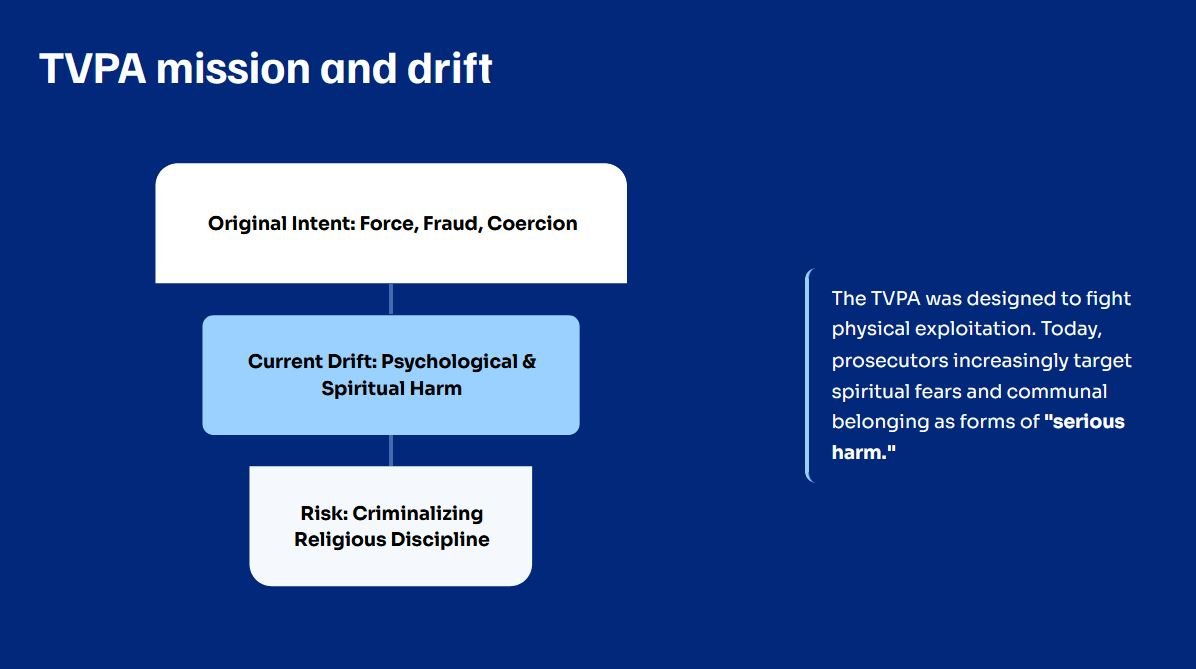
The reauthorization of the TVPA (Trafficking Victims Protection Act) now before the U.S. Congress carries consequences that reach far beyond trafficking policy. The statute was conceived to fight forced prostitution, passport confiscation, debt bondage, and the exploitation of migrants and children. Its current interpretation has drifted into a different territory, where prosecutors treat spiritual fears, communal belonging, and religious discipline as forms of psychological harm. This drift has affected religious and spiritual communities across the United States, and the pending legislation offers Congress a rare opportunity to correct course.
The Supreme Court’s “Kozminski” precedent in 1988 warned that expanding forced-labor law to psychological pressure would expose ordinary religious life to criminal prosecution. The Court described the risk with unusual clarity, observing that a religious leader who obtains services through doctrinal teaching could be accused of involuntary servitude.
Twelve years later, with the TVPA, Congress introduced the concept of “serious harm” and included psychological, financial, and reputational harm without a limiting principle for religious or spiritual activity. The Conference Report accompanying the Act acknowledged that the new language might require future refinement, stating that “the conferees are aware that the Department of Justice may seek additional statutory changes in future years to address further the issues raised in Kozminski, as courts and prosecutors develop experience with the new crimes created by this Act.”
Experience has arrived. The forced-labor conspiracy conviction in the recent “Cherwitz” decision against the leaders of OneTaste is the first federal case where prosecutors relied entirely on spiritual and communal fears to establish serious harm. The government conceded that no physical restraint existed and that every participant could leave. The theory presented to the jury was that members feared exile from their community and spiritual ruin and had been subject to “brainwashing” by the leaders.
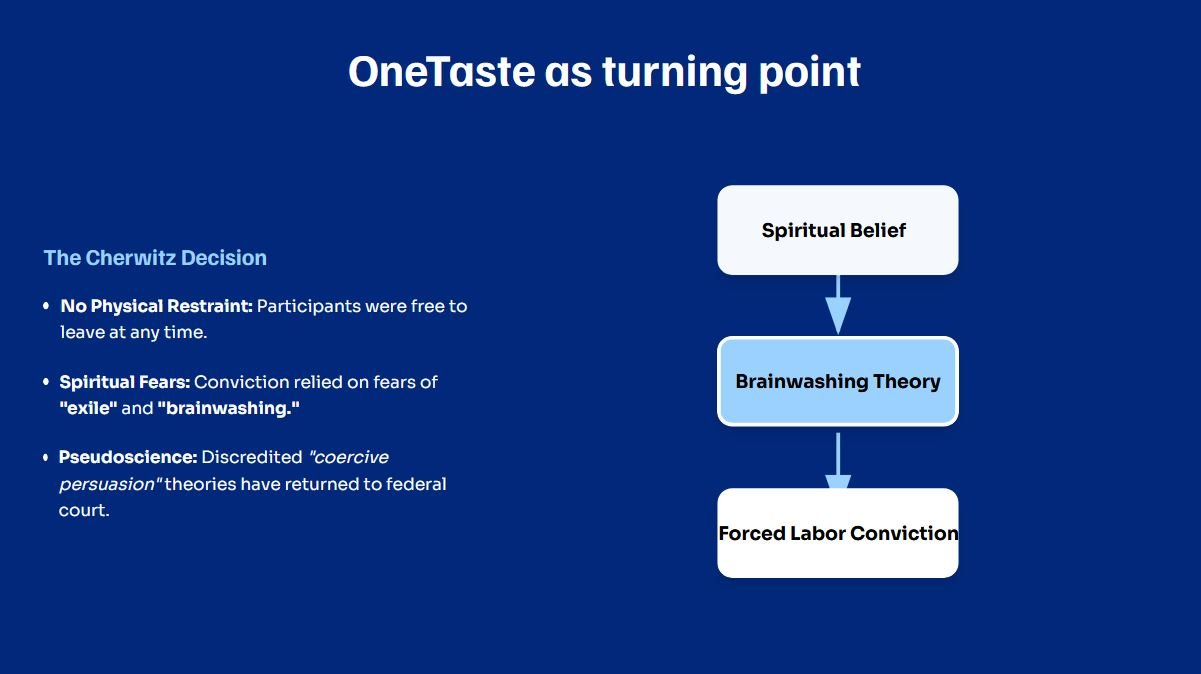
This approach reintroduces the theory of “brainwashing” by “cults,” treats belief itself as the mechanism of harm, and places religious and spiritual organizations in a precarious position. A scholar of religion cannot help but notice that theories of “brainwashing,” once dismissed by courts and academia as pseudoscience comparable to flat-earth speculation, have returned in federal prosecutions. One veteran purveyor of this long-discredited theory, deprogrammer Steven Hassan, exerted influence over the Department of Justice’s handling of religion-related trafficking cases and on some prosecutors, including in “Cherwitz.”
The consequences are visible beyond the OneTaste case. Civil and criminal cases invoking psychological coercion have been filed against Pentecostal congregations, Baptist churches, Catholic religious orders, and communities associated with Asian spiritual traditions. The theory moves easily from one target to another, and its reach expands each time a court accepts it.
Congress has the opportunity to address this situation through two amendments. The first would restore a religious-freedom limiting principle to the definition of serious harm, ensuring that spiritual teaching, religious counseling, and communal discipline are not treated as forced labor unless undertaken with the specific purpose of extracting labor in violation of the statute. The second would require reliability standards for federal training materials, preventing the use of coercive persuasion methodologies that courts or scientific bodies have rejected unless an agency makes a particularized finding of reliability.
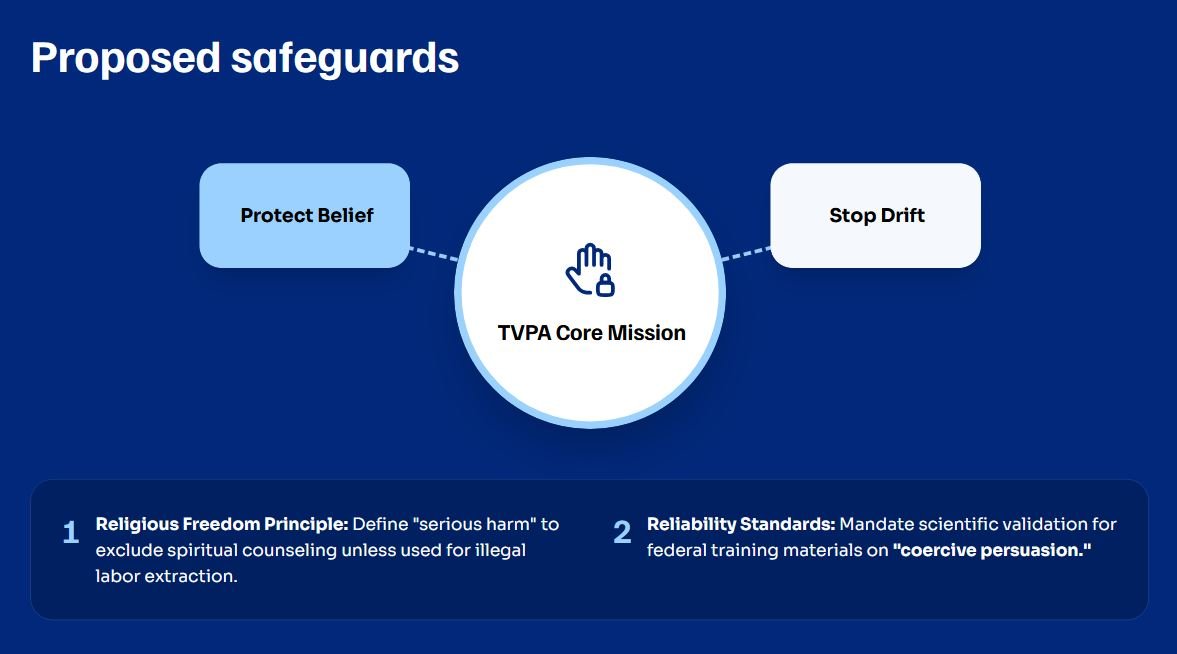
These amendments would preserve the TVPA’s core mission while protecting religious freedom from theories that treat belief as evidence of coercion. Genuine trafficking involving force, fraud, physical restraint, document servitude, and the exploitation of migrants and children would continue to be prosecuted with full vigor. The amendments ensure that the statute does not drift further into areas that Congress never intended to reach.
The United States has long defended freedom of religion and belief as a foundational principle. The TVPA reauthorization is an opportunity to reaffirm that principle by clarifying that spiritual life, voluntary religious service, and communal belonging are not forms of forced labor. Congress anticipated the need for refinement in 2000. The moment to act has arrived.
Massimo Introvigne (born June 14, 1955 in Rome) is an Italian sociologist of religions. He is the founder and managing director of the Center for Studies on New Religions (CESNUR), an international network of scholars who study new religious movements. Introvigne is the author of some 70 books and more than 100 articles in the field of sociology of religion. He was the main author of the Enciclopedia delle religioni in Italia (Encyclopedia of Religions in Italy). He is a member of the editorial board for the Interdisciplinary Journal of Research on Religion and of the executive board of University of Pennsylvania Press’ Nova Religio. From January 5 to December 31, 2011, he has served as the “Representative on combating racism, xenophobia and discrimination, with a special focus on discrimination against Christians and members of other religions” of the Organization for Security and Co-operation in Europe (OSCE). From 2012 to 2015 he served as chairperson of the Observatory of Religious Liberty, instituted by the Italian Ministry of Foreign Affairs in order to monitor problems of religious liberty on a worldwide scale.