A condensed report on fieldwork, interviews, and emerging themes in European Shincheonji communities.
by Márk Nemes*
*A paper presented at the European Academy of Religion’s Ninth Annual Conference, LUISS University of Rome, July 3, 2026.
Readers of “Bitter Winter” are no strangers to the Shincheonji Church of Jesus, the Temple of the Tabernacle of the Testimony, which is a Christian millenarian new religious movement founded by the now unjustly detained Korean pastor Lee Man-hee. The church emerged from the religious effervescence of the 1960s and is best known for its novel interpretations of the Book of Revelation and its active proselytizing, which has achieved growing success in South Korea, especially among those from conservative Protestant and Catholic backgrounds.
In the Cultural West, Shincheonji is less well known, aside from the fact that it became the subject of intense scrutiny in 2020, when it was accused of spreading COVID-19 by violating public safety regulations in South Korea. This development received focused attention from scholars and FoRB specialists; among others, Bitter Winter has also reported on it. Eventually, the Korean Supreme Court ruled Shincheonji not guilty of all COVID-related charges. Yet, the movement continued to be labeled a “cult” by organized anti-cult groups, whose activities now affect the everyday religious lives of Shincheonji members outside Korea.
My study explores Shincheonji’s Western presence, specifically the Philip Tribe’s European activity, which encompasses congregations in the UK, Ireland, Italy, Switzerland, and Hungary. It offers selected insights from extensive mixed-methods research initiated in early 2026, including semi-structured interviews and fieldwork analysis. I aim to elaborate on aspects of lived religion, conversion narratives, and personal member experiences from a narrower sample, offering a more detailed understanding of how members join, how they retain their affiliation, and what challenges they face when choosing and maintaining a new and, in Europe, evidently less accepted form of religion.
My fascination with Shincheonji began during fieldwork in South Korea in 2025, when I visited a local congregation and saw Chairman Lee in person. After learning about their international network of believers, several questions came to mind. Do they have members in my home country, Hungary? What might distinguish how local South Korean and European congregations live their faiths? Do all congregations face similar opposition and persecution? I was interested in how and why anyone would join a millennial new religious movement rooted in Christianity that originated on the opposite side of the planet, and how this affiliation affects their lives.
To gain a more detailed understanding, I approached the movement’s European representatives with a research proposal. After negotiations, I was approved to conduct my research, provided that I would consult with three regional representatives who assisted in selecting prospective interview subjects and clarifying emic terminology. To ensure a broad range of responses, I requested that at least two long-standing members represent each country in the Philip Tribe. Without concrete statistical data on the movement in Europe, I opted for a 50-50 gender split, with ages ranging from 20 to 40. This approximation was confirmed during my visit to the London church, which serves as the Tribe’s UK headquarters. Members observed that they constituted an outstanding majority of this cohort, with a balanced gender ratio. I maintained the 50-50 ratio as a methodological safety net. I also chose the broadest possible range of education, from vocational to doctoral degrees. The selection process yielded 24 interviews with participants aged 23–41, with varied backgrounds and nationalities, but with a disproportionately high number of British citizens, due to the interviews being conducted exclusively in English.

For transparency, it is necessary to note that personnel from the Philip Tribe provided the set of prospective subjects. Such a practice could raise concerns, as the researcher’s positional neutrality might become more difficult to maintain, and the roster might be selected to ensure a more positive outlook. Anyone who has conducted initial case studies of underresearched minority religions faces such obstacles. Breaking ground is always difficult, and the results should be interpreted as early inductive inquiries that seek individual life stories that intersect in matters of religiosity, worldview, and shared spiritual community.
To ensure value for the academic field of new religions studies, a twofold approach is necessary: the researcher’s objective positionality must not be jeopardized, and unacceptable requests or enforced censorship should be rejected. In my case, the representatives understood and accepted these conditions. I provided them with a detailed methodological and ethical plan emphasizing neutrality. I was allowed to discuss personal struggles and faith challenges, as well as issues associated with choosing a new religious conviction, which sometimes resulted in traumatic family conflicts and the loss of friendships and relationships. Moreover, it is necessary to note that the research was self-funded. In line with scholarly ethics, I anonymized my interview subjects’ identities, while my conclusions were formulated from an etic, external scholarly perspective.
My methodology excludes those who do not consider themselves members of Shincheonji, including those in the early stages of joining the movement. I consciously excluded this cohort for ethical reasons: interfering during a transitional period in one’s spiritual life would be disruptive. My question set was tailored for those who had ample time to consider and verify their convictions, were active members, and would neither express overenthusiasm nor provide insufficient information. As such, I limited the entry threshold to active membership for at least three years. Another cohort I excluded is those who no longer consider themselves members. Some found faith elsewhere, some remained seekers, and some found something incompatible with their envisioned future. A smaller but vocal minority of disgruntled ex-members who spend considerable time criticizing the movement they have left is labeled “apostates.” While some of their narratives are valuable sources, my research focused on active members.
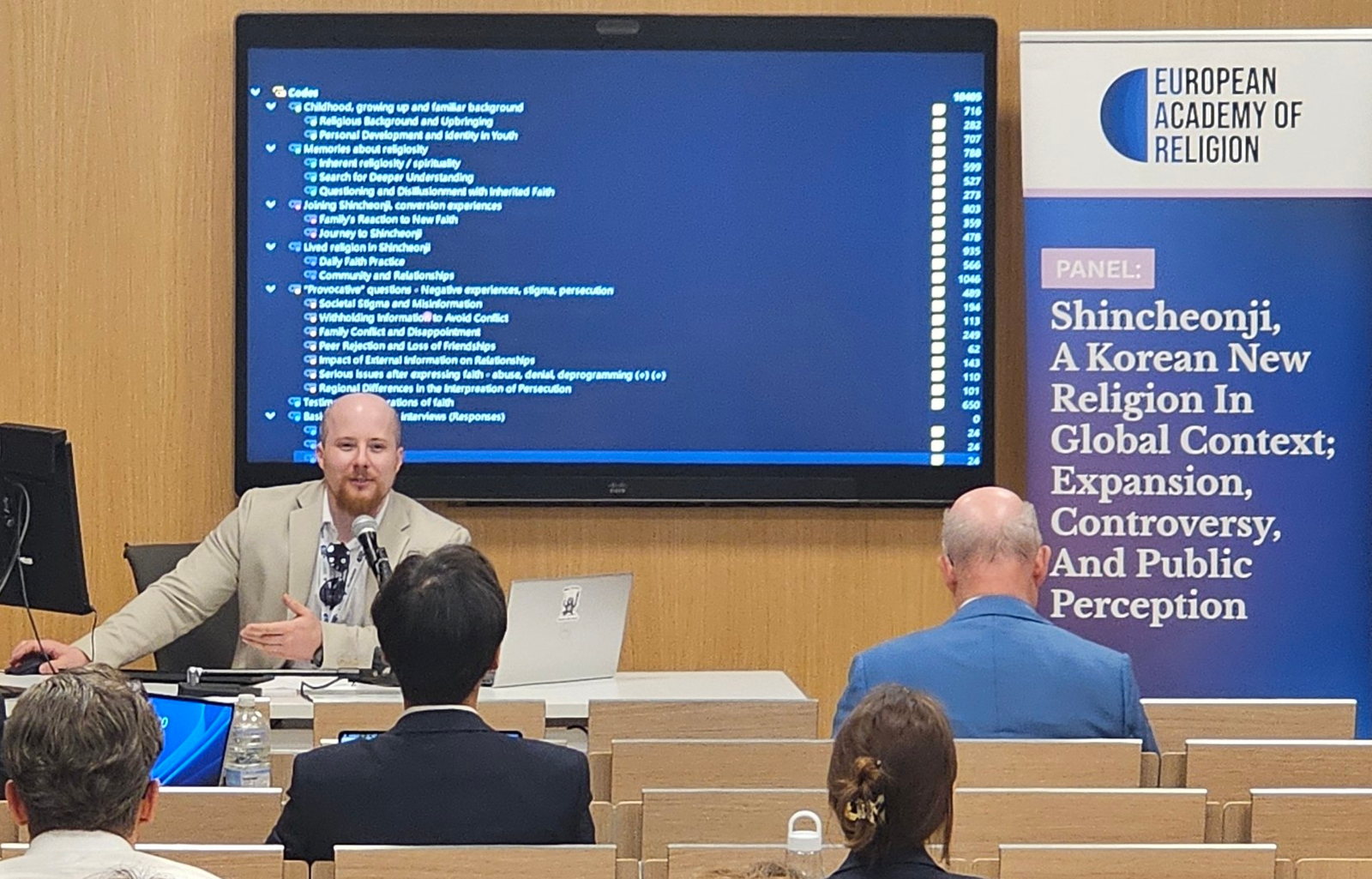
I used a mixed-methods approach, drawing on Clifford Geertz’s thick description for fieldwork notes and complementing it with thematic and content analyses of semi-structured interviews within a grounded theory framework. Interviews were scheduled before fieldwork to build familiarity with worldview and lived religiosity. Field notes served as verifiers or indicators for necessary corrections. The main body of processed material consisted of video recordings of 24 online interviews, totaling more than 20 hours of cut footage. The footage was machine-transcribed, manually checked, and uploaded to MAXQDA26. Using Kuckartz and Rädiker’s outline, I applied in vivo coding for sentiments and thematic coding for main subjects, aiming for thematic homogeneity with secondary informational layers. The in vivo method enabled the integration of recurring narratives into the research focus. The broader thematic codes covered childhood memories and upbringing, memories of inherent religiosity, conversion memories, lived religious experiences, and experiences of stigma and persecution. Additional subcodes delineated specific experiences or recurring narrative elements. Within the 24 transcripts, 10,405 lines of reference code were included. Cross-referencing this sum of data ensured that crucial matters, such as conversion narratives and struggles to maintain faith, could be considered credible.

During the evaluation process, recurring themes included the search for clear truth beyond traditional teachings, a desire for a logical understanding of the Bible, and a deep desire for divine acknowledgment; finding one’s place in a community with strong moral and dogmatic unity; difficulties with acceptance from parents and peers; personal struggles and transformation; and the call for proselytization in an important eschatological time.
Regarding upbringing, the majority of subjects had some religious education but found the taught narratives lacking in depth or encountered discrepancies between the message and behavior. Most were raised in Christian households where faith was integral. For many, church attendance was mandatory, leading to obligation or estrangement. Some parents were highly devout, even having pastoral duties in their congregation, which influenced the subjects’ early perceptions of faith. Others grew up in strict Christian environments, attended church out of routine, or found that practicing faith was more like tradition than a meaningful relationship with God. Several subjects described early religious life as tranquil or peaceful, yet lacking deeper understanding. Others expressed a dichotomy between learned tradition and a desire to deepen their religious lives. Some noted having a diverse religious exposure, including connections to various forms of mainline Christianity, Islam, as well as other minority religions.
Many individuals’ early experiences led them to question their inherited faith, pursue greater understanding, and ultimately encounter Shincheonji’s teachings. Several subjects described their conversion as a process marked by intellectual curiosity, emotional resonance, and a sense of long-sought answers. Several noted that their pursuit was either initiated by deep dissatisfaction with their worldly lives or catalyzed by a desire to find reconciliation after life’s traumas and challenges. Throughout the recall of their joining process, many noted feeling satisfied with how the importance of Bible study is framed, highlighting the values of doctrinal clarity and communal unity. Many also described challenges: parental opposition, social stigma, accusations shaped by anti-cult narratives, and the difficulty of disclosing or withholding their faith to their families, peers, and colleagues.
Some personal narratives also note that external intrusion – whether it’s for the perceived good of the individual or motivated by apostasy – can cause significant friction, even ruptures, within the family unit. A crucial finding of the study was that these processes take time and that disclosing one’s new faith mustn’t be hurried or pressured by outsider vigilantes.
After joining, the lived religion in Shincheonji was described as structured, communal, and centered on study, worship, and proselytization. Subjects expressed strong commitment to their faith communities, describing them as supportive and providing moral guidance and spiritual purpose beyond their mundane lives. Most also articulated a sense of eschatological urgency and a desire to share their faith and religious truth with others. Experiences of stigma and persecution were common, especially in areas where Shincheonji was less well known. Subjects described misunderstandings, prejudice, and conflicts with family and friends. Yet they also expressed resilience, emphasizing that their faith provided strength to navigate these challenges. Compared to East Asia, especially South Korea and Japan, however, these clashes were categorically less damaging and were considered repairable by the interview subject.
In summary, the research revealed a complex interplay among early religious upbringing, personal spiritual search, gradual conversion experiences, and lived religiosity within Shincheonji’s Philip Tribe. Subjects’ narratives highlighted both the appeal of Shincheonji’s teachings and the challenges of belonging to a minority religion in Europe. Their stories offer valuable insights into the contemporary process of choosing a new faith, aligning one’s life with a new set of norms, mitigating conflicts with families and peers, and expressing resilience amid faith challenges and external pressure. Elements of lived experiences of believers navigating faith amid misunderstanding and opposition were also highly valuable, as these illustrated how such frictions are mitigated and what level of existential and moral support Shincheonji provides for its faithful at the local and international levels.
The collected and coded data contain far more information than is shown here. A more detailed version of this article will be published in “The Journal of CESNUR” later in the year. In the future, I plan to publish more detailed studies to allow deeper exploration of these subjects.

Márk Nemes is a historian and a graduate in the academic study of religions. He received his doctorate in philosophy at the University of Szeged’s PhD program in 2025 and works as a researcher at the Hungarian Academy of Arts’ Research Institute of Art Theory and Methodology. As an awardee of the Hungarian National Eötvös Scholarship, he served as a visiting researcher at CESNUR from 2023 to 2024. For the past 10 years, he has focused on researching new, alternative, and emergent forms of religiosity in Hungary, Iceland, the US and most recently, in Italy. Since 2025, he serves as the Deputy Director of CESNUR