The title of the new law, which came into force on July 1, 2026, invokes unity and progress, but it is just another form of crackdown.
by Marco Respinti

The People’s Republic of China’s (PRC) new “Law on Promoting Ethnic Unity and Progress” (民族团结进步促进法) came into force on July 1, 2026, after having been approved by the PRC’s National People’s Congress on March 12, 2026. As repeatedly denounced by “Bitter Winter,” together with the Guidelines for its implementation issued by the United Front, the law is a draconian piece of legislation designed to steamroll the cultural identities of all the divergent ethnic groups living in the Middle Kingdom, to browbeat people living in the (still, though much diminished in freedom) special administrative regions of Hong Kong and Macao to sacrifice their special privileges in the interest of “the security of the nation,” and to threaten people in the Republic of China (Taiwan) into submission.
The immediate victims of the new legislation will be the Tibetans living on the Tibetan plateau, the Uighur people living in the Xinjiang/East Turkestan region, and the Mongolians of Inner Mongolia. No wonder that, just a few days before the law came into force, representatives of these long-suffering communities took to the streets of Amsterdam, in the Netherlands, to raise their voices in protest.
“For ethnic minorities in China, this law further narrows the space for meaningful cultural and political autonomy,” James Leibold, emeritus professor at Australia’s La Trobe University, a leading authority on racial politics in the PRC, told “Al Jazeera.” “It tells Tibetans, Uighurs, Mongols and other non-Han peoples that their languages, histories and identities will be protected only when they fit within the Communist Party’s preferred story of a single Chinese nation.”
Imposition by language
For example, Mandarin is sought to be imposed on these communities with their respective mother tongues. “Schools and other educational institutions use the national common language and script as the basic language and script for education and teaching,” Art. 15 of the law says. “The state promotes that preschool children learn Mandarin and that teenagers who complete compulsory education have a basic grasp of the national common language and script.” Violations of these legal provisions amount to a crime and, as Art. 6 clarifies, “[a]ctions that undermine national unity or create national division are prohibited.” Art. 58 is even more explicit: “Any organization or individual that violates the relevant provisions of this Law and undermines national unity and progress shall be promptly stopped and ordered to rectify the situation by the relevant departments of the people’s government at or above the county level, in accordance with their respective responsibilities, and shall be punished according to law. If the act constitutes a violation of public security administration, the public security organ shall impose public security administration penalties according to law; if the act constitutes a crime, criminal liability shall be pursued according to law.”
Truly Art. 10 drops the mask: “We resolutely oppose all acts of slander, smearing, containment, suppression, infiltration, and sabotage against the People’s Republic of China under the pretext of ethnicity, religion, or human rights.” After all, art. 46 is clear: “Religious organizations, religious schools and religious venues shall carry out publicity and education to strengthen the sense of community of the Chinese nation, adhere to the direction of Sinicization of religion in China, guide religion to adapt to socialist society, guide religious personnel and believers to carry forward the tradition of patriotism, and promote ethnic harmony, religious harmony and social harmony.”
Transnational repression as usual
The new piece of legislation is also openly designed for carrying on, and continuing, transnational repression, which is one of the major plagues for the Chinese diaspora. Theoretically, being assigned extraterritorial jurisdiction, along with the diaspora, the non-Chinese critics of the Chinese Communist Party (CCP) in foreign countries may also become targets. Art. 63 says it: “Organizations and individuals outside the territory of the People’s Republic of China who engage in acts that undermine national unity and progress or create national separatism against the People’s Republic of China shall be held legally responsible in accordance with the law.”
This aspect has particularly alarmed the US Congress. On the eve of the law’s coming into force, Congressman John Moolenaar, chairman of the Select Committee on China of the US House of Representatives, strongly stated: “The Chinese Communist Party’s dystopian and deceptively named ‘Ethnic Unity and Progress Law’ is set to go into force on July 1. This law is an ugly escalation of the CCP’s cruelty and paranoia, and China plans to use it to continue its harassment and intimidation of critics who live beyond its borders. On July 1, a press release by the same Select Committee on China reiterated: “[W]e are deeply concerned by language in the law that demands ideological compliance with the CCP, mandating that even people outside China deemed to be undermining ‘ethnic unity and progress’ by the Chinese government can be held legally responsible in China. This sweeping legislation gives Beijing near-limitless authority to prosecute those who would speak out against Beijing’s oppression. It only continues its development of a legal framework to legitimize its transnational repression.”

Also, the European Union in Brussels, Belgium, reacted along the same lines: “Parliament condemns this law for encouraging assimilation policies and restricting cultural, religious, and linguistic freedoms, in contradiction with China’s obligations under international law,” says a resolution of April 30. Moreover, members of the European Parliament have denounced “[…] the transnational repression against individuals residing within the EU” and courageously and significantly “urge member states to suspend their extradition treaties with China. Finally, they call on the Council to implement the EU Global Sanctions Regime against those responsible for the new law.”
The European Parliament also addressed another important aspect of the CCP’s systematic repression of religions and ethnic groups, carried out under a variety of guises. It in fact stressed, “that the succession of the Dalai Lama is a religious matter and should be determined in accordance with Tibetan Buddhist traditions alone.” It is well known, in fact, that the CCP is trying to manipulate that fundamental aspect of Tibetan Buddhism and Tibet, preparing to sabotage, in due time, the whole process of recognition of the next incarnation of His Holiness.
Legal experts have pointed out that the law, apart from its repressive substance, is also notable for its structure, which is shorn of fundamental values and organized around political slogans, Marxist rhetoric, and the sermons of President Xi Jinping. The Preamble of the new law, states that “[a]s socialism with Chinese characteristics enters a new era, the Communist Party of China has adhered to combining Marxist ethnic theory with the specific realities of China’s ethnic issues and with China’s outstanding traditional culture” and Art. 2 develops: “The cause of national unity and progress adheres to the overall leadership of the Communist Party of China, holds high the great banner of socialism with Chinese characteristics, upholds Marxism-Leninism, Mao Zedong Thought, Deng Xiaoping Theory, […] fully implements Xi Jinping Thought on Socialism with Chinese Characteristics for a New Era.” It is more a political doctrine to establish the supremacy of the CCP among the ethnic minorities of the country than a legal document. It ignores the moral requirement of giving protection to the language and culture of the minority ethnic groups.
No one is spared
Having said that, the mention of Deng Xiaoping (1904‒1997) in the text of the law is also out of place. One need not be a fan of Deng’s façade reformism to recognize that during his tenure as the supreme leader of the PRC, the 1984 Regional Ethnic Autonomy Law was passed: it explicitly provided for education in minority languages. It warned against chauvinism exerted by the majority. But President Xi’s hardcore new-communist recruits all who fit its aims.
As for the Tibetans, whose land was finally invaded by the PRC’s People’s Liberation Army in 1950, they are alarmed. “The legislation provides a comprehensive legal framework for accelerating the assimilation of Tibetans and other ethnic minorities by weakening their distinct languages, cultures, religions, and identities in the name of ethnic unity,” the Central Tibetan Administration (CTA), or the Tibetan government in exile in Dharamsala, India, has warned.
In fact, “[…] the law transforms long-standing assimilation policies into legal obligations by mandating Mandarin-medium education, encouraging demographic engineering through mixed communities and intermarriage, expanding state surveillance, and extending China’s jurisdiction beyond its borders to target critics and members of the Tibetan diaspora,” Sikyong (prime minister) of the CTA, Penpa Tshering, has said in an appeal, asking the international community to oppose the law.
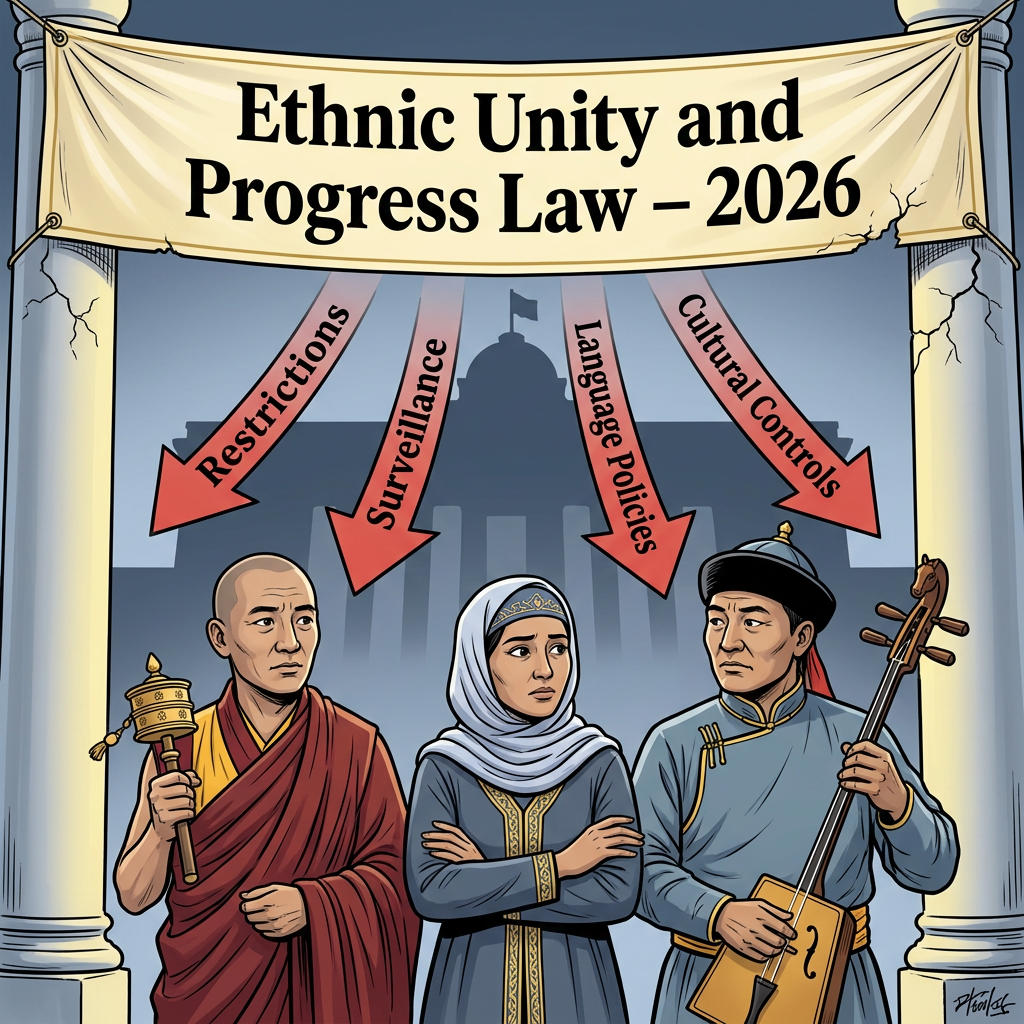
But the new law formalizes a practice that has been in effect for years. CCP has already taken steps to ensure the cultural assimilation of the Tibetan people. For years, Tibetan families have been required to send their children to state-run boarding schools, where Mandarin is the primary language of instruction. There, the children are educated within the framework of the dominant Han culture. All forms of preservation of Tibetan religious practices, language, and cultural traditions will now be interpreted as detrimental and construed as “separatism.”
Xinjiang/East Turkestan is the other province in the PRC where ethnic minorities form the majority of the population. Of the estimated 11 million Uighurs living there, one to three million are being held in so-called re-education camps, which in reality are detention centers. Efforts to suppress the Uighur language have been continuing for years. As an expatriate Uyghur said only last year, “[…] in our homeland, the Chinese government is doing everything possible to stop the Uyghur language from being passed down to the next generation” and “China has ended the use of Uyghur as a language of instruction, closed libraries, and brutally persecuted editors and publishers.”
In Southern Mongolia, Beijing has been trying to enforce a new education policy to replace the Mongolian language since at least 2020. When protests sparkle, the government responds with mass detentions, re-education programs and forced public “confessions” from protesters. There were digital crackdowns on Mongolian-language internet use when Mongolians turned to the internet to keep their language and culture alive.
And for people living in Hong Kong, Macao and the Republic of China (Taiwan), the ominous warning of the new law is that they must “consciously preserve the nation’s sovereignty, security and development interests” and “jointly carry forward the Chinese culture.”
No news, another bad law from Communist China.

Marco Respinti is an Italian professional journalist, member of the International Federation of Journalists (IFJ), author, translator, and lecturer. He has contributed and contributes to several journals and magazines both in print and online, both in Italy and abroad. Author of books and chapter in books, he has translated and/or edited works by, among others, Edmund Burke, Charles Dickens, T.S. Eliot, Russell Kirk, J.R.R. Tolkien, Régine Pernoud and Gustave Thibon. A Senior fellow at the Russell Kirk Center for Cultural Renewal (a non-partisan, non-profit U.S. educational organization based in Mecosta, Michigan), he is also a founding member as well as a member of the Advisory Council of the Center for European Renewal (a non-profit, non-partisan pan-European educational organization based in The Hague, The Netherlands). A member of the Advisory Council of the European Federation for Freedom of Belief, in December 2022, the Universal Peace Federation bestowed on him, among others, the title of Ambassador of Peace. From February 2018 to December 2022, he has been the Editor-in-Chief of International Family News. He serves as Director-in-Charge of the academic publication The Journal of CESNUR and Bitter Winter: A Magazine on Religious Liberty and Human Rights.