Accusing “cults” of “coercive persuasion” looked démodé, at least in academia and courts of law outside of France. But the discredited theory is coming back.
by Massimo Introvigne*
*A paper presented at the European Academy of Religion’s Ninth Annual Conference, LUISS University of Rome, July 3, 2026.

Introduction: A Discredited Theory That Refuses to Die
At the end of the twentieth century, most scholars of new religious movements believed that the long and contentious history of “cult brainwashing” theories had finally reached its conclusion. For decades, sociologists, psychologists, historians of religion, and legal scholars had demonstrated that the idea of irresistible mental manipulation by minority religions lacked empirical grounding and scientific coherence. The notion that “cults” deploy mysterious techniques of “mind control” or “coercive persuasion” to override individual autonomy was exposed as pseudoscience, no more respectable than flat‑earth cosmology. Its function was ideological and political: it provided a veneer of scientific legitimacy to the stigmatization and repression of unpopular religious minorities.
Schools had reached this conclusion well before the U.S. Commission on International Religious Freedom (USCIRF), in a 2020 report, explicitly denounced the use of “brainwashing” rhetoric as the hallmark of the pseudo-scientific anti‑cult ideology hostile to religious liberty. Some “contrarian” scholars were treated as academic curiosities and relegated to the margins.
This academic consensus was not confined to scholarly journals or religious liberty watchdog reports. Courts in democratic countries increasingly recognized that “brainwashing” theories were unreliable and inadmissible.
In the United States, the decisive moment came in 1990 with “United States v. Fishman.” A federal court examined whether the theories of coercive persuasion advanced by anti-cult psychologist Margaret Singer and her colleagues met the standards of scientific reliability required for expert testimony. After extensive hearings, the judge concluded that they did not. The theories lacked empirical support, were rejected by the mainstream scientific community, and relied on circular reasoning. The court therefore excluded the testimony of Singer and another anti‑cult scholar, declaring that “theories regarding the coercive persuasion practiced by religious cults are not sufficiently established to be admitted as evidence in federal courts of law.”
European jurisprudence reached similar conclusions. In 1981, the Italian Constitutional Court abolished the Fascist‑era crime of “plagio,” a statute akin to “brainwashing,” declaring it incompatible with both scientific knowledge and religious liberty. In 2010, the European Court of Human Rights observed that no generally accepted scientific definition of “mind control” exists and that behaviors often cited as evidence of coercion—such as intense commitment, communal living, deference to leaders, and enthusiastic proselytism—are common across many religious traditions.
By the early 2000s, it seemed that the judicial use of “brainwashing” theories had been relegated to the past. They survived in the media, where deprogrammers like Steven Hassan tirelessly promoted simplified versions of Singer’s discredited models, but they no longer shaped legal outcomes. Except in France, where the peculiar 2001 anti‑cult legislation had preserved the concept under new names and expanded it further in 2024 with the criminalization of “psychological subjection.”
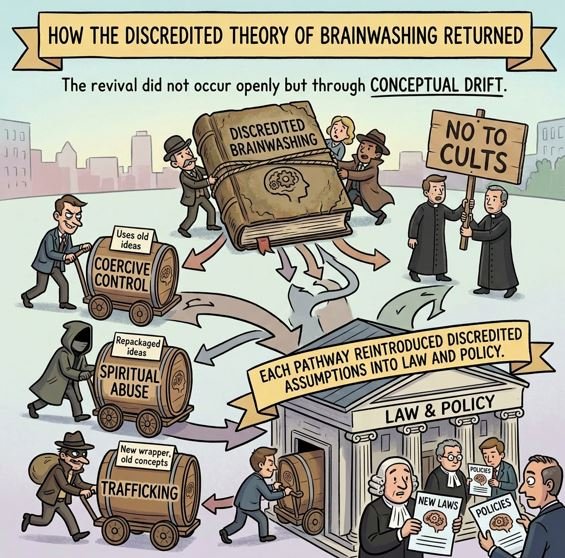
Yet history rarely moves in straight lines. What had been expelled through the front door began to creep back in through the windows. The return did not take the form of a direct rehabilitation of “brainwashing.” Instead, it emerged through three indirect pathways: the expansion of coercive‑control theories beyond the domestic domain, the judicialization of the concept of “spiritual abuse,” and the infiltration of “brainwashing” rhetoric into the interpretation of human‑trafficking statutes.
2. How “Brainwashing” Returned: Three Pathways
By the early twenty‑first century, scholars believed the matter had settled. Brainwashing theories had been discredited, their legal use curtailed, and their scientific foundations dismantled. The anti‑cult movement continued to invoke them rhetorically, but they no longer shaped judicial or public reasoning in democratic countries other than France. This confidence, however, proved premature.
A. First Pathway: The Expansion of Coercive Control
The first pathway through which brainwashing theories returned was the attempt to stretch the concept of “coercive control” far beyond its original domain. Coercive control was developed to describe the dynamics of abusive intimate relationships, particularly those involving domestic violence. It focuses on patterns of domination, isolation, economic dependency, and threats that occur within a family relationship marked by emotional attachment and vulnerability. Within that context, the concept may have legitimate applications.
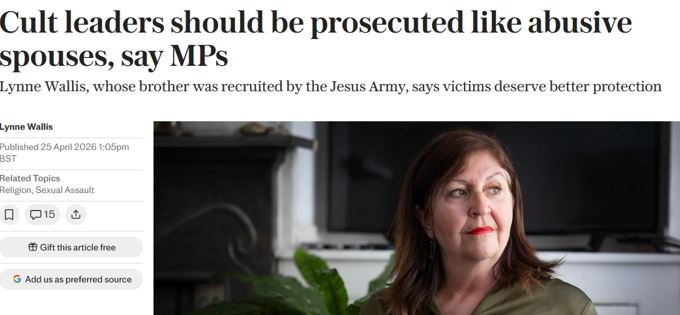
Extending coercive control to religious organizations is a conceptual leap without justification. The dynamics of a marriage or intimate partnership cannot be transposed wholesale onto a voluntary religious community. Yet anti‑cult activists have increasingly attempted to do precisely this. In the United Kingdom, a group of parliamentarians has advocated for the inclusion of religious groups within coercive‑control legislation. In Australia, the Victoria Inquiry on Cults has heard similar proposals, often driven by sensational media narratives and political pressures rather than empirical evidence.
The argument is superficially appealing: if coercive control is a crime in intimate relationships, why not in religious groups? The answer is straightforward. The psychological, relational, and structural dynamics are fundamentally different. Coercive‑control theories presuppose a relationship including emotional dependency, economic entanglement, and personal intimacy—not one of these elements alone—that does not characterize membership in a religious organization. To apply the concept to religious groups is to revive, through a back door, the discredited idea that members of minority religions are incapable of autonomous decision‑making because they are constantly subjected to irresistible psychological manipulation. It is “brainwashing” under a new name.
B. Second Pathway: The Judicialization of “Spiritual Abuse”
The second pathway is more subtle and dangerous: the judicialization of “spiritual abuse.” The concept went through three phases. The first phase emerged in the early 1990s within evangelical Christian circles as a pastoral metaphor. Authors such as David Johnson and Jeff VanVonderen used the term to describe the misuse of spiritual authority within Christian communities. They spoke of authoritarian leadership, manipulative use of Scripture, and shaming practices that undermined spiritual growth. The remedies they proposed were internal: better leadership, accountability, pastoral counseling, reconciliation, or, in some cases, leaving an unhealthy community.
Crucially, early proponents explicitly rejected the idea that spiritual abuse should be criminalized. They understood it as a matter of church health, not as a legal category. They did not invoke psychological trauma, PTSD, or coercive control. They did not imagine that the state would intervene in doctrinal or disciplinary matters.
The second phase began in the early 2000s, when the term migrated into the contexts of psychology, counseling, and safeguarding. Here it underwent a profound transformation. What had been a metaphor became a quasi‑clinical category. Psychologists began to describe spiritual abuse as a form of emotional or psychological trauma. The scope of the term expanded dramatically. It now includes not only leadership misconduct but also doctrinal teachings, religious socialization practices, and emotional experiences associated with guilt, fear, or moral exhortation.
Attempts were made to develop measurement tools, but these instruments were often ad hoc, lacked validation, and relied on subjective self‑reporting. Definitions became increasingly broad, sometimes reducing spiritual abuse to “using God or a higher power to control or induce fear.” Such definitions risk pathologizing any religious tradition that speaks of sin, judgment, karma, or post‑mortem consequences. They also risk criminalizing ordinary religious socialization, which often involves moral instruction, communal norms, and spiritual discipline.
This psychological reframing created the conditions for the third and most problematic phase: the incorporation of spiritual abuse into law and policy. The third phase is the most troubling: the transformation of spiritual abuse into a legal category. Once the term had been broadened and psychologized, it became available for use in campaigns against minority religions, for state intervention in religious communities, and for the creation of new criminal offenses. Yet spiritual abuse, in its current form, is far too vague and subjective to serve as a basis for legal proceedings. Existing laws already address concrete harms such as sexual abuse, fraud, and physical assault. Creating a separate category for spiritual abuse is redundant at best and dangerous at worst.
Japan offers a striking example. The concept was introduced into law as “religious child abuse,” defined not as physical or sexual harm but as inducing fear or psychological distress through religious teachings. After the assassination of former Prime Minister Abe, government guidelines criminalized practices such as the use of religious images that might induce fear or lead children to behaviors that deviate from societal norms, mentioning Jehovah’s Witnesses’ prohibition of celebrating birthdays as a specific example of spiritual abuse. Then, courts and regulations expanded “spiritual abuse” from children to adults. These broad notions played a role in the first‑ and second‑degree decisions that dissolved the Unification Church, closed its churches, and confiscated its assets. International bodies, including two United Nations documents, have condemned these measures as violations of human rights and religious freedom.

In South Korea, the election of left-leaning President Lee Jae Myung in 2025 led to a crackdown on both new religious movements, such as the Unification Church and Shincheonji, and conservative Christian churches, accused of trying to influence elections (a crime for clergy and religious organizations under Korean law). Proving the accusations linked to politics and possible illegal financing of politicians was difficult. It became clear that they often referred to the individual misconduct of rogue church officers rather than the organizations themselves. President Lee then switched to anti-cult rhetoric. He accused what he called “heretical movements” of harming their members and society through spiritual and psychological abuse. His party proposed a law to enable swift administrative dissolution and the seizure of their assets, which is currently pending in the Korean Parliament amid widespread international criticism.
In South Africa, the Cultural, Religious, and Linguistic (CRL) Rights Commission reinterpreted spiritual abuse to justify proposals for state oversight of religious groups, including mandatory registration and regulatory supervision. These initiatives were driven by sensational media reports and anti‑cult rhetoric rather than empirical evidence, and they threatened to undermine religious diversity and autonomy.
In the United Kingdom, the case “Samrai v. Kalia” (2024) demonstrated judicial skepticism in a case brought against the priest of the Temple to Baba Balak Nath in Coventry, part of a Hindu religious movement regarded as a branch of Shaivism. The court scrutinized expert testimony purporting to establish spiritual abuse and found it methodologically flawed. It held that subjective distress alone does not constitute legal harm.

Courts can resist the expansion of vague psychological categories into the legal sphere, but the pressure to legislate spiritual abuse remains strong. Spiritual abuse, in its current broad and subjective forms, is ill‑suited for legal use. It may have a legitimate role in pastoral self‑regulation, but it cannot serve as a basis for criminal prosecution without reintroducing, in disguised form, the pseudoscience of brainwashing.
C. Third Pathway: Trafficking
The third and perhaps most dangerous pathway through which “brainwashing” theories have returned is the reinterpretation of human‑trafficking statutes.
Trafficking law carries immense moral authority, and anti-cult activists have learned to exploit it by importing terms such as “psychological coercion” and “manipulation” into the anti-trafficking discourse. Argentina pioneered this strategy through expansive notions of vulnerability, enabling its special prosecutorial office, PROTEX, to treat minority religions as trafficking networks. Volunteer work was reframed as forced labor, spiritual teachings as grooming, and members’ insistence that they were not victims was dismissed as evidence of “brainwashing.” Some courts rejected these theories, but others allowed cases to proceed. U.S. TIP Reports repeatedly criticized Argentina’s definitions as excessively broad, yet parts of the U.S. antitrafficking establishment praised PROTEX.
This convergence was facilitated by institutional amnesia. After the Waco tragedy, U.S. federal agencies had learned—thanks to scholars such as Nancy Ammerman—to avoid anticult narratives. But trafficking units created later had no exposure to that expertise and proved receptive to activists who reframed “cult brainwashing” as trafficking by psychological coercion.
The OneTaste case became the turning point. After years of investigation of an organization whose activities included the promotion of female sexual awareness through both meditation and physical techniques, the FBI found no basis for sex crime charges, yet prosecutors pursued forced labor allegations grounded entirely in “coercive persuasion.” The resulting conviction marked the first U.S. federal case based solely on psychological influence, without physical coercion, setting a dangerous precedent.
A key figure in this shift was deprogrammer Steven Hassan, who counseled witnesses, shaped media narratives, and reintroduced behavioral models that had been rejected under the “Fishman” precedent. Hassan openly stated that he sought a case capable of establishing a new legal foundation for brainwashing-based trafficking prosecutions—and the OneTaste verdict appears to have fulfilled that ambition. The fusion of trafficking rhetoric with anticult ideology represents a new and potent threat to religious freedom, allowing revived brainwashing theories to enter courtrooms through the back door of “psychological coercion to force labor.”
Conclusion
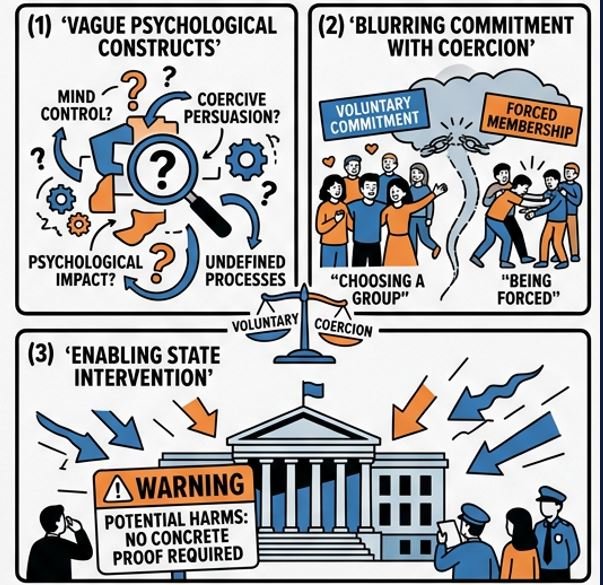
Coercive control, spiritual abuse, and trafficking law have each become vehicles for the reintroduction of models that courts and scholars rejected decades ago. The dissolution of the Unification Church in Japan, the prosecutions in Argentina, and the OneTaste conviction in the United States show that these theories now shape real legal outcomes, with profound consequences for freedom of thought, belief, and association.
“Brainwashing” theories, no matter how often they are discredited, retain a powerful cultural appeal. They offer simple explanations for complex human behaviors. They allow states to intervene in religious life under the guise of protecting victims. They provide activists with a moral vocabulary that is difficult to challenge. And they tempt prosecutors with the promise of expanding their jurisdiction.
Vigilance is essential. Scholars, jurists, and defenders of religious freedom must continue to expose the pseudoscientific foundations of brainwashing theories, whatever name they take. They must insist on clear legal definitions, empirical evidence, and respect for voluntary religious commitment. And they must remind courts and policymakers that freedom of thought and belief is not a privilege granted by the state but a fundamental right that ideological fashions cannot override.
The return of “brainwashing’ in disguise is a warning. If we fail to recognize it, we risk repeating past errors—errors that have already cost lives, destroyed communities, and undermined the very principles on which democratic societies are built.
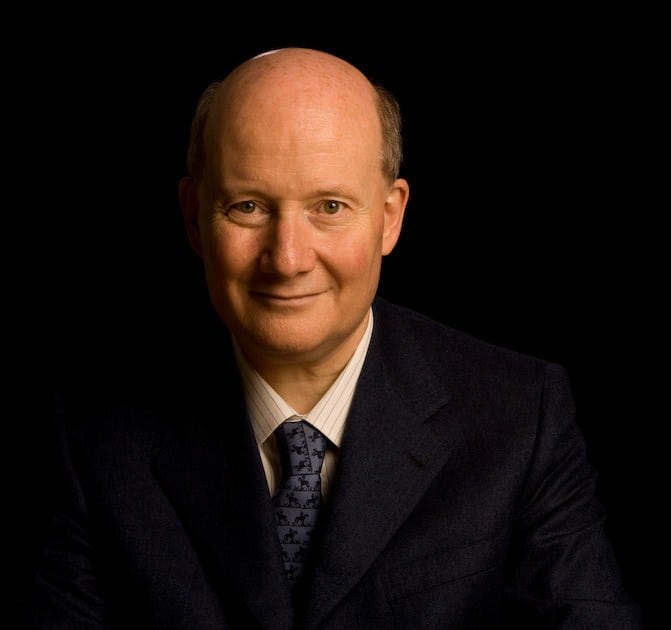
Massimo Introvigne (born June 14, 1955 in Rome) is an Italian sociologist of religions. He is the founder and managing director of the Center for Studies on New Religions (CESNUR), an international network of scholars who study new religious movements. Introvigne is the author of some 70 books and more than 100 articles in the field of sociology of religion. He was the main author of the Enciclopedia delle religioni in Italia (Encyclopedia of Religions in Italy). He is a member of the editorial board for the Interdisciplinary Journal of Research on Religion and of the executive board of University of Pennsylvania Press’ Nova Religio. From January 5 to December 31, 2011, he has served as the “Representative on combating racism, xenophobia and discrimination, with a special focus on discrimination against Christians and members of other religions” of the Organization for Security and Co-operation in Europe (OSCE). From 2012 to 2015 he served as chairperson of the Observatory of Religious Liberty, instituted by the Italian Ministry of Foreign Affairs in order to monitor problems of religious liberty on a worldwide scale.