A CCP manifesto reveals how scholarship is being redesigned as an instrument of ideological discipline.
by Massimo Introvigne
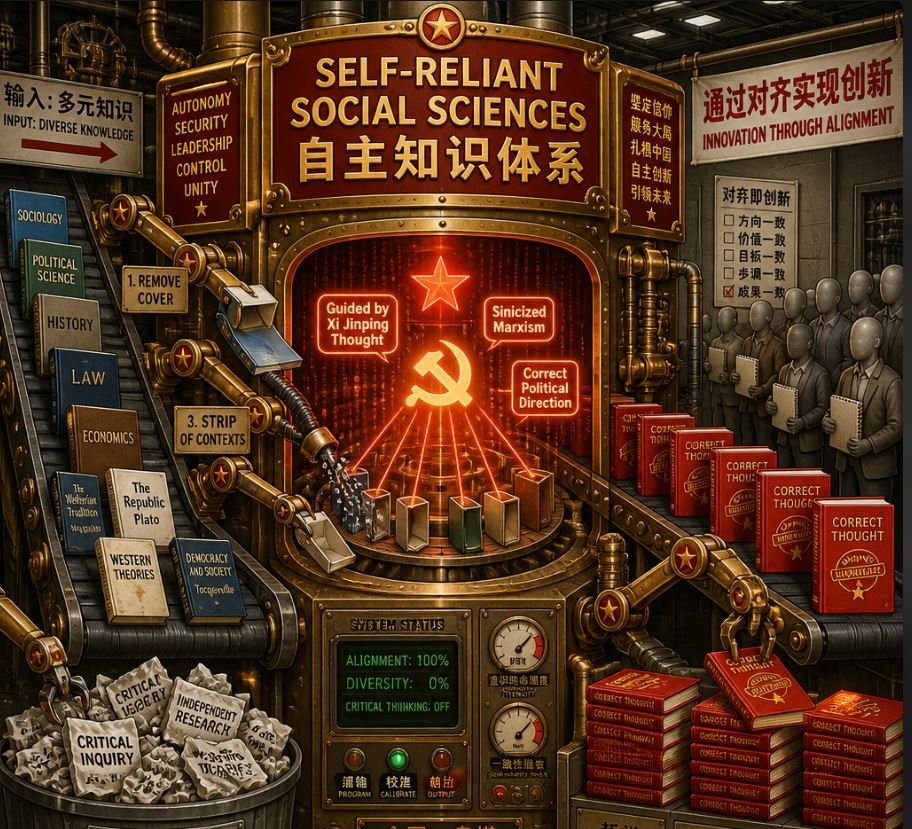
The Chinese Communist Party has now made explicit what has long been implicit: the future of China’s philosophy and social sciences lies not in intellectual independence but in political subordination. Two new texts that appeared with others in the “People’s Daily”—one carrying Xi Jinping’s own instructions, the other authored by the Central Party School—lay out a comprehensive blueprint for what Beijing calls an “autonomous knowledge system.” The autonomy in question, however, is not “from” power but “for” power. It is a project to detach Chinese scholarship from global academic standards and reattach it firmly to the Party’s ideological needs.
Xi’s message is that China must accelerate the construction of a social science system that is “self-generated,” “self-confident,” and “self-directed”—terms that appear lofty until one reads the fine print. The “self” in question is not the scholarly community but the Party itself. The new system must be guided by Xi Jinping Thought, must “uphold and strengthen the Party’s overall leadership,” and must ensure that research remains aligned with the political formulations of the Central Committee. The goal is to free Chinese scholarship not from foreign influence but from the possibility of dissent.
The Party School’s companion article is even more revealing. It argues that Western theories—liberalism in particular—are inherently incompatible with China’s “people-first” values, and that using them “without discrimination” weakens China’s “spiritual and political independence.” The solution is to stop interpreting Chinese realities through Western frameworks and instead elevate Party-approved concepts—“whole-process people’s democracy,” “common values of all humanity,” “new quality productive forces”—into the status of universal scholarly categories. In other words, the CCP intends to turn political slogans into academic paradigms.
The Party School describes a vast institutional effort to reshape the entire research ecosystem. Disciplines such as Marxist philosophy, Marxist political economy, and scientific socialism are to be strengthened as “advantage disciplines.” New fields such as national security studies and discipline-inspection studies—fields whose very existence presupposes the Party’s political priorities—are to be built from the ground up. Even the textbook system is being redesigned to ensure that the most “authoritative” materials on Marxism and Xi Jinping Thought come from the Party School itself.
The article also reveals how the CCP understands the nature of scholarship. “There are no pure social sciences,” it declares; every discipline reflects ideological choices. This is true in a trivial sense—no research is really value-free—but the Party uses this observation to justify the opposite of academic freedom. If all scholarship is ideological, then the only legitimate ideology is the Party’s. The result is a system in which the distinction between research and propaganda collapses by design.
The Party School proudly recounts its historical role in shaping ideological orthodoxy—from the Yan’an Rectification Movement to the debates on the “criterion of truth” in the early reform era—and presents its current mission as a continuation of that legacy. Today, it is tasked with producing “systematized and theoretically rigorous” expositions of Xi Jinping Thought, compiling oral histories that present the new era in language “easy for the people and foreigners to accept,” and training a new generation of scholars whose first qualification is “clear political direction.”
The emphasis on talent cultivation is particularly telling. Young scholars must master Xi Jinping Thought, Party history, and Marxist-Leninist classics; they must read widely in traditional culture to “thicken humanistic foundations,” but always within the boundaries of political correctness. They are encouraged to emulate Party School heroes who carried Marxist texts on the Long March or devoted their lives to translating “Das Kapital.” Scholarship is a form of political service, and intellectual excellence is inseparable from ideological loyalty.
What emerges from these documents is a coherent, ambitious, and deeply illiberal vision. The CCP is not content with controlling universities; it wants to redefine what counts as knowledge. It seeks a social science that does not analyze power but legitimizes it, does not question ideology but elaborates it, does not interpret the world but confirms the Party’s interpretation of it. The “autonomous knowledge system” is thus a paradox: a system that claims independence from the West while demanding dependence on the Party.
China is building a scholarly universe in which political conformity is the precondition for academic participation and the boundary between research and propaganda is intentionally erased. This is not a retreat from Western influence but a retreat from the very idea of critical inquiry. And it signals that the CCP’s longterm goal is to govern the categories through which China—and perhaps the world—understands itself.

Massimo Introvigne (born June 14, 1955 in Rome) is an Italian sociologist of religions. He is the founder and managing director of the Center for Studies on New Religions (CESNUR), an international network of scholars who study new religious movements. Introvigne is the author of some 70 books and more than 100 articles in the field of sociology of religion. He was the main author of the Enciclopedia delle religioni in Italia (Encyclopedia of Religions in Italy). He is a member of the editorial board for the Interdisciplinary Journal of Research on Religion and of the executive board of University of Pennsylvania Press’ Nova Religio. From January 5 to December 31, 2011, he has served as the “Representative on combating racism, xenophobia and discrimination, with a special focus on discrimination against Christians and members of other religions” of the Organization for Security and Co-operation in Europe (OSCE). From 2012 to 2015 he served as chairperson of the Observatory of Religious Liberty, instituted by the Italian Ministry of Foreign Affairs in order to monitor problems of religious liberty on a worldwide scale.