A case of such importance and consequences should have been conducted in open court. That it was not was a further violation of the Constitution.
by Manabu Ishizaki
Article 6 of 6. Read article 1, article 2, article 3, article 4, and article 5.
1. Public Trials and Hearings
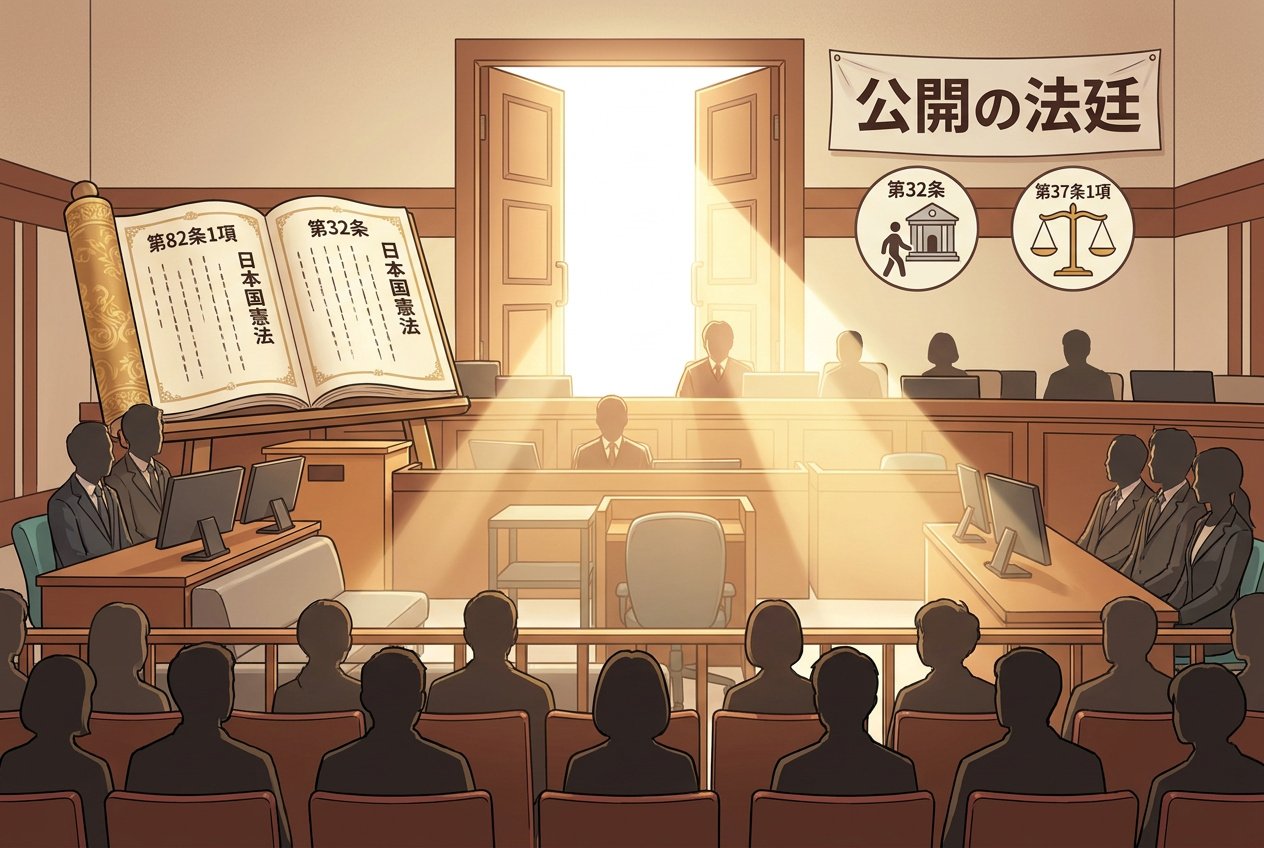
Article 82, paragraph 1 of the Constitution provides that “trials and judgments shall be conducted in open court.” Public hearings are also mandated by Articles 32 and 37, paragraph 1, of the Constitution.
In case law, the term “trial” in this provision has been understood to mean “proceedings which are, by their nature, purely contentious cases”—that is, proceedings which, regardless of the parties’ intentions, finally determine the facts and adjudicate the existence or non-existence of the rights and obligations asserted by the parties (Grand Bench decision of the Supreme Court of Japan, July 6, 1960, Minshu Vol. 14, No. 9, p. 1657). Conversely, matters that are not “purely contentious cases by nature” are not considered “trials” within the meaning of this provision. Such matters (non-contentious cases) are conducted in accordance with procedures prescribed by the Non-Contentious Case Procedures Act and related statutes, and the principle of public hearings under Article 82 does not apply to them (see Article 30 of the Non-Contentious Case Procedures Act; Koji Sato, op. cit., p. 658).
2. Application to the Dissolution Order in the Present Case
Article 81, paragraph 7 of the Religious Corporations Act provides that “procedures concerning trials relating to the dissolution of a religious corporation shall be governed by the Non-Contentious Case Procedures Act (Act No. 51 of 2011).” In other words, it treats such “trials” concerning dissolution not as “trials” in the constitutional sense, but as non-contentious proceedings.
However, a dissolution order against a religious corporation constitutes a severe restriction on the freedom of religious association—including the right to acquire legal personality—guaranteed under Article 20, paragraph 1 of the Constitution. It is a proceeding that finally determines the relevant facts and, on that basis, restricts the parties’ rights. As such, it is, by its nature, a “purely contentious case,” and therefore falls within the meaning of a “trial” under Article 82, paragraph 1 of the Constitution, and must be conducted in public.
This conclusion is further supported by Article 82, paragraph 2 of the Constitution, which provides that “the hearings of cases involving the rights of the people guaranteed in Chapter III of this Constitution shall always be conducted in public.”
Accordingly, although the dissolution order in this case against the appellant constitutes a “trial” within the meaning of Article 82, paragraph 1—that is, a “purely contentious case by nature”—it was conducted under the non-public procedures prescribed by the Non-Contentious Case Procedures Act. Therefore, Article 81, paragraph 7 of the Religious Corporations Act, which mandates such treatment, violates Article 82, paragraph 1 of the Constitution and should be deemed unconstitutional and void under Article 98, paragraph 1.
Conclusion
Koji Sato (a prominent constitutional law expert in contemporary Japan) has observed that the manner in which the freedom of religion is guaranteed “serves as a barometer indicating the state of protection of spiritual freedoms” (Koji Sato, op. cit., p. 252). The judgment of the Supreme Court of Japan in the present case will therefore bear significantly not only on the appellant’s freedom of religion, but also on the overall level of protection afforded to spiritual freedoms in Japan.
If the Court were to dismiss the appellant’s special appeal and uphold the dissolution order, that level of protection would be substantially diminished. Moreover, this case concerns a fundamentally important issue: how intermediate groups are to be positioned within the basic structure of Japan’s current Constitution. In other words, whether the Court recognizes the right of associations—including religious associations—to acquire legal personality will determine whether it understands the Constitution as premised on a 19th-century bipolar structure of state and individual, or on a 20th-century tripartite structure of state, intermediate groups, and individuals.
At the time of the Supreme Court’s 1996 Decision, this issue was not fully appreciated in constitutional scholarship, political discourse, or judicial practice. Since then, however, the legal framework governing the conferral of legal personality on intermediate groups has undergone a fundamental transformation, and the ability of such groups to obtain legal personality has come to be recognized as a legally protected interest. In constitutional theory as well, the right of intermediate groups to acquire legal personality has come to be strongly advanced as a constitutional right.
The Supreme Court should now move beyond its 1996 Decision, deepen its understanding of the current Constitution—which, unlike the Declaration of the Rights of Man and of the Citizen, expressly guarantees freedom of association—and thereby provide more robust protection for the freedom of religion. To that end, it should proceed toward recognizing the right of associations, including religious associations, to acquire legal personality.

Manabu Ishizaki (photo omitted for privacy reasons) is a Japanese constitutional scholar and professor in the Department of Law, Faculty of Law, Ryukoku University. Born in 1968 in Kanagawa Prefecture, he graduated from the Department of Law at the Faculty of Law, Meiji University, in 1992. He completed the doctoral program at the Graduate School of Law, Ritsumeikan University, in 1997. He became an assistant at the Faculty of Law, Asia University in 1998, a full-time lecturer in 1999, and an associate professor in 2002. He became a professor at the Ryukoku University Law School in 2010 and at the Faculty of Law, Ryukoku University, in 2017. Professor Ishizaki specializes in constitutional law, with research focusing on modern human rights theory, Article 9 of the Japanese Constitution, and the rights of persons with a psychiatric disability. His major publications include “The Transition of Human Rights” and “Real Constitutional Law” (co-edited).