A study of a one-sided documentary that gave voice only to angry ex-members and anti-cultists—a trend that repeats itself when the media deals with “cults.”
Rosita Šorytė*
*A paper presented at the Sixth International ISFORB Conference, “FORB and the European Union,” Institute for the Study of Freedom of Religion or Belief, Evangelical Theological Faculty, Leuven, Belgium, May 7, 2026.
Article 1 of 2
Introduction: Anti‑Cultism as Media Performance
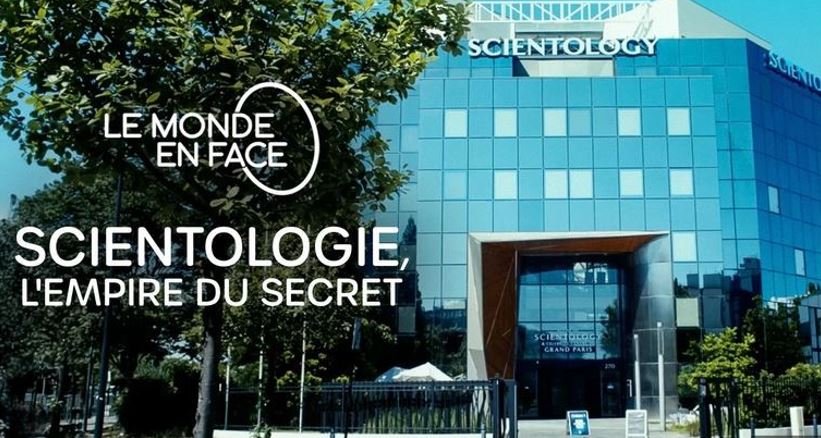
On 15 February 2026, the French public broadcaster France TV aired a documentary titled “Scientology, the Empire of Secrecy.” Presented as an investigative exposé, the program belongs to a long‑standing genre of media productions that frame minority religions through the interpretive lens of the anti‑cult movement. Rather than offering a balanced inquiry, the documentary exemplifies what scholars of new religious movements (NRMs) identify as a “ritual of public denunciation”: a symbolic performance in which a religious minority is cast as a threat, apostates are elevated as authoritative witnesses, and dissenting or contextualizing voices are excluded. This paper argues that the France TV broadcast is best understood not as journalism but as a cultural script that reproduces anti‑cult ideology through selective sourcing, narrative simplification, and the systematic omission of scholarly expertise.
The documentary’s structure, casting choices, and accompanying roundtable discussion reveal a consistent pattern: the construction of Scientology as inherently dangerous, opaque, and socially deviant, achieved through a carefully curated set of testimonies and interpretive cues. The program’s rhetorical strategies—its reliance on professional apostates, its uncritical use of “brainwashing” discourse, its mockery of religious beliefs, and its refusal to include either Scientologists or neutral scholars—illustrate how media can function as an extension of anti‑cult activism rather than as an independent investigative force. The case also raises broader questions about the responsibilities of public broadcasters in pluralistic societies, particularly when reporting on unfamiliar religious movements.
Production Context and Structural Conflicts of Interest
Tohubohu, a company with a long history of collaborations with France Télévisions, produced the documentary. Its director, Romain Icard, is also a co‑founder of the production company. His business partner, Thierry Demaizière, is married to a member of France Télévisions’ Ethics Committee. While this arrangement does not in itself determine editorial content, it raises legitimate concerns about structural conflicts of interest in a public broadcasting environment that is legally required to maintain impartiality. French broadcasting regulations emphasize the need for independence and transparency, yet the proximity between the producer and the oversight body complicates perceptions of neutrality.
The documentary’s opening sequence sets the tone: Scientology is introduced as “one of the most controversial organizations in the world,” followed immediately by a list of court cases the Church has lost. Absent are the cases it has won, including those against anti‑cult organizations whose representatives appear in the program. The documentary then repeats a familiar anti‑cult trope: that Scientology is “moribund,” a claim not supported by data and contradicted by the program’s own admission that the movement continues to attract members and resources.
The documentary also employs visual strategies to amplify the appearance of widespread public opposition to Scientology. Footage of a 2024 protest in East Grinstead, UK, is presented as evidence of large‑scale mobilization against the Church. In reality, fewer than 30 individuals attended the event (46 attended a parallel protest in 2023). Through tight framing and selective editing, the program creates the impression of a significant demonstration, reinforcing the narrative that Scientology is a widely rejected and socially dangerous organization. Such techniques are not uncommon in media portrayals of NRMs, but their use by a public broadcaster raises questions about editorial responsibility.
Apostates as “Victims”: The Central Casting of Anti‑Cult Narratives
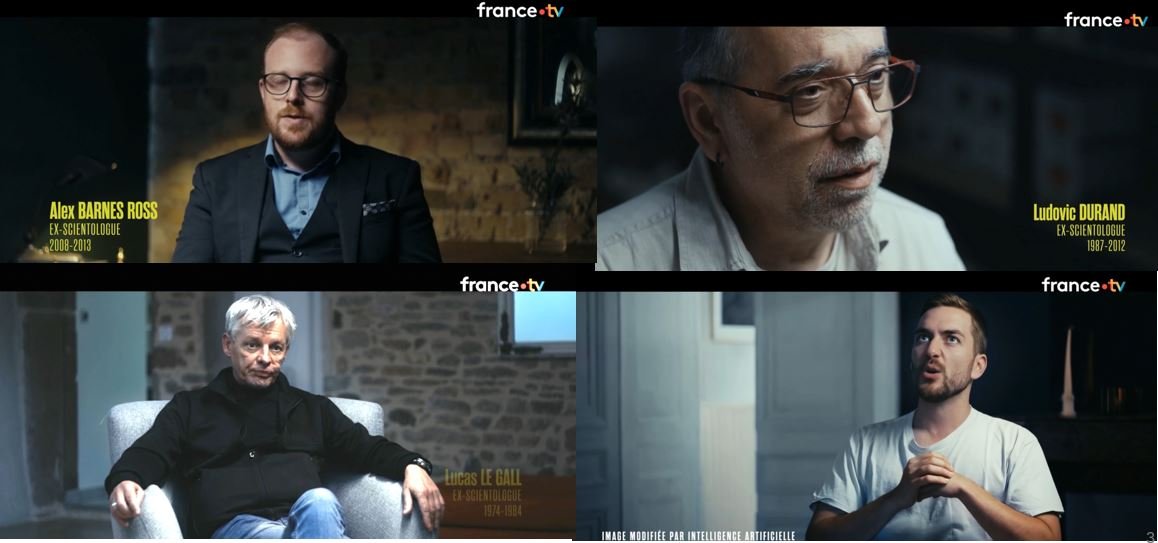
The documentary’s primary narrative engine is a series of testimonies from former Scientologists, introduced as “victims.” In the sociology of religion, these individuals are known as “apostates”—a technical term referring to the minority of ex‑members who become active opponents of their former religious community (most ex-members are not apostates). While anti‑cult activists often object to the term, one of the documentary’s own witnesses proudly declares, “I am an apostate,” inadvertently confirming the analytical accuracy of the category.
The program features a familiar roster of professional apostates who appear regularly in anti‑Scientology media: British activist Alex Barnes‑Ross; American ex‑members Claire and Marc Headley, singer Joy Villa, and Amy Scobee; and French apostates Ludovic Durand, Cyril Chiquet, and “Lucas Le Gall,” whose real name is Eric Gonnet. The latter is the son of Roger Gonnet, a long‑time anti‑Scientology activist known for his aggressive rhetoric, including insults directed at scholars of religion. Eric Gonnet claims to have spent four years in Scientology’s Sea Organization and to have held high‑ranking international responsibilities. Church records, however, indicate that he spent only three months in the Sea Org, in Copenhagen, in 1980, in a modest administrative role. His own writings acknowledge a tendency to embellish or fabricate stories, a fact omitted from the documentary.
The program also includes an anonymous French apostate whose face is reconstructed by artificial intelligence. France is home to thousands of Scientologists, yet the production chose to generate a semi-synthetic witness rather than interview a current member.
Experts Without Expertise: The Anti‑Cult Interpretive Monopoly
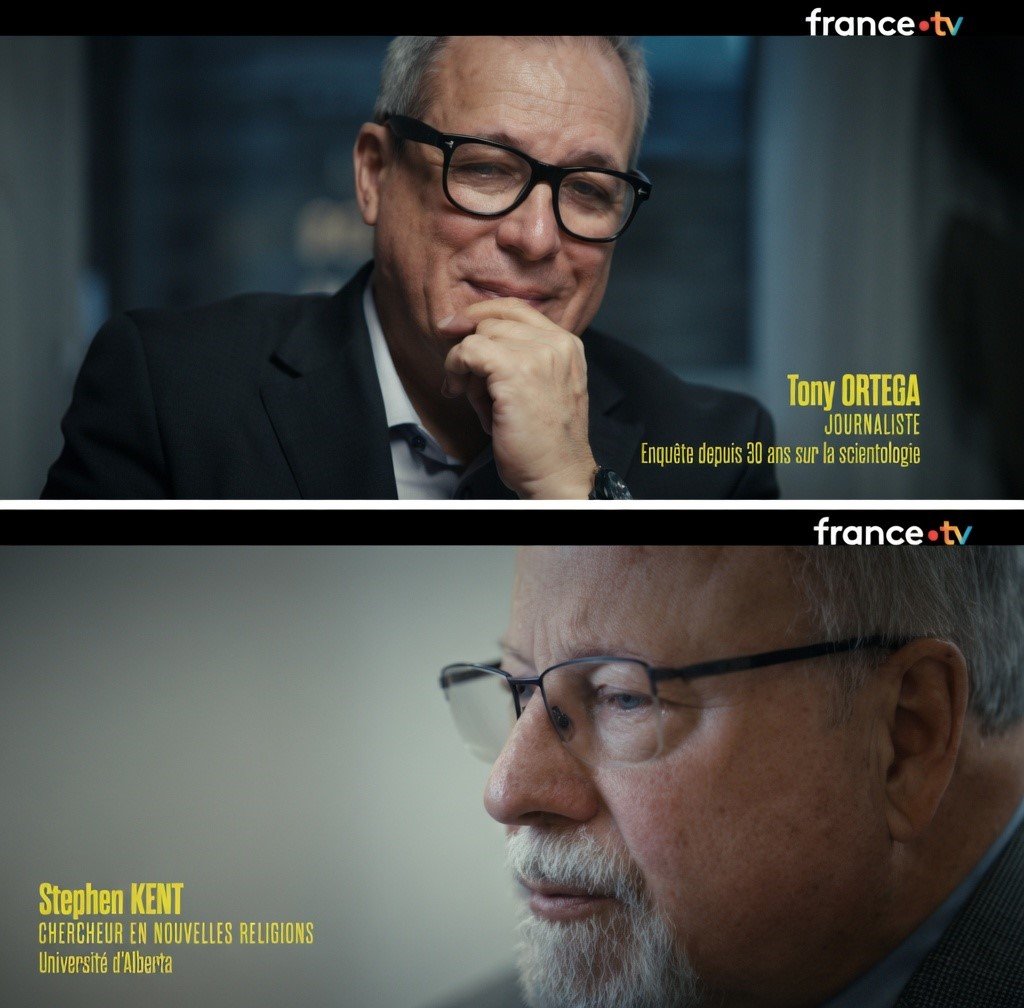
Only two “experts” appear in the documentary: American journalist Tony Ortega and Canadian sociologist Stephen Kent. Both are well‑known critics of Scientology, and both represent the anti‑cult movement’s interpretive framework.
Ortega is introduced as a journalist who has spent thirty years investigating Scientology. The program does not mention his controversial editorial history, including his departure from a major American publication following his defense of Backpage.com, which the FBI later shut down for facilitating child trafficking.
Kent, meanwhile, is part of a small minority of scholars who support anti‑cult theories. His broader work includes psychiatric reductionist interpretations of major world religions; he has publicly suggested that the founders of traditions such as Islam and Christianity suffered from severe mental disorders. When someone applies such diagnoses to the entire history of religion, their sudden clinical certainty about Scientology warrants scrutiny. Yet the documentary presents Kent as a neutral academic authority.
Notably absent are scholars of NRMs who have conducted extensive research on Scientology, such as Bernadette Rigal‑Cellard in France and Donald Westbrook internationally. Their exclusion is not accidental but reflects a deliberate editorial choice to avoid perspectives that might complicate the anti‑cult narrative.
Brainwashing as the Master Explanation
A recurring theme in the documentary is the invocation of “brainwashing” or “mind control” to explain why individuals join or remain in Scientology. Apostates describe themselves as having been reduced to “zombies,” having had their “spirit broken,” or having lost their “capacity of analysis.” Joy Villa claims that her career success within Scientology was the result of “brainwashing.” Durand attributes his positive memories to “emprise,” a French term associated with coercive control.
The concept of “brainwashing” has been widely discredited in academic research on NRMs. Scholars have demonstrated that it lacks empirical grounding and functions primarily as a rhetorical device to delegitimize religious commitment. The documentary does not acknowledge this scholarly consensus. Instead, it treats “brainwashing” as an unquestioned explanatory framework, thereby pathologizing religious belief and denying the agency of Scientologists.
The program also highlights that some Scientologists received modest weekly reimbursements—between 30 and 150 euros—for performing volunteer work. This is presented as evidence of exploitation or trafficking, now a popular accusation against religious organizations. Yet volunteer labor is common in religious orders and lay organizations in mainline churches, many of which provide no reimbursement at all. The anonymous apostate admits that he worked “to help the planet,” not for money, yet the program reframes his experience as coercive.

Rosita Šorytė was born on September 2, 1965 in Lithuania. In 1988, she graduated from the University of Vilnius in French Language and Literature. In 1994, she got her diploma in international relations from the Institut International d’Administration Publique in Paris.
In 1992, Rosita Šorytė joined the Ministry of Foreign Affairs of Lithuania. She has been posted to the Permanent Mission of Lithuania to UNESCO (Paris, 1994-1996), to the Permanent Mission of Lithuania to the Council of Europe (Strasbourg, 1996-1998), and was Minister Counselor at the Permanent Mission of Lithuania to the United Nations in 2014-2017, where she had already worked in 2003-2006. In 2011, she worked as the representative of the Lithuanian Chairmanship of the OSCE (Organization for Security and Cooperation in Europe) at the Office for Democratic Institutions and Human Rights (Warsaw). In 2013, she chaired the European Union Working Group on Humanitarian Aid on behalf of the Lithuanian pro tempore presidency of the European Union. As a diplomat, she specialized in disarmament, humanitarian aid and peacekeeping issues, with a special interest in the Middle East and religious persecution and discrimination in the area. She also served in elections observation missions in Bosnia and Herzegovina, Georgia, Belarus, Burundi, and Senegal.
Her personal interests, outside of international relations and humanitarian aid, include spirituality, world religions, and art. She takes a special interest in refugees escaping their countries due to religious persecution and is co-founder and President of ORLIR, the International Observatory of Religious Liberty of Refugees. She is the author, inter alia, of “Religious Persecution, Refugees, and Right of Asylum,” The Journal of CESNUR, 2(1), 2018, 78–99.
Languages (fluent): Lithuanian, English, French, Russian.