The Chinese Communist Party celebrates Japan’s court ruling as a welcome boost to its global campaign against an unwelcome church.
by Massimo Introvigne
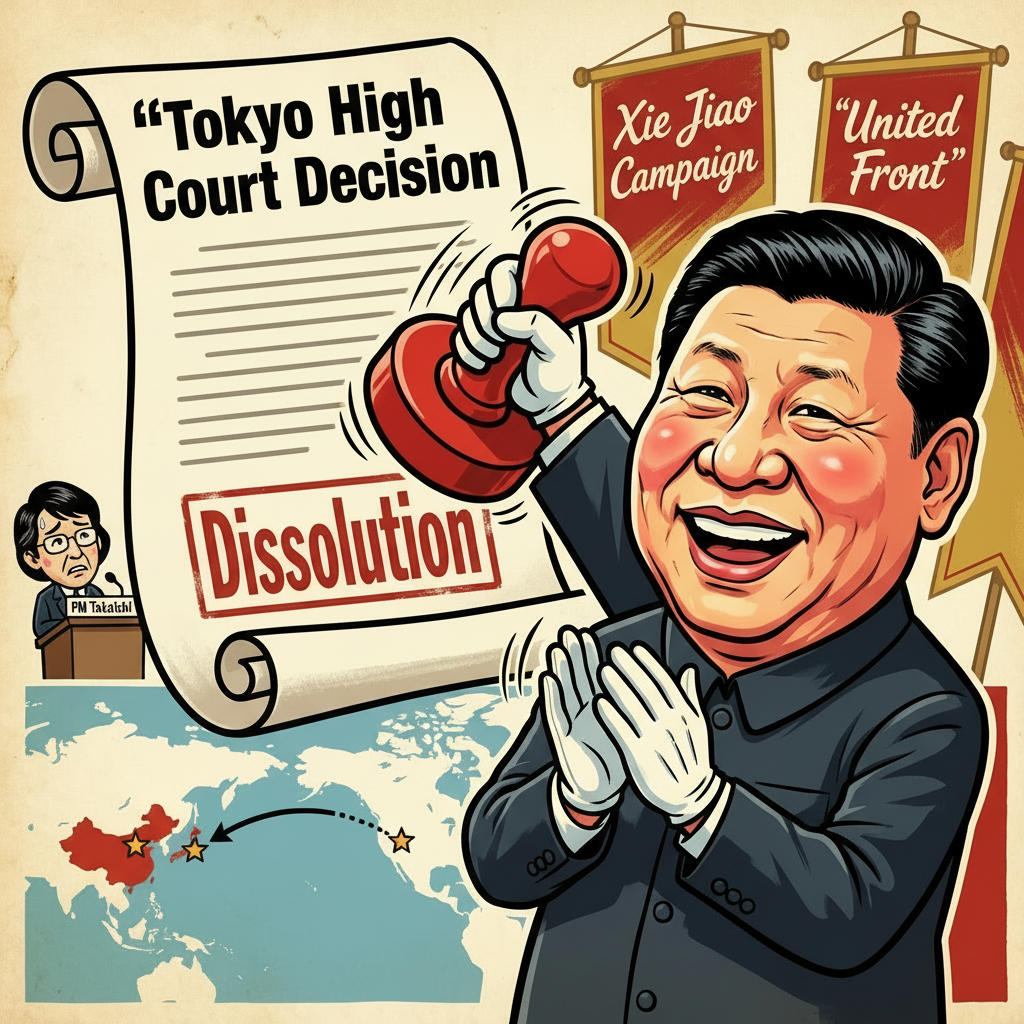
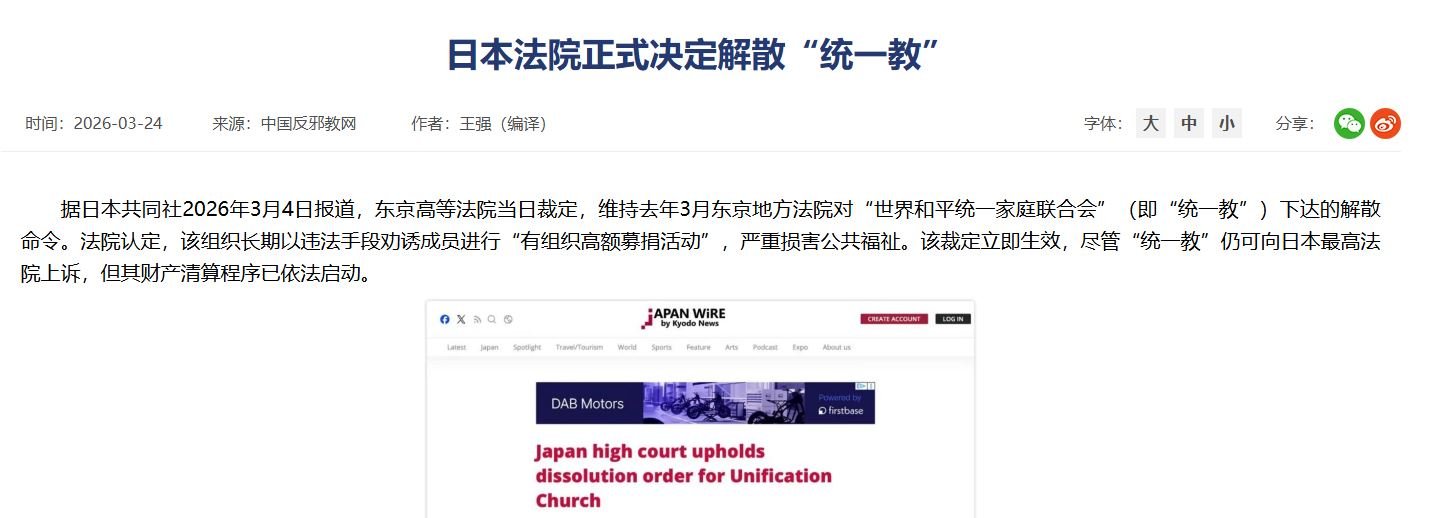
China reacted to the Tokyo High Court’s dissolution of the Unification Church with the enthusiasm of someone discovering that a neighbor, long suspected of moral laxity, has finally begun to behave “properly.” On March 24, 2026, the China AntiXie Jiao Association issued a statement that looks like a congratulatory telegram mixed with a recruitment brochure. “Xie jiao” is an expression that many, including the Chinese government itself, translate as “evil cults.” Still, it has been used in China to designate religions that the government has prohibited since the early Middle Ages, and it literally means “organizations spreading heterodox teachings.” Most scholars do not translate “xie jiao” and simply transliterate the expression, as they do for “Qigong,” “Kung Fu,” and other quintessential Chinese expressions.
The China Anti-Xie Jiao Association, which proudly describes itself as the largest anticult association in the world, claims branches in every city, town, and remote village of the People’s Republic. This would be impressive if it were true, and even more impressive if it were actually a private organization. It is not. It is a branch of the United Front, the same United Front that Xi Jinping once called the Party’s “magic wand” for controlling Chinese society and the Chinese diaspora abroad. When the China AntiXie Jiao Association speaks, it is the CCP speaking—just with a slightly different logo.
The statement begins by summarizing and praising the Tokyo High Court’s decision. Still, the real excitement comes when it identifies what it considers the historic breakthrough: for the first time, a religious corporation in Japan has been dissolved not for criminal offenses but for civil violations alone. The Association writes, with the satisfaction of a teacher watching a slow student finally grasp a lesson, “This case establishes the judicial principle that ‘civil violations are sufficient grounds for dissolution,’ marking a crucial step forward for Japan in combating economic harm committed under the guise of religion.”
The implication is that Japan, long accused by Chinese commentators of being too tolerant, too democratic, too enamored with Western notions of religious freedom,
has finally taken a page from Beijing’s playbook. In China, religious organizations that the government dislikes can be classified as xie jiao and eliminated without the inconvenience of proving any crime. Now, the CCP-affiliated association suggests, Japan is inching toward the same enlightened approach. For Beijing, this legal development is a geopolitical victory: a democratic country appears to be adopting the Chinese model of managing religion.
Having applauded Japan for its newfound rigor, the statement moves on to a target Beijing finds even more interesting than the Unification Church: Japan’s Prime Minister Sanae Takaichi. Her views on Taiwan and other sensitive issues have irritated the CCP, which perceives her as a danger. The dissolution case, therefore, becomes a convenient stick with which to beat her. The statement repeats allegations circulated by Japanese leftist politicians and media that Takaichi has “deep ties with the Unification Church” and even a “stable financial relationship” with organizations affiliated with it. In Japan, many consider these claims false or wildly exaggerated, but the Chinese statement treats them as fact. “Media outlets generally believe,” it declares, “that the long-term interactions between Takaichi and others with the Unification Church reflect a controversial aspect of Japan’s political funding oversight system and have become a factor influencing political issues and the public image of related politicians.” The phrase “media outlets generally believe” is doing a lot of heavy lifting here, especially since the outlets in question are mostly anticult and leftleaning publications, some with unmistakable ties to China. Still, the CCP-controlled organization insists that “several authoritative international media outlets continue to reveal the deep ties between Japanese Prime Minister Sanae Takaichi and the Unification Church,” as though repetition alone could transform speculation into evidence. The goal is transparent: weaponize the High Court decision to damage a politician Beijing dislikes.
The final section of the statement is the most revealing. It warmly welcomes Japan as a new partner in China’s long-standing campaign against the Unification Church. It reminds readers that “In 1997, the Unification Church was designated as a xie jiao by the Chinese government,” and notes that Chinese citizens and foreign visitors suspected of ties to the Church have been arrested in China. The reason for this hostility, the statement explains, is that the Unification Church has consistently spread “anticommunist doctrines,” and that its connected U.S. newspaper, “The Washington Times,” is antiCommunist, antiChinese, and supported American agencies that suggested a possible laboratory leak in Wuhan as the origin of the COVID pandemic. For Beijing, this is political heresy. And now, the CCP-affiliated organization suggests with evident satisfaction, Japan—an American ally, no less—has joined China in its global effort to destroy an antiCommunist church.
The tone of the statement is a mixture of triumph, vindication, and opportunism. China sees in the Tokyo High Court’s decision not only the downfall of a religious movement it has long despised but also a chance to claim ideological alignment with a democratic neighbor and to score political points against a prime minister it views as unfriendly. Whether Japan intended any of this is another matter entirely. But in Beijing’s reading, the dissolution of the Unification Church is more than a Japanese legal decision. It is a moment of geopolitical clarity, a sign that even democracies can be persuaded—under the right circumstances—to walk a little closer to the Chinese model.
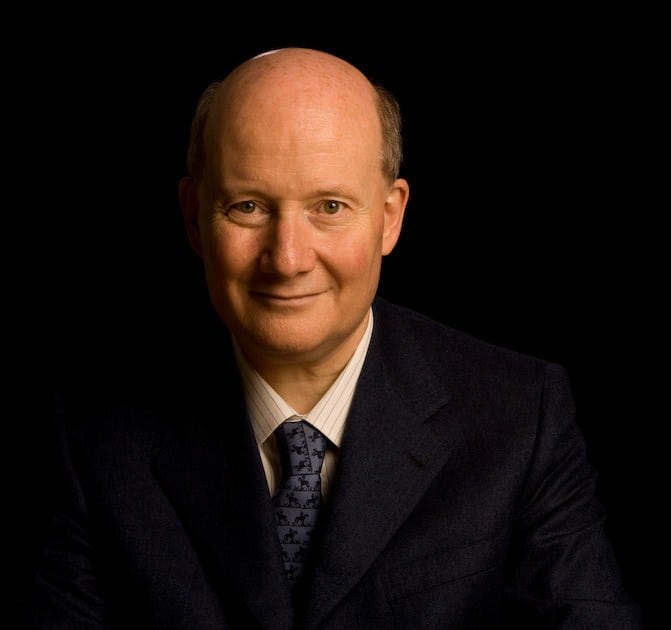
Massimo Introvigne (born June 14, 1955 in Rome) is an Italian sociologist of religions. He is the founder and managing director of the Center for Studies on New Religions (CESNUR), an international network of scholars who study new religious movements. Introvigne is the author of some 70 books and more than 100 articles in the field of sociology of religion. He was the main author of the Enciclopedia delle religioni in Italia (Encyclopedia of Religions in Italy). He is a member of the editorial board for the Interdisciplinary Journal of Research on Religion and of the executive board of University of Pennsylvania Press’ Nova Religio. From January 5 to December 31, 2011, he has served as the “Representative on combating racism, xenophobia and discrimination, with a special focus on discrimination against Christians and members of other religions” of the Organization for Security and Co-operation in Europe (OSCE). From 2012 to 2015 he served as chairperson of the Observatory of Religious Liberty, instituted by the Italian Ministry of Foreign Affairs in order to monitor problems of religious liberty on a worldwide scale.