An award for the book that highlights the human cost of China’s population control through the extraordinary story of separated twins.
by Massimo Introvigne

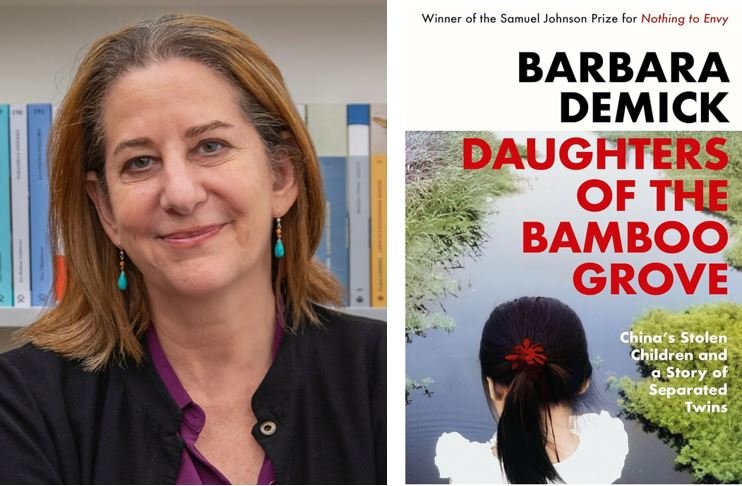
Barbara Demick has received the China Book Review Nonfiction Award for her 2025 book “Daughters of the Bamboo Grove: From China to America, a True Story of Abduction, Adoption, and Separated Twins” (Random House). The award honors a work that tells a compelling story and thoroughly investigates one of the painful impacts of China’s one-child policy: the forced separation of families and the hidden violence that enabled these separations.
At the core of the book is the story of identical twin girls born in 2000 in rural China, when local officials faced heavy pressure to enforce population limits. The mother gave birth in a bamboo grove to avoid detection, since she already had two daughters and would be severely punished for violating the one-child policy for the second time. One of the infants was taken by family-planning authorities—part coercion, part punishment, and part a result of a system that treated children like demographic violations. The baby was later offered for international adoption and raised in Texas by an American Christian family who thought they were saving an abandoned child. Her sister remained in China, growing up with relatives who lived under years of secrecy and fear.
Demick’s reporting was crucial in uncovering the truth. While looking into the larger issue of children taken from their families under the one-child policy, she found evidence that a girl in the U.S. might actually have a twin in China. The American child, having forgotten her early life, felt confusion and anxiety when faced with the idea of a twin sister she had never known. Her adoptive family, still mourning the recent loss of the father, was also unprepared for the emotional turmoil that followed.
Demick handled the situation with caution. For years, she held back from publishing the story, honoring the adoptive family’s desire for privacy. Over time, however, the girl’s view shifted. As she matured, her curiosity about her origins grew, and she eventually wanted to reach out to her sister in China. Demick’s thoughtful mediation—initially through online chats and later through face-to-face meetings—was key in connecting the two families. The book details the 2019 meeting, when Demick traveled with the twin raised in America and her family to the Chinese village where her sister lives, illustrating with care how the reunion was both joyous and demanding, offering healing while prompting everyone involved to face the impact of past choices made under political pressure.
The narrative is not just deeply personal; it also powerfully critiques the human rights abuses tied to the one-child policy. Demick reports how local officials, eager to meet quotas, took children from families labeled non-compliant, sending them into an international adoption system that often overlooked the children’s backgrounds. The book also points out the ongoing effects of these practices. Even years after the policy ended, China still deals with its legacy, and adoptees who try to reconnect with their birth families often face bureaucratic hurdles and political complications, especially as the government works to limit contact between Chinese citizens and the West.
Demick succeeds in blending personal stories with a wider political critique. She avoids simple moral judgments, instead showing how ordinary people—parents, local officials, adoptive families—found themselves in a system that favored conformity and punished kindness. The twins’ separation serves as a way to understand the workings of reproductive control: the fines that bankrupted families, the forced abortions and sterilizations, the black-market networks that prospered in the policy’s shadow, and the international adoption surge built on incomplete or misleading information.
The China Book Review Nonfiction Award recognizes works that enhance public understanding of China’s social realities. “Daughters of the Bamboo Grove” achieves this goal. It restores individuality to a story too often reduced to statistics and policy discussions, reminding readers that the consequences of the one-child policy did not end with its repeal. They continue to affect families still looking for lost children, adoptees trying to form coherent identities, and a society that must confront the moral price of decades of government-imposed reproductive control.
Demick’s book is both a touching narrative and a significant addition to the literature on human rights in modern China. She truly deserves the award.

Massimo Introvigne (born June 14, 1955 in Rome) is an Italian sociologist of religions. He is the founder and managing director of the Center for Studies on New Religions (CESNUR), an international network of scholars who study new religious movements. Introvigne is the author of some 70 books and more than 100 articles in the field of sociology of religion. He was the main author of the Enciclopedia delle religioni in Italia (Encyclopedia of Religions in Italy). He is a member of the editorial board for the Interdisciplinary Journal of Research on Religion and of the executive board of University of Pennsylvania Press’ Nova Religio. From January 5 to December 31, 2011, he has served as the “Representative on combating racism, xenophobia and discrimination, with a special focus on discrimination against Christians and members of other religions” of the Organization for Security and Co-operation in Europe (OSCE). From 2012 to 2015 he served as chairperson of the Observatory of Religious Liberty, instituted by the Italian Ministry of Foreign Affairs in order to monitor problems of religious liberty on a worldwide scale.